Jeff Russell’s Starship Dimensions

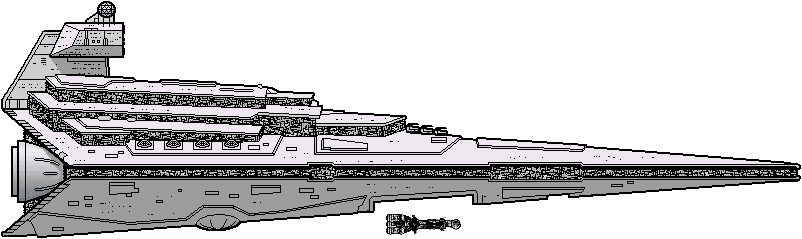
This site has been promoted so much and by so many, that it hardly needs any help from me, but it is way cool. Jeff Russell’s Starhip Dimensions compares the spacecraft from almost every science fiction tv show, movie, anime, and many books as well as a few real-life space ships. If you ever wanted to see which is larger: Star Trek’s Enterprise, the Battlestar Galactica, Farscape’s Moia, or Star Wars’s Star Destroyer, now you can. If you are using IE (or Firefox with the IE Tab add-on) you can drag the images around and set them one atop another. Yes, I know this makes me a big nerd, but I don’t care.

Attendance

Attendance is one of those areas in schools where technology has left the law and common sense behind. According to Nevada state law, the official record of attendance is the teacher’s roll book. It has been years however since teachers have used a roll book. Attendance is done by computer and it is recorded at the district office. At my school district, teachers don’t even have the ability to print a hard copy of attendance in their rooms. Consequently the school district sends us a copy at the end of each month. This leads to the ridiculous result of having the “OFFICIAL” attendance record being just a printed copy of the school district’s computer records.

Princess of Amathar: Chapter 1 Excerpt


I don’t expect you to believe this story, but it is the truth. My name is Alexander Ashton. I was born in the heart of the American west. I have often been known to say that I was born either a hundred years too late, or perhaps a hundred years too early. It always seemed to me that I had the misfortune to live in the single most unexciting period of time the panorama of history had to offer. I don’t say that I longed to be transported to another time or to another world, for never in my wildest dreams did I believe this to be possible. I was destined to be surprised.

I was born in a small city. I played as a child in a park that was once a dusty street where outlaws of the old west fought famous gunfights. When I was seven, my parents were killed in a motor vehicle accident. I really remember little of them. I was put in a state run children’s home where I lived until I was eighteen, passed by time after time by prospective adoptive parents primarily because I was too old. I hold no ill feelings about it now. If there is one thing I learned while I was a ward of the state, it is that no matter how bad off one may be, there is always some one worse off than you are.

After graduating high school and being set on my own by the state, I entered college at the local university. I became a voracious reader and excelled in athletics, but did poorly in my required studies. After two semesters of academic probation I was asked to leave. I walked down the street to the Army Recruiter’s office and enlisted. There wasn’t much to the army, since there was no war on at the time. While I was there, I did learn to shoot, and fight with a saber, and to keep in good physical condition, but otherwise I left the service just as I had gone in.

After finding a new apartment in my old home town, I happened to run into a fellow whom I knew from college. He was running a small grocery store, and doing quite well, since no large grocery chain was interested in such a small market area. He offered me a job, I took it, and we became pretty close friends.

My friend, the grocery store owner, was engaged to a nice girl, and they decided in time to get married. I was chosen to be the best man. The wedding was nice, and the reception was even better. I have never been much of a drinking man, but that night I made a name for myself in that capacity. I don’t know why I drank so much. Maybe I was feeling sorry for myself and my lot in life, I don’t know. I do know that in short order, I had worked myself into a staggering, slobbering, half-conscious stupor. How, when, and where I became unconscious, I cannot say, but at some point I did. And this is where my story truly begins.

I awoke with a chill in my bones. I was lying down in a small stream bed with icy water running over my feet. I tried to rise, but couldn’t. My body was stiff and weak and its only response was to shiver uncontrollably. Around me was a thick forest, and I could see dark shapes moving around in the trees. I sensed then, on some deeper level, that I was in a place I had never been before. Then I heard a deep growling as I passed once again into unconsciousness.

When next I awoke I looked around to find myself in a small shack. I was lying on a cot made of animal furs, and I was bathed in a cold sweat. The walls of the small shelter were made from cut logs and a roughly fashioned wooden chair was the room’s only furnishing. When the door of the shack opened, I truly believed for the first time in my life that there were life forms other than those I was familiar with on earth.

The creature that stepped inside the door, and closed it after him, was most ugly. That he was intelligent was demonstrated not only by the fact that he had opened and then closed the door, but also by the fact that he wore clothing– ugly clothing yes, but clothing nonetheless. He was about five feet tall and stood in a kind of perpetual crouch. His body was covered with coarse brown hair, two to three inches long, from his head to his feet, which reminded me of the feet of a dog or a wolf, although larger. He was somewhat wolf-like in every aspect, such as his protruding snout, but he also seemed somewhat baboon-like in his expressive eyes. I am comparing him to earthly animals, but this is really inadequate, as the similarities were actually quite superficial, and he was totally unearthly in appearance. I remember most looking at his hands. He had four fingers not too different from my own, but his abbreviated thumb possessed a great, long, curving claw.

The creature, stepping slowly over to me, reached out a hand and gave me a piece of dried fruit. I found myself quite hungry and the fruit quite good. As I began to eat, the being began to bark and growl at me. At first I thought he was angry, but then I realized that he was trying to communicate in his language. I was too tired to respond and fruit still in hand, passed back into sleep. When I woke again the creature was sitting in the chair looking at me with his head cocked to one side. I pushed myself up on one elbow and he spoke to me again, this time in a more human sort of language. It seemed almost like French, but having learned a few phrases of that language in the army, I knew that it was not. This language was so much less nasal. He pointed to his chest and said “Malagor” then he pointed to me. I said “Alexander”. He smiled wide exposing a magnificent row of long, sharp teeth. My language lessons had begun.

No Child Left Behind


The No Child Left Behind Act of 2001 plays a big part in my life and in the lives of teachers around the country. So what is it? There is a very good page that covers is quite well on Wikipedia here.

Here is a brief description of the law from that article.

NCLB is the latest federal legislation (another was Goals 2000) which enacts the theories of standards-based education reform, formerly known as outcome-based education, which is based on the belief that setting high expectations and establishing measurable goals can improve individual outcomes in education.

In other words, No Child Left Behind provides for testing students, in the hopes that this will make them achieve more and hopefully learn more. This is the same philosophy that imagines that if you simply step on the scales every day, you will lose weight.

The other big part of NCLB, is the increasing levels of expected performance. In order to meet NCLB a school must show that 50% of its students are proficient in Math and Language Arts. Then the next year, students must be 60% proficient. And the levels increase each year until at some point schools are to have all students testing proficiency. This moving target is called AYP, or Adequate Yearly Progress. If I had a dollar for every time I heard someone say AYP, I could retire and hire a private tutor for each of my 165 students.

Prehistoric Mammals

Most kids love dinosaurs. I don’t know why. People who are much smarter than me have suggested it is because they are big and powerful. When I was a kid I was certainly no exception. I loved dinosaurs. I also loved the prehistoric animals that came before and after the dinosaurs, like the prehistoric mammals of the pleistocene. I think the mammels get short shrift. Most of them are at least as interesting as the dinosaurs. Of course many people already think that they are dinosaurs, as evidenced by the inclusion of mammoths and saber-tooths in bags of plastic dinosaurs and dinosaur-shaped chicken nuggets. Of course some of the greatest documentaries about any prehistoric animals are the Walking with Dinosaurs series, including Walking with Prehistoric Beasts (mammals) and Walking with Monsters (pre-dinosaur creatures), but I remember another show from my youth. It was called What’s New and was on PBS. If anyone has any information on that show, let me know.

Blog Formatting

If you’ve read the chapter excerpts that I’ve posted the past few days, you know I’ve been having some formatting problems. Does anyone know if there is a way to indent? I’ve tried spacing in, and it looks fine until I save it, then the spaces disappear. Help!

The Steel Dragon: Chapter 1 Excerpt


Chapter One Excerpt

Past the Great Church of the Holy Savior, bounded on the south by Avenue Hart, the north by the railroad yards, the west by Contico Boulevard and on the east by what Senta didn’t know, was one of the city’s seemingly never-ending masses of tenement buildings. Here were countless brown-stones, put up quickly and cheaply, with none of the artistic style, careful engineering, or safety considerations taken into account when the buildings of the Old City had been built centuries before. The shortest among them were seven or eight stories high, but most were at least fifteen. The highest among them, reached up into the sky more than twenty stories. Senta, still skipping despite the hour and a half long journey from the park, reached the entrance of her own building and skipped up the eight steps to the front door. From that point on, skipping was out of the question. Even a child with as much energy at her disposal as had Senta, was worn out by the time she reached the twelfth story. And the twelfth story was where Senta lived with her Granny.
She turned the doorknob as she leaned against the door, and burst into Granny’s apartment. Senta had always thought of it as Granny’s apartment, rather than her own. She was only one of the children who lived there. There were six. Bertice, who was a pretty and very quiet seventeen year old, worked fourteen hours a day sewing in the shirtwaist factory. Geert, a surprisingly husky boy of twelve, traveled each day to the King’s warehouse, where the government gave away bushels of apples. Then he took the apples to the train station to sell them for a pfennig a piece. Senta herself, at nine, fell next in line. Then was Maro, Geert’s eight year old brother, who worked in a printers’ shop. He had lost the two endmost fingers on his right hand playing too near the printing press. Didrika was a cute and precocious four year old. She and her baby sister, Ernst, were Granny’s only real grandchildren, Bertice being the granddaughter of Granny’s younger sister and Senta being the granddaughter of Granny’s older sister. Senta wasn’t too sure what the exact relationship was for Maro and Geert, but everyone in the house was somehow related and everyone in the house was treated as though they were a cherished grandchild by the hunch-backed, grey-haired old woman who looked up from her washing when Senta entered.
The front door opened into the combination living room/kitchen. An old table and two chairs sat next to the coal-fire stove and just to the left of that was a large, two-basin sink with running water. This was used for washing clothing, washing dishes, and washing children. On the other side of the room, a ragged sofa sat next to a mismatched chair. At night, the room was used as a bedroom by Geert, who slept on a sheepskin, which was pulled out from under the sofa and rolled out onto the floor; and by Maro, who pushed the two chairs away from the table, and placing them side by side, spent the night lying across them.
In addition to this room, there was one other in the apartment—a bedroom. The double bed that had come with the apartment was shared by Granny and Bertice and Didrika, who was small enough to curl up between them. Ernst had her own baby crib, which had arrived when she and Didrika had, two years before. Senta didn’t know what had happened to the two girls’ parents, any more than she knew what had happened to her own, but they were dead now. Senta had her own special bed which had been made by setting side by side three wooden crates, two which had originally held Geert’s apples, and one a carrot crate, given by an old man who with his little donkey, delivered carrots to the many eating establishments in and around the great plaza. Then the three crates were covered with a hand-stuffed mattress.
Granny had a bucket in the bottom of the right hand sink. The bucket was filled with soapy water and dirty clothes. The old woman picked up from beside the sink, the washer, a device which looked like a large brass plunger attached to a broomstick, and placing it in the bucket on top of the clothes, began to plunge it up and down while turning it. This was a lot of work, but nowhere near as much as cleaning clothes with a washboard, and it was much easier on the clothes too.
“Payday,” said Senta, giving Granny a hug, and then handing over the fourteen copper pfennigs she had earned for the week.
“Thank you, dear,” said Granny, pausing from the washing to accept the money. She then handed two pfennigs back and said. “Keep one for yourself and put one in the meter. The gas went out this morning, and we’re going to need some light tonight. Maro will want to read to us, and I have to catch up on my knitting.”
High on the wall, above the coal fire stove was the gas meter. It was a square device about two feet across which controlled the flow of gas from the pipes in the wall to the two gas lamps on the ceiling. It had a coin slot and a knob on it. When a pfennig was placed in the slot and the knob was turned, the appropriate amount of gas would be allowed to flow out to be used by the family for evening light. It usually lasted about two and a half evenings, so the family, most weeks budgeting two pfennigs for artificial light, had five evenings lit by gas. The other two evenings were either lit by a single candle, or kept dark. Senta pressed the less shiny of the two pfennigs in her hand into the slot and turned the knob. She could hear the little copper coin fall down a pipe, making a little echo as it went down into the wall. A second later, she could hear hissing of the gas making its way from the meter toward the lamps. It hissed only a moment then stopped. They wouldn’t light the lamps until after dark. Waste not, want not.
“Would you like me to go get the coal for the stove, Granny?” asked Senta.
The coal supply was located in the basement—the lowest level of two basements. This meant walking down fourteen flights of stairs, and walking back fourteen flights of stairs with a bucket full of coal.
“Getting the coal is not a job for a little girl,” said Granny.
“I can do it.” “Oh, I know you can. But Geert is already getting it.”
“How come he’s home so early?”
“Oh, he had a very good day today. He sold all of his apples so quickly this morning that he was able to go get a second bushel just for us. I’m going to make a pie this evening.”
At that moment, Geert entered with a bucket full of coal. He grunted at Senta and walking over to the cast iron stove, opened the small door at its very bottom and shoveled in about a third of the bucket. He then took a sheet of newspaper from the stack nearby and wadded it up. He struck a wooden match and lit the paper, tossing it in after the coal.
An hour later, the room was warm with the heat of the oven, Ernst woke up from her afternoon nap, Didrika returned from playing with her friend on the eleventh floor, and Senta helped Granny make an apple pie. By the time the apple pie was cooked, Maro had returned from his job at the print shop and had plopped down on the sofa, while Granny and Senta peeled potatoes. Dinner was ready when Bertice arrived home, completely exhausted, curling up in the mismatched chair, able to stay awake just long enough to eat her potato soup and apple pie.
The rest of the evening was spent together in the living room/kitchen. Bertice was quietly snoring, Granny was knitting, and the rest of the children were listening to Maro read, by the light of the gas lamps, from the broadsheet he had brought home with him from work. Senta didn’t know it, but the broadsheet was just one of the many propaganda-based papers which were distributed around the city each day—some pro-government and some supporting various opposition groups. The main story in this one was about how the government was gathering all of the wizards in the kingdom and making them spend their time creating enchantments and weapons for use in a possible war with the kingdom’s hereditary enemies Freedonia and Mirsanna. This, according to the broadsheet, left no wizards to cast the spells needed by average citizens: to protect homes, to increase the crop yields of farms, and to create enchanted vehicles. Not to mention, thought Senta, to tell fortunes and create beauty or love or happiness potions. There were also local news stories—a fire had burned down a candle shop, someone had stolen a brand new steam carriage in broad daylight, and another young woman was murdered near the waterfront. Afterwards, someone nudged Bertice awake long enough for her to change into her nightgown. Everyone else changed into their own nightclothes, and they all went to bed.
Senta didn’t know what woke her up in the middle of the night, but she was awakened. Moonlight streamed in the tiny window of the bedroom. She lay on her bed, made of three crates and a hand-stuffed mattress for a long time, listening to Bertice quietly snore, and Ernst breathe. She couldn’t hear Didrika for a while, but then she heard the six year old quietly whimper as she sometimes did when she was cold. Senta thought that the blanket must have come off of her. Quietly getting up, she tip-toed over to the bed, and found that sure enough, Didrika’s knitted baby blanket had slipped down to her knees. Leaning over Granny’s form, she pulled the blanket back up to the girl’s shoulders and tucked her in. As she leaned back, Senta looked at Granny’s face. Granny’s eyes were open.
“Granny?” said Senta.
Granny didn’t answer. Senta put her hand near the old woman’s nose and mouth. No breath came from either. She then put her hand on Granny’s cheek. It was smooth and soft, but it was cold. She made the sign of the cross for the second time that day. Senta was young, but she was not naïve. No child living in the masses of brownstone tenement apartments in the great city of Brech could afford to be naïve. Life was hard. Life was unsympathetic. Life was a trial. But Granny no longer needed to worry about the trial of life. Granny was dead.
Princess Mononoke

I am a huge fan of the films of Hayao Miyazaki. The best is arguably Princess Mononoke. The American version stars the voice talents of Billy Crudup, Billy Bob Thornton, Claire Danes, Minnie Driver, and Gillian Anderson. If you haven’t seen it, you should. It will change your whole perception of animated movies.

No Pencils or Paper

More and more, students are not arriving to class with school supplies. Part of this is that times are getting tough, but another part is that children are less and less aware of their needs and supplies. (This is also evidenced by the number of jackets, books, and even iPods that the kids just leave behind.) I decided that this year, rather than fighting it, I would just give a pencil to every kid who needed one. The end of the first quarter is a week away yet, and I have already gone through 432 pencils.

The Steel Dragon: Chapter 1 Excerpt

Chapter One Excerpt

It was a beautiful day—though Senta didn’t know it, it was the first day of spring. Senta made her way along, dodging between the many other pedestrians. It was warm enough that she felt quite comfortable in her brown linen dress, worn over her full length bloomers, and her brown wool sweater. The weather was very predictable here in the Brech. The early spring was always like this. Late in the afternoon, the sky would become overcast, and light showers would sprinkle here and there around the city. Most days, they were so light that a person would scarcely realize that he had been made wet before he was dried off by the kindly rays of the sun. Still, the ladies would raise their parasols to protect their carefully crafted coiffures from the rain, just as they now used them to protect their ivory complexions from the sun.

Summers here were warm and dry, but not so hot that people wouldn’t still want to eat in the outdoor portion of Café Carlo. Not so in the fall or winter, however. The fall was the rainy season. It would become overcast, and stay that way for months, and it would rain buckets every day. The streets would stay slick and shiny. Then winter would come and dump several feet of snow across the city. The River Thiss would freeze over and they would hold the winter carnival on the ice. And the smoke from all of the coal-fired and gas-fired stoves, and the smoke from all of the wood-filled fireplaces would hang low to the ground, and it would seem like some smoky, frozen hell. The steam carriages would be scarcer, as the price of coal became dearer, but the horse-drawn trolley would still make its way through the grey snow and make its stops every three minutes.
Senta skipped and walked and skipped again east from the plaza down the Avenue Phoenix, which was just as busy as the plaza itself. Travelers hurried up and down the street, making their way on foot, or reaching to grab hold of the trolley and hoist themselves into the standing-room-only cab. Quite a number of couples could be seen strolling along together, arm in arm; the man usually walking on the side closest to the street, in case a steam carriage should splash up some sooty water. Senta didn’t know it, but the custom a generation before had been for the men to walk furthest from the street, in case a careless apartment dweller should splash down an emptying chamber pot, modern conveniences having prevailed over custom. Others on the street were shopping, because both sides of the Avenue Phoenix were lined with stores. There were quite a few stores which sold women’s clothing and a few that sold men’s, a millinery shop, a haberdasher, a bookseller, a store which sold fine glassware, a clockmaker, a tobacconist, a jeweler, a store which sold lamps, a florist, and at the very end of the avenue, where it reached the Prince Tybalt Boulevard, just across the street from the edge of the park, on the right hand side, a toy store.
Stopping to press her face against the glass, right below the printed sign that said “Humboldt’s Fine Toys”, Senta stared at the wonders in the store. She had never been inside, but had stopped to look in the window many times. The centerpiece of the store display was a mechanical bird. It worked with gears and sprockets and springs and was made of metal, but it was covered in real bird feathers in a rainbow of hues, and would sit and peck and chirp and sing as though it were alive, until it finally wound down, and the toy maker would walk to the window and say the word to reactivate the bird’s magic spell. Senta knew that the bird would remain in the window for a long, long time, until some young prince or princess needed a new birthday gift, because that bird would have cost as much as the entire Café Carlo. Arranged around it were various mechanical toy vehicles—ships, trains, and steam carriages. Some were magical and some worked with a wind-up key, but they all imitated the real life conveyances from which they were patterned.
None of these wonderful toys held as much fascination for Senta though, as the doll which sat in the corner of the window. It wasn’t magical. It wasn’t even animated by a wind-up mechanism. It was a simple doll with a rag body and porcelain hands, feet, and face. It was wearing a simple black dress. Its brown hair had been cut in a short little bob, and looked like real human hair. It had a painted face with bright blue eyes and pink lips. It may well have been one of the lesser priced toys in the shop. It was definitely the least expensive item in the window, but Senta would never be able to purchase it. Had she been able to save every pfennig she earned, it still would have taken her more than thirty weeks before she had enough to purchase the doll. And she could not save every pfennig she earned. Most weeks, she could not even save one.
Pushing herself regretfully away from the glass, and leaving two hand smudges, a forehead smudge, and a nose smudge, Senta ran across Prince Tybalt Boulevard, which crossed perpendicularly, making a “T” at the end of Avenue Phoenix. She ran in a zigzag motion to avoid being run over by any of the numerous steam carriages which whizzed by. Several of them honked at her with a loud ‘ah-oogah’ but none of them ran over her. And then she stood at last on the edge of Hexagon Park. Senta had no idea that Hexagon Park was so named because of its six sided shape. She didn’t even know what a hexagon was. She did not realize that Hexagon Park was the exact same size and shape as the Great Plaza, where Café Carlo was located. To her, the park had always seemed so much larger. Nor did she know that the park, the plaza, and the rest of the “Old City” had been laid out and marked, using a stick dragged through the dirt, by Magnus the Great, the King of the Zur, when he had conquered the continent almost nineteen hundred years before.
Hexagon Park was lovely in the spring. This eight hundred yard diameter wonderland was filled with delights. At the south end, to Senta’s right, the park was carefully cultivated, with large rose gardens, numerous small beds full of colorful annuals, ancient fountains spraying water from the mouths of mythical animals or pouring water from pitchers carried by statues of naked women, abundant fruit trees now in bloom behind their own little wrought iron fences, and still reflecting pools filled with tadpoles. At the north end, to Senta’s left, the park was kept more natural, with large expanses of beautifully green grass, large shade trees, now filled with more than enough leaves to do their duty, winding pathways, and small ponds full of colorful fish. Senta headed for the center of the park, following the flagstone path that led to the central courtyard. Here was a small amphitheater, a series of park benches arranged around a mosaic map of the kingdom inlaid in the pavement, and the wonderful, wonderful steam-powered calliope, which played joyful music from mid-morning to mid-afternoon.
The calliope, which had been between songs as Senta walked through the park, began toot-toot-tooting the next tune, just as she arrived in the center courtyard. Senta had heard this tune many times, though she didn’t know its name. It was lively and bouncy and made her feel even more like skipping than she usually did. The growls of hunger from her stomach overcame the urge to skip down the paths of the park though, so she sat down on one of the benches, unwrapped her red plaid bindle, opened the wax paper, and stuffed her sandwich into her mouth. Mouth watering with each bite of the course bread, the salty ham, and the tangy brown mustard, she had finished off more than half of it before she stopped to take a breath and to look around her.
There were numerous people in the park, walking down the paths, admiring the flowers, and lying on the large swaths of green grass. Several small boys, about five or six years old, tried to catch tadpoles in the reflecting pool some forty yards away. There were relatively few people in the central courtyard though. The calliope man was there, making small adjustments to the great machine. It was a large, square, red wagon upon four white wood-spoked wheels, with a shining brass steam engine, which bristling with hundreds of large and small brass pipes, each spitting steam in turn to create the wonderful music. A young man in his twenties—nicely dressed but not obviously rich—sat reading a newspaper while he ate fish and chips from a newspaper cone, which he had no doubt purchased from a vending cart just outside the park boundaries. On the bench closest to the one on which Senta sat eating, was an older man in a shabby brown overcoat. He was tossing bits of bread to several of the foot-tall flying reptiles that could be found just about everywhere in the city. Unlike birds—tending in these parts to be smaller—which hopped along when not in flight, these fuzzy, large-headed reptiles ran from bread crumb to bread crumb, in a waddling motion, with their bat-like wings outstretched.
“Anurognathus,” said the man in the shabby brown overcoat, when he noticed that Senta was looking in his direction.
“No, thank you,” said Senta, in the loud voice she used for people who were deaf or addlepated. When she did so, a piece of her sandwich flew out of her mouth. One of the flying reptiles quickly ran over and gobbled it down.
The older man in the shabby brown overcoat paid her no more attention, and the winged reptile soon realized that no more partially-masticated ham was likely to come its way and so scampered back to the sure thing of the man throwing pieces of bread. Senta finished her sandwich and then opened the wax paper that contained her dill pickle. Dill pickles were one of her favorites, not that she had a wide experience with produce. She chomped her way through what had once been a prince among cucumbers, and then wiped the remainder of the vinegar from her hands and face upon the red plaid cloth. Gathering everything together, she walked over to the dust bin and deposited all her waste. She didn’t see a policeman around, but they were always around somewhere, in their stiff blue uniforms, with their tall blue helmets, carrying their stout black cop clubs—just waiting to use them to thump someone littering or spitting on the street or (at other times of the year) someone picking the fruit from the trees which grew behind their own little wrought iron fences.
The steam powered calliope was playing a different, though equally happy tune now. This time, Senta did not stifle her impulse to skip, and skipped her way north out of the park. The journey back home was quite a long one. One had to follow Prince Tybalt Boulevard through the Arch of Conquest, and out of the Old City. Then one turned east once again and followed the Avenue Hart until one reached Contico Boulevard. At the corner was the Great Church of the Holy Savior.