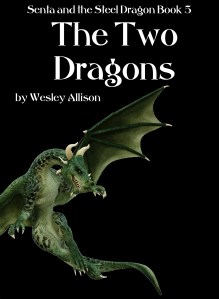
The Two Dragons – Chapter 11 Excerpt

“So what can I do for you today, Inspector?” asked Iolanthe, looking across the great expanse of her desk.

“I would like your help, Ma’am,” replied Saba Colbshallow. “We need to expand the police force. We need half a dozen more men, and we need our own wizard.”

“A—wouldn’t this be more properly a matter put to the city council, and B—we have Zurfina at our service, do we not?”

“To answer your last point first, I would prefer to have an official police wizard, not only because he would then see to police needs first, but also because he would have no other agenda. And Birmisia Colony is more than just Port Dechantagne now. There are half a dozen little settlements going up along the coast. Soon there will be more. It’s not just a city matter anymore.”

Iolanthe burst into a large and uncharacteristic smile.

“What is it?” asked Saba.

“I was just remembering you as a boy.”

“That’s the problem with you women. It’s hard to be a man around you lot when you all knew me as a child.”

“You women? You lot?” asked Iolanthe. Her lips lost their smile and instead took on the round, contracted shape that so many feared.

“Um,” Saba paused like a hunter who has realized that he has activated his own trap. “Anyway, I didn’t know you ever noticed me.”

“Don’t make it more than it is,” she said. “You were one of my household, that’s all.”

“Yes Ma’am.”

“I will take your thoughts on this matter under serious consideration. Your points are valid. Go down to my carriage please, and inform Ursal that you and I are dining out together, so I won’t need him. When you come back up, you may suggest which of our city’s fine establishments we should visit.”

“Yes Ma’am.” Saba stood up and marched out of the office.

Less than five seconds later Mrs. Wardlaw poked her head in the door.

“Governor, there is a man here to see you. I told him you were busy, but he says that he is an old friend.”

“That’s fine, Mrs. Wardlaw. Send him in.”

A lean swarthy man with close-cropped hair entered and walked briskly towards Iolanthe. She held out her hand.

“Good morning. I don’t think I know… you!”

“Yes, it is I,” said the man, grasping her hand in his. She tried to pull it away, but he held on.

“Jolon Bendrin. I told you that if I ever saw you again, I would shoot you.”

“Your mouth says shoot shoot, but your eyes say yes yes.”

She tried to jerk her hand away but to no avail. He grasped her right elbow in his left hand and pulled her to him. Then he wrapped his right arm around her, pinning her left arm against her, and pressed his mouth onto hers. She jerked her right hand free and slapped him across the face. He laughed and fondled her through her dress with his left hand.

“You can’t pretend to be the sweet little virgin this time,” he said. “You’re an old married woman now, but I just had to see you while I was here, for old time’s sake.”

“I was a girl and you took advantage of me.”

“You wanted it and you still…”

There was a loud smack and Bendrin’s face contorted in pain. He bent to the side, revealing an enraged Saba Colbshallow standing just behind him. Saba wrapped his left arm around Bendrin’s neck and hit him again and again in the side, several loud pops indicating cracked ribs. The man crumpled to the floor. Kneeling down over him, Saba planted punch after punch on the upturned face. As he pulled his fist back, a splash of blood flew across the air spattering the bottom of Iolanthe’s dress. Saba stopped, his fist in the air, and looked at her.

“That’s quite all right, Inspector,” she said, stepping toward her desk. “Don’t stop on my account.”

Saba beat Bendrin until he had to sit back and take a breath, and until Bendrin’s face looked like raw meat. Then the police inspector stood up, and as Iolanthe watched from her chair behind her desk, he kicked the moaning man several times, and then grabbed his almost lifeless body by the jacket collar and dragged him from the room.

Iolanthe’s mind drifted away from the present as she remembered that summer. She had been a happy seventeen year old, enjoying life in the country near Shopton. She had been out on horseback twenty miles from the Dechantagne Estate. There, beside a small flowing brook, she had been met by Bendrin. He had seemed nice at first. They discussed their future plans and their unhappy situations. His parents had died in a train wreck. Her father had killed her mother and was now wasting away in a permanent drunken stupor. She had enjoyed his company. Then one day that had changed.

They had both attended Dorit Banner’s coming out party. Afterwards they had walked in the garden. They had talked. Everything seemed wonderful. He had kissed her. She even let him. But then he had pushed her down onto a stone bench and reached under her dress. He put his hand over her mouth so that she wouldn’t scream, though it hadn’t occurred to her. He forced himself on her. He raped her. And he did it again. Though she tried to avoid him, he found her alone several more times over the course of that year. Each time she tried to fight him off, but there seemed to be no more that she could do. He was from a prominent family. Who could she tell—the constable? She would be disgraced. Her father? He was a shell of a man. Terrence was away in the military and Augie was just a boy. When she had turned eighteen, she had gone back to Brech without her father’s permission.
The Two Dragons – Chapter 10 Excerpt

“What did he do then?”

“He didn’t do anything. He just sat there and watched me. After a while, all the lizzies got up and they began carrying offerings up to him—big pieces of meat mostly.”

“What a remarkable experience that must have been,” marveled Mrs. Kane.

“It’s disturbing, that’s what it is,” said Staff. “Who is in charge here? Is it the dragon? Is it the Great King? Is it the Freedonians?”

“Does it really matter?” asked Mr. Vever. “It doesn’t seem as if any of them want to do business with us. If the King isn’t the problem, then it’s the power behind the throne. Whether the power behind the throne is this dragon, or the Freedonians, or someone else, it’s clear they are not on our side. What difference does it make?”

“You’re right of course,” said Staff. “It may not make any difference for the possibility of trade. On the other hand, it might make a great deal of difference for our survival and the long term survival of Port Dechantagne.”

“I was with Zeah Korlann just after he spoke to this dragon,” said Bratihn. “I’ll admit that I didn’t fully believe him about it, but it’s obvious now he was telling the truth. The dragon questioned him and was concerned about humans invading his territory. If he’s the real power, he might not be any more keen on having the Freedonians here than us. Perhaps there’s room for negotiations there.”

“The King may feel the same way. The Freedonians might have seemed like a good idea to him when Zurfina destroyed Suusthek, but now that they’re here, he might not feel the same.”

“On the other hand, he might like them,” said Manring. “He seemed to enjoy his machine gun. I know I would.”

“And we know what Klaus II wants,” said Wissinger. “We’ve watched him going after it for the last twenty years. He and the Reine Zauberei want to rule the world.”

“We need a new strategy. Brown and the Kanes will join Bratihn and Vever in trade negotiations. I know they won’t bear fruit, but it’s the only real contact we have with the government of Tsahloose. Wissinger you’ll join too. I know you’re not a lawyer, but you can try to keep us out of any diplomatic gaffs. Croffet and Werthimer, you two stay on them like paste. If there’s trouble, you take charge.

“Senta and I are going to take Buttermore with us, along with Manring. We’ll visit the Freedonians.”

The discussion ended as the troop of lizzie servants delivered food once again. This time they brought small birds, cleaned and dressed, and no bigger than Senta’s fist. Manring once again proved his culinary prowess by roasting the little creatures using his bag of seasoning. There were also sweet potatoes, which had been cooked prior to delivery, grapes, pears, small green apples, blackberries, carrots, and radishes. Everyone felt quite satisfied long before the quantity of food provided had been exhausted. Then they once again retired to their sleeping chambers for the night.

Senta, who had taken a bath upon her return from the great plaza earlier in the day, took another. The rectangular tub was just over seven feet long and five feet wide, which by human standards made it quite spacious. Its depth however was what made it remarkable. Though she was an even six feet tall, Senta could not touch the bottom even on her tip-toes, without dunking her head. Four square stone spouts provided a continuous flow of water into the tub, which spilled over the top and ran down to a drain cut with four long grooves from a one foot square piece of stone.

After the bath, Senta returned to her room dressed in her large fluffy housecoat. She sat down on her sleeping mat and thought about opening Matter and the Elements once more, but just couldn’t face it. Instead she reached into her bag and pulled out a well-worn copy of Intruder by Anarosa Freedman. It was a relatively easy matter to find the racy parts, as the corners of the pages had become dog-eared with rereading.

“Well, what are we priming ourselves up for?” asked Mrs. Kane, when she entered a few minutes later.

“Just reading a bit.”

“So I see. You’ve had an exciting day.” Mrs. Kane sat down cross-legged next to Senta. “You know I’ve always thought that you were a remarkable young woman,” she said, placing her hand on Senta’s shoulder.

“Thanks…”

“I’ve thought that you might be someone I would like to get to know better.”

“Okay…”

“My husband and I have an agreement. He’s free to pursue other women, as am I.”

“As you are what?”

“Free to pursue other women.”

Senta stared uncomprehending for a moment. Then recognition kicked her in the side of the head just above the ear.

“Eww!”

“Now don’t be that way,” said Mrs. Kane. “The love between two women can be a beautiful thing.”

“I’ve got all the loving women that I need,” said Senta. “What’s more, I have a loving man.”

“That’s what I’m trying to tell you, dear. You don’t really need one of those.”

“There we must agree to disagree.” Senta lifted the woman’s hand from her shoulder and set it aside.

“Pity,” said Mrs. Kane, moving to her own sleeping mat. “If you change your mind, you know where to find me.”

“Yes, I’m sure I could navigate thirty-three inches if needed.”

The Two Dragons – Chapter 9 Excerpt

As the boat rounded the bend, the river spread wider and slowed, giving a view of the city beyond that was nothing less than spectacular. Dark brooding pyramids, frighteningly high spiral shaped towers, and rose and peach colored palaces all peered out over ivory walls. Giant constructions with overhanging plants and artificial waterfalls sat amid great domed aviaries filled with colorful birds and hairy winged reptiles. Though there were obvious similarities between Tsahloose and Suusthek (they had after all been built by members of the same race of beings), there were differences as well—in color, in shape, and in design scheme. Neither was anything like any city of Sumir—any human city.

The party had walked down from the highlands where they had found the Dragon Fortress. They made good time, and Mr. Brown had mostly recovered from his spider bite. The little stream that they had followed had veered sharply away to the west, but three days later, they reconnected with it and followed it down to the forests at the base of the hills. The stream combined with others, becoming a fair sized river. At the fork where their river met an even larger one, they spotted a lizzie village. The village was not unlike those seen closer to home, about two hundred square wooden houses, half of them built on stilts in the shallows of the river and the other half on solid ground just above the high water mark. The lizardmen here painted their bodies just as those near Port Dechantagne did, though with different colors and designs. The lizzies had seemed far more curious than hostile of the strange warm-blooded travelers who had so suddenly interrupted the course of their lives. Still, they had seemed wary. They also knew what firearms were.

Through a combination of the lizard language and hand signals, the party had negotiated the purchase of a boat. It was a great canoe, made of a single gigantic pine tree trunk more than fifty feet long, cut and shaped, and then fitted with outriggers on either side. Ten large leaf-shaped paddles were included. Staff had paid two and a half marks for it—in copper pfennigs. Then they had all climbed aboard and sailed smoothly down the river. In some places it had been wide and slow and in others narrow and swift, but all along its length, it had been navigable.

“Tsahloose must be larger than Brech,” said Mr. Vever from his seat just behind Senta.

“Nonsense,” said Buttermore, just behind him. “Brech is the largest city in the world.”

“This may not be as large as Brech,” said Manring, just in front of Senta. “But I would match it against Natine or Bangdorf.

Senta just nodded. She had lived in Brech, but she didn’t remember it that well. The size and scope of such a city had made little impression on a child of less than nine years of age. She had read about Natine and Bangdorf, and though they were alive in her imagination with style and mystery and majesty in a way that her home city could not match, she knew that they were younger and smaller than the capital of the United Kingdom of Greater Brechalon. None of those Sumerian cities could match up to inhuman, frightening, shining Tsahloose though, because Tsahloose was here and now.

The river flowed right into the middle of the city and the party of explorers followed it in. They sailed among dozens of lizardman watercraft, most much more elaborate than their canoe, but a few were simple one man fishing vessels. The city wall formed an impressive arch over the water and scores of lizzies lined it to watch the approaching humans. Brightly painted reptilians, wearing large feathered headdresses peered from behind gauzy curtains on large square floating barges. Other less ornately adorned lizzies watched from the bank. Floating under the arch, Senta, Staff and the others were swallowed up by Tsahloose. The towers and buildings and pyramids seemed to grow toward the sun all around them, reminding them of how insignificant they were.

They sailed about a half-mile into the city and into a large bay with docks on all three sides. It was only then that they saw floating in the skies above the lizard city, the airship. Huge, sleek, and modern, it was bright silver in the summer sunlight, except for the yellow tail with the large black eagle emblem of Freedonia. They let the canoe coast to the dock, and then slowly swing around to come parallel with it. As they climbed out, a column of lizardmen carrying spears approached. Senta readied herself, but when they reached the humans, they came to a stop and a lizzie wearing a bright red cape of feathers stepped forward.

“Greetings you of the north,” he said, loudly. “You have arrived in Tsahloose.”

His voice was impressive, as was his command of the Brech language. If but for a very slight accent, he might have been a human. Only after hearing him talk for a while, did Senta notice that he was avoiding those labial phonemes that traditionally gave lizzies such a problem with her language.

“I greet you for the great leader, Khassna, of the line of leaders of Tsahloose for a dozen generations, chosen of Hissussisthiss, and august in his citizen’s eyes.” The envoy bowed deeply at the waist, placed his hand on his dewlap palm out, and then bowed again. “I take you now to great Khassna as his guests.”

Senta, Staff, and the others gathered together their packs and were led away from the docks. The two lines of spear-carrying lizardmen flanked them as they walked. The streets of the strange city were made of large square stones fitted together and worn smooth by the countless feet of pedestrians who walked over them, for there were neither wheeled vehicles nor domesticated animals in evidence. The buildings on either side of the thoroughfare had smooth facades, free of ornamentation, painted with pastel colors. Seemingly every available balcony and window box was lined with flowerbeds filled with cascading plants and multihued blossoms. Where there was no flat surface available, pots were hung by chains or ropes to serve as planters. And there were the lizzies, thousands of them, tens of thousands, on the balconies, in the doorways, and lining the street, all of them staring in rapt and silent attention.

The wide street gave way to an even wider one, which in turn gave way to an even wider one, which opened into a magnificent plaza, lined with pyramids, at the end of which sat the most magnificent palace that human eyes had ever seen. It was built in broad platforms one atop another like a great wedding cake, and like a wedding cake it was decorated on every surface. This was in marked contrast to every other building in the city, excepting only the small square temples that topped each of the pyramids. And like the temples, the decorations on the great palace were of one type only—faces. Not the faces of lizardmen; the faces of dragons. And floating in the air beyond the palace like great clouds of doom were not one or two, but five Freedonian airships.

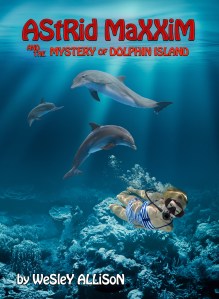
Astrid Maxxim and the Mystery of Dolphin Island

Astrid Maxxim and the Mystery of Dolphin Island is scheduled for release March 9th, 2018.

Genius girl inventor Astrid Maxxim is back! Called to the aid of her friend Océane Feuillée, Astrid leaves her friends and family to journey to an uncharted tropical paradise. Here she must use every ounce of her ingenuity to solve the mystery of Dolphin Island.

Watch for the preorder at your favorite ebook store.

The Two Dragons – Chapter 8 Excerpt

Café Etta was shaded by the tall pines, which grew majestically in most of the city’s vacant land. The summer sun was still well above the horizon. White clad waiters with red checked aprons ran everywhere: lighting lanterns hanging around the edge of the awning, showing guests to their tables, cleaning up after guests who had left, and bringing great trays of food out to those who had already ordered. One waiter, a tall thin young man with black hair and the beginnings of a mustache carried a dessert tray to a table in the back of the café. Carefully balancing it in one hand, he lowered plates of cheese, sliced apples, butter biscuits, grapes, and thickly sliced gingerbread onto the cloth-covered surface. Replacing these on the tray with the last of the dirty dinner dishes, he nodded to the four seated patrons and headed for the kitchen.

“I don’t think I have room for another bite,” said Saba Colbshallow, leaning back from the table. He patted the waistcoat of his charcoal grey suit to show how full he was.

“It was a lovely meal,” said his wife, reaching over and popping a pair of large grapes into her mouth. “This new chef really can do wonders with a pork roast.”

Mrs. Loana Colbshallow was without a doubt the most beautiful woman in the café. Her multihued hair was swept back beneath a broad-brimmed, bright red hat with white flowers that matched her bright red dress. The plunging neckline showed a bit more skin than was current fashion, but neither her husband nor any other man in the establishment seemed to object. Directly across from Mrs. Colbshallow in a quite fetching sky blue gown, Mrs. Dot Shrubb clearly was bothered both by the lack of cloth which covered her dinner partner’s breasts and by the amount of breast which threatened to jump out at her. All through dinner she had stared at the prodigious amount of cleavage and scrunched her nose. Her husband seated to her right had been oblivious to this, and fortunately for him, seemed oblivious to the cleavage as well.

“I’ll say this,” he said. “If we had dined on this meal in Brech City, we would have had to pay a pretty pfennig for it.”

“I think we may very well pay a pretty pfennig tonight,” replied Saba. “Dining out is one of the few things that isn’t dirt cheap in Birmisia.”

“I hear the new café, Bonny Nurraty, is only half the price, because they employ a lizzie wait staff.”

“It’s Bonne Nourriture,” said Saba. “I also hear the food’s not half as good, though I’m sure that has nothing to do with the lizzies.”

“Unless my mother-in-law decides to open her own restaurant,” said Loana. “I don’t see anyone taking the fine dining crown away from Aalwijn Finkler.”

“And you can be bloody positive he won’t ever have a lizzie wait staff either,” added Eamon. “Actually it’s nice to have a place to come where there aren’t any.”

“What do you think about it, Dot?” asked Saba.

Dot just shrugged.

“Dot’s getting to be a lizzie-lover,” said Eamon, stroking his wife’s long coppery hair.

“You like her too,” said Dot, in the nasal voice that was the result of her deafness.

“Well, our lizzie is all right. She dotes on the boys—takes them for walks and plays her little block game with them.”

“That’s just it, isn’t it,” said Loana. “Everyone seems to like their own lizzie. They just don’t trust the rest of them. I have several to take care of things and one that comes in twice a week to clean and have never had any problem with any of them.”

“How are the boys, anyway?” said Saba, intentionally changing the subject.

“They’re fine. Young Saba showed me this week that he can do addition, and little Al isn’t far behind.”

“Alasdair,” corrected Dot, punching her husband on his meaty shoulder.

“And how is Darsham?”

“Wonderful. He follows Saba and Alasdair everywhere they go. Best dog I’ve ever seen.”

“You know he was going to name one of the boys Darsham,” Saba told his wife.

“That’s right,” said Eamon. “But I was overruled on account of my wife fancying your husband.”

Dot hit him again. “You named Saba. I named Alasdair.”

Saba, Eamon, and Loana all laughed. Dot scrunched up her nose. Aalwijn Finkler stepped up to the table between Saba and his wife.

“Inspector, Sergeant, ladies. How was your dinner this evening?”

“Dinner was lovely,” replied Loana.

“Wonderful,” said Aalwijn. “And what are we celebrating?”

“We’re celebrating being able to afford to go out for dinner,” replied Saba.

“I’ve always said the police were underpaid. I’m having a very nice sparkling wine brought out. It’s on the house.”

“I hope this isn’t a bribe,” said Eamon, grinning.

“Nonsense,” replied Aalwijn. “Everyone says that Inspector Colbshallow is above such things, and I don’t expect that you could be bought for less than three bottles.”

Saba burst out laughing. Eamon’s grin dropped to a rather uncomfortable smile. As Aalwijn walked away, he said, “What do you suppose he meant by that?”

“He was just joking,” said Saba. “Everyone knows you’re honest to a fault.”

“It’s just that you accept quite a few gifts,” said Loana.

The smiles on both men’s faces were wiped away. Dot, noticing a sudden change in the mood though she had not followed all the conversation, looked from one to another of her fellow diners.

“Well, you do accept gifts,” repeated Loana.

“There’s nothing wrong with a police constable receiving a gratuity now and then,” said Saba.

“But you never do it.”

“I don’t, well that is… I don’t have any opportunity. I don’t walk a tour anymore.”

Loana batted her eyes at him and said. “You didn’t when you were a PC either.”

“I um… hmm.”

Eamon looked at him, but Saba just shrugged. The rest of dessert was eaten in silence. At least what dessert was eaten, was eaten in silence. Loana sampled something of everything and was especially fond of the fruit. Dot halfheartedly nibbled a biscuit. Neither Saba nor Eamon touched anything. When the waiter arrived with the check, Eamon snatched it out of his hand.

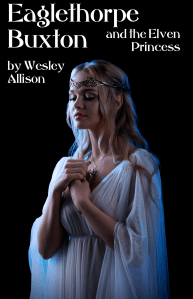
Eaglethorpe Buxton and the Elven Princess – Chapter 17

I must admit that I slept well, notwithstanding the fact that I was using a rock for my pillow, and I had no mattress but the bare ground, and I hadn’t even my own blanket to keep warm. I slept well. I slept well until just before dawn, when suddenly, which is to say all of a sudden and without warning, I felt the weight of several bodies fall upon me. I struggled and threw one or two punches that found their targets, but having been attacked in my sleep and no doubt lulled into a state of drowsiness by elven magic, it was inevitable that I was overpowered. They took me captive, which is to say they tied my hands behind my back, gagged me, and put a sack over my head. Then they hobbled my legs with a piece of rope so that I could take only the most mincing of steps.

I heard some shouting and I thought I recognized Jholiera’s voice, but with the bag over my head it was impossible to make out what was being said. Once I thought I heard her demand my release, but I wasn’t released. I wasn’t sure who had attacked me, but I was relatively sure that it wasn’t goblins. Oh to be sure, goblins are thick in those parts. But had goblins come upon a sleeping man, they would have sliced his throat rather than taken him captive.

The point of something sharp jabbed me in the back. I didn’t know if it was a dagger or a sword or a pike or a javelin or a sharp stick, but the meaning behind it seemed clear enough to me. I was to go in the direction opposite from the side in which I was being jabbed, which is to say the back of me, so I should go forward. I did, but I didn’t go very fast, being hobbled as I was. Despite the fact that it had been my captors who had hobbled me, they didn’t seem to want to take that into consideration, for they kept jabbing me to hurry me up.

It is hard to judge time when your senses are deprived, which is to say your head is in a sack. But as I was marched along, enough light came in through the weave of the cloth that I could tell when dawn arrived and could more or less make out in which direction the sun was to be found as it move up and across the sky. We didn’t stop to break our fast, and we didn’t stop for elevenses, and we didn’t stop for lunch. When we didn’t stop for tea, I tried to protest by planting my feet on the ground and refusing to go on. The only effect that my protest had was an even fiercer jab with a dagger or a sword or a pike or a javelin or a sharp stick right below my left shoulder blade—fierce enough to draw blood. This, as you can imagine, didn’t make the walk any more fun at all.

Fortunately it was only a few more hours after that fierce jab when we arrived at our destination. I was jerked and pulled around until they had me right where they wanted me. Then my hood was pulled off, revealing to me three of my abductors. They were warriors, wearing shining armor. Their long golden hair and long pointed ears, as well as their stature, gave evidence to their obvious relation to my little half-orphan friend, who was at that moment nowhere to be found. The warriors removed my gag and hobble but kept my hands tied. Then they left me.

I looked around to find that I was in a small cave that had been turned into a prison with metal bars across its entrance. From the mouth of the cave I could see nothing but trees and forest. Inside the cave there was nothing but a ratty old blanket on the rough stone ground. You may think that it would be impossible to sleep under the circumstances, and ordinarily I might agree with you. But as I had been awakened in the middle of the night and cruelly marched almost an entire day, I was very tired and very sore and the wound in my back was beginning to sting. I suspected that without being cleaned it might gather an infection, especially in such a place as I now found myself in, full of noxious cave vapors.

When I woke, there was a small bowl of mush sitting just inside the bars. It was mildly humiliating to have to eat like a dog, since my hands were still tied behind my back, but I did it. I have learned on the few occasions that I have found myself behind bars that one should keep up one’s strength if possible. So if you are behind bars and you are given food, you should eat it. In the jails of Theen, I was lucky when I got a maggot-filled potato. In the prisons in Aerithraine I have eaten curds and stale bread. Food in Lyrrian prisons are a mixed bag, depending upon which city-state you find yourself. And woe be to him who is imprisoned in Thulla-Zor. I was once thrown in a tomb-like cell there and had to hunt for my own food—and you don’t want to know what it was. Imagine my surprise when I ate this bowl of mush then to find a delicious mix of unborn grains and dried fruits. So I ate. I sat down against the wall. I waited to see what would come.

The Two Dragons – Chapter 7 Excerpt

As soon as Senta and the other three members of her group had approached the far left side of the courtyard, they had seen the small passage leading down into the darkness. It was about the same width as the typical human doorway, though only about five feet tall, which meant that all of them would have to stoop to enter. Senta would have gone right on in, had Bratihn not stopped her with a wave of his hand. He then stepped in the doorway first, bending down, and following the downward slope. Senta and then Vever and then Brown followed. They had gone no more than thirty feet from the doorway, when Bratihn stopped.

“We need a torch,” he said to Senta.

She reached into her tiny bag and pulled out an oil lantern. As she handed it to Bratihn, the cloth wick inside ignited, bathing the corridor in light. Bratihn took the lantern and continued on. He slid a bit on the sand that dusted the stone floor. Forty feet beyond, the narrow little corridor joined a much wider and higher one, which ran perpendicular to the first.

“I think our entryway here was a ventilation shaft. It probably had some kind of grating over it long ago.” Bratihn held up the lantern and looked left and right down the larger hallway. “This looks more like something someone would walk in. See those holes in the wall on either side? They’re evenly spaced. I’ll bet there was some kind of lighting there—oil lamps or sconces for wooden torches.”

“So which way do we go?” asked Senta.

“Left should take us out toward the front, so right should take us further back.”

“Right it is then.”

No longer needing to crouch, the four explorers were free to move more quickly. Only the darkness and their unfamiliarity with the oppressive passageway kept them to a slower pace. The air in the corridor was cool, dry, and odorless. After about one hundred twenty feet, the passage intersected another forming a tee. Bratihn held the lantern high over his head and looked down each of the three open passageways, but there seemed to be nothing to distinguish one from the others.

“Which way now?” asked Brown, peering over Vever’s shoulder.

“Right,” replied Bratihn.

“Why?”

“Orientation. When we leave, we can simply follow the left wall and it will take us right out.”

“Isn’t it time we headed back?” offered Brown.

Bratihn took out his pocket watch and held it in the lantern light. “We’ve only been gone ten minutes.”

“Come on. We’re wasting time,” said Senta.

“You heard the lady,” said Bratihn, turning to the right and stepping quickly but cautiously down the hall.

This hallway went about another hundred feet and then took a ninety-degree turn to the left. Sixty feet beyond the turn, it ended with an open doorway into a much larger chamber. The four of them examined the sides of the door. Here, like on the great gate in front of the fortress, were indications that there had once been hinges and some sort of lock, but whatever door had once barred the way was now long gone. The light spilling from the lantern spread out as they entered the room beyond the doorway, but it was a tiny drop in an ocean of darkness. The room was huge.

Twenty feet past the doorway, there was a large step downward. Twenty feet beyond that, there was another. Then another. To either side, stretching out into the distance, cut into the stone floor, were benches. Their surfaces had been worn smooth by years, maybe centuries, of use.

“This is an amphitheater,” said Bratihn.

Senta, who had never seen an amphitheater before, strained to make out what she could in the darkness.

“But why build an amphitheater underground?” wondered Vever. “Wouldn’t it be better outside, where you can see?”

“They must have had lighting—like in the corridor,” replied Bratihn. “Maybe whatever they were watching was better underground—some kind of secret rites.”

“Or perhaps they could see in the dark,” muttered Brown.

“How big do you suppose it is?” wondered Senta, still peering around.

“We can go down to the bottom and get an idea. We have to be careful not to get turned around though. We need to find our way back up this particular walkway.”

“When we get near the bottom, we can scratch a mark on the floor,” suggested Vever. “If no one else has anything, I have a pliers in my backpack that should do the trick.”

Senta put her arm over the shoulder of the little man and walked side by side with him, behind Bratihn, while Brown brought up the rear. They walked and then stepped down and walked and stepped down. The amphitheater seemed impossibly huge, and by the time they had reached the bottom, they had passed more than four hundred rows of seats. Vever set down his backpack and pulled out his pliers, using them to scrape an arrow, pointing back the direction in which they had come, on the floor. Senta meanwhile jumped down the last step into a vast expanse of sand that made up the floor of what must have been a mighty coliseum.

“What do you think? Gladiator fights, like in the time of Magnus the Great?”

“Could be,” said Bratihn. “I’m sure it wasn’t dinner theater.”

Suddenly a horrible cry rent the subterranean air. It echoed through the great chamber from somewhere across the darkness. It was impossible to tell from which direction, but it seemed clear that it was at their level and not along the top.

“Kafira Kristos!” said Vever. “What is that?”

The cry rang out again.

“I don’t know, but it can see us,” said Bratihn. “Get over here, girl.”

Eaglethorpe Buxton and the Elven Princess – Chapter 16 Excerpt

Jholeira curled up in my blanket next to the fire and went to sleep without another word. I didn’t think this strange, but when she did not deign to speak to me the following morning I began to feel a little put off. I decided that if she wasn’t going to speak to me, then I wouldn’t speak to her either. We packed up and left our campsite in complete silence. By elevenses I was getting rather tired of the quiet. Over a brief meal of raisins and cheese I tried first to coax her and then to trick her into speaking. She would have none of it however and I eventually stopped trying.

The little path that we followed wound down through a series of small valleys, eventually coming to the stream. The trees grew thick on both sides of the stream and indeed on the far side there was a vast expanse of forest that is Elven Wood. The stream itself was no more than twenty feet wide and its broadest expanse and in those places where it widened out thus, it was only a few inches deep. Though the banks were icy, the water was clear and free flowing. Upon reaching it in late afternoon, we followed it southeast until, finding a narrow spot where the water deepened to several feet, I stopped to drink and look for fish.

The greatest skill I ever learned, with the single possible exception of story telling which is more of an art form than a skill, is that of guddling fish. Fish that have swum up the shallow part of a stream, will often take shelter under a rock or a ledge when they come to a deeper and slower moving part of a river. When they do, they become prey for the guddler. He reaches his hand under the ledge, knowing where a fish ought to be, and carefully locates the fish’s tail. Then he begins tickling the fish with his finger, tickling its tail, then tickling its belly, and finally tickling right under the gills. Then with a quick grasp, he pulls the fish from the water and tosses it up onto the shore, ready to be cleaned, cooked, and eaten. If the temperature of the water made the fish sluggish, you couldn’t tell it by the ones I found, though it didn’t do me any good sticking my arm in. I caught two lovely river trout that day, one which I cleaned and cooked over the fire for our supper, and the other which I kept captive by running a string through its gill, and tying one end to a sapling, and tossing the other end, attached to the fish, back in the water. This second fish we ate for breakfast.

It was late the following afternoon before we reached the intersection of the stream with the East Road. By this time I had resolved myself to the fact that my little orphan boy/girl was never going to speak to me again, but as we crossed the small bridge, which spanned the juxtaposition of the road and the stream, as bridges are wont to do, she at last broke her silence.

“We should spend the night on this side of the stream.”

“Why?”

“The forest is dangerous, especially at night.”

“I don’t care,” said I. “I’m not talking to you.”

“Yes you are,” she replied.

“No. I am not.”

“I was not talking to you, but now I am. But you are definitively talking to me.”

“No, I’m not.”

“Yes you are.”

“I’m not talking to you. I’m just telling you that I’m not talking to you.”

“That means that you are talking to me, because in order to tell a person something you have to talk to them.”

“No you don’t.”

“Now you are just being contrary,” said she.

“No I’m not.”

“Fine,” said she. “I don’t care whether you are talking to me or not…”

“Yes you do.”

“I don’t care whether you are talking to me or not and I don’t care whether you are being contrary or not. In either case we should spend the night on this side of the stream.”

“No we shouldn’t,” said I.

“No?”

“No.”

“Why not?”

“Because,” I explained.

“Well as long as your reasoning is sound,” said she.

“No it isn’t.”

We spent the night on the west side of the bridge, just at the edge of the trees on that side of the stream. By the time we made camp, it was too late for me to find any fish to guddle, so we ate dried beef and drank coffee for our supper. Jholeira curled up in the only blanket while I snuggled up in my coat and set my head upon a large flat rock to use as a pillow.

“Are you cold?” she asked.

“No.”

“I’m sorry I stopped talking to you. You have been a very great help to me and you didn’t have to and here I am wrapped up in your only blanket while you have nothing but your coat to keep you warm.”

“I have the fire. Besides, it is only fitting that you have the blanket, being an orphan or a girl or a princess or some combination of the three.”

I stayed awake quite late watching the stars and listening to Hysteria complain about her lack of oats. She should have been happy, as in that particular spot by the bridge there grew not only an abundance of grass but some early flowering szigimon, which any stable master can tell you is the very best horse feed in the world. Many times she has had to make due with busy grass, which is the least best horse feed in the world—not that it is bad for horses, but it does nothing more than give them something to chew on and doesn’t provide any real nourishment. You would think by now she would know when she had it good.

“What are you doing?” asked a small voice from the other side of the campfire.

“I’m pondering horse feed,” said I.

“Well, go to sleep.” It must have been some kind of elf magic, because no sooner had she said this than my eyes closed, seemingly of their own volition.

The Two Dragons – Chapter 6 Excerpt

The landscape had changed as the altitude increased. Thick forests of redwood, maple, and aspens had given way to stunted cedar trees and large bushes sticking out from between massive and strangely square boulders stacked in odd piles here and there as though a giant had set them up like blocks and then kicked them over. The twelve members of the expedition moved easily enough on foot through the uneven terrain. Unlike the plains they had passed through the day before, which had been filled with great herds of horned triceratops, giant sauropods, and packs of vicious dinosaur predators, here there seemed to be little animal life. A single telmatosaurus, full grown but only fifteen feet long, wandered between bushes munching on conifer needles. Several long-nosed white-furred opossums were startled from their hiding places as the column of men and women passed by. A squat-bodied furry creature halfway between a bear and a dog barked at them from the top of a rock and then ran over the hill and out of site.

Radley Staff stopped to look back at the line of people following him and make sure that there were no stragglers. The formation remained tight, which was a miracle considering the diversity of the party members. Behind Staff was Amoz Croffut, a veteran soldier only recently retired from the militia, or the Colonial Guard as it was now officially known. He had already proven more than once on this trip that he could spot danger. Third was Senta, the tall, thin, blond, seventeen year old sorceress. Next came Taddeus Vever, sweating and puffing as he marched along on his short legs. Vever was a jeweler by trade, a sedentary job that gave him little time to exercise, so he was horribly out of shape. He didn’t complain though. Unlike Paxton Brown, who followed closely behind Vever and whose constant protests had long since worn thin. The man was supposed to be a scholar of lizzie behavior, and Staff had chosen him over several other naturalists for that reason. Now he was beginning to regret his decision. Behind him was the husband and wife duo of engineers, Ivo and Femke Kane. They looked at each other and smiled, apparently enjoying Brown’s discomfort. They were followed by Isaak Wissinger, the writer. Arriving from Freedonia two years before to join relatives, Wissinger had already published several well-known works of fiction and non-fiction. He was on this journey for his keen ear and understanding of language, though he spoke the hissing tongue of the lizzies less well than some of the others. He was followed by Lawrence Bratihn, the head of trade for Birmisia Colony, as well as the only person in Port Dechantagne besides Senta who had been in a lizzie city before. Occupying the tenth spot in line was Edin Buttermore. Buttermore was in much better shape than he had been when he arrived in Mallon. Now though, he was struggling under a pack filled with a good seventy pounds of photographic equipment. Pulling up the rear were Bertrand Werthimer and Woodrow Manring. Both were accomplished soldiers, though they like Croffut and Bratihn for that matter, no longer wore uniforms. All members of the party, excepting only Senta, wore khaki shirt and khaki trousers tucked into high boots. Senta wore black leather pants and a black and red leather corset that left her shoulders covered only by her long blond hair.

Staff let Croffut pass him and took up a spot beside the girl.

“I should have had you change into your khakis.”

“I didn’t bring any. Zurfina packed for me.”

“Black is too hot for a journey.”

“Do I look hot?”

“No. You look remarkably comfortable. But there is the question of camouflage. You stand out.”

“I’m supposed to stand out.”

“All right. Are your spells ready?”

She grinned at him. “You’ve worked with wizards in the navy, eh?”

“Yes.”

“I’m not a wizard. My spells are always ready.”

“Potent too, from what I understand. It’s been a couple of years since I’ve actually seen you do magic.”

“How is married life?” she asked, changing the subject. “I would think it would be hard being married to the governor.”

“It’s good. It’s a bit like being in the navy. If you don’t mind taking orders, it’s a good life.”

“Say there, Senta,” said Vever catching up to the other two. “Is it magic that you’re not exhausted like I am?”

“Yes, it’s magic,” replied Staff. “It’s the magic of youth. She has twice the energy that either of us has and half as much idea what to do with it.”

“It’s a shame,” said Vever, though he didn’t complete the proverb. “That youth is wasted on the young.”

“Would you like me to carry your pack for a while, Mr. Vever?” asked Senta.

“I would never allow a young lady…”

She patted Vever, who was a foot shorter than she was, twice on the top of his head and then grabbed the pack by one of the loops on the back and lifted it off his shoulders. Pointing downward and swirling around her index finger, she said “Uuthanum izesic.” She tossed the backpack into the air just above where she had pointed, and it plopped onto an invisible surface, three feet above the ground. Senta smiled and continued on, following Croffut who was none the wiser. The backpack and whatever transparent thing supported it followed five feet behind her.

Staff and Vever stopped walking and wondered at the hovering object. As they stood thus amazed, Paxton Brown rushed past them. Catching up with the invisible transport, he flung his own pack on top of Vever’s. Now both haversacks followed along in the air behind the girl.

“Do you think I could..?” asked Buttermore, puffing up beside them.

Eaglethorpe Buxton and the Elven Princess – Chapter 15

The following morning found both Jholeira and me awake and refreshed. So we made an early start. It was not as early as Ellwood Cyrene who had left at the crack of dawn. However when I went down to the common room that morning, not only did I find that my friend had paid for breakfast for my elf girl and myself, but he had left a package for me as well. Wrapped in a large oiled cloth, were several pounds of dried beef, a wheel of yellow cheese, two or three pounds of raisins and a small cloth sack with a half dozen coins in it.

Ellwood Cyrene never seemed to be in need of money, despite the fact that he seldom took payment for his many acts of manly heroism. I have seen a bucket of gold coins gathered together by a town to pay the hero that saved them from the threat of a raging monster, only to have it politely refused by a smiling Ellwood Cyrene. I have seen him pass out coppers to every orphan in a six block radius of the inn in which he was staying. To be fair I have seen him plunder more than one baggage train, and on numerous occasions he has rifled through the pockets of a man he has just stabbed—but who hasn’t done that, when you get right down to it.

I was not able to procure any oats for my poor steed, which is to say Hysteria, but I did get a small bundle of dried hay to supplement the small amount of forage we were likely to find in that country in winter.

We set off on the East Road, but following the advice I had been given, we soon turned off to the north, following a cattle path that wandered over the hills and down into the valley. Our new path veered off from our previous course, but not enough that I thought we would lose our way. In fact at teatime, we stopped among a small copse of trees at the top of a hill. From this point we were able to look down to the south across a vast valley. True to Ellwood’s warning, a great battle was being fought. It was impossible to tell who the two sides were, as their banners at this distance were too difficult to read. All that was certain was that both sides were humans. I took some small pains to make sure that we weren’t spotted, but considering the distance and the chaos on the battlefield, I judged that there was little chance of it.

After journeying the remainder of the day, we made camp just off the path in a little hollow which had been formed by three massive boulders piled one atop of the other two. I can only imagine that some giant piled them up thus as there was no nearby mountain down which they might have slid to come to rest in such a fortuitous configuration, which is to say a pretty good shape.

“We should reach the edge of Elven Wood tomorrow,” I told my companion.

“Really? I don’t seem to recognize any landmarks.”

“Maybe when we get closer,” I offered. “How long since you’ve been home?”

“Six or seven years I would suppose.”

“That must be tough, being without your family for so long.”

“Yes.” She sighed. “And what about you? You’ve been without your family for quite a while now too.”

“What?”

“How long has it been?”

“How long has what been?”

“How long has it been since your family disappeared?”

“Oh. That. I really can’t say.”

“You know, I’ve been thinking.” Jholeira stood up and began to pace back and forth beside the campfire. “The purple drops on the floor, as I’ve already said, could be from the blueberry pie you were expecting.”

“Fiends!” said I.

“As far as Gervil’s knife being stuck in his bed is concerned, that could be an indicator of foul play or of nothing at all.”

“I see.”

“The floorboards being pried up however tells us something. Whoever the culprit or culprits were, they were looking for something hidden under the floor. Money maybe? Family jewels?”

“The unpublished manuscripts by the world famous Eaglethorpe Buxton,” I offered.

“I suppose that is conceivable,” said she. “What I don’t understand is the onions in the rafters. The only thing I can think of is that they were trying to ward off vampires.”

“Monsters!” said I. “But wait. Isn’t that supposed to be garlic?”

“Maybe they couldn’t find any. Or maybe they didn’t know the difference. Garlic looks a lot like an onion.”

“Oh, my family would know the difference,” said I. “My poor old father was a fine onion farmer. In fact one variety, the Winter Margram onion was named for him. My cousin Gervil wrote an epic poem about onions, though I was never able to memorize more than the first five hundred twelve lines.”

“Is that all?” she wondered.

“Tuki was Onion Queen three years running.”

“So it is possible that your family would have had onions around? Say, hanging from the rafters?”

“Only at harvest time.”

“Was it harvest time?”

“Was what harvest time?”

“Was it harvest time when your family disappeared?”

“It could have been.”

“So there really are no clues at all,” postulated the half-orphan.

“What about the tracks?” I asked. “What about the tracks that ended mysteriously after only fifty feet?”

“You said it was a stormy night. The rain probably washed the tracks away.”

“You’re right,” said I. “The next time it will be morning.”

“What do you mean next time?”

“Um, nothing.”

“You mean the next time your family gets kidnapped or the next time you tell about it?”

“Well…”

“Your family never was stolen at all!” She stood up with back straight and finger pointed accusingly. She looked quite intimidating. “You lied!”

“It’s wasn’t a lie,” I explained. “It was a story. Well, it was a first draft.”