Unknown's avatar

About wesleyallison

Author of twenty science-fiction and fantasy books, including the popular "His Robot Girlfriend."

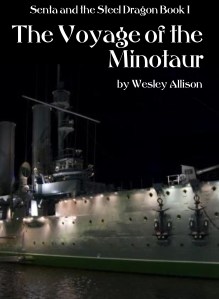
The Voyage of the Minotaur – Chapter 2 Excerpt

Iolanthe Dechantagne held onto the bedpost with both hands while her dressing maid Yuah pulled with all her might on the lacings of Iolanthe’s new Prudence Plus fairy bust form corset.  When the two sets of lacing holes reached as close a proximity as they were likely to, Yuah jerked the lacings down, pulling them into the crimping holes so that they would stay tight until she managed to tie them into one of her patented infallible knots.  Only when this knot, immotile as any which anchored a battleship to a dock, was tied, did Iolanthe let out her breath.  Though still able to fasten her own bustle around her waist, the beautiful young woman was now helpless to bend over and pull on her own stockings, so Yuah carefully rolled each of the expensive silk garments up a leg, fastening it at the top to the several suspenders hanging down from the corset. Then Iolanthe stepped into her shoes, which were alligator skin high-tops with four-inch heels.  The maid kneeled down once again, this time to fasten each shoe’s twenty-four buttons using a buttonhook.

“The white pinstriped dress today?” asked Yuah.

“No.  I wore that just last week.”

“The chantilly dress?”

“Yes I think.”

Yuah brought over the dress.  Yards of sheer black lace overlaid a pink silk base that was as smooth as lotion. The dressing maid helped Iolanthe put her arms through the sleeveless shoulders and then fastened the dress up behind her.  Then she helped her on with the matching jacket.  Though the dress was sleeveless and had a fairly low neckline, the jacket had long sleeves with puffs of black lace at the end, and fastened all the way up and around Iolanthe’s long thin neck.  The hat that went with this ensemble was a black straw boater, which like so much of Iolanthe’s hat collection, imitated a man’s style.  But in addition to the black lace veil hanging down to below her neck all the way around, the top of this boater was decorated with a dozen pink and black flowers and a small stuffed bird.  She wore no rings on her fingers or ears, but draped a cameo necklace carefully across her bosom.

Iolanthe turned and looked at herself in the floor-length cheval glass.  The cameo necklace, the hat, jacket, dress, shoes and stockings, and the Prudence Plus fairy bust form corset were only the finishing touches of a process that had taken the first two hours of the morning. A hot bath and shampoo had come first, followed by shaving her body (with straight razor), and then applying four different types of body lotion and body powder.  Next was a careful facial, culminating in the retouching of her very thin, carefully arched brows.  Styling her long auburn hair into a bun and constructing small ringlets with a curling iron to frame her face, had next occupied her.  Then she had donned her panties, her bloomers, her underbrassier, her brassier, and her camisole.  Yuah had carefully manicured her fingernails and pedicured her toes. Finally came rouge, eye shadow, mascara, and lipstick—just enough to look as though she didn’t need any and thus had worn none—painted on with the care and attention to detail of the finest portrait artist.

“You look beautiful, Miss.”

“Yes, I know.”

“Will there be anything else, Miss?”

“No.”

Yuah left and Iolanthe continued to stare at herself for several moments in the mirror. Once she had decided that everything was perfect, she hyperventilated for a minute before leaving.  Doing so allowed her to make it all the way down to the steam carriage without having to gasp for breath, despite the small inhalations allowed by the Prudence Plus fairy bust form corset, though doing so exacerbated the possibility of her fainting.  Women frequently fainted in Brech.  It was just part of the cost of fashion.

The house that the Dechantagne family owned in the Old City was a large square four-story building occupying most of a city block.  It was so large in fact that two thirds of the rooms were unused, the furniture covered by white linen drop cloths and the doors kept locked.  Iolanthe had been tempted to sell the house, as she had much of the family’s other city properties, but then finding a new place to live would have occupied far too much of her time, and she doubted that any place she found would have been appropriate for entertaining the class of people that she had needed to entertain during the past year.  Since she had been essentially forced to keep it, she had spent considerable money modernizing the portions that she used.  Houses built three hundred years before did not have the benefits of indoor plumbing and there was no way that she would go without her bathtub, or for that matter a modern flushing toilet.  Stairs were fine as well for making a grand entrance, but for the everyday up and down of three flights, an elevator was a must.  Then there were the dumbwaiters, the gaslights, and the upgraded kitchen.  The only things that hadn’t needed to be improved were the servants’ quarters, which were more than adequate.
The Voyage of the Minotaur – Chapter 1 Excerpt

She had to wait several minutes for Carlo to notice her.  He was busy delivering sandwiches to the two soldiers who sat with the woman in the white pinstriped dress.  Not cucumber sandwiches on white bread.  Their sandwiches were thick slices of dark bread, piled high with slab after slab of ham. This was no surprise to Senta. Soldiers were always hungry.  She had seen them eating many times: the officers here at Café Carlo, and the common soldiers purchasing food from vendors near the park, or at the beanery in her own neighborhood.  At last, Carlo noticed her and held out his hand to her, dropping her fourteen copper pfennigs for the week into her callused palm. They were small coins, with the profile of the King on the obverse side, and the front of a stately building, Senta didn’t know which building, on the reverse side.  She stuffed the coins, a few fairly bright, but most well worn, into her pocket.

“See Gyula,” said Carlo.

A surprised Senta nodded and scurried back to the kitchen.  This was an unexpected boon.  Gyula was the junior of the two line cooks, which meant that he was the lowest ranked of the four people who prepared the food in the café.  An order to see him was an indication that she was being rewarded with foodstuffs of some kind.  When she entered the kitchen, Gyula looked up from his chopping and smiled. He was a young man, in his mid twenties, with a friendly round face, blond hair, and laughing eyes.  He was chopping a very large pile of onions, and the fact that he had only his left hand to do it, seemed to hinder him not at all. When Gyula was a child, about the same age as Senta was now, he had worked in a textile mill, where his job was to stick his tiny arm into the gaps in the great machines and remove wads of lint that had gummed up the works.  In his case, as in many others, the restarting machine proved quicker than his reflexes, and snipped off his arm just below the elbow.

“Hey Senta!” said Gyula, setting down his knife and wiping his left hand on his white apron.

“Carlo sent me back.”

“Excellent,” said Gyula.

He became a one-handed whirlwind, as he carved several pieces of dark bread from a big loaf, and piled an inch of sliced ham, slathered with dark brown mustard between them. He wrapped the great sandwich, which Senta happily noted was even bigger than those the soldiers had received, in wax paper.  He likewise wrapped a monstrous dill pickle, and placed both in the center of a large clean red plaid cloth; folding in the four corners, and tying them in a bow, to make a bindle.  Gyula handed the package to Senta, smiling.  When he had the opportunity, the young line cook favored Senta with great, heaping bounties of food, but he dared not do it without Carlo’s permission. It wouldn’t be easy for a one-armed man to find a job this good, and no one in his right mind, however kind-hearted and happy-go-lucky he was, would endanger it for a child he didn’t really even know.

“Thank you, Gyula,” said Senta, and grabbing the red plaid bundle, scurried out the door and down the sidewalk.

It was a beautiful day—though Senta didn’t know it, it was the first day of spring.  She made her way along, dodging between the many other pedestrians.  It was warm enough that she felt quite comfortable in her brown linen dress, worn over her full-length bloomers, and her brown wool sweater.  The weather was very predictable here in the Brech.  The early spring was always like this.  Late in the afternoon, the sky would become overcast, and light showers would sprinkle here and there around the city. Most days, they were so light that a person would scarcely realize that he had been made wet before he was dried off by the kindly rays of the sun.  Still, the ladies would raise their parasols to protect their carefully crafted coiffures from the rain, just as they now used them to protect their ivory complexions from the sun.

Summers here were warm and dry, but not so hot that people wouldn’t still want to eat in the outdoor portion of Café Carlo.  Not so in the fall or winter, however.  The fall was the rainy season.   It would become overcast, and stay that way for months, and it would rain buckets every day.  The streets would stay slick and shiny.  Then winter would come and dump several feet of snow across the city.  The River Thiss would freeze over and they would hold the winter carnival on the ice.  And the smoke from all of the coal-fired and gas-fired stoves, and the smoke from all of the wood-filled fireplaces would hang low to the ground, and it would seem like some smoky frozen hell.  The steam carriages would be scarcer, as the price of coal became dearer, but the horse-drawn trolley would still make its way through the grey snow and make its stops every three minutes.

Senta skipped and walked and skipped again east from the plaza down the Avenue Phoenix, which was just as busy as the plaza itself.  Travelers hurried up and down the street, making their way on foot, or reaching to grab hold of the trolley and hoist themselves into the standing-room-only cab.  Quite a number of couples could be seen strolling along together, arm in arm; the men usually walking on the side closest to the street, in case a steam carriage should splash up some sooty water.  Others on the street were shopping, because both sides of the Avenue Phoenix were lined with shops.  There were quite a few stores which sold women’s clothing and a few that sold men’s, a millinery shop, a haberdasher, a bookseller, a store which sold fine glassware, a clockmaker, a tobacconist, a jeweler, a store which sold lamps, a florist, and at the very end of the avenue, where it reached Prince Tybalt Boulevard, just across the street from the edge of the park, on the right hand side, a toy store.

Stopping to press her face against the glass, right below the printed sign that said “Humboldt’s Fine Toys”, Senta stared at the wonders in the store.  She had never been inside, but had stopped to look in the window many times.  The centerpiece of the store display was a mechanical bird.  It worked with gears and sprockets and springs and was made of metal, but it was covered in real bird feathers in a rainbow of hues, and would sit and peck and chirp and sing as though it were alive, until it finally wound down, and the toy maker would walk to the window and say the word to reactivate the bird’s magic spell.  Senta knew that the bird would remain in the window for a long, long time, until some young prince or princess needed a new birthday gift, because that bird would have cost as much as the entire Café Carlo.  Arranged around it were various mechanical toy vehicles—ships, trains, and steam carriages.  Some were magical and some worked with a wind-up key, but they all imitated the real life conveyances from which they were patterned.

None of these wonderful toys held as much fascination for Senta though, as the doll that sat in the corner of the window.  It wasn’t magical.  It wasn’t even animated by a wind-up mechanism.  It was a simple doll with a rag body and porcelain hands, feet, and face.  It wore a simple black dress.  Its blond hair had been cut in a short little bob, and looked like real human hair.  It had a painted face with grey eyes and pink lips.  It may well have been one of the lesser-priced toys in the shop.  It was definitely the least expensive item in the window, but Senta would never be able to purchase it.  Had she been able to save every pfennig she earned, it still would have taken her more than thirty weeks to purchase the doll.  And she could not save every pfennig she earned. Most weeks, she could not even save one.

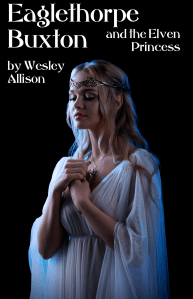
Eaglethorpe Buxton and the Elven Princess – Chapter 20

Chapter Twenty: Epilog.

Three years after the events in this tale, I was sitting beside the fireplace in the Singing Siren Tavern in the city of Antriador, having just finished telling the tale of Eaglethorpe Buxton and the Elven Princess, when I heard a voice calling out.  “Gah! You are the worst story-teller ever!”

It was Jholiera.  She was no longer dressed as an orphan boy.  Nor was she clad in her leather elven-style princess dress with a leaf motif carved into it, and lots of gold jewelry.  She was dressed as a traveling warrior, with armor carefully tailored to her short and feminine form, and a sword on her back that was nearly as large as she was.  Her golden hair, now almost reaching her waist was styled into dozens of thin braids, each adorned with beads of bone and ivory.  She threw her arms around me and pulled me close in a tight embrace, then released me before continuing.

“You are the worst storyteller ever.  None of that was right—the pies, the goblins, the elves.  None of it happened that way at all.  Only that bit in the Inn with Ellwood Cyrene was remotely true.  And I most certainly did not kiss you.  Not even once.”

“A little romance makes for a better story,” said I.

“I’m surprised you didn’t have me throw myself at you.”

“I had to keep it proper,” said I.  “You were dressed as a boy most of the story.”

“Come here, you great fool,” she said, and taking my face in her small hands, she pulled me down to her eye level and kissed me, this time deeply, on the lips, and with great passion.  It was such a shock that for a moment I couldn’t speak.

“What are you doing now?” she asked.

“I am pondering a new ending to the story.”

“You’re not thinking of making up an ending where I show up in a tavern dressed as a warrior and, taking your face in my small hands, I pull you down to eye level and kiss you, this time deeply, on the lips, and with great passion, are you?”

“Of course not,” said I.  “Perish the thought.”


The End

The Voyage of the Minotaur – Chapter 11 Excerpt

“Uuthanum,” said the girl, and the teapot rose slowly up into the air and floated across to the other side of the table, coming to rest in front of Egeria Lusk.

“Brilliant!” said the short, fire-haired woman.  “I see you will soon be as great a sorceress as your guardian.”

Zeah Korlann sat back in amazement.  When he was Senta’s age, he had barely been able to write his own name. This child was some kind of magical prodigy.  Zeah had often heard of secret wizard colleges where young men and sometimes women, young adults really, at the age of majority, went to study magic. Afterwards they would presumably apprentice with a master wizard somewhere.  But he had never heard of a child casting magic spells.

“Where is your dragon today?” asked Miss Lusk

“He’s sleeping today.”

“All day?”

“Yup.  He stays awake for two days at a time, and then he likes to sleep for four or five.”

“He sleeps four or five days straight through?” wondered Zeah.

“Yup.  Zurfina says dragons sleep a lot.  The older they get, the longer they sleep.”

Miss Lusk picked up the tea pot and poured more tea into Zeah’s cup, then Senta’s, and finally her own.  She passed the plate around to each in turn, allowing them to take their share of the tiny sandwiches, made with meatless sausage and cheese between two crisps. They had biscuits for dessert. Miss Lusk had catered the whole tea herself.  Zeah marveled that a woman who could master complex mathematical equations and create what she called “programs” for the most advanced machine in the world, could also provide a fine repast, seemingly at the drop of a hat.  She had only learned that he would be available for tea the day before.  She had also invited the sorceress’s ward.  Had the two of them dined alone, people would have talked.

Tea with Miss Lusk presented a welcomed change for Zeah.  Each day seemed to be just like the day before it. Almost all of his time was spent organizing activities for the passengers, which would provide the necessities of life or a change of pace to prevent boredom or depression caused by long confinement on the ship.  The first two days after their departure from the island of Enclep, he had been occupied seeing to the inventorying and storage of the supplies purchased there. The following day, he had to arrange for the priests onboard and Dr. Kelloran to deal with a fungus infection that had broken out among many passengers and crew.  The day after that had been washing day, which always kept him busy.  It had ended with the death of Miss Kilmurray and the summary execution of Mr. Murty by Master Terrence.  Zeah would have liked to have seen Murty tried for his crimes, but he was as loud in his laudation for Master Terrence as anyone else on the ship.  His daughter could have easily have been Murty’s next target, or Miss Lusk.  The following day, Zeah had organized a memorial service for Miss Kilmurray.  Two days after that, when Lieutenant Staff had completed his investigation, Murty’s body, which had been kept on ice, was dumped unceremoniously over the side.

It was surprising to Zeah, who had expected that there would be a somber mood among the passengers following the memorial, but the atmosphere on the Minotaur actually seemed to lighten.  There had been a cloud hanging over the lives of everyone onboard since the murder of Miss Astley, though most had not realized at the time that the murder was one of a series.  Now with the murderer dead, people were much freer with their smiles, their attitudes, and their actions.  Zeah had originally planned a series of games and activities to slowly raise people’s spirits, but had changed his plans and instead scheduled a dance.  It took place the evening of Pentuary ninth, ten days after leaving Enclep.

The danced proved to be a great success and everyone who was there seemed to have a wonderful time.  Miss Dechantagne surprised everyone by attending.  She wore a beautiful royal blue evening gown with large balloon sleeves and a white satin belt with embroidered blue and silver silk flowers. She had a bouquet of fresh flowers at her waist and atop her curled auburn hair.  And the bare expanse of her shoulders and the choker of pearls she wore made her long, thin neck look even more so.

Everyone admired Miss Dechantagne’s beauty, but Zeah found Miss Lusk’s charms even richer.  She had arrived in a buttercup yellow gown with butterfly sleeves.  The skirt had little pleated waves of fabric falling straight on the sides, and was trimmed with vines of embroidery in gold and beads extending down each side of the front.  It was ornamented on one side with a velvet panel, and on the other with two large velvet bows.

Zeah had not yet spoken to either of the two women when Master Augie arrived with Dr. Kelloran.  Lieutenant Dechantagne was dressed in a fine cutaway coat, which exposed a red waistcoat embroidered with a dragon motif.  He had a new grey felt derby, which he must have purchased just before leaving Brech, with a red carnation in the band.  Dr. Kelloran’s Thiss-green silk gown might not have stood out as much as those of yellow or royal blue, but it was equally fine in an understated way. Decorated with beads of jade and tiger-eye, it was wonderfully offset by her long white suede gloves.

Every passenger attending, especially the women, came in their finest clothes.  It seemed less like a simple dance staged rather quickly aboard a crowded naval ship than the social event of the season.  More than a few officers and sailors attended as well, and all of them wore their dress-whites.  Notably absent was Lieutenant Staff, who was on duty that evening.  Master Terrence was not in attendance either.  Zeah thought that this was a shame, as seventy-four unmarried women, and more than a few who were married, all seemed to be looking for him.

Eaglethorpe Buxton and the Elven Princess – Chapter 19

Chapter Nineteen: Wherein I make an escape, a plot element that I normally wouldn’t reveal, but you know that I am alive anyway because I am telling you the story.

I was given another bowl of the delicious mush, which I ate, this time with more difficulty because my back really ached when I bent over to eat like a dog.  I certainly didn’t sleep though.  Oh you can be sure of that.  I didn’t sleep.  Knowing that you are going on trial in one hour is not nearly the cure for sleepiness that knowing you are to be executed in the morning is.

“Eaglethorpe,” a voice called.

I turned to see Jholiera bathed in the light of the setting sun as it diffused through the trees.  She was no longer dressed as a boy.  She had on a leather dress cut in an elven style with a leaf motif carved into it. It left her shoulders bare and though her form was slight, there was no longer any question that she was a young woman. She had golden jewelry on her arms and a delicate golden crown on her head.

“Eaglethorpe, how are you?”

“I’ve a pretty nasty stab wound in my back, and my arms are aching from them being tied behind me.  I think I skinned my knee when I was trying to eat from a bowl like a dog, but there’s no way to check.  Oh yes, and they are going to kill me in a few hours.  Other than that, I’m fine.”

“Come here, close to the bars.”

I did as directed and she reached through the bars and cut the bands that were holding my wrists together.  My muscles cried out as blood rushed back into them, and a shooting pain went from my back straight into my heart.

“I think I shall die before they have a chance to kill me,” said I. “Serves them right.”

“Don’t say that.  I’m going to get you out of here.”

“How?”

“I’ll be back after midnight.  In the meantime, try to get some rest.”

“You have no idea, girl,” said I, as she went off into the trees.

Remarkably I did sleep this time.  I must have.  I don’t remember falling asleep or even sitting down.  But when I was awakened, by small pebbles hitting against my face, I found myself sitting against the wall of the cave.

“Ow!  Stop it,” said I, as one of the small pebbles hit me in the eye.

“Quiet you,” said Jholiera.  “I’m almost ready to rescue you.  Get over here and wait by the cell door.  You have to be ready at a moment’s notice.”

“Why aren’t you rescuing me now?”

“I don’t have the key yet.”

“You don’t have the key?”

“Calm down.  I’ll be back in a few minutes.”

She did return, but it wasn’t in a few minutes.  It was quite a bit later.  In fact, by the time she did return, I was beginning to fear that the first rays of predawn light might make escape impossible.  But when she arrived, Jholiera did have the key.  She quickly opened the cell door, and taking me by the hand, led me through a maze of trees.  We hurried around massive trunks and over fallen logs, through curtains of trailing vines, until we came to another small glade.  Here was my beautiful steed, which is to say Hysteria.

I can tell you I had a hard time saddling my horse due to my injury.  But with the elven princess’s help, the deed was soon done.  As I prepared to mount, Jholiera stopped me.

“Thank you Eaglethorpe,” she said, and gave me a tender kiss on the cheek.

“You are coming with me, aren’t you?” I asked.  “You can’t live with such a horrible father, or marry such a horrible husband.”

“Don’t worry.  My father is not so bad.  And Iidreiion probably won’t want to marry me anyway after he finds out what I had to do to get the key away from his cousin.  Besides, I’ve had enough adventuring for now.  I just want to stay home and be safe.”

With that she gave me an even tenderer kiss on the cheek.  I climbed into my saddle and took off through the woods, just as the early dawn was beginning to break.  And I didn’t see the little elven princess again.

Eaglethorpe Buxton and the Elven Princess – Chapter 18

Chapter Eighteen: Wherein I find out what fate the elves intend for me.

It was well into the morning before I was given a clue as to what was going on. Three new elven men arrived outside the bars of my cell.  I mean that they were new because I hadn’t seen them before, not that they were new because they were newly born.  In fact, they were fully grown though their age was indeterminate, all looking quite youthful.  One had long grey hair while the other two sported long blond locks.  It was the grey-haired elf who spoke to me.

“You are to be tried for the kidnapping of a princess of the elven people,” he said.

“This is a big mistake,” said I.  “I had nothing to do with any kidnapping.  Quite the contrary.  I was helping her return to her home.”

“All the important details will come out in the trial,” he replied.  “Our only purpose at this moment is to introduce ourselves.  I am King Jholhard and I will act as your judge.”

“Well, that’s a relief,” I sighed.  “I know that I will be treated fairly by Jholiera’s father.”

“This is Iidreiion, Jholiera’s betrothed, who will act as the prosecutor.”

I didn’t know what to say to this fellow.  I looked into his face and didn’t see any obvious malice.  Maybe he would simply present the facts as known. I certainly hoped he was dedicated to the truth and not to seeking out a conviction at any cost as is so often the case in human societies.

“And this is Iidreiior and he will act as your defense counsel.”

“I am very pleased to meet…” I stopped and looked from my defense counselor to the prosecutor, back to my defense counselor, back to the prosecutor, back to the defense counselor, back to the prosecutor.  They looked exactly the same.  They were twins.

“Um, well when is my trial to begin?” I asked.

“In one hour,” replied the king.  “You should take your rest until then.”

I was not going to rest until then.  I defy anyone to “rest until then” in a similar situation.  Try this with someone you know.  Tell them “I’m going to tell you something that will change your life in one hour.  Rest until then.”  See if they rest.  Or tell them “In one hour you will find out if you live or die.  Rest until then.”  I will wager that they won’t rest.  Or tell them “In one hour I’m going to give you a pie.”  Then don’t give them a pie.  They won’t rest.  That may not be exactly the same, but they won’t rest.  Watch and see.

“What are you doing now?” asked the king.

“I’m pondering the future.”

“Such as it is,” he said, nodding sagely.  Then the three walked away, leaving me to my own thoughts.

An hour later I was marched out of my cell and taken to an open glade within the wood.  This space had obviously been used as a ceremonial center for many years. Covered areas had been built for spectators as well as individuals involved in whatever ordinance was being performed.  The awnings were made of wood, but they were covered with many layers of vines, while here and there, trees grew up through them.  Most of the seats were intricately carved of stone and had been worn very smooth by extended use.  I was led to a spot on one side, where Iidreiior waited.  On the other side of the glade, stood his twin.

A few minutes after I arrived, a whole crowd of elves began filing into the open forest area.  There must have been about two hundred of them.  Though I carefully watched for her, Jholiera was nowhere to be seen.  At last King Jholhard appeared and took his place in a stone chair raised only slightly higher than the others.

“What is the charge?” asked the king without any preamble.

“The prisoner is charged with the abduction of a princess of the royal blood,” said Iidreiion.

“How does he plead?”

“Guilty,” said Iidreiior.

“What?  Wait.”

“After having weighed all the important details,” said the king, placing far too much emphasis on the word important for my liking.  “The prisoner is hereby found guilty as charged.”

“What?  Wait.”

“Recommended sentence?”

“Death,” said Iidreiion.

“Agreed,” said Iidreiior.

“What?  Wait. What kind of trial is this?”  I demanded accusingly, my back straight, but without my arm being outstretched, as it was still tied to the other arm.

“It is a show trial,” said the king.  “It is called a show trial because it is only for show.  There is no real justice involved.”

“I know what a show trial is,” said I.  “I’ve been in enough of them.”

The two hundred or so elves in attendance watched mutely as I was dragged back to the cell in the cave and left there once again.  All in all, it was hardly worth being dragged to the glade in the first place.  They could just as easily have told me I was guilty and condemned to death right there. Sitting down, I leaned against the wall of the cave and winced as my back came into contact with the stone. After a few minutes the king appeared outside the bars.

“Why bother with a show trial that lasts three minutes?” I wondered.

“As I said, it is for show,” he said.

“But why?  I never kidnapped your daughter.  I was helping her come home.”

“Yes I know.  It’s her punishment.  She needs to learn that she can’t run off.  There are consequences.  Your trial and your execution tomorrow morning will remind her of that fact.”

“You’re going to execute an innocent man to make a point to your daughter?”

“It’s not as though you were an elf,” he said.  “You’re only human.”

Eaglethorpe Buxton and the Elven Princess – Chapter 17

Chapter Seventeen: Wherein I become prisoner of the elves.

I must admit that I slept well, notwithstanding the fact that I was using a rock for my pillow, and I had no mattress but the bare ground, and I hadn’t even my own blanket to keep warm.  I slept well.  I slept well until just before dawn, when suddenly, which is to say all of a sudden and without warning, I felt the weight of several bodies fall upon me.  I struggled and threw one or two punches that found their targets, but having been attacked in my sleep and no doubt lulled into a state of drowsiness by elven magic, it was inevitable that I was overpowered.  They took me captive, which is to say they tied my hands behind my back, gagged me, and put a sack over my head.  Then they hobbled my legs with a piece of rope so that I could take only the most mincing of steps.

I heard some shouting and I thought I recognized Jholiera’s voice, but with the bag over my head it was impossible to make out what was being said.  Once I thought I heard her demand my release, but I wasn’t released.  I wasn’t sure who had attacked me, but I was relatively sure that it wasn’t goblins. Oh to be sure, goblins are thick in those parts.  But had goblins come upon a sleeping man, they would have sliced his throat rather than taken him captive.

The point of something sharp jabbed me in the back.  I didn’t know if it was a dagger or a sword or a pike or a javelin or a sharp stick, but the meaning behind it seemed clear enough to me.  I was to go in the direction opposite from the side in which I was being jabbed, which is to say the back of me, so I should go forward.  I did, but I didn’t go very fast, being hobbled as I was.  Despite the fact that it had been my captors who had hobbled me, they didn’t seem to want to take that into consideration, for they kept jabbing me to hurry me up.

It is hard to judge time when your senses are deprived, which is to say your head is in a sack.  But as I was marched along, enough light came in through the weave of the cloth that I could tell when dawn arrived and could more or less make out in which direction the sun was to be found as it move up and across the sky.  We didn’t stop to break our fast, and we didn’t stop for elevenses, and we didn’t stop for lunch.  When we didn’t stop for tea, I tried to protest by planting my feet on the ground and refusing to go on.  The only effect that my protest had was an even fiercer jab with a dagger or a sword or a pike or a javelin or a sharp stick right below my left shoulder blade—fierce enough to draw blood.  This, as you can imagine, didn’t make the walk any more fun at all.

Fortunately it was only a few more hours after that fierce jab when we arrived at our destination.  I was jerked and pulled around until they had me right where they wanted me.  Then my hood was pulled off, revealing to me three of my abductors.  They were warriors, wearing shining armor.  Their long golden hair and long pointed ears, as well as their stature, gave evidence to their obvious relation to my little half-orphan friend, who was at that moment nowhere to be found.  The warriors removed my gag and hobble but kept my hands tied.  Then they left me.

I looked around to find that I was in a small cave that had been turned into a prison with metal bars across its entrance.  From the mouth of the cave I could see nothing but trees and forest. Inside the cave there was nothing but a ratty old blanket on the rough stone ground.  You may think that it would be impossible to sleep under the circumstances, and ordinarily I might agree with you.  But as I had been awakened in the middle of the night and cruelly marched almost an entire day, I was very tired and very sore and the wound in my back was beginning to sting.  I suspected that without being cleaned it might gather an infection, especially in such a place as I now found myself in, full of noxious cave vapors.

When I woke, there was a small bowl of mush sitting just inside the bars.  It was mildly humiliating to have to eat like a dog, since my hands were still tied behind my back, but I did it.  I have learned on the few occasions that I have found myself behind bars that one should keep up one’s strength if possible. So if you are behind bars and you are given food, you should eat it.  In the jails of Theen, I was lucky when I got a maggot-filled potato.  In the prisons in Aerithraine I have eaten curds and stale bread.  Food in Lyrrian prisons are a mixed bag, depending upon which city-state you find yourself.  And woe be to him who is imprisoned in Thulla-Zor.  I was once thrown in a tomb-like cell there and had to hunt for my own food—and you don’t want to know what it was.  Imagine my surprise when I ate this bowl of mush then to find a delicious mix of unborn grains and dried fruits.  So I ate. I sat down against the wall.  I waited to see what would come.

Eaglethorpe Buxton and the Elven Princess – Chapter 16

Chapter Sixteen: Wherein we travel for two days without my companion uttering a single word.

Jholeira curled up in my blanket next to the fire and went to sleep without another word.  I didn’t think this strange, but when she did not deign to speak to me the following morning I began to feel a little put off.  I decided that if she wasn’t going to speak to me, then I wouldn’t speak to her either.  We packed up and left our campsite in complete silence.  By elevenses I was getting rather tired of the quiet.  Over a brief meal of raisins and cheese I tried first to coax her and then to trick her into speaking.  She would have none of it however and I eventually stopped trying.

The little path that we followed wound down through a series of small valleys, eventually coming to the stream.  The trees grew thick on both sides of the stream and indeed on the far side there was a vast expanse of forest that is Elven Wood.  The stream itself was no more than twenty feet wide and its broadest expanse and in those places where it widened out thus, it was only a few inches deep.  Though the banks were icy, the water was clear and free flowing.  Upon reaching it in late afternoon, we followed it southeast until, finding a narrow spot where the water deepened to several feet, I stopped to drink and look for fish.

The greatest skill I ever learned, with the single possible exception of story telling which is more of an art form than a skill, is that of guddling fish. Fish that have swum up the shallow part of a stream, will often take shelter under a rock or a ledge when they come to a deeper and slower moving part of a river.  When they do, they become prey for the guddler.  He reaches his hand under the ledge, knowing where a fish ought to be, and carefully locates the fish’s tail.  Then he begins tickling the fish with his finger, tickling its tail, then tickling its belly, and finally tickling right under the gills. Then with a quick grasp, he pulls the fish from the water and tosses it up onto the shore, ready to be cleaned, cooked, and eaten.  If the temperature of the water made the fish sluggish, you couldn’t tell it by the ones I found, though it didn’t do me any good sticking my arm in.  I caught two lovely river trout that day, one which I cleaned and cooked over the fire for our supper, and the other which I kept captive by running a string through its gill, and tying one end to a sapling, and tossing the other end, attached to the fish, back in the water.  This second fish we ate for breakfast.

It was late the following afternoon before we reached the intersection of the stream with the East Road.  By this time I had resolved myself to the fact that my little orphan boy/girl was never going to speak to me again, but as we crossed the small bridge, which spanned the juxtaposition of the road and the stream, as bridges are wont to do, she at last broke her silence.

“We should spend the night on this side of the stream.”

“Why?”

“The forest is dangerous, especially at night.”

“I don’t care,” said I.  “I’m not talking to you.”

“Yes you are,” she replied.

“No.  I am not.”

“I was not talking to you, but now I am.  But you are definitively talking to me.”

“No, I’m not.”

“Yes you are.”

“I’m not talking to you.  I’m just telling you that I’m not talking to you.”

“That means that you are talking to me, because in order to tell a person something you have to talk to them.”

“No you don’t.”

“Now you are just being contrary,” said she.

“No I’m not.”

“Fine,” said she.  “I don’t care whether you are talking to me or not…”

“Yes you do.”

“I don’t care whether you are talking to me or not and I don’t care whether you are being contrary or not.  In either case we should spend the night on this side of the stream.”

“No we shouldn’t,” said I.

“No?”

“No.”

“Why not?”

“Because,” I explained.

“Well as long as your reasoning is sound,” said she.

“No it isn’t.”

We spent the night on the west side of the bridge, just at the edge of the trees on that side of the stream.  By the time we made camp, it was too late for me to find any fish to guddle, so we ate dried beef and drank coffee for our supper.  Jholeira curled up in the only blanket while I snuggled up in my coat and set my head upon a large flat rock to use as a pillow.

“Are you cold?” she asked.

“No.”

“I’m sorry I stopped talking to you.  You have been a very great help to me and you didn’t have to and here I am wrapped up in your only blanket while you have nothing but your coat to keep you warm.”

“I have the fire.  Besides, it is only fitting that you have the blanket, being an orphan or a girl or a princess or some combination of the three.”

I stayed awake quite late watching the stars and listening to Hysteria complain about her lack of oats.  She should have been happy, as in that particular spot by the bridge there grew not only an abundance of grass but some early flowering szigimon, which any stable master can tell you is the very best horse feed in the world.  Many times she has had to make due with busy grass, which is the least best horse feed in the world—not that it is bad for horses, but it does nothing more than give them something to chew on and doesn’t provide any real nourishment.  You would think by now she would know when she had it good.

“What are you doing?” asked a small voice from the other side of the campfire.

“I’m pondering horse feed,” said I.

“Well, go to sleep.” It must have been some kind of elf magic, because no sooner had she said this than my eyes closed, seemingly of their own volition.

Eaglethorpe Buxton and the Elven Princess -Chapter 15

Chapter Fifteen: Wherein we take the road less traveled.

The following morning found both Jholeira and me awake and refreshed.  So we made an early start.  It was not as early as Ellwood Cyrene who had left at the crack of dawn.  However when I went down to the common room that morning, not only did I find that my friend had paid for breakfast for my elf girl and myself, but he had left a package for me as well.  Wrapped in a large oiled cloth, were several pounds of dried beef, a wheel of yellow cheese, two or three pounds of raisins and a small cloth sack with a half dozen coins in it.

Ellwood Cyrene never seemed to be in need of money, despite the fact that he seldom took payment for his many acts of manly heroism.  I have seen a bucket of gold coins gathered together by a town to pay the hero that saved them from the threat of a raging monster, only to have it politely refused by a smiling Ellwood Cyrene.  I have seen him pass out coppers to every orphan in a six block radius of the inn in which he was staying.  To be fair I have seen him plunder more than one baggage train, and on numerous occasions he has rifled through the pockets of a man he has just stabbed—but who hasn’t done that, when you get right down to it.

I was not able to procure any oats for my poor steed, which is to say Hysteria, but I did get a small bundle of dried hay to supplement the small amount of forage we were likely to find in that country in winter.

We set off on the East Road, but following the advice I had been given, we soon turned off to the north, following a cattle path that wandered over the hills and down into the valley.  Our new path veered off from our previous course, but not enough that I thought we would lose our way.  In fact at teatime, we stopped among a small copse of trees at the top of a hill. From this point we were able to look down to the south across a vast valley.  True to Ellwood’s warning, a great battle was being fought.  It was impossible to tell who the two sides were, as their banners at this distance were too difficult to read.  All that was certain was that both sides were humans. I took some small pains to make sure that we weren’t spotted, but considering the distance and the chaos on the battlefield, I judged that there was little chance of it.

After journeying the remainder of the day, we made camp just off the path in a little hollow which had been formed by three massive boulders piled one atop of the other two.  I can only imagine that some giant piled them up thus as there was no nearby mountain down which they might have slid to come to rest in such a fortuitous configuration, which is to say a pretty good shape.

“We should reach the edge of Elven Wood tomorrow,” I told my companion.

“Really?  I don’t seem to recognize any landmarks.”

“Maybe when we get closer,” I offered.  “How long since you’ve been home?”

“Six or seven years I would suppose.”

“That must be tough, being without your family for so long.”

“Yes.”  She sighed. “And what about you?  You’ve been without your family for quite a while now too.”

“What?”

“How long has it been?”

“How long has what been?”

“How long has it been since your family disappeared?”

“Oh.  That. I really can’t say.”

“You know, I’ve been thinking.”  Jholeira stood up and began to pace back and forth beside the campfire. “The purple drops on the floor, as I’ve already said, could be from the blueberry pie you were expecting.”

“Fiends!” said I.

“As far as Gervil’s knife being stuck in his bed is concerned, that could be an indicator of foul play or of nothing at all.”

“I see.”

“The floorboards being pried up however tells us something.  Whoever the culprit or culprits were, they were looking for something hidden under the floor.  Money maybe?  Family jewels?”

“The unpublished manuscripts by the world famous Eaglethorpe Buxton,” I offered.

“I suppose that is conceivable,” said she.  “What I don’t understand is the onions in the rafters.  The only thing I can think of is that they were trying to ward off vampires.”

“Monsters!” said I.  “But wait. Isn’t that supposed to be garlic?”

“Maybe they couldn’t find any.  Or maybe they didn’t know the difference.  Garlic looks a lot like an onion.”

“Oh, my family would know the difference,” said I.  “My poor old father was a fine onion farmer.  In fact one variety, the Winter Margram onion was named for him.  My cousin Gervil wrote an epic poem about onions, though I was never able to memorize more than the first five hundred twelve lines.”

“Is that all?” she wondered.

“Tuki was Onion Queen three years running.”

“So it is possible that your family would have had onions around?  Say, hanging from the rafters?”

“Only at harvest time.”

“Was it harvest time?”

“Was what harvest time?”

“Was it harvest time when your family disappeared?”

“It could have been.”

“So there really are no clues at all,” postulated the half-orphan.

“What about the tracks?” I asked.  “What about the tracks that ended mysteriously after only fifty feet?”

“You said it was a stormy night.  The rain probably washed the tracks away.”

“You’re right,” said I.  “The next time it will be morning.”

“What do you mean next time?”

“Um, nothing.”

“You mean the next time your family gets kidnapped or the next time you tell about it?”

“Well…”

“Your family never was stolen at all!”  She stood up with back straight and finger pointed accusingly.  She looked quite intimidating.  “You lied!”

“It’s wasn’t a lie,” I explained.  “It was a story.  Well, it was a first draft.”

Eaglethorpe Buxton and the Elven Princess – Chapter 14

Chapter Fourteen: Wherein we spend the evening and night in the inn.

Ellwood had just returned when the husky innkeeper appeared in the common room and made an announcement. His announcement wasn’t loud and it needn’t have been. The room wasn’t that large and there weren’t that many people in it. I counted sixteen, ourselves included. There were the three of us, the innkeeper and serving wench, six men and two women who were obviously locals—farmers no doubt, a traveling tinker; a sell-sword, which is to say a mercenary, who from the looks of things had not been doing too well; and a darkly cloaked figure in the corner. Now one might expect a darkly cloaked figure in the corner to be the cause of potential mischief, but the truth is that I have hardly ever been in an inn or a pub or a taproom or a tavern or a bar or a saloon that didn’t have a darkly cloaked figure in the corner. Most of the time, they do nothing more than mind their own business. It’s only those few who end up in stories causing trouble, that the name of darkly cloaked corner lurkers everywhere becomes tarnished.

“We are privileged to have in our presence today,” said the innkeeper, “the world famous storyteller Eaglethorn Beltbuckle.”

Ellwood snorted into his recently filled cup. Was it his twelfth or thirteenth refill? I stood up.

“Eaglethorpe Buxton at your service.” I casually moved around the room to find the best spot for story telling, eventually settling on a stool near the fireplace. “And this is the story of the Queen of Aerithraine.”

“Oh God! Not her again!” shouted Ellwood. “Don’t you have any new material?”

The sellsword at the bar began to get up, whether in defense of the Queen or of my story-telling or just to make for the outhouse I don’t know, but a single steely look from Ellwood put him in his seat again. Apparently neither of them had any doubt whom was top dog.

“I shall recount the tale of how I sold my sword to get a poor but beautiful farm girl out of prison and then slew a werewolf using only this fork!” I triumphantly pulled the fork from my fork pocket.

Suddenly the darkly cloaked figure in the corner jumped to his feet. He swept aside his cloak to reveal black armor and a dozen long thin knifes on a bandolier across his chest. He began plucking the knives and launching them directly at Ellwood Cyrene, so quickly that seven were in flight at one time before the first met its destination. That destination was not, as had been intended, the torso of my friend, for Ellwood had jumped up at almost the same instant. With a quick flick of his wrist, he deflected the first two knives toward the wooden bar, where they stuck with loud thunks. He ducked to the side of the third and fourth knife, and then grabbed the fifth, sixth, and seventh right out of the air and sent them back at the cloaked figure. By this time the assailant had thrown two more knives, but Ellwood easily dodged them. One of them hit the wall just near my head. The other went into the fireplace causing a cloud of embers to float up into the air like fireflies. And then it was all over, for the three knives that my friend had returned to the would-be assassin had all found their marks—one in the man’s right hand, one in his chest, and one in his throat.

Everything was quiet for one moment, and then chaos erupted as the townsfolk and the traveling tinker rushed this way and that to get out of the way of a battle that was already over. In thirty seconds, the three of us, and the darkly cloaked dead body, were the only ones left in the room. Even the sellsword had fled.

“That’s better,” said Ellwood. “Everyone likes a werewolf story.”

I recounted my story of the farm girl and the werewolf, at least so far as I had revised it up to that time, to my friend and my half-orphan companion. I’m not going to tell it now, because I want to make some final editing before it sees print. You should always get a true story just right before you print it.

Afterwards we made our way up to our rooms and I have to say that they were quite nice. I would have half a mind to write up a review for a travel company and give that particular inn three stars if only I could remember what the name of the little town was. In any case the rooms were very nice, all the more so since they were free to me. I made sure that my little elf princess was settled in and had the door locked before preparing for bed myself, and was just about to lie down when there was a knock at my door.

I pulled the portal open a crack to find Ellwood Cyrene. He leaned in very close to me. I could smell the ale on his breath.

“I have something to tell you,” he said.

“Yes?” I leaned closer only to better hear him.

“I’ll be gone when you wake Eaglethorpe,” said he. “Don’t continue on the East Road. There will be a battle fifteen miles east of here tomorrow. You will have to make a detour.”

“All right.”

“And Eaglethorpe?”

“Yes?”

“Be careful, won’t you?” He reached up his hand and brushed aside a strand of hair from my forehead. Then he turned and walked down the hallway to his room.