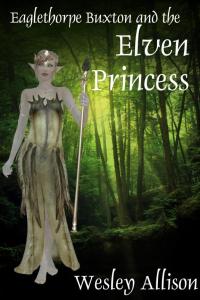
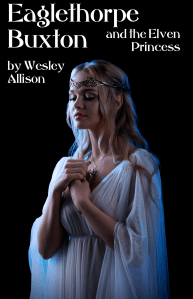
Enjoying the chapters of Eaglethorpe Buxton and the Elven Princess? Can’t wait for the next chapter? Well, Eaglethorpe has a new and revised tenth anniversary edition (two years earl) available for free download. Get the latest, greatest version of Eaglethorpe’s first adventure. Download free at Smashwords.
Category Archives: Eaglethorpe Buxton
Eaglethorpe Buxton and the Elven Princess – Chapter 8
I put away my knife and then climbed back into the saddle. The orphan had regained his feet and I reached down, took his hand, and lifted him back into his spot behind me. He reached around my waist and held on tight.
“Thank you,” he said.
“All is well,” said I. “A few goblins are no match for a trained warrior.”
“Then how did they manage to prevent Prince Jared from becoming the King of Aerithraine? Did they catch him asleep and murder him?”
“One might have supposed that, under ordinary circumstances.” I continued my story. “These times were not ordinary. Goblins are not only small and stupid and smelly; they are disorganized. But every once and so often, there comes along a goblin who is big enough and just smart enough to unite the goblin tribes and lead them on the warpath against the civilized lands of humans.”
“I had always heard that none of the human lands were truly civilized,” said he.
“What an odd and unorphanish thing to say.”
“Um… oh. I’m just discombobulated from the incident with the goblins.”
“Even so,” I agreed. “Well, at the time my story takes place, there was one such goblin king, who came to power by killing and eating his many rivals. And as happens when the goblins become unified in such a way, they experienced a population explosion. The mountains of the Goblineld were teaming with the little blighters. When the mountains could no longer contain them, they swept out across the southern third of the Kingdom of Aerithraine, destroying everything in their path.”
“Frightening,” said the orphan.
“Quite frightening.”
“Still…”
“Still what?”
“Humans are so large and goblins are so small. You vanquished three pairs of goblins, and did it quite handily too.”
“Thank you.”
“And you don’t seem particularly skilled or particularly bright.”
“What?”
“I just wonder that an entire human kingdom could not put together an army to destroy even a large horde of goblins,” said the orphan. “I would imagine that even a well-trained militia could do the job. I once heard the story of the Calille Lowain who held off five thousand goblins at Greer Drift.”
“I don’t know that story,” said I.
“Perhaps I will tell it to you sometime,” said he. “But what about it? Couldn’t the humans defeat the goblins?”
“There were tens of thousands of them. Hundreds of thousands. Thousands of thousands. But you are right. In other times, such hordes were sent packing, back to their mines and tunnels in the Goblineld. This time though, the goblins had a hidden ally. Far to the east, the Witch King of Thulla-Zor, who is always looking for ways to cause destruction and chaos, saw this as an opportunity. He supplied the goblin king with magic and weapons, and sent trolls and ogres to strengthen his ranks. None of these facts were known to King Justin when he rode forth with the Dragon Knights to meet them.
“King Justin, his three younger sons, and all of the Dragon Knights were slaughtered—to a man. Prince Jared, who had been in the north fighting sea raiders, hurried his forces south, only to meet a similar fate. The goblins were waiting for him. The entire southern third of the kingdom fell— and remained in the goblins’ filthy little hands for almost twenty years. And the Goblin King feasted on the spoils of war, sitting on his throne far below the surface of the mountains, drinking his disgusting goblin wine from a cup made from the skull of King Justin.”
“How horrible,” murmured the orphan.
“Yes indeed,” I continued. “And I think the worse part of the story is what happened to Queen Beatrix.”
“What happened to her?”
“She died. She died of a broken heart. And her unborn child almost died with her.
“Unborn child? It didn’t die?”
“No, the court physician cut the child from the Queen’s belly. It was a tiny baby girl.”
“Queen Elleena!” snapped the orphan.
“She should have been,” said I.
“What do you mean?”
“She should have been Queen the moment she was birthed, but that wasn’t to be. There were too many competing interests at court. Too many nobles wanted the throne for themselves. And in the chaos that followed the fall of the south lands, they might have done it, had it not been for the church. Little Princess Elleena Postuma was whisked off to the temple in Fall City, where she stayed for the next fourteen years, and Pope Bartholomew became the regent of the kingdom.”
“Did they keep Elleena prisoner in the temple?” wondered the orphan.
“Of course they didn’t,” said I. “Though I will wager she sometimes felt that she was in a prison. She could go anywhere she wanted to as long as she stayed in Fall City and under constant protective guard. In the meantime she was given all the training and education that was necessary for one who would one day rule.”
“It is like prison,” said the orphan.
“Neither you nor I will ever really know the truth of that.”
At that moment, I spied a light in the distance. The story, or at least this chapter of the story over, conversation ceased. I urged Hysteria forward, which is to say I encouraged her onward toward the distant light, which turned out to be a small cabin on the side of the road. Yellow light spilled from its tiny windows onto the snow.
Not having had the best of luck so far that night with regard to welcomes, which is to say that I had been attacked three times already that night, two times of which I have already described for you here, I dismounted and crept around to the side of the cabin to the window and peered inside. Lying on the floor in a pool of blood was a man in common work clothes. The single room of the little cabin had been ransacked. And dancing around, or sitting and singing, or drinking were more of the little, round-headed blighters, which is to say goblins.
Eaglethorpe Buxton and the Elven Princess – Chapter 5
“You said that you do not live far from here,” I mentioned, once we had finished the pies. One might say the purloined pies, but I would not. I would instead insist that they rightly belonged to us in recompense for our unjust confinement.
“That is correct,” said he.
“The pies rightfully belong to us?”
“No. I live not far from here. Are you carrying on some other conversation in your head about the pies?”
“Of course not,” I replied. “You are an orphan.”
“I am well aware of that fact. There is no need to keep rubbing it in my face.”
“What I mean is you don’t have a proper home anymore now that you are an orphan.”
“Even an orphan may have extended family,” he explained. “Perhaps I live with them.”
“Do you?”
“One might suppose that I do.”
“One might suppose a great many things,” said I. “But would it not be better to base our future activities less on supposition than on actual remembrances?”
“One might suppose we should,” said he.
“You have an odd way of talking,” I commented. “You don’t quite sound orphanish at all.”
“Really? How many orphans have you known?”
“Quite a few actually,” I revealed. “The Queen of Aerithraine…”
“With whom you once had the pleasure of spending a fortnight.”
“Indeed it is so. The Queen of Aerithraine, with whom I once had… well, she has a soft spot for orphans. Some years back she opened an orphanage called Elleena’s House.”
“Is that because her name is Elleena?”
“Why would her name cause her to have a soft spot for orphans?” I wondered. “No, I believe it is because she was an orphan herself.”
“No. Is it called Elleena’s House because her name is Elleena? And how could a queen be an orphan? Doesn’t she have to be a princess? Or did the King find her in an orphanage and come to sweep her off her feet? That would be a lovely story.”
“Well, there is no king,” said I.
“Gah!” he exclaimed. “You are the worst storyteller in the world. You are messing everything up and making me confused.”
“Forsooth! I am the best storyteller in the world. I do not expect you to know so, as you are an unfortunate orphan without any knowledge of the world.” I looked over my shoulder at his pinched little face. “In truth I was not trying to tell you the story of the Queen of Aerithraine. If I had, you would be filled with wonder and excitement. I have made half my fortune from that story, and a better story, a truer story, a more profound story; you are not likely to hear in all the days of your life. But I was not trying to tell that story. I was trying to explain that the Queen of Aerithraine has a soft spot for orphans. In fact, I suppose that I do so myself, as I am almost an orphan.”
“You are almost an orphan?”
“Indeed.”
“How can you be almost an orphan?”
“Why couldn’t I be?” I demanded. “If anyone can be, I could be.”
“What I mean is…” He took a deep breath. “How can one be almost an orphan?”
“Oh. Well, it’s only that my parents aren’t dead.”
“I see,” said he.
“But they were kidnapped,” I confided.
“Are you sure they didn’t just run away?” he asked.
“It was a stormy night and I had been away from my parents’ home, which is to say my former home, which is to say Cor Cottage just outside Dewberry Hills, and I was returning for a visit. As I approached I heard a disturbance, though at first I attributed it to the sounds of the storm. Then I looked up at the cottage window to see figures silhouetted on the shade, locked in a grim struggle.”
“What did you do?”
“Why, I rushed forward to aid my poor old mother, who as I recall smells of warm pie, and my poor old father, and my sister Celia, and my aunt Oregana, and my cousin Gervil, and my other cousin Tuki, who is a girl cousin, which is to say a cousin who is a girl, which makes sense, because whoever heard of a boy named Tuki.”
“They were all struggling by the window?”
“They may all have been struggling by the window, or some of them may have been, or perhaps only one of them was struggling by the window. I don’t know, because when I burst in through the front door, they were all gone. The back door was open wide and the rain was splashing in.”
“What happened to them?”
“I know not.”
“Were there any clues?”
“Indeed there were.”
“What were they?”
“The table had been set for nine, which was two places too many.”
“Three places!” said the orphan triumphantly. “You thought I wasn’t paying attention. There was your father, mother, sister, aunt, and two cousins. That makes six.”
“They would also have set a place for Geneva.”
“Of course they would have. Who is she?”
“She’s my other cousin, which is to say Gervil’s sister, only she’s imaginary, but she wasn’t always imaginary, which is to say she died, but Gervil still sees her, so Aunt Oregana always sets a place for her.”
“What other clues?”
I listed them off. “There was a knife stuck in Gervil’s bed. Floorboards had been loosened in several rooms. There were drops of purple liquid leading out the back door. And someone had hung bunches of onions from the rafters of the dining room. Most mysterious of all was the fact that the tracks led away from the house only fifty feet and then disappeared entirely.”
The orphan gripped me around the waist and squeezed. “How terrible,” he said, in a tiny voice.
Eaglethorpe Buxton and the Elven Princess – Chapter 4 Excerpt
When we were not two hundred yards down the road, I let Hysteria drop to a trot, for in truth I did not expect anyone to follow us into the night, daring wild animals, bandits, or hobgoblins regardless of how fine a piesmith Mistress Gaston was reported to be. A few hundred yards beyond that, my horse dropped of her own accord to a walk and I expect she was beginning to feel a bit mopey because of the slap the orphan had dealt her. At that moment I was less interested in her mental condition than my own physical one though, because I was holding a cast pie pan in each hand and they were both heavy and still quite warm.
“Here.” I turned in the saddle and handed one pie to the orphan. “We can eat while we ride. If we wait until we find a campsite, the pies will be cold.”
“Do you have a fork?” the boy asked.
I mused that this seemed an unlikely request from any boy, most of whom I have found uninterested in tableware on the best occasion, and especially from an orphan whom one might have supposed to have been forced by necessity to dig into all manner of food scraps with his hands. However it was not a question to which I needed reply in the negative, for I always carry my fork in the inner left breast pocket of my coat, which I call my fork pocket. I gave the orphan my fork and pulled my knife from my boot to use on the remaining pie.
“This is a very nice fork,” said the orphan.
“Of course it is,” said I. “That fork came from the table of the Queen of Aerithraine herself.”
“You stole this fork from a Queen?”
“Impudent whelp!” cried I. “That fine fork was a gift from the queen, with whom I once had the pleasure of spending a fortnight.”
“What kind of queen gives a man a fork?”
“A kind and gracious one.”
That apparently satisfied the boy’s curiosity for the moment and for the next few minutes we concentrated upon the pies. I am not one to mourn a lost pie and that is well, for the pie that was lost to me on that night, as I have previously mentioned, was a pie for the ages. A fine pie. A beautiful pie. A wonderful pie. This new pie was almost as good though. It was a crabapple pie, which was a common pie to come upon in winter in those parts, which is to say Brest, as cooks used the crabapples they had put up the previous fall. This pie was an uncommonly good pie, with nutmeg and cinnamon and cloves and butter. I had more than a few bites by the time the boy spoke again.
“What kind of pie is that?”
“Crabapple,” I replied. “What pie do you have?”
“It is a meat pie.”
“A meat pie,” I mused, as I thought back upon how long it had been since I had eaten any other meat than venison. I had eaten a sausage a week before, but it had been a fortnight and half again since I had eaten mutton stew with potatoes and black bread in Hammlintown. That had been a fine stew and the serving wench who brought it to me had been nice and plump with the top two buttons of her blouse undone and she had smiled quite fetchingly when she had set down the tray. Stew is a wonderful food and even when it is not served by a nice, plump serving wench with the top two buttons of her blouse undone. It always seems to give me the same feeling when I eat it that a nice, plump serving wench with the top two buttons of her blouse undone gives me when I see her.
“What are you doing now?” asked the orphan.
“Pondering stew,” said I.
“Well stop it. Rather ponder this instead. You eat half of your crabapple pie and I will eat half of my meat pie. Then we can trade and eat the other halves of each others pies.”
“All right,” I agreed. “But this will mean that I have to eat my dessert first and my supper after.”
“Just pretend that the meat pie is your dessert and the crabapple pie is your supper.”
“A crabapple pie could be a fine supper. In fact I have been to countries where the most common part of a supper is crabapple pie.”
“Fine then.”
“But a meat pie is in no country a dessert.”
“Then trade me now.”
“How much have you eaten?” I asked.
“About a fourth. How much have you eaten?”
“About a fifth.”
“Then eat another twentieth,” said he. “Then we will trade pies and each eat two thirds of what remains and then trade them back. At that point, we will each eat what remains of the pie we originally started with. That way you can think of the first portion of the crabapple pie as an appetizer, the portion you eat of the meat pie as your supper, and the final portion of the crabapple pie as your dessert.”
“You are a fine mathematician for an orphan,” said I. “But it suits me. Will it not bother you that your appetizer and your dessert are of meat pie and your supper is of crabapple pie?”
“I have decided that I will make this sacrifice,” said he. “Since it was you that provided the meal.”
Eaglethorpe Buxton and the Elven Princess – Chapter 3
I pulled the boy out through the hole that I had created and into the deep snow that had formed in a drift beside the shack. He almost disappeared, as he couldn’t have been more than four foot ten.
“Grab the back of my belt,” said I. “I will guide you. The first thing we must do is find my noble steed.”
“The stable is on the other side of the Inn, just beyond the cart path.”
“Very good. Come along. I am sure that the noise of our escape was heard and any moment I may have to fight off a dozen or so angry villagers with pitchforks and such.”
“Do you have a weapon?” asked the boy.
“I have a knife in my boot, but I would be loath to stick it into a person over such a thing as this.”
“They deserve it,” said the boy, now trailing along behind me as I negotiated my way around the buildings in the gloomy night. “If my father was here, he’d lay waste to this town.”
“Quite the fierce cobbler was he?”
“Um… yes. Before he died…leaving me an orphan.”
I trudged through the snow around the large building that I now knew was the inn and crossed the cart path, distinguishable from the rest of the landscape by two parallel ruts in which the snow was not quite as deep as everywhere else. I perceived no danger from any direction and indeed could still hear the voices of men and women singing in the inn. The stable, which I would have recognized even without the orphan’s help, was dark and silent. The pleasant aroma of horse dung enveloped me as the slight breeze turned in my direction. I crept up to the large double door and pulled one side open slightly.
“Hysteria,” I called in a whisper and was answered by a gentle knicker, which is to say the sound that horses make when they are neither angry nor excited nor otherwise engaged.
Inside the stable was pitch black, and I cast around for a lantern, but the lad needed no such artifice.
“I see your horse in the last stall,” said he.
“You have very good night vision, orphan,” said I.
The little ragamuffin guided me by the hand to the far stall and by the time we arrived there I could make out the more prominent shapes including that of Hysteria, which is to say my horse, who tossed her head in greeting.
“Poor girl,” said I, running my hands over her. “They didn’t even bother to unsaddle you or remove your bit and bridle.”
“All the better for us and our escape,” said the boy.
I led Hysteria out of the stall, through the dark of the stable, and into the lesser dark of the night. It was in fact, quite a good night for traveling, at least as far as light was concerned. The moon was reflected off the white snow, and though the ghostly illumination created monsters of the many gaunt and gnarled trees, they were easily negotiated through. This put me in mind of a number of similar nights, when the moon was shining upon the snow. It seems somehow unfair that I more than most find myself sneaking in or out of town on cold, dark nights. I am not one to complain about my lot in life though. Then at that moment, as if to remind me that the lot of others was worse than my own, the boy tugged at my sleeve.
“What are you doing?” said he.
“I am pondering life,” I replied.
“Can you ponder life once we’ve made our escape from this wretched town?”
“Quite so,” said I, placing my foot in the stirrup. Once I was in the saddle, I reached down for my charge. “Come along orphan.”
“In some circles it might be considered rude to keep calling me an orphan,” he opined.
“Your parents are dead and so you are an orphan,” said I, lifting him up to sit behind me. “If I call you something else, your parents will still be dead.”
“Even so,” he agreed. “Let us get out of here.”
“Not until we make this town pay for its injustice and our indignities,” said I.
I spurred Hysteria forward, though truth be told I did not spur her precisely because I do not wear spurs. Spurs seem unnecessarily mean and pointed and Hysteria is possessed of something of a fragile ego. If one speaks harshly too her, she is likely to go into a mope for weeks on end and jabbing her haunches or belly with pointy metal objects could send her into a serious downward spiral of depression. It would be a sad thing to see. So I encouraged her forward. I urged her forward. I coaxed her forward. I asked her to go forward and she went forward, which now that I think about it, is the direction that she is usually most likely to go.
I guided her through the snow, across the cart path, and around the corner of the inn to the spot where upon I had first been laid hold of. I fully expected that the pie I had originally seen would by now be gone. As cold as the weather was, the pie would have gone from hot to warm to cool to quite cold in the time that I had spent escaping from the shack and rescuing my valiant steed, which is to say Hysteria. I was not wrong. The pie was gone. But Ho! There were now two new pies sitting on the very same window ledge.
Sitting astride Hysteria as I was, the pies were now at a level between my shoulder and my waist, and I could easily look inside the window. A fat woman with red cheeks and red hair and wearing a white apron was rolling out dough with a rolling pin. She was too busy to notice me. That was not the case with the stout fellow who at that moment entered from the common room beyond. He caught sight of me and let out a yell that could have, and in fact did, summon everyone in the place. The sounds of singing stopped as others rushed to see the source of his consternation.
“Let this be a lesson to you not to waylay innocent travelers!” I shouted, scooping up the pies, one in each hand. I urged Hysteria onward, but no doubt feeling the warm air exiting the window, she was loath to move. The orphan fixed that by slapping her on the backside, her fragile ego notwithstanding. She jumped and shot around to the front of the inn just as the gang of toughs from inside came out the front door. They were just in time to watch us race off into the darkness with two warm and steamy pies.
Eaglethorpe Buxton and the Elven Princess – Chapter 2
“I am not a pie thief,” said I, waiting for my eyes to adjust to the limited light of the little room. “If anything, I am a procurer of pies to be paid for at a later time, which is to say an eater of pies on account.”
“I don’t judge you,” said the little voice from the dark corner. “After all, am I not incarcerated for the same crime? It may well have been the same pie that I attempted to steal earlier in the evening that you tried to…”
“Check for doneness,” I interrupted.
“Steal.”
“Taste test.”
“Steal.”
“Borrow.”
“Steal.”
“For someone who doesn’t judge, you seem quite judgmental to me,” I opined. “And if self control did escape me for a moment, could I be blamed? Here am I, a cold and weary traveler from a far land, cold to the bone and hungry. And there sits a pie, and not just any pie, but a pie for the ages, sitting as if waiting especially for me, on the window ledge.”
“Mistress Gaston is an excellent piesmith.”
“I shall have to take your word for that,” said I, starting to make out the form of a child. “And what is it they call you, lad?”
“I am called Galfrid.”
“Come out of the corner and let me have a look at you.”
“Promise me that you won’t hurt me,” said he.
“All the country knows the name of Eaglethorpe Buxton and it knows that he is not one to harm children or ladies, nor old people or the infirm. Rather he is a friend to those who are in need of a friend and a protector to those who are in need of a protector and a guardian to those who are in need of a guardian.”
“So long as it is not a pie that needs guarding,” said he.
“Pies are something altogether unique. Pies are special, which is to say they are wonderful, but not rare. No, indeed they are common, but that does not make them worthless. Quite the contrary. Life is quite like a pie, at least in-so-much-as a life lived well is like a pie—warm and delicious on the inside with a protective crust on the outside. There are places in the world where pies are worshiped.”
“No.”
“No what?”
“There is no place in the world where pies are worshipped.”
“That is not worshipped, but revered as one might revere the saints.”
“No.”
“Far to the east of here, in the city of Bertold, in the land of Holland, they revere pies.”
“No. There is no city of Bertold in Holland and nowhere east of here do they revere pies.”
“You are a saucy child,” said I. “And if they do not revere pies east of here, then I should not like to travel in that direction.”
“So are you implying that you are this Englethorpe Boxcar and that I therefore have nothing to fear from you?”
“Eaglethorpe, with an A instead of an N, and Buxton, with an X and a ton, and yes, I am he and you have nothing to fear. Though to be sure there are plenty who would claim the name of Eaglethorpe Buxton, with and E not an N and an X and a ton, because greatness will ever have its imitators.”
“So you might well be an imposter,” said he.
“You may rest assured that I am not,” said I.
“But if you were an imposter, would you not insist that you were not an imposter?”
“You may be sure that I would.”
“Then how can I trust that you are the real Englethorpe Boxcar?”
“Just look at me!” I exclaimed, throwing my arms out and giving him a good look.
“Swear that you will not harm me,” said he. “And furthermore, swear that you will be my protector and guardian until I can return to my home?”
“How far away do you live?”
“Not far.”
“I swear to be your protector and guardian until you reach your home, though it be on the far side of creation,” said I. “Now come closer and let me get the measure of you.”
The lad crept forward until he stepped into a beam of moonlight shining through a space between the boards of the shack wall. He was a slight little ragamuffin, with a build that suggested he had not eaten in some time. He had a dirty face and wool cap pulled down to his eyes. His clothes were dirty and torn, but I immediately noticed that his shoes while dirty, seemed too fine for a ragamuffin such as this. I asked upon them.
“You see, Sir Boxcar, my parents were, um… cobblers… but they died, leaving me a destitute and lonely orphan child. These shoes were the only things they left me.”
“May they rest in peace,” said I, whipping off my cap, which is only proper courtesy to offer, even if one is only offering it to an orphan. “But on to the situation at hand. I see that you are a sturdy boy, despite your condition. Why did you not bust out of this shack? It looks as though it would take no more than a couple of kicks.”
The lad stared at me with his mouth open, obviously chagrined that he had not thought of this means of escape himself. “Yes,” he said at last. “I am a sturdy… boy…. but I think you will find the shack is sturdier than it looks. It is hammered together with iron nails.”
I turned and leveled a kick at the side wall through which crack I had but a moment before been peering. One of the boards flew off, landing in the snow six or seven feet away and leaving an opening almost big enough for the boy to pass through. I kicked a second board off the side of the structure and I was outside in a jiffy. Turning around, I reached through to aid my companion’s escape.
“Come along orphan,” said I.
Eaglethorpe Buxton and the Elven Princess – Chapter 1
There was a pie. There was a pie cooling on the window ledge. Steam was rising up into the frosty air, illuminated by the flickering candlelight coming from within the building. Is there a more welcoming sight? Is there a more welcoming sight for a traveler from a far land, trudging through the cold, dark forest on a cold, dark night, waist deep in snow, frozen to the bone, than the sight of a pie cooling on the window ledge with steam rising up into the frosty air? You don’t have to wonder. I can tell you. There is no more welcoming sight than such a pie. On this night there were sights and sounds and smells, all nearly as welcoming, and they were arrayed around this particular pie like the elements of a fine meal might be arrayed around a very nicely roasted chicken breast. Candlelight flickering through the shutters casting shadows on the snow, smoke rising from the chimneys in a quaint small town, the smell of burning wood and the smell horses just overpowering the smell of pine, the sounds of men and women singing; all welcoming but not as welcoming as pie. I was as happy to see that pie as I was to see the little town in which it cooled on the window ledge.
I should stop and introduce myself. I am Eaglethorpe Buxton, famed world traveler and storyteller. Of course you have heard of me, for my tales of the great heroes and their adventures have been repeated far and wide across the land. Yes, I am sad to say that many of my stories have been told without the benefit of my name being attached to them. This is unfortunate as my appellation, which is to say the name of Buxton and of Eaglethorpe would add a certain something to the verisimilitude of a story, which is to say the truthfulness or the believability of the story. But such is the jealousy of other storytellers that they cannot bear to have my name overshadow theirs. In truth I am probably better known in any case, as an adventurer in my own right than as a teller of the adventures of others. But in any case, there was a pie.
I had been traveling for days through the snowy forests of Brest, which of course one might associate with a nicely roasted breast of chicken, but that is not necessarily the case. To be sure I have had one or two nicely roasted chickens during my travels in this dark, cold country, as I traveled from one little hamlet to the next. I would say though that I’ve eaten far more mutton and beef stew than roasted chicken breast. I suppose this has to do with the fact that eggs are dear, though I’ve seldom found an inn that didn’t offer a scrambled egg on porridge of morning. In fact, in distant Aerithraine, where I was once privileged to spend a fortnight with the Queen, I have had some of the finest breast of chicken dinners than any man has ever enjoyed. But notwithstanding this, there was a pie.
I had trudged through the snow for days, forced to lead my poor horse Hysteria who had taken lame with a stone, through drifts as high as my belt. So I was cold and I was tired. More than this though, I was hungry. And above the smell of pine and frost and people and horses and smoke, there was the smell of that pie. It smelled so very good. It smelled of warmth and happiness and home and my dear old mother. It was a pie for the ages.
I would not steal a pie. I did not steal this pie. Though I have been most unfairly accused of being a thief on one or two or sixteen occasions, I have never been convicted of such a heinous crime, except in Theen where the courts are most unfairly in control of the guilds, and in Breeria which is ruled by a tyrant, and one time in Aerithraine when the witnesses were all liars. So as you can see, I am not one to steal a pie. But being concerned that the pie might be getting too cold, I reached up to check the temperature. It was at this moment that I was laid upon by at least two pairs of rough hands.
“This is a fine welcome for a stranger to your town,” said I.
They called me varlet and scoundrel and dastard and pie thief and tossed me bodily into the confines of a small shack just out behind the structure in which the pie had rested on the window ledge. I looked around in the darkness. It was not true darkness to be sure, because the shack was poorly put together, with wide gaps through which the cold and frosty air entered with impunity. It struck me immediately that it would not be too hard work to bust out of this prison, but I waited and put my eye to one of the cracks to see if my attackers had left and to see if I could spot what they intended for Hysteria my valiant steed, which is to say my horse.
The two ruffians who had attacked me were making their way back to the front of the nearest building and just beyond them I could see one short fellow attempting to lead Hysteria away, though she tossed her head unhappily and pulled at the reigns. I sighed, and could see the steam from my breath forming a little cloud just beyond the confines of the little shack.
“So,” said a small voice, and I turned to peer into the darkened corner of the shack. “They have caught another pie thief.”
Motivations: Eaglethorpe Buxton and the Sorceress
I had finished Eaglethorpe Buxton and the Elven Princess and had a lot of fun writing it. I was still busily trying to find a publisher for Senta and the Steel Dragon, so I decided to spend my free time writing a second Eaglethorpe book.
A few years ealier, I had written a little play, which was performed by the Brown Junior High Drama Club to great success, and I decided that this play had been written by Eaglethorpe. The play involves characters from his world– specifically the parents of the Queen of Aerithraine, so it fit. Incidentally, there were two showings of this play, which went really well, and I taped one of them using a big old VHS camcorder. About two years later, my wife taped over it. I don’t remember what show she taped now.
I was watching lots of Shakespeare at the time I was writing Eaglethorpe and you will see a lot of not so subtle nods to the Bard. The third part of Eaglethorpe (which is in The Many Adventures of Eaglethorpe Buxton) is really a continuation of the story in Sorceress.
Another bit of trivia: In the old D&D game that I played with my kids many years ago, Myolaena, the sorceress in this story, had a sister– Zurfina, whom you’ll recognize from Senta and the Steel Dragon.
Motivations: Eaglethorpe Buxton and the Elven Princess
It was 2009 and His Robot Girlfriend was being dowloaded by the tens of thousands. I had just finished editing The Voyage of the Minotaur and was entering it into the Amazon Breakthrough Novel Contest. (It made it to round two.) So what to write next?
I wanted to do something short and fun and I decided on a fantasy comedy. I had read an enjoyed Lemony Snicket’s Series of Unfortunate Events, particularly the character of Lemony Snicket who is narrator and somehow involved with the characters and frequently hints at things outsidet the story. I decided that my hero would be a story-teller who changed the story to suit himself. Eaglethorpe Buxton was born.
I set the story in (sort of) the world I had created for my D&D campaign. My kids still have fond memories of some of the settings in which the stories take place and even met some of the characters when they played– notably Queen Elleena of Aerithraine. I had a lot of fun writing EBEP and many people have written to tell me that they like him. I’ve heard a few negative comments too, but that’s okay.
The book is very short and was always intended as a freebie, but there are a very few paperback copies around.
TMAO Eaglethorpe Buxton
Ellwood Cyrene is Eaglethorpe Buxton’s best friend. He is more or less right out of my old D&D campaign. He is rather overaffectionate toward Eaglethorpe, and the latter constantly has to remind himself of how manly they both are. Of course, Ellwood has a big secret, and the discovery of that secret leads Eaglthorpe through a series of adventures.
Ellwood is the only character that is actually from the D&D game I ran for my children when they were growing up. The world of Eaglethorpe is the world of that game, but Eaglethorpe and all the others, aside from Ellwood, were made up for the stories.