
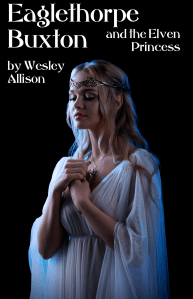
Eaglethorpe Buxton and the Elven Princess – Chapter Seven

Chapter Seven: Wherein my story is interrupted by goblins, thereby explaining why it might not seem as good as it really was.

Goblins are nasty little blighters.  They remind me of my cousin Gervil’s friend called Rupert.  His name was Sally, which explains why he was called Rupert.  But like goblins, he was short and had a big, round head.  I don’t know why goblins have such large heads for their little bodies. Of course I don’t know why Rupert did either.  There doesn’t seem to be much advantage in it.  On the other hand, goblins have excellent night vision, making it very easy to sneak up on people in the dark.  And they have abnormally large mouths with an abnormally large number of teeth in them. This was very unlike Rupert, which is to say Sally, who as I recall had only five or six teeth, though he made up for that by having an extra toe.  In addition to which I don’t believe his night vision was all that it might have been, for once he kicked me in the head when he was on his way to the outhouse. Of course that could have been on purpose.  Rupert was a bit of a nasty blighter too.

“What are you doing?” asked the orphan, as Hysteria took a step back.

“Thinking about a fellow called Rupert,” said I.

“Well stop it, and get us away.”

I said that Hysteria took a step back, but I should have said that she took two steps back, one on each side.  I could tell she didn’t want the foul little creatures around her feet. She’s very particular about her feet, as most horses are wont to be.  As they approached still nearer, she reared up a bit—not enough to bother me, but just enough for the orphan to slip off her haunches and land with a poof on his seat in the snow.  The goblins cackled grotesquely and I’m sure that they thought they had secured for themselves a snack.  They stopped laughing though when I kicked my leg over Hysteria’s shoulder and dropped lightly to the ground.

With a quick motion, I pulled my knife, still stained red from crabapple pie, from my boot.  It was a small enough weapon to face off six attackers and I would have much rather had a sword, but I had been forced to sell my sword in order to get a fellow out of prison.  I didn’t really know him, but he was the beloved of a poor but beautiful farm girl. In retrospect it would have been better if he had not turned out to be a werewolf, but that is another story.  If I ever write this down, maybe I’ll say that I sold it to get the poor but beautiful farm girl out of prison and that I slew the werewolf.  Yes, that’s a much better story.

“What are you doing?” asked the orphan.

“Recalling the time I slew a werewolf,” said I.

“Finally something useful!” he exclaimed.

The two foremost goblins looked at one another.  While six or seven goblins might sneak up on a man when he was asleep, or might chase down a maiden who was alone and defenseless, they would have to be extraordinary members of their species to take on a seasoned warrior with a weapon.

“That’s right potato head!” shouted the orphan, jumping to his feet. “Werewolves, vampires, giants; he’s killed them all.

“Gree yard?” said the first goblin.

“Grock tor,” said the second goblin.

“I don’t think they understand us,” said I.

The first began to skirt around me to the right and the second began to skirt around me to the left.  The others were following along.  I don’t know whether their intention was to surround me so that they could attack from all sides at once, or to get by me and get at the boy, but I wasn’t going to let either of those things happen.  I took a quick step to the right and kicked the big round head of the first goblin, which flew almost as far as the kickball I kicked as a child, and of course the rest of the goblin went right along with his head.

As a child, kickball was one of my favorite pastimes.  We had our own little team and I was almost always the bowler. Sally and Gervil and several other boys made up the outfield.  Tuki played first, second, and third base.

“Look out for the other one!” the orphan cried, interrupting my fond memories.

I twisted around to my left and kicked the head of the second goblin, sending it in a lovely arc off into the forest.  If my first kick had scored a double, which is to say a trip to second base, then this kick must surely have been a triple.  And I would dare Tuki to say that either of those goblin’s heads went out of bounds.

“Look out!” the orphan shouted again.

I turned to give him a dirty look and saw a third goblin who was attempting to use the distraction of his fellows, which is to say their current use as substitute kickballs, to slice my Achilles tendon with a rusty old razor.  With a quick jab, I thrust the point of my knife into his head and he dropped to the ground—dead.  When I looked back around, the other goblins had wisely run away.

Eaglethorpe Buxton and the Elven Princess – Chapter Six

Chapter Six: Wherein I begin to tell the story of the Queen of Aerithraine.

Hysteria clomped along slowly down the snow-covered road for some time.  The orphan was so quiet that for a while I thought he must have fallen asleep.  But at last he stirred and shifted a bit in his seat, which is to say upon Hysteria’s flank.  I myself had been quiet as I remembered the events of that horrible night.

“What are you thinking about?” asked the orphan.

“I’m thinking about that horrible night,” I replied.

“Did you never find your family?”

“No, though I searched for weeks.  My mother was to make me a blueberry pie that night, and I not only have never seen my mother since, I did not get to eat that pie either.”

“I’m sorry I brought up such a painful memory,” he said, and then paused. “Do you suppose that the purple drops on the floor could have been from your blueberry pie?”

“Fiends!” said I.  “To rob a man of his mother and his pie in the same night!”

“Perhaps it were best that we think on something else,” said he.

“Perhaps,” I agreed.

“If you are really such a great storyteller…”

“The greatest in the world.”

“And if the story of the Queen of Aerithraine is a great story…”

“Wonderful.  Exciting. True.  Profound.”

“Well, maybe you could tell me the story.”

“I get half a crown for that story in Illustria,” said I.

“I have a shiny penny,” said he.

“The story begins in Aerithraine, far to the west, along the coast of the great ocean sea.  From storied Illustria, its capital, to Cor Cottage just outside Dewberry Hills in River County, Aerithraine has been a great and powerful country for some seven hundred years more or less.  By more or less, I mean that it has been more or less seven hundred years that Aerithraine has been a country and that it has been more or less great and more or less powerful during those seven hundred years.  But about fifty years ago, it was less.  That was when the old king died, and as is the way of kings, a new one was crowned.  He was King Julian the Rectifier.

“He was called Julian the Rectifier because he was chiefly interested in rectifying.  He spent most of his time rectifying.  He rectified all over the place.  And he was good at it.  He rectified like nobody else.”

“It means setting things to right,” said the orphan.

“Of course it does and that is just what he did.  Under his reign, the kingdom was prosperous and wealthy.  And, as he wasn’t so interested in warring as in rectifying, there was peace throughout the land.  King Julian had only one son, and he passed to that son the strongest and wealthiest kingdom in all of Duaron, and if it had only remained so, Elleena would have become nothing more than a minor princess perhaps.”

“Which would not have made a half-crown story,” pointed out the orphan.

“That is so.”

“Carry on then.”

“King Justin was the son of Julian.  I hear tell that he was once called Justin the Good and Justin the Wise, though now when storytellers refer to him, they usually call him Justin the Weak or Justin the Unready.”

“What do you call him?”

“I just call him King Justin,” said I.  “Though I truly believe he may deserve the title Justin the Brave, it is not what the listeners want to hear.”

“Go on.”

“King Justin married a princess from the faraway land of Goth.  The Arch-Dukes of Goth, which is to say the rulers of that land, have for generations, maintained power through a tightly woven web of treaties with its mighty neighbors.  Their chief barter in this endeavor is the marriage of the many female members of the family.  I hear the current Arch-Duke has but four daughters at least as of yet, but his father who was Arch-Duke before him had seventeen, and his father, which is to say the grandfather of the current Arch-Duke had nineteen.”

“That hurts just thinking about it.”

“What?”

“Nothing.  Go on.”

“It must have been quite a coup of diplomacy for the Arch-Duke of Goth to make a match with the King of Aerithraine, but he did, marrying to the King his daughter Beatrix.  And though I hear that the women of that country wear too much make-up, she was nevertheless accounted a great beauty.  She had pale white skin, raven hair, smoldering eyes, and a gold ring in her nose, as is the fashion in the east.

“King Justin and Queen Beatrix had four strong sons, the eldest of whom was Prince Jared.  He was particularly beloved of the people.  I saw him once when I was a child of four or five, sitting on my poor old father’s shoulders as the Dragon Knights passed on their tall white steeds. That is to say, I was seated on my father’s shoulders and the Prince was not.  Neither were the Dragon Knights nor their steeds.  I don’t remember why the Prince and the knights were in River County. It was too long ago.  He would have grown to be King upon his father’s death if it was not for…”

“Goblins!”

“Yes, that’s right.  You didn’t say you had heard the story before, though I’ll warrant it wasn’t told as well…”

“No!” screamed the orphan.  “Goblins! Right there!”

He pointed straight ahead, and sure enough, stepping out of the shadows and into the moonlight were a half dozen creepy little man-things. They were no more than three feet tall, their over-sized round heads, glowing eyes, and gaping maws giving away their identity.  As they came closer those mouths widened into grins filled with jagged little teeth, looking far too much like the teeth on the blade of a cross-cut saw for my taste. They brandished what weapons they had, mostly things they had picked up from the ground—a stick, a length of cord with a knot in it.  But a couple of them carried old, discarded straight razors.

Eaglethorpe Buxton and the Elven Princess – Chapter Five

Chapter Five: Wherein I reveal the mystery of my family.

“You said that you do not live far from here,” I mentioned, once we had finished the pies.  One might say the purloined pies, but I would not.  I would instead insist that they rightly belonged to us in recompense for our unjust confinement.

“That is correct,” said he.

“The pies rightfully belong to us?”

“No.  I live not far from here.  Are you carrying on some other conversation in your head about the pies?”

“Of course not,” I replied.  “You are an orphan.”

“I am well aware of that fact.  There is no need to keep rubbing it in my face.”

“What I mean is you don’t have a proper home anymore now that you are an orphan.”

“Even an orphan may have extended family,” he explained.  “Perhaps I live with them.”

“Do you?”

“One might suppose that I do.”

“One might suppose a great many things,” said I.  “But would it not be better to base our future activities less on supposition than on actual remembrances?”

“One might suppose we should,” said he.

“You have an odd way of talking,” I commented.  “You don’t quite sound orphanish at all.”

“Really?  How many orphans have you known?”

“Quite a few actually,” I revealed.  “The Queen of Aerithraine…”

“With whom you once had the pleasure of spending a fortnight.”

“Indeed it is so.  The Queen of Aerithraine, with whom I once had… well, she has a soft spot for orphans. Some years back she opened an orphanage called Elleena’s House.”

“Is that because her name is Elleena?”

“Why would her name cause her to have a soft spot for orphans?”  I wondered.  “No, I believe it is because she was an orphan herself.”

“No.  Is it called Elleena’s House because her name is Elleena?  And how could a queen be an orphan?  Doesn’t she have to be a princess?  Or did the King find her in an orphanage and come to sweep her off her feet? That would be a lovely story.”

“Well, there is no king,” said I.

“Gah!” he exclaimed.  “You are the worst storyteller in the world.  You are messing everything up and making me confused.”

“Forsooth!  I am the best storyteller in the world.  I do not expect you to know so, as you are an unfortunate orphan without any knowledge of the world.”  I looked over my shoulder at his pinched little face.  “In truth I was not trying to tell you the story of the Queen of Aerithraine.  If I had, you would be filled with wonder and excitement.  I have made half my fortune from that story, and a better story, a truer story, a more profound story; you are not likely to hear in all the days of your life.  But I was not trying to tell that story.  I was trying to explain that the Queen of Aerithraine has a soft spot for orphans. In fact, I suppose that I do so myself, as I am almost an orphan.”

“You are almost an orphan?”

“Indeed.”

“How can you be almost an orphan?”

“Why couldn’t I be?” I demanded.  “If anyone can be, I could be.”

“What I mean is…”  He took a deep breath.  “How can one be almost an orphan?”

“Oh.  Well, it’s only that my parents aren’t dead.”

“I see,” said he.

“But they were kidnapped,” I confided.

“Are you sure they didn’t just run away?” he asked.

“It was a stormy night and I had been away from my parents’ home, which is to say my former home, which is to say Cor Cottage just outside Dewberry Hills, and I was returning for a visit.  As I approached I heard a disturbance, though at first I attributed it to the sounds of the storm.  Then I looked up at the cottage window to see figures silhouetted on the shade, locked in a grim struggle.”

“What did you do?”

“Why, I rushed forward to aid my poor old mother, who as I recall smells of warm pie, and my poor old father, and my sister Celia, and my aunt Oregana, and my cousin Gervil, and my other cousin Tuki, who is a girl cousin, which is to say a cousin who is a girl, which makes sense, because whoever heard of a boy named Tuki.”

“They were all struggling by the window?”

“They may all have been struggling by the window, or some of them may have been, or perhaps only one of them was struggling by the window.  I don’t know, because when I burst in through the front door, they were all gone.  The back door was open wide and the rain was splashing in.”

“What happened to them?”

“I know not.”

“Were there any clues?”

“Indeed there were.”

“What were they?”

“The table had been set for nine, which was two places too many.”

“Three places!” said the orphan triumphantly.  “You thought I wasn’t paying attention.  There was your father, mother, sister, aunt, and two cousins. That makes six.”

“They would also have set a place for Geneva.”

“Of course they would have.  Who is she?”

“She’s my other cousin, which is to say Gervil’s sister, only she’s imaginary, but she wasn’t always imaginary, which is to say she died, but Gervil still sees her, so Aunt Oregana always sets a place for her.”

“What other clues?”

I listed them off.  “There was a knife stuck in Gervil’s bed.  Floorboards had been loosened in several rooms.  There were drops of purple liquid leading out the back door.  And someone had hung bunches of onions from the rafters of the dining room.  Most mysterious of all was the fact that the tracks led away from the house only fifty feet and then disappeared entirely.”

The orphan gripped me around the waist and squeezed.  “How terrible,” he said, in a tiny voice.

Eaglethorpe Buxton and the Elven Princess – Free

Eaglethorpe Buxton, famed adventurer and story-teller, friend to those in need of a friend and guardian to those in need of a guardian. He is a liar and braggart, not to be trusted, especially around pies. Who are we to believe? Buxton himself leads us through his world as he comes to the aid of… a poor orphan? An elven princess? Who can guess with Eaglethorpe himself telling the tale?

Eaglethorpe has revised and edited this manuscript for its tenth anniversary (two years early). Read and enjoy the ultimate edition of Eaglethorpe Buxton’s first adventure.

Download Eaglethorpe Buxton and the Elven Princess free at Smashwords.

Eaglethorpe Buxton and the Elven Princess – Free

Eaglethorpe Buxton, famed adventurer and story-teller, friend to those in need of a friend and guardian to those in need of a guardian. He is a liar and braggart, not to be trusted, especially around pies. Who are we to believe? Buxton himself leads us through his world as he comes to the aid of… a poor orphan? An elven princess? Who can guess with Eaglethorpe himself telling the tale?

Eaglethorpe has revised and edited this manuscript for its tenth anniversary (two years early). Read and enjoy the ultimate edition of Eaglethorpe Buxton’s first adventure.

Download Eaglethorpe Buxton and the Elven Princess free at Smashwords.

Eaglethorpe Buxton and the Elven Princess

Chapter Twenty: Epilog.

Three years after the events in this tale, I was sitting beside the fireplace in the Singing Siren Tavern in the city of Antriador, having just finished telling the tale of Eaglethorpe Buxton and the Elven Princess, when I heard a voice calling out.  “Gah! You are the worst story-teller ever!”

It was Jholiera.  She was no longer dressed as an orphan boy.  Nor was she clad in her leather elven-style princess dress with a leaf motif carved into it, and lots of gold jewelry.  She was dressed as a traveling warrior, with armor carefully tailored to her short and feminine form, and a sword on her back that was nearly as large as she was.  Her golden hair, now almost reaching her waist was styled into dozens of thin braids, each adorned with beads of bone and ivory.  She threw her arms around me and pulled me close in a tight embrace, then released me before continuing.

“You are the worst storyteller ever.  None of that was right—the pies, the goblins, the elves.  None of it happened that way at all.  Only that bit in the Inn with Ellwood Cyrene was remotely true.  And I most certainly did not kiss you.  Not even once.”

“A little romance makes for a better story,” said I.

“I’m surprised you didn’t have me throw myself at you.”

“I had to keep it proper,” said I.  “You were dressed as a boy most of the story.”

“Come here, you great fool,” she said, and taking my face in her small hands, she pulled me down to her eye level and kissed me, this time deeply, on the lips, and with great passion.  It was such a shock that for a moment I couldn’t speak.

“What are you doing now?” she asked.

“I am pondering a new ending to the story.”

“You’re not thinking of making up an ending where I show up in a tavern dressed as a warrior and, taking your face in my small hands, I pull you down to eye level and kiss you, this time deeply, on the lips, and with great passion, are you?”

“Of course not,” said I.  “Perish the thought.”


The End

Eaglethorpe Buxton and the Elven Princess

Chapter Nineteen: Wherein I make an escape, a plot element that I normally wouldn’t reveal, but you know that I am alive anyway because I am telling you the story.

I was given another bowl of the delicious mush, which I ate, this time with more difficulty because my back really ached when I bent over to eat like a dog.  I certainly didn’t sleep though.  Oh you can be sure of that.  I didn’t sleep.  Knowing that you are going on trial in one hour is not nearly the cure for sleepiness that knowing you are to be executed in the morning is.

“Eaglethorpe,” a voice called.

I turned to see Jholiera bathed in the light of the setting sun as it diffused through the trees.  She was no longer dressed as a boy.  She had on a leather dress cut in an elven style with a leaf motif carved into it. It left her shoulders bare and though her form was slight, there was no longer any question that she was a young woman. She had golden jewelry on her arms and a delicate golden crown on her head.

“Eaglethorpe, how are you?”

“I’ve a pretty nasty stab wound in my back, and my arms are aching from them being tied behind me.  I think I skinned my knee when I was trying to eat from a bowl like a dog, but there’s no way to check.  Oh yes, and they are going to kill me in a few hours.  Other than that, I’m fine.”

“Come here, close to the bars.”

I did as directed and she reached through the bars and cut the bands that were holding my wrists together.  My muscles cried out as blood rushed back into them, and a shooting pain went from my back straight into my heart.

“I think I shall die before they have a chance to kill me,” said I. “Serves them right.”

“Don’t say that.  I’m going to get you out of here.”

“How?”

“I’ll be back after midnight.  In the meantime, try to get some rest.”

“You have no idea, girl,” said I, as she went off into the trees.

Remarkably I did sleep this time.  I must have.  I don’t remember falling asleep or even sitting down.  But when I was awakened, by small pebbles hitting against my face, I found myself sitting against the wall of the cave.

“Ow!  Stop it,” said I, as one of the small pebbles hit me in the eye.

“Quiet you,” said Jholiera.  “I’m almost ready to rescue you.  Get over here and wait by the cell door.  You have to be ready at a moment’s notice.”

“Why aren’t you rescuing me now?”

“I don’t have the key yet.”

“You don’t have the key?”

“Calm down.  I’ll be back in a few minutes.”

She did return, but it wasn’t in a few minutes.  It was quite a bit later.  In fact, by the time she did return, I was beginning to fear that the first rays of predawn light might make escape impossible.  But when she arrived, Jholiera did have the key.  She quickly opened the cell door, and taking me by the hand, led me through a maze of trees.  We hurried around massive trunks and over fallen logs, through curtains of trailing vines, until we came to another small glade.  Here was my beautiful steed, which is to say Hysteria.

I can tell you I had a hard time saddling my horse due to my injury.  But with the elven princess’s help, the deed was soon done.  As I prepared to mount, Jholiera stopped me.

“Thank you Eaglethorpe,” she said, and gave me a tender kiss on the cheek.

“You are coming with me, aren’t you?” I asked.  “You can’t live with such a horrible father, or marry such a horrible husband.”

“Don’t worry.  My father is not so bad.  And Iidreiion probably won’t want to marry me anyway after he finds out what I had to do to get the key away from his cousin.  Besides, I’ve had enough adventuring for now.  I just want to stay home and be safe.”

With that she gave me an even tenderer kiss on the cheek.  I climbed into my saddle and took off through the woods, just as the early dawn was beginning to break.  And I didn’t see the little elven princess again.

Eaglethorpe Buxton and the Elven Princess

Chapter Eighteen: Wherein I find out what fate the elves intend for me.

It was well into the morning before I was given a clue as to what was going on. Three new elven men arrived outside the bars of my cell.  I mean that they were new because I hadn’t seen them before, not that they were new because they were newly born.  In fact, they were fully grown though their age was indeterminate, all looking quite youthful.  One had long grey hair while the other two sported long blond locks.  It was the grey-haired elf who spoke to me.

“You are to be tried for the kidnapping of a princess of the elven people,” he said.

“This is a big mistake,” said I.  “I had nothing to do with any kidnapping.  Quite the contrary.  I was helping her return to her home.”

“All the important details will come out in the trial,” he replied.  “Our only purpose at this moment is to introduce ourselves.  I am King Jholhard and I will act as your judge.”

“Well, that’s a relief,” I sighed.  “I know that I will be treated fairly by Jholiera’s father.”

“This is Iidreiion, Jholiera’s betrothed, who will act as the prosecutor.”

I didn’t know what to say to this fellow.  I looked into his face and didn’t see any obvious malice.  Maybe he would simply present the facts as known. I certainly hoped he was dedicated to the truth and not to seeking out a conviction at any cost as is so often the case in human societies.

“And this is Iidreiior and he will act as your defense counsel.”

“I am very pleased to meet…” I stopped and looked from my defense counselor to the prosecutor, back to my defense counselor, back to the prosecutor, back to the defense counselor, back to the prosecutor.  They looked exactly the same.  They were twins.

“Um, well when is my trial to begin?” I asked.

“In one hour,” replied the king.  “You should take your rest until then.”

I was not going to rest until then.  I defy anyone to “rest until then” in a similar situation.  Try this with someone you know.  Tell them “I’m going to tell you something that will change your life in one hour.  Rest until then.”  See if they rest.  Or tell them “In one hour you will find out if you live or die.  Rest until then.”  I will wager that they won’t rest.  Or tell them “In one hour I’m going to give you a pie.”  Then don’t give them a pie.  They won’t rest.  That may not be exactly the same, but they won’t rest.  Watch and see.

“What are you doing now?” asked the king.

“I’m pondering the future.”

“Such as it is,” he said, nodding sagely.  Then the three walked away, leaving me to my own thoughts.

An hour later I was marched out of my cell and taken to an open glade within the wood.  This space had obviously been used as a ceremonial center for many years. Covered areas had been built for spectators as well as individuals involved in whatever ordinance was being performed.  The awnings were made of wood, but they were covered with many layers of vines, while here and there, trees grew up through them.  Most of the seats were intricately carved of stone and had been worn very smooth by extended use.  I was led to a spot on one side, where Iidreiior waited.  On the other side of the glade, stood his twin.

A few minutes after I arrived, a whole crowd of elves began filing into the open forest area.  There must have been about two hundred of them.  Though I carefully watched for her, Jholiera was nowhere to be seen.  At last King Jholhard appeared and took his place in a stone chair raised only slightly higher than the others.

“What is the charge?” asked the king without any preamble.

“The prisoner is charged with the abduction of a princess of the royal blood,” said Iidreiion.

“How does he plead?”

“Guilty,” said Iidreiior.

“What?  Wait.”

“After having weighed all the important details,” said the king, placing far too much emphasis on the word important for my liking.  “The prisoner is hereby found guilty as charged.”

“What?  Wait.”

“Recommended sentence?”

“Death,” said Iidreiion.

“Agreed,” said Iidreiior.

“What?  Wait. What kind of trial is this?”  I demanded accusingly, my back straight, but without my arm being outstretched, as it was still tied to the other arm.

“It is a show trial,” said the king.  “It is called a show trial because it is only for show.  There is no real justice involved.”

“I know what a show trial is,” said I.  “I’ve been in enough of them.”

The two hundred or so elves in attendance watched mutely as I was dragged back to the cell in the cave and left there once again.  All in all, it was hardly worth being dragged to the glade in the first place.  They could just as easily have told me I was guilty and condemned to death right there. Sitting down, I leaned against the wall of the cave and winced as my back came into contact with the stone. After a few minutes the king appeared outside the bars.

“Why bother with a show trial that lasts three minutes?” I wondered.

“As I said, it is for show,” he said.

“But why?  I never kidnapped your daughter.  I was helping her come home.”

“Yes I know.  It’s her punishment.  She needs to learn that she can’t run off.  There are consequences.  Your trial and your execution tomorrow morning will remind her of that fact.”

“You’re going to execute an innocent man to make a point to your daughter?”

“It’s not as though you were an elf,” he said.  “You’re only human.”

Eaglethorpe Buxton and the Elven Princess

Chapter Seventeen: Wherein I become prisoner of the elves.

I must admit that I slept well, notwithstanding the fact that I was using a rock for my pillow, and I had no mattress but the bare ground, and I hadn’t even my own blanket to keep warm.  I slept well.  I slept well until just before dawn, when suddenly, which is to say all of a sudden and without warning, I felt the weight of several bodies fall upon me.  I struggled and threw one or two punches that found their targets, but having been attacked in my sleep and no doubt lulled into a state of drowsiness by elven magic, it was inevitable that I was overpowered.  They took me captive, which is to say they tied my hands behind my back, gagged me, and put a sack over my head.  Then they hobbled my legs with a piece of rope so that I could take only the most mincing of steps.

I heard some shouting and I thought I recognized Jholiera’s voice, but with the bag over my head it was impossible to make out what was being said.  Once I thought I heard her demand my release, but I wasn’t released.  I wasn’t sure who had attacked me, but I was relatively sure that it wasn’t goblins. Oh to be sure, goblins are thick in those parts.  But had goblins come upon a sleeping man, they would have sliced his throat rather than taken him captive.

The point of something sharp jabbed me in the back.  I didn’t know if it was a dagger or a sword or a pike or a javelin or a sharp stick, but the meaning behind it seemed clear enough to me.  I was to go in the direction opposite from the side in which I was being jabbed, which is to say the back of me, so I should go forward.  I did, but I didn’t go very fast, being hobbled as I was.  Despite the fact that it had been my captors who had hobbled me, they didn’t seem to want to take that into consideration, for they kept jabbing me to hurry me up.

It is hard to judge time when your senses are deprived, which is to say your head is in a sack.  But as I was marched along, enough light came in through the weave of the cloth that I could tell when dawn arrived and could more or less make out in which direction the sun was to be found as it move up and across the sky.  We didn’t stop to break our fast, and we didn’t stop for elevenses, and we didn’t stop for lunch.  When we didn’t stop for tea, I tried to protest by planting my feet on the ground and refusing to go on.  The only effect that my protest had was an even fiercer jab with a dagger or a sword or a pike or a javelin or a sharp stick right below my left shoulder blade—fierce enough to draw blood.  This, as you can imagine, didn’t make the walk any more fun at all.

Fortunately it was only a few more hours after that fierce jab when we arrived at our destination.  I was jerked and pulled around until they had me right where they wanted me.  Then my hood was pulled off, revealing to me three of my abductors.  They were warriors, wearing shining armor.  Their long golden hair and long pointed ears, as well as their stature, gave evidence to their obvious relation to my little half-orphan friend, who was at that moment nowhere to be found.  The warriors removed my gag and hobble but kept my hands tied.  Then they left me.

I looked around to find that I was in a small cave that had been turned into a prison with metal bars across its entrance.  From the mouth of the cave I could see nothing but trees and forest. Inside the cave there was nothing but a ratty old blanket on the rough stone ground.  You may think that it would be impossible to sleep under the circumstances, and ordinarily I might agree with you.  But as I had been awakened in the middle of the night and cruelly marched almost an entire day, I was very tired and very sore and the wound in my back was beginning to sting.  I suspected that without being cleaned it might gather an infection, especially in such a place as I now found myself in, full of noxious cave vapors.

When I woke, there was a small bowl of mush sitting just inside the bars.  It was mildly humiliating to have to eat like a dog, since my hands were still tied behind my back, but I did it.  I have learned on the few occasions that I have found myself behind bars that one should keep up one’s strength if possible. So if you are behind bars and you are given food, you should eat it.  In the jails of Theen, I was lucky when I got a maggot-filled potato.  In the prisons in Aerithraine I have eaten curds and stale bread.  Food in Lyrrian prisons are a mixed bag, depending upon which city-state you find yourself.  And woe be to him who is imprisoned in Thulla-Zor.  I was once thrown in a tomb-like cell there and had to hunt for my own food—and you don’t want to know what it was.  Imagine my surprise when I ate this bowl of mush then to find a delicious mix of unborn grains and dried fruits.  So I ate. I sat down against the wall.  I waited to see what would come.

Eaglethorpe Buxton and the Elven Princess

Chapter Sixteen: Wherein we travel for two days without my companion uttering a single word.

Jholeira curled up in my blanket next to the fire and went to sleep without another word.  I didn’t think this strange, but when she did not deign to speak to me the following morning I began to feel a little put off.  I decided that if she wasn’t going to speak to me, then I wouldn’t speak to her either.  We packed up and left our campsite in complete silence.  By elevenses I was getting rather tired of the quiet.  Over a brief meal of raisins and cheese I tried first to coax her and then to trick her into speaking.  She would have none of it however and I eventually stopped trying.

The little path that we followed wound down through a series of small valleys, eventually coming to the stream.  The trees grew thick on both sides of the stream and indeed on the far side there was a vast expanse of forest that is Elven Wood.  The stream itself was no more than twenty feet wide and its broadest expanse and in those places where it widened out thus, it was only a few inches deep.  Though the banks were icy, the water was clear and free flowing.  Upon reaching it in late afternoon, we followed it southeast until, finding a narrow spot where the water deepened to several feet, I stopped to drink and look for fish.

The greatest skill I ever learned, with the single possible exception of story telling which is more of an art form than a skill, is that of guddling fish. Fish that have swum up the shallow part of a stream, will often take shelter under a rock or a ledge when they come to a deeper and slower moving part of a river.  When they do, they become prey for the guddler.  He reaches his hand under the ledge, knowing where a fish ought to be, and carefully locates the fish’s tail.  Then he begins tickling the fish with his finger, tickling its tail, then tickling its belly, and finally tickling right under the gills. Then with a quick grasp, he pulls the fish from the water and tosses it up onto the shore, ready to be cleaned, cooked, and eaten.  If the temperature of the water made the fish sluggish, you couldn’t tell it by the ones I found, though it didn’t do me any good sticking my arm in.  I caught two lovely river trout that day, one which I cleaned and cooked over the fire for our supper, and the other which I kept captive by running a string through its gill, and tying one end to a sapling, and tossing the other end, attached to the fish, back in the water.  This second fish we ate for breakfast.

It was late the following afternoon before we reached the intersection of the stream with the East Road.  By this time I had resolved myself to the fact that my little orphan boy/girl was never going to speak to me again, but as we crossed the small bridge, which spanned the juxtaposition of the road and the stream, as bridges are wont to do, she at last broke her silence.

“We should spend the night on this side of the stream.”

“Why?”

“The forest is dangerous, especially at night.”

“I don’t care,” said I.  “I’m not talking to you.”

“Yes you are,” she replied.

“No.  I am not.”

“I was not talking to you, but now I am.  But you are definitively talking to me.”

“No, I’m not.”

“Yes you are.”

“I’m not talking to you.  I’m just telling you that I’m not talking to you.”

“That means that you are talking to me, because in order to tell a person something you have to talk to them.”

“No you don’t.”

“Now you are just being contrary,” said she.

“No I’m not.”

“Fine,” said she.  “I don’t care whether you are talking to me or not…”

“Yes you do.”

“I don’t care whether you are talking to me or not and I don’t care whether you are being contrary or not.  In either case we should spend the night on this side of the stream.”

“No we shouldn’t,” said I.

“No?”

“No.”

“Why not?”

“Because,” I explained.

“Well as long as your reasoning is sound,” said she.

“No it isn’t.”

We spent the night on the west side of the bridge, just at the edge of the trees on that side of the stream.  By the time we made camp, it was too late for me to find any fish to guddle, so we ate dried beef and drank coffee for our supper.  Jholeira curled up in the only blanket while I snuggled up in my coat and set my head upon a large flat rock to use as a pillow.

“Are you cold?” she asked.

“No.”

“I’m sorry I stopped talking to you.  You have been a very great help to me and you didn’t have to and here I am wrapped up in your only blanket while you have nothing but your coat to keep you warm.”

“I have the fire.  Besides, it is only fitting that you have the blanket, being an orphan or a girl or a princess or some combination of the three.”

I stayed awake quite late watching the stars and listening to Hysteria complain about her lack of oats.  She should have been happy, as in that particular spot by the bridge there grew not only an abundance of grass but some early flowering szigimon, which any stable master can tell you is the very best horse feed in the world.  Many times she has had to make due with busy grass, which is the least best horse feed in the world—not that it is bad for horses, but it does nothing more than give them something to chew on and doesn’t provide any real nourishment.  You would think by now she would know when she had it good.

“What are you doing?” asked a small voice from the other side of the campfire.

“I’m pondering horse feed,” said I.

“Well, go to sleep.” It must have been some kind of elf magic, because no sooner had she said this than my eyes closed, seemingly of their own volition.