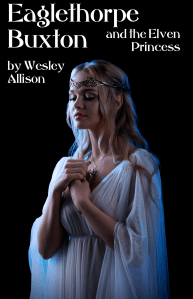
Eaglethorpe Buxton and the Elven Princess – Chapter 12

Chapter Twelve: Wherein I hear the story of a Princess of the Elves.

Not having a hare to cook for our morning meal, and in truth I never really expected there to be one, I didn’t bother building a fire. We shared cold pickles and Hysteria ate the last of her oats. The sun was high in the sky and even though we were eating our meager meal amid large drifts of snow, as long as we stayed in the sun, it was pleasant enough. As you can imagine, my mind was reeling at the possibility that my orphan boy was not only a girl and an elf, but quite possibly a seventy-nine year old half-orphan princess. My mind was so awash in the news that I scarcely paid any attention to the pickles I was eating. It was a real shame, because I enjoy a good pickle. My poor old mother made some of the best pickles ever. Did you know that pickles don’t have to come from cucumbers? You can pickle just about anything.

“What are you doing now?” asked the half-orphan princess.

“I’m attempting to ponder pickles.”

“That figures,” said she.

“But I find myself unable to.”

“Oh? Why?”

“Because of you, my very own little liar.”

“Stop calling me a liar. I didn’t lie. Everything I’ve told you is the truth… except for the part about being a boy and being called Galfrid and being an orphan.”

“And now you claim to be a princess.”

“I am a princess,” she argued. “My father is Jholhard of the wood elves.”

“Come,” I said, wiping the pickle juice off my fingers. “Let’s get going and you can tell me your woeful tale as we ride.”

We remounted my noble steed, which is to say Hysteria, and started off once again down the road. The mood was subdued. At least the mood was subdued between myself and the half-orphan princess. Hysteria seemed quite jovial, and threatened to break into a trot on several occasions. I can only assume that she was happy to have had oats for elevenses. I am sure she didn’t realize that we had no more.

“It is just like in your story of the Queen of Aerithraine when she was trapped in Fall City,” Jholeira said at last.

“What is?”

“Being a princess. It’s like being in jail.”

“You were locked away?”

“Well, not really. I had the run of the entire wood. It’s just that I didn’t realize just how small a world that wood really was until I left.”

“Now we come to the first plot element,” said I. “Why did you leave?”

“I ran away,” she said. “I ran away because my father was going to force me to marry.”

“Well that’s hardly worth running away over,” said I. “I mean, fathers all across the world are busy arranging marriages for their daughters. What was wrong with the fellow? Wasn’t he tall enough? Was he bald? Did he have a wooden eye? It was a wooden eye, wasn’t it?”

“He didn’t have a wooden eye.”

“If he didn’t have a wooden eye, then what was wrong with him?” I wondered. “Maybe you are just being too picky.”

“There was nothing wrong with him. I just didn’t want to marry him. I didn’t want to marry anyone.”

“That seems a bit obstinate to me,” said I.

“Don’t berate me about it now,” she sulked. “I have paid dearly for running away. I was captured by slavers and taken halfway to Lyrria. I only escaped them when bandits attacked them. The bandits took me captive and carried me away to their camp in the mountains. I was taken from the bandit camp when trolls attacked it. The trolls took me into the woods. Then I was stolen away from the trolls by ogres, who put me in a cage and took me to their horrible city. There things got even worse when I was captured from the ogres by a band of wererats.”

“Hold on.” I counted them off on my fingers. “Slavers, bandits, trolls, ogres, and wererats… If this were my story, then next would come… harpies.”

“Pixies.”

“Oh, well, that doesn’t sound so bad. Pixies are little.”

“Evil pixies.”

“Still. Little.”

“Evil pixies from hell.”

“Ah. But at least you got away from them.”

“I managed to escape.”

“Because they’re little, right?”

“Um, yes. But then I was captured by pirates.”

“Pirates in the middle of North Lyrria? By the Ogre Mountains? Far away from the ocean?”

“They were on holiday.”

“Pirates on holiday?”

“Yes.”

“All right. And how did you get away from them?” I asked.

“One of the pirates, a woman named Prudence released me. I think she was jealous that the pirate captain might fancy me instead of her.”

“Prudence? Prudence the pirate?”

“That’s right.”

“And you say she was jealous?”

“Yes.”

I ran through the details in my mind. Slavers, bandits, trolls, ogres, and wererats. Then came the pixies, but I would change them to harpies. Finally there was Prudence the pirate. Prudence who was jealous. Possessive! Possessive Prudence the pirate. Or Prudence the possessive pirate. Yes, I quite like the sound of that. Prudence the Possessive Pirate—that had to be a half-crown story if ever I heard one. I could take a title like that, work it into something, take it to every pub and inn in Illustria, and make a fortune. Of course I would send the half-orphan elf girl a percentage. On the other hand, she said she was a princess. Princesses are rich. She probably doesn’t need the paltry amount made from the sale of a story. She might be insulted if I tried to pay her.

“Now I’ve had more than enough,” said she.

“You don’t want any money?”

“No. I’ve had more than enough adventure and I want to go home,” she replied. “Are you carrying on some other conversation in your head about how you are going to take my story to every pub and inn in Illustria, and make a fortune, and not pay me anything for it?”

“Of course not,” I replied. “You want to go home. And besides, I am a firm believer in maintaining all the appropriate copyrights.”
Eaglethorpe Buxton and the Elven Princess – Chapter 10

Chapter Ten: Wherein I discover the true nature of my companion.

I never did find out what the man who owned that cabin did for a living.  I didn’t examine his body closely enough to see if he was old enough to have retired from somewhere else to settle in the country.  I didn’t see if he had any outbuildings where he could have carried on a trade.  I don’t know if he was a good man or a bad one. And to tell the truth, I didn’t notice much about him physically.  I do know this… he had a very fine bed.  It had been nearly three weeks since I had slept in a bed and this one was at least as good as that one had been.  Before you ask, the other one was in the second floor of an in an inn called the Lonesome Hedgehog, where incidentally a nice, plump serving wench with the top two buttons of her blouse undone had brought me a very nice mutton stew.  No pie though.

What with all the adventures that had come upon me of late, and what with not having slept on a bed in a fortnight and a half, as you can imagine, it didn’t take me long to fall asleep.  I had brushed down my noble steed, which is to say Hysteria.  Then I had taken off my boots and wiggled my toes. Then I put my knife under my pillow. When my head touched lightly on the pillow, I was dreaming.  I don’t remember exactly what I dreamed about.  Only that it had something to do with my cousin Gervil, and that for some reason he was chopping onions.  I never found out why he was chopping onions, because I was awakened by the sound of the cabin door opening.

I didn’t stir.  I kept my eyes squinted so that they looked shut to someone looking at me, but I could still see.  At the same time I slid my hand under my pillow to take hold of my knife.  I needn’t have worried though, as it was the orphan returning from outside and bolting the door after him.  I suppose that he had stepped out to answer nature’s call.  I started to return to slumber when something about the orphan stopped me.

I continued to watch him as there was something different about him.  It took me several moments to realize what it was, but then it hit me.  I was seeing my companion for the first time without his cap.  Where before his head had been covered by a ratty wool creation, it was now covered by long, golden locks, held down with braided strands around the temples.  And on either side of his head was a long slender pointed ear, pierced three or four times by thick silver rings.  He was a girl!  He was a girl and he was an elf!  This was quite a strange development and I didn’t know what to do about it, so I did nothing.  I simply went back to sleep.

The next morning the orphan was waiting for me when I woke.  His long golden hair and his long pointed ears were now carefully tucked under the cap.  I suppose at this point in my story, I should probably begin calling the orphan she instead of he.  Truth be known, I still think of her sometimes as a boy.  It just goes to show that my poor old mother was right.  First impressions are important.

“It’s about time you woke,” said she.

“Did I have some specific reason to rise early?” I wondered.  “Do I have an appointment at the apothecary?  Is the Queen of Aerithraine, with whom I once had the pleasure of spending a fortnight, waiting to give me an audience?”

“No need for sarcasm,” said she.  “I merely point out that the sun has been up for some time.  I’ve gone through the larder of the poor human… I mean the poor man who lived here and found some food not spoiled by goblins. We have a jar of crabapples, a jar of pickles, and a few bits of dried meat.  There are also bags of coffee, flour, and dried beans that you can take with you.”

“Why didn’t you whip up a pot of coffee for us?” I asked.  “Especially as you are so concerned about the hour.  It would have woken me up earlier.”

“Um, I don’t know how to make coffee.”

“Really?  Oh well.”

We ate our bit of dried meat and crabapples for breakfast and saved the pickles for later.  I put them, along with the coffee, flour, and dried beans in my pack, and then loaded the pack and the saddle onto Hysteria.  And though she and I were both loath to leave the relative warmth of the cabin to return to the snowy outside, we did.  The frosty overnight weather had frozen the bodies of human and goblin alike to the ground, so that I would have had to wait until they thawed a bit before I could give them a proper burial, even if I had been so inclined.  I wasn’t.  So, hoisting the orphan back up behind me, which is to say upon Hysteria’s haunches, we started off again down the road.

Eaglethorpe Buxton and the Elven Princess – Chapter Nine

Chapter Nine: Wherein I demonstrate the value of a classical education.

“Do you think they are the same goblins that we saw earlier?” asked the orphan, at my shoulder, peering into the window.

I could only shrug, for in truth one goblin looks much the same as another to me.  Though I had relatively close contact with three of the creatures earlier that evening, which is to say having kicked two and poked one in the head with my knife, I can’t say that I had become familiar enough with any of the three to distinguish them from any other of their race.  That being said, I was relatively sure that the one I had poked in the head with my knife was not among those now in the little cabin.  These goblins were singing or drinking or dancing or doing some combination of the afore-mentioned, all of which are extremely difficult if not impossible to do when one is dead.

“What are you going to do?” wondered the orphan.

“Why do you suppose I should do anything?” I wondered.

“Shouldn’t you avenge the poor man lying on the floor?  After all, he is a human being killed by foul goblins, and you are a… I mean we are human beings too.”

“Aye, it is true that we are human beings.”

“And he was killed by goblins.”

“I do hate goblins.”

Hysteria knickered.  She hated goblins too, probably because they stand so low to the ground and as I have pointed out before, she dislikes anything too near her feet.

“And I am frozen,” the orphan continued.  “I would love to spend the night inside of doors and near a warm fire.”

“Now you make a compelling argument,” said I.

“So what are you going to do?”

“Have you ever heard of Brementown?”

“Uh…no.  Why?”

“There is a story told there of a group of musician animals.”

The orphan rolled his eyes.  I explained my plan, devised on a variation of the Brementown story.  Turning Hysteria so that her rear end was pointed toward the wall of the cabin, I left her with the orphan while I went back to the front and took a position by the door.  Pulling out my knife, I placed my fingers in my mouth and whistled, which was the prearranged signal for both my noble steed and the orphan.

At the signal, Hysteria began kicking the wall of the cabin with both hind feet and the orphan commenced to making all manner of strange noises.  I was so surprised by the cacophony of sounds, which is to say noises that came out of the youngster’s mouth that I almost forgot my own part of the plan.  I am aware that boys are well-versed in the creation of creative noises as well as all kinds of mimicry, having been a boy myself once.  But this orphan was a true artist.  He belted out the yowls of a wildcat, the braying of a donkey, the barking of a dog, the screech of harpy, and the gurgling growl of a frog-bear. Not to be outdone, Hysteria let loose with the squeal of an angry equine, which is to say a horse.

It was scant seconds before the door burst open and the goblins began pouring out into the snow, their shrieks clearly indicating that they were frightened out of their tiny little minds.  The first two who came out were quickly dispatched with my knife.  After that I decided that it was too strenuous to keep bending down to kill them, as they are so low to the ground and I had been riding all night long, which under the best of conditions can give one a sore back.  Thereafter, I reverted to my now well-practiced maneuver of using their heads as makeshift kickballs, which is to say I kicked them on their kickball-shaped heads.

In the space of twenty seconds, I managed to get rid of all the goblins, which turned out to be seven.  I can’t swear that all of the goblins were dead, as five had been sent in long arcs through the air into the darkness of the woods.  They were gone though.  Scant moments later, the orphan, Hysteria, and I were inside the cabin.  I put Hysteria in the corner furthest from the fireplace and directed the boy to stoke the fire, while I pulled the body of the unfortunate former owner out into the snow next to two of his apparent murderers. Thereafter, I went back inside and bolted the door.

“That was a wonderful plan,” said the orphan.

“Indeed it was.”

“I’m surprised you thought of it.”

“Just one of the benefits of a classical education,” said I.  “If I did not know the story of the Musicians of Brementown, I would not have known what to do.  And as I recall, you looked noticeably unimpressed when I mentioned my knowledge of this particular bit of culture.”

“I do admit I thought it a waste of time, um… at the time,” admitted he.  “I offer you my apologies.”

“I suppose I will have to accept them,” said I.  “What with you being a poor, ignorant orphan.”

“Your magnanimity is wonderful to behold,” said he.  “In any case, I think I would like to hear the story of the Musicians of Brementown.”

“Oh no!” cried I.  “You still owe me a shiny penny for the story of Queen Elleena of Aerithraine.”

“But you didn’t finish it.”

“Of course I did.”

“No.  You didn’t. When you stopped, she wasn’t even Queen yet.  She was stuck in the temple in Fall City.”

“When she turned fourteen, she returned to the capital in Illustria and was crowned Queen by the Pope, after which she took control and banishing him back to Fall City.”

“How did she do that?”

“No one knows.”

“Gah!” he cried.  “You are the worst storyteller ever!”

“What would a poor, ignorant orphan know about it?”

“I know you’re not getting my penny!”

“Go to sleep,” I ordered him.  “You sleep on the rug by the fire.  I will take the bed, after I give Hysteria a good rub-down.”

Eaglethorpe Buxton and the Elven Princess – Chapter Eight

Chapter Eight: Wherein I return to my story of the Queen of Aerithraine.

I put away my knife and then climbed back into the saddle.  The orphan had regained his feet and I reached down, took his hand, and lifted him back into his spot behind me.  He reached around my waist and held on tight.

“Thank you,” he said.

“All is well,” said I.  “A few goblins are no match for a trained warrior.”

“Then how did they manage to prevent Prince Jared from becoming the King of Aerithraine? Did they catch him asleep and murder him?”

“One might have supposed that, under ordinary circumstances.”  I continued my story.  “These times were not ordinary.  Goblins are not only small and stupid and smelly; they are disorganized. But every once and so often, there comes along a goblin who is big enough and just smart enough to unite the goblin tribes and lead them on the warpath against the civilized lands of humans.”

“I had always heard that none of the human lands were truly civilized,” said he.

“What an odd and unorphanish thing to say.”

“Um… oh. I’m just discombobulated from the incident with the goblins.”

“Even so,” I agreed.  “Well, at the time my story takes place, there was one such goblin king, who came to power by killing and eating his many rivals.  And as happens when the goblins become unified in such a way, they experienced a population explosion.  The mountains of the Goblineld were teaming with the little blighters.  When the mountains could no longer contain them, they swept out across the southern third of the Kingdom of Aerithraine, destroying everything in their path.”

“Frightening,” said the orphan.

“Quite frightening.”

“Still…”

“Still what?”

“Humans are so large and goblins are so small.  You vanquished three pairs of goblins, and did it quite handily too.”

“Thank you.”

“And you don’t seem particularly skilled or particularly bright.”

“What?”

“I just wonder that an entire human kingdom could not put together an army to destroy even a large horde of goblins,” said the orphan.  “I would imagine that even a well-trained militia could do the job.  I once heard the story of the Calille Lowain who held off five thousand goblins at Greer Drift.”

“I don’t know that story,” said I.

“Perhaps I will tell it to you sometime,” said he.  “But what about it?  Couldn’t the humans defeat the goblins?”

“There were tens of thousands of them.  Hundreds of thousands.  Thousands of thousands.  But you are right.  In other times, such hordes were sent packing, back to their mines and tunnels in the Goblineld.  This time though, the goblins had a hidden ally.  Far to the east, the Witch King of Thulla-Zor, who is always looking for ways to cause destruction and chaos, saw this as an opportunity.  He supplied the goblin king with magic and weapons, and sent trolls and ogres to strengthen his ranks.  None of these facts were known to King Justin when he rode forth with the Dragon Knights to meet them.

“King Justin, his three younger sons, and all of the Dragon Knights were slaughtered—to a man. Prince Jared, who had been in the north fighting sea raiders, hurried his forces south, only to meet a similar fate. The goblins were waiting for him. The entire southern third of the kingdom fell— and remained in the goblins’ filthy little hands for almost twenty years.  And the Goblin King feasted on the spoils of war, sitting on his throne far below the surface of the mountains, drinking his disgusting goblin wine from a cup made from the skull of King Justin.”

“How horrible,” murmured the orphan.

“Yes indeed,” I continued.  “And I think the worse part of the story is what happened to Queen Beatrix.”

“What happened to her?”

“She died. She died of a broken heart.  And her unborn child almost died with her.

“Unborn child? It didn’t die?”

“No, the court physician cut the child from the Queen’s belly.  It was a tiny baby girl.”

“Queen Elleena!” snapped the orphan.

“She should have been,” said I.

“What do you mean?”

“She should have been Queen the moment she was birthed, but that wasn’t to be.  There were too many competing interests at court. Too many nobles wanted the throne for themselves.  And in the chaos that followed the fall of the south lands, they might have done it, had it not been for the church.  Little Princess Elleena Postuma was whisked off to the temple in Fall City, where she stayed for the next fourteen years, and Pope Bartholomew became the regent of the kingdom.”

“Did they keep Elleena prisoner in the temple?” wondered the orphan.

“Of course they didn’t,” said I.  “Though I will wager she sometimes felt that she was in a prison.  She could go anywhere she wanted to as long as she stayed in Fall City and under constant protective guard.  In the meantime she was given all the training and education that was necessary for one who would one day rule.”

“It is like prison,” said the orphan.

“Neither you nor I will ever really know the truth of that.”

At that moment, I spied a light in the distance.  The story, or at least this chapter of the story over, conversation ceased. I urged Hysteria forward, which is to say I encouraged her onward toward the distant light, which turned out to be a small cabin on the side of the road.  Yellow light spilled from its tiny windows onto the snow.

Not having had the best of luck so far that night with regard to welcomes, which is to say that I had been attacked three times already that night, two times of which I have already described for you here, I dismounted and crept around to the side of the cabin to the window and peered inside. Lying on the floor in a pool of blood was a man in common work clothes.  The single room of the little cabin had been ransacked.  And dancing around, or sitting and singing, or drinking were more of the little, round-headed blighters, which is to say goblins.

Eaglethorpe Buxton and the Elven Princess – Chapter Seven

Chapter Seven: Wherein my story is interrupted by goblins, thereby explaining why it might not seem as good as it really was.

Goblins are nasty little blighters.  They remind me of my cousin Gervil’s friend called Rupert.  His name was Sally, which explains why he was called Rupert.  But like goblins, he was short and had a big, round head.  I don’t know why goblins have such large heads for their little bodies. Of course I don’t know why Rupert did either.  There doesn’t seem to be much advantage in it.  On the other hand, goblins have excellent night vision, making it very easy to sneak up on people in the dark.  And they have abnormally large mouths with an abnormally large number of teeth in them. This was very unlike Rupert, which is to say Sally, who as I recall had only five or six teeth, though he made up for that by having an extra toe.  In addition to which I don’t believe his night vision was all that it might have been, for once he kicked me in the head when he was on his way to the outhouse. Of course that could have been on purpose.  Rupert was a bit of a nasty blighter too.

“What are you doing?” asked the orphan, as Hysteria took a step back.

“Thinking about a fellow called Rupert,” said I.

“Well stop it, and get us away.”

I said that Hysteria took a step back, but I should have said that she took two steps back, one on each side.  I could tell she didn’t want the foul little creatures around her feet. She’s very particular about her feet, as most horses are wont to be.  As they approached still nearer, she reared up a bit—not enough to bother me, but just enough for the orphan to slip off her haunches and land with a poof on his seat in the snow.  The goblins cackled grotesquely and I’m sure that they thought they had secured for themselves a snack.  They stopped laughing though when I kicked my leg over Hysteria’s shoulder and dropped lightly to the ground.

With a quick motion, I pulled my knife, still stained red from crabapple pie, from my boot.  It was a small enough weapon to face off six attackers and I would have much rather had a sword, but I had been forced to sell my sword in order to get a fellow out of prison.  I didn’t really know him, but he was the beloved of a poor but beautiful farm girl. In retrospect it would have been better if he had not turned out to be a werewolf, but that is another story.  If I ever write this down, maybe I’ll say that I sold it to get the poor but beautiful farm girl out of prison and that I slew the werewolf.  Yes, that’s a much better story.

“What are you doing?” asked the orphan.

“Recalling the time I slew a werewolf,” said I.

“Finally something useful!” he exclaimed.

The two foremost goblins looked at one another.  While six or seven goblins might sneak up on a man when he was asleep, or might chase down a maiden who was alone and defenseless, they would have to be extraordinary members of their species to take on a seasoned warrior with a weapon.

“That’s right potato head!” shouted the orphan, jumping to his feet. “Werewolves, vampires, giants; he’s killed them all.

“Gree yard?” said the first goblin.

“Grock tor,” said the second goblin.

“I don’t think they understand us,” said I.

The first began to skirt around me to the right and the second began to skirt around me to the left.  The others were following along.  I don’t know whether their intention was to surround me so that they could attack from all sides at once, or to get by me and get at the boy, but I wasn’t going to let either of those things happen.  I took a quick step to the right and kicked the big round head of the first goblin, which flew almost as far as the kickball I kicked as a child, and of course the rest of the goblin went right along with his head.

As a child, kickball was one of my favorite pastimes.  We had our own little team and I was almost always the bowler. Sally and Gervil and several other boys made up the outfield.  Tuki played first, second, and third base.

“Look out for the other one!” the orphan cried, interrupting my fond memories.

I twisted around to my left and kicked the head of the second goblin, sending it in a lovely arc off into the forest.  If my first kick had scored a double, which is to say a trip to second base, then this kick must surely have been a triple.  And I would dare Tuki to say that either of those goblin’s heads went out of bounds.

“Look out!” the orphan shouted again.

I turned to give him a dirty look and saw a third goblin who was attempting to use the distraction of his fellows, which is to say their current use as substitute kickballs, to slice my Achilles tendon with a rusty old razor.  With a quick jab, I thrust the point of my knife into his head and he dropped to the ground—dead.  When I looked back around, the other goblins had wisely run away.

Eaglethorpe Buxton and the Elven Princess – Chapter Six

Chapter Six: Wherein I begin to tell the story of the Queen of Aerithraine.

Hysteria clomped along slowly down the snow-covered road for some time.  The orphan was so quiet that for a while I thought he must have fallen asleep.  But at last he stirred and shifted a bit in his seat, which is to say upon Hysteria’s flank.  I myself had been quiet as I remembered the events of that horrible night.

“What are you thinking about?” asked the orphan.

“I’m thinking about that horrible night,” I replied.

“Did you never find your family?”

“No, though I searched for weeks.  My mother was to make me a blueberry pie that night, and I not only have never seen my mother since, I did not get to eat that pie either.”

“I’m sorry I brought up such a painful memory,” he said, and then paused. “Do you suppose that the purple drops on the floor could have been from your blueberry pie?”

“Fiends!” said I.  “To rob a man of his mother and his pie in the same night!”

“Perhaps it were best that we think on something else,” said he.

“Perhaps,” I agreed.

“If you are really such a great storyteller…”

“The greatest in the world.”

“And if the story of the Queen of Aerithraine is a great story…”

“Wonderful.  Exciting. True.  Profound.”

“Well, maybe you could tell me the story.”

“I get half a crown for that story in Illustria,” said I.

“I have a shiny penny,” said he.

“The story begins in Aerithraine, far to the west, along the coast of the great ocean sea.  From storied Illustria, its capital, to Cor Cottage just outside Dewberry Hills in River County, Aerithraine has been a great and powerful country for some seven hundred years more or less.  By more or less, I mean that it has been more or less seven hundred years that Aerithraine has been a country and that it has been more or less great and more or less powerful during those seven hundred years.  But about fifty years ago, it was less.  That was when the old king died, and as is the way of kings, a new one was crowned.  He was King Julian the Rectifier.

“He was called Julian the Rectifier because he was chiefly interested in rectifying.  He spent most of his time rectifying.  He rectified all over the place.  And he was good at it.  He rectified like nobody else.”

“It means setting things to right,” said the orphan.

“Of course it does and that is just what he did.  Under his reign, the kingdom was prosperous and wealthy.  And, as he wasn’t so interested in warring as in rectifying, there was peace throughout the land.  King Julian had only one son, and he passed to that son the strongest and wealthiest kingdom in all of Duaron, and if it had only remained so, Elleena would have become nothing more than a minor princess perhaps.”

“Which would not have made a half-crown story,” pointed out the orphan.

“That is so.”

“Carry on then.”

“King Justin was the son of Julian.  I hear tell that he was once called Justin the Good and Justin the Wise, though now when storytellers refer to him, they usually call him Justin the Weak or Justin the Unready.”

“What do you call him?”

“I just call him King Justin,” said I.  “Though I truly believe he may deserve the title Justin the Brave, it is not what the listeners want to hear.”

“Go on.”

“King Justin married a princess from the faraway land of Goth.  The Arch-Dukes of Goth, which is to say the rulers of that land, have for generations, maintained power through a tightly woven web of treaties with its mighty neighbors.  Their chief barter in this endeavor is the marriage of the many female members of the family.  I hear the current Arch-Duke has but four daughters at least as of yet, but his father who was Arch-Duke before him had seventeen, and his father, which is to say the grandfather of the current Arch-Duke had nineteen.”

“That hurts just thinking about it.”

“What?”

“Nothing.  Go on.”

“It must have been quite a coup of diplomacy for the Arch-Duke of Goth to make a match with the King of Aerithraine, but he did, marrying to the King his daughter Beatrix.  And though I hear that the women of that country wear too much make-up, she was nevertheless accounted a great beauty.  She had pale white skin, raven hair, smoldering eyes, and a gold ring in her nose, as is the fashion in the east.

“King Justin and Queen Beatrix had four strong sons, the eldest of whom was Prince Jared.  He was particularly beloved of the people.  I saw him once when I was a child of four or five, sitting on my poor old father’s shoulders as the Dragon Knights passed on their tall white steeds. That is to say, I was seated on my father’s shoulders and the Prince was not.  Neither were the Dragon Knights nor their steeds.  I don’t remember why the Prince and the knights were in River County. It was too long ago.  He would have grown to be King upon his father’s death if it was not for…”

“Goblins!”

“Yes, that’s right.  You didn’t say you had heard the story before, though I’ll warrant it wasn’t told as well…”

“No!” screamed the orphan.  “Goblins! Right there!”

He pointed straight ahead, and sure enough, stepping out of the shadows and into the moonlight were a half dozen creepy little man-things. They were no more than three feet tall, their over-sized round heads, glowing eyes, and gaping maws giving away their identity.  As they came closer those mouths widened into grins filled with jagged little teeth, looking far too much like the teeth on the blade of a cross-cut saw for my taste. They brandished what weapons they had, mostly things they had picked up from the ground—a stick, a length of cord with a knot in it.  But a couple of them carried old, discarded straight razors.

Eaglethorpe Buxton and the Elven Princess – Chapter Five

Chapter Five: Wherein I reveal the mystery of my family.

“You said that you do not live far from here,” I mentioned, once we had finished the pies.  One might say the purloined pies, but I would not.  I would instead insist that they rightly belonged to us in recompense for our unjust confinement.

“That is correct,” said he.

“The pies rightfully belong to us?”

“No.  I live not far from here.  Are you carrying on some other conversation in your head about the pies?”

“Of course not,” I replied.  “You are an orphan.”

“I am well aware of that fact.  There is no need to keep rubbing it in my face.”

“What I mean is you don’t have a proper home anymore now that you are an orphan.”

“Even an orphan may have extended family,” he explained.  “Perhaps I live with them.”

“Do you?”

“One might suppose that I do.”

“One might suppose a great many things,” said I.  “But would it not be better to base our future activities less on supposition than on actual remembrances?”

“One might suppose we should,” said he.

“You have an odd way of talking,” I commented.  “You don’t quite sound orphanish at all.”

“Really?  How many orphans have you known?”

“Quite a few actually,” I revealed.  “The Queen of Aerithraine…”

“With whom you once had the pleasure of spending a fortnight.”

“Indeed it is so.  The Queen of Aerithraine, with whom I once had… well, she has a soft spot for orphans. Some years back she opened an orphanage called Elleena’s House.”

“Is that because her name is Elleena?”

“Why would her name cause her to have a soft spot for orphans?”  I wondered.  “No, I believe it is because she was an orphan herself.”

“No.  Is it called Elleena’s House because her name is Elleena?  And how could a queen be an orphan?  Doesn’t she have to be a princess?  Or did the King find her in an orphanage and come to sweep her off her feet? That would be a lovely story.”

“Well, there is no king,” said I.

“Gah!” he exclaimed.  “You are the worst storyteller in the world.  You are messing everything up and making me confused.”

“Forsooth!  I am the best storyteller in the world.  I do not expect you to know so, as you are an unfortunate orphan without any knowledge of the world.”  I looked over my shoulder at his pinched little face.  “In truth I was not trying to tell you the story of the Queen of Aerithraine.  If I had, you would be filled with wonder and excitement.  I have made half my fortune from that story, and a better story, a truer story, a more profound story; you are not likely to hear in all the days of your life.  But I was not trying to tell that story.  I was trying to explain that the Queen of Aerithraine has a soft spot for orphans. In fact, I suppose that I do so myself, as I am almost an orphan.”

“You are almost an orphan?”

“Indeed.”

“How can you be almost an orphan?”

“Why couldn’t I be?” I demanded.  “If anyone can be, I could be.”

“What I mean is…”  He took a deep breath.  “How can one be almost an orphan?”

“Oh.  Well, it’s only that my parents aren’t dead.”

“I see,” said he.

“But they were kidnapped,” I confided.

“Are you sure they didn’t just run away?” he asked.

“It was a stormy night and I had been away from my parents’ home, which is to say my former home, which is to say Cor Cottage just outside Dewberry Hills, and I was returning for a visit.  As I approached I heard a disturbance, though at first I attributed it to the sounds of the storm.  Then I looked up at the cottage window to see figures silhouetted on the shade, locked in a grim struggle.”

“What did you do?”

“Why, I rushed forward to aid my poor old mother, who as I recall smells of warm pie, and my poor old father, and my sister Celia, and my aunt Oregana, and my cousin Gervil, and my other cousin Tuki, who is a girl cousin, which is to say a cousin who is a girl, which makes sense, because whoever heard of a boy named Tuki.”

“They were all struggling by the window?”

“They may all have been struggling by the window, or some of them may have been, or perhaps only one of them was struggling by the window.  I don’t know, because when I burst in through the front door, they were all gone.  The back door was open wide and the rain was splashing in.”

“What happened to them?”

“I know not.”

“Were there any clues?”

“Indeed there were.”

“What were they?”

“The table had been set for nine, which was two places too many.”

“Three places!” said the orphan triumphantly.  “You thought I wasn’t paying attention.  There was your father, mother, sister, aunt, and two cousins. That makes six.”

“They would also have set a place for Geneva.”

“Of course they would have.  Who is she?”

“She’s my other cousin, which is to say Gervil’s sister, only she’s imaginary, but she wasn’t always imaginary, which is to say she died, but Gervil still sees her, so Aunt Oregana always sets a place for her.”

“What other clues?”

I listed them off.  “There was a knife stuck in Gervil’s bed.  Floorboards had been loosened in several rooms.  There were drops of purple liquid leading out the back door.  And someone had hung bunches of onions from the rafters of the dining room.  Most mysterious of all was the fact that the tracks led away from the house only fifty feet and then disappeared entirely.”

The orphan gripped me around the waist and squeezed.  “How terrible,” he said, in a tiny voice.

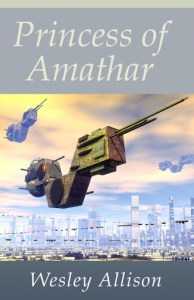
Princess of Amathar – Chapter 15 Excerpt

The sky train sped above the seemingly endless city. Several times it stopped at stations, but we remained aboard. I continued to watch in fascination, the buildings passing by. Abruptly the color, style, and size of the structures changed. We were now crossing a region of huge, dark buildings, many of which were larger than the giant warehouses and sports stadiums that I had seen before. These were far less ornate and far more utilitarian than the other buildings as well.

“This is one of the industrial regions. It is a circle one hundred kentads (about fifty miles) in diameter containing nothing but factories and warehouses. This is where the majority of our manufactured goods come from— this or one of the nine other regions just like it.”

I acknowledged Vena Remontar’s commentary, and then turned away from the window. Several food servers in the traditional white bodysuits were delivering tall glasses of ice water and trays of small appetizer cakes. The young knight, and I as her companion, were served first.

“There certainly seems to be a great deal of respect and privilege associated with being a knight,” I observed.

“That is very true,” Vena Remontar replied, with a slight smile, “but it is more than that in my case. The Remontar family name is well known, as are all who carry that name. In addition, my cousins are the heirs of the Sun Overlord. Norar Remontar and his sister are beloved of the entire city.”

We busied ourselves eating the delicious cakes, which were filled with ground meat and a variety of vegetables. In certain parts of the land of my birth, they might have been called pasties, though they were seasoned unlike anything found on Earth. The water was delicious. It seemed that water was the beverage of choice among the Amatharians, and they went to great lengths to see that any water found within the city was not only crystal clear and healthful, but tasty as well. With the exception of mirrah, and a few other fermented drinks, water was all that was available to drink in most city places.

We had just finished eating when the sky train made one more stop in the industrial center. After it began on its way again, we crossed out of the region of factories and complexes and began crossing a vast open cultivated land. I watched out the window as we continued on, and the buildings of the city grew distant behind us. Roaming the ground like huge grazing animals, were monstrous machines, planting, thinning, and harvesting a tremendous variety of vegetables and fruits.

“Have we left the city?” I asked.

“This is one of the five cultivation areas within the city,” explained the knight. “Each is a circle two hundred fifty kentads (about two hundred miles) in diameter. Four are in operation growing our food, while a fifth lies fallow.”

As we cruised along, our conversation did not lag. I had a thousand, no ten thousand questions for this lovely young woman from a very alien culture. She explained much about the hopes and aspirations of the Amatharian people, the day-to-day functioning of the clans and family businesses, and the many obligations and requirements. Even though I know that I learned much during the course of that lengthy ride, it is hard to remember the exact order of the conversation now.

We passed the far edge of the cultivation area and once again entered into the urban mass. This portion of the city was obviously of far greater age than the majority of the buildings I had seen until now, though these old edifices maintained the same style and ornamentation as the newer ones. I had come to think of Amathar as one would think of a city one Earth, a great urban realm, but this city was on an entirely different scale. Within the walls of the Amatharians’ home were not only vast areas of cultivated fields, but mountains, lakes, and rivers as well. This older portion of the city, though still urban, was built upon a low mountain range.

The train stopped at a station upon a platform high in the air, and this time we stood up and stepped off the sky train. Vena Remontar led me down a great escalator so steep that it seemed I was walking straight down. Once at the bottom I looked around at a plaza some two miles across. Great statues of stone, some as high as forty feet were interspersed with surging fountains, tall green hedgerows, and monstrous tile pictures. Two sides of the plaza were lined with large buildings resembling hotels. The third side faced a large park or wilderness area. Facing the fourth side was a fantastic stepped pyramid, more than a mile wide and more than two thousand feet high.

“That is the Temple of Amath,” my blue-skinned companion said. “At the other end is the Garden of Souls.”

Princess of Amathar – Chapter 14 Excerpt

I had literally just closed the door after Nicohl Messonar had left, when the disembodied voice announced that Vena Remontar had arrived. I am sure that the two must have passed in the hall, though I was not fortunate enough to witness it.

“Are you ready?” asked Vena Remontar. “Wear your swords.”

I strapped my weapons belt on below my tabard and carefully sheathed my swords in their new holders. In spite of the fact that the swords were uncounted years older than the sheaths, they fit perfectly. We started out the door, and down the hallway. It was the first time I had been out of Norar Remontar’s apartment since I had arrived, and it felt good.

“We need to stop here first,” said Vena Remontar, as we stepped off the escalator onto the fifth floor.

The lower floors had much higher ceilings and seemed more spacious than those of the upper floors. Here were located restaurants, shops, and other facilities used by the people in the building. We entered through an open doorway to find a large gymnasium. There were two young girls; I would have thought them about ten years of age, practicing their swordsmanship in a haphazard manner, at the far end of the room. As they noticed us, they stopped to stare at me and giggle.

“I wish to see if the title of swordsman that Norar Remontar laid upon you is warranted,” the female knight said.

She drew her long sword and I followed suit. We nodded respectfully to one another. Then with a skill and speed born of battle, Vena Remontar charged at me, bringing her blade down directly toward my face. I raised my own to block the stroke, and just as quickly she swung two more blows. The only thing I could do was take the offensive, so as I blocked the third blow, I swung my weapon on around in a great arc toward her side. The woman was off balance from her attack, so the only way she could block the arc of weapon, was to turn her back on me, and swing her blade outward to meet mine. I expected that this would offer me a chance to attack her back, but it didn’t. As soon as she had done so, she tucked and rolled forward, spinning as she rose to face me. This was a brilliant maneuver and would have put several yards between us, but I wasn’t ready to let up. Using my gravity-enhanced strength, I jumped forward, almost landing on top of her. Vena Remontar thrust quickly several times. I blocked those attacks and countered.

“Not bad, thus far,” she said.

“Thank you.”

As I said this, I swung down. I knew that were we really engaged in battle, her sword would have glowed with power, and sliced through the mundane metal of my own, but for now, the soul was asleep, and we were on equal terms. Actually, I had an advantage of superior strength. She blocked my swing, but was unprepared for the added power, and it knocked her from her feet. Without hesitation, she swung toward my knees. I jumped up, and the blade passed harmlessly below me. The young knight rolled to her feet.

I could see by the half smile on her lips that she was enjoying herself. With a flick of her left wrist so quick that I almost didn’t see it, she whipped her short sword from its sheath and grasped it like a dagger. I chopped down with my blade in an attempt to catch her off balance, but she wasn’t off balance. She blocked my blow with the shorter blade and began to attack with the longer. Then she attacked with both swords, forcing me to defend, and I am sure, hoping to wear me down. Unable to attack for the moment, I began to leap quickly to either side, and then to the back, forcing her to chase me. I knew that it was I who would be able to wear her down first, and after several dozen parries, I could see in her eyes that she was coming to the same realization.

Here was the advantage I needed. I rained a series of blows at her head, and then swung with power at her side. Like she had before, Vena Remontar spun around with her back to me and swung her sword, tip down, outward to meet mine. I expected to have a quick shot at her exposed back and left side, but even as she blocked my attack, she drove her short sword, in her left hand, straight back under her arm, and into my stomach.

“Umph!” I grunted in surprise. I expected that I had been cut through, but the tip of her sword merely pricked my skin.

Vena Remontar wiped the tiny drop of blood from her sword tip onto her tabard, and then sheathed her sword. With the drawing of first blood, the contest was over.

“I’m satisfied,” she said. “I thought that perhaps Norar Remontar was being overly generous. But you are quite skilled.”

Princess of Amathar – Chapter 13 Excerpt

I opened my eyes to find myself looking at the ceiling. For a moment I though that I was back in my bedroom at home on Earth, and that all of my adventures in Ecos were just a fantastic dream. Then Malagor leaned over to look into my face.

“I have slept, gotten up, explored the city, eaten, and slept again. You are just now waking.”

“How very nice for you,” I replied.

I sat up, and then climbed out of bed, noticing a distinct disadvantage to the Amatharian beds. Yet I felt so refreshed that my gravity enhanced muscles sent me bounding up onto the floor. I started toward the washbasin, but noticed the doorway just to the left. Passing through it, I found the bathroom. It was a huge room. The bathtub was a small pool, designed to look like a thermal spa, with water constantly flowing from a waterfall into the pool, and then out at the other end. The room also had the other features that one might expect, and they were similarly fashioned to resemble natural features.

I hopped up into the bath and floated in the hot water. The little pool was large enough for me to swim around in, and when I stood up, the water still reached the middle of my chest. Beside the inlet waterfall was a small shelf with a variety of brushes and cleaning agents. I found something that seemed close to shampoo and washed myself from head to toe. I hopped out just long enough to retrieve my knife from beside the bed, then hopped back in and relaxed in the water as I shaved my ragged beard. When I exited the bath a second time, I felt presentable enough for polite Amatharian society. Malagor was waiting for me with some new clothes— a black Amatharian body suit, a plain white tabard, and a pair of boots.

“At Norar Remontar’s direction, I got these from the clothier on the first floor,” he said. “I had to have my own clothing specially ordered.”

I was interested to see how the bodysuit was put on. I found that it had an open waist in the back. Still it took me several moments to discover how to get my lower portion in, and still be able to insert my upper half. Fortunately the material used by the Amatharians was extremely flexible. Once I had it on, it seemed not so much to stretch to fit, as to shrink to fit. It covered every inch of my body in a cool embrace. It was extremely comfortable. The tabard which I put on over it was, as one would expect, slightly encumbering, though no more so than a light jacket or sweater. It reached just below my knees in front and in back, but was open on the sides. Finally I put on the boots, and found them to be the most comfortable footwear that I have ever tried on. All that remained was for me to strap on the weapons belt beneath my tabard. Malagor had also seen to it that I had the appropriate sheaths for my swords. I looked like an Amatharian that had somehow been deprived of his beautiful blue skin.

“Where is Norar Remontar?” I asked.

“He left to see members of his family,” replied Malagor.

Just then an ethereal voice spoke seemingly out of nowhere. “Nicohl Messonar is waiting at the door.” The two of us looked around the room expectantly for a moment, and then at each other.

“Must be a kind of doorbell,” I offered. Malagor shrugged.

I walked out of the bedroom, followed by my alien friend, and opened the front door. Outside, stood an Amatharian woman. She looked to be in her early fifties, and possessed a more mature form of the beauty that was apparently common to all Amatharian women. Her silky black hair cut straight across her forehead, and reaching the middle of her back, was touched with grey, but her dark blue skin remained flawless. She wore a white tabard with a crest— a flaming sun supported by a pedestal— indicating that she was a knight. But instead of the black bodysuit of a soldier, hers was light lavender. She carried no swords; just a satchel slung over one shoulder.

Stepping confidently into the apartment, the woman looked me over, coldly, for a moment before speaking.

“I am Nicohl Messonar,” she said.

“So I understand,” I replied. “Nicole is a common name among my people.”

“The name is Nicohl.”

“Nicohl.”

“Yes, and my name is Nicohl Messonar.” She arched an eyebrow. “It is impolite not to use both names. That is only for husbands and wives, sharing an intimate moment.”