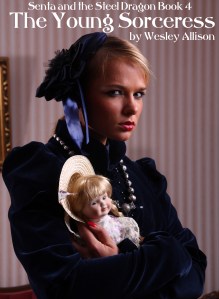
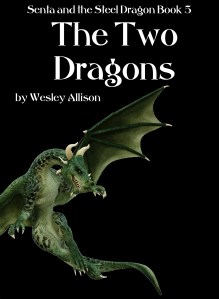
The Two Dragons – Chapter 2 Excerpt

The train station, originally a wooden structure smaller than most homes, had been partially rebuilt of stone and marble. It was in fact, well into a program of construction that would require the better part of a decade. That was not to say that the station was not in service. Trains rolled in from distant St. Ulixes in Mallontah on an average, three times a day. Every other day, a coal train arrived from the south. Two trains were in station at the present time. One was sitting idle and would leave for Mallontah later that day. The other, the B-412, had arrived from St. Ulixes within the last half hour and its engine was still emitting steam from its boiler.

More than one hundred passengers had arrived on the B-412 and most of them were still at the station, collecting their luggage and waiting for friends and relatives to meet them, or hugging and kissing those friends and relatives who had already arrived. Graham Dokkins was just swinging off the steps of the passenger car, with a duffle bag over his shoulder.   A stocky young man of seventeen, a late growth spurt had brought him up to his full five foot eleven. He wore a grey wool suit straight from Greater Brechalon, but his bowler hat was all Birmisia, with its hatband made of velociraptor skin. Not what most would call handsome, he had a thick shock of brown hair and laughing eyes.

“You look quite dapper in that suit,” said Senta.

Graham smiled, tossed his bag on the cement platform, and stepped over to embrace her.   As she pressed her cheek to his, Senta closed her eyes and felt the warmth of his skin. After a moment, he took her by the shoulders and held her back at arm’s length, looking questioningly into her face.

“You’ve been gone too long.” She answered his unasked question.

“It’s nice to be missed.”

“I was at the docks. I thought you’d come by ship.”

“I could have, but I would have been another three days getting home. The new cranes are coming on the Gabrielle.”

“It’s good that you had the option. I suppose that comes from being an important muckey-muck.”

“Assistant Port Manager, at your service.” Graham doffed his hat and bowed at the waist.

“Do you want to go to the Café for tea?”

“Ma will kill me if I don’t go straight home. Walk with me?”

Senta nodded.

Graham picked his duffle back up and threw it over his shoulder. He held out his elbow and Senta took it as they walked through the half constructed station, down the stone steps in front, and down the brick-lined street to the trolley stop. The southbound trolley arrived only seconds after they did. It was pulled by a triceratops, but not Harriet. Senta didn’t recognize the animal, but Graham did. He knew all the city’s dinosaurs.

“Hello Meg,” he said, slapping the beast on its right hind leg before climbing into the trolley cab.

“Hey Graham,” said the driver.

“Hey Gideon.”

Gideon gave Senta a sidelong glance but didn’t meet her eyes. Graham pulled two pfennigs from his pocket and dropped them into the glass box next to the driver’s station before leading Senta by the hand to the middle seats and sitting down. After Meg had been fed, and with a clang of the bell, the vehicle began rolling down the grass pathway in the center of Terrence Dechantagne Boulevard. The triceratops let loose of five or six gallons of dung, which dropped onto the tracks beneath her tail, and which the trolley subsequently ran over.

“They have steam-powered trolleys in St. Ulixes now,” said Graham.

“Were they nice?”

“Oh, heck no. Too much smoke and soot everywhere.”

“Not as many dung pies though?”

“That’s good fertilizer. I always said it was a shame to let the lizzies have all of that. We should keep some of it for our own gardens.”

“Don’t you have enough fertilizer already?”

“I meant all of us—all the soft-skins.”

“How did you find the lizzies in Mallontah?” she asked, remembering her own visit years before.

“They’re not really lizzies at all, are they? Different animal altogether. They call them trogs.”

“That’s right,” remembered Senta.

The trolley stopped four times on the main boulevard before it turned east onto Whipple Avenue. The second stop after the turn was Graham’s, and both he and Senta stepped out. Two years before, the Dokkins family, reveling in new wealth, had purchased a family estate in what seemed at the time, a remote location. The city had quickly expanded though to gobble it up. Had it been in Greater Brechalon, the two-story house would have been the home of some gentry, and indeed though from common enough stock, here in Birmisia, that was just how the Dokkins family was thought of. An unusually high wrought iron fence surrounded the estate, which encompassed some twenty acres. Graham opened the gate and allowed Senta to enter before him, then closed it after them. Almost immediately the ground began to tremble.

The rumbling grew stronger and stronger and bursting from behind a stand of bushes, a monster raced toward them. The creature was an iguanodon, almost thirty feet long and weighing more than three tons. Roughly the same size as Harriet and Meg, it was much sleeker than a triceratops and ran on its hind feet, though it remained bent over like a quadruped. It trumpeted loudly as it ran at the two humans.

“Whoa, Stinky!” shouted Graham. “Whoa!”
The Two Dragons – Chapter 1 Excerpt

The Church of the Apostles was a stately stone structure—no less imposing for the fact that it wasn’t yet complete. On the first day of Septurary 1907, the church was filled to overflowing as the citizens of Port Dechantagne, dressed in their finest, celebrated a wedding that was the social event of the season. Mother Linton, the High Priest of Kafira in Birmisia stood at the pulpit, unwilling to relinquish her position to anyone. Behind her and to her right however, owing to the era of tolerance now in full flower, was the Zaeri Imam Mr. Francis Clipers. The wedding party members were arrayed across the chancel. The matron of honor, Mrs. Yuah Dechantagne, and the four bridesmaids Miss Hero Hertling, Miss Gabrielle Bassett, Miss Dutty Speel, and Miss Laila Melroy wore shimmering gowns of teal trimmed with white lace. The groomsmen, Mr. Paxton Brown, Mr. Leopold Ghent, Mr. Isaak Wissinger, and Mr. Efrain Rochambeau were all dressed in black tails, though the Best Man Inspector Saba Colbshallow wore his blue police uniform. In the center of the group was the groom. Zeah Korlann unlike the building around him, could not be described as stately, though even in his days as a household servant, he had been dignified. After nine years as mayor of Port Dechantagne, he had gained a kind of gravitas. As the string quartet struck the first chords of Kafira’s Marriage he, like everyone else in the church, turned his attention to the back of the aisle where the bride appeared.

No cloud could have aspired to the whiteness of Egeria Lusk’s wedding gown. The bodice was tight but simple and it blossomed out at the waist to a truly remarkable expanse at the hemline, the train following twenty feet behind her. Though the dress was strapless and shoulderless, it had long, gauzy sleeves, split on the outside and held together by a series of small white bows. She defied convention by not wearing a veil, but had a mass of tiny white flowers arranged within her brilliant red hair, which was swept up into a complex Mirsannan twist. She slowly walked up the center aisle, unattended, in time to the music, arriving before the alter to join her beaming bridegroom. Mother Linton began the litany.

Senta Bly sat in the third row on the groom’s side. She wore a dress of deep purple silk, gathered together in bunches so that if fell in pleats. With thin straps over bare shoulders and no sleeves, it showed off her tall, lithe body to best advantage. It was completely unadorned with brocade, beading, or fringe and didn’t even have a bow over the bustle, though none could tell that with her seated. No one else sat on the pew with her despite the fact that every other seat in the building was taken, and more than sixty people stood across the narthex. It might have been that her disappointment at not being invited as part of the wedding party caused an unpleasant expression to sit upon her countenance, or it might have been something else entirely.

As Mother Linton approached the portion of the service in which she explained the duties of a husband and wife, Hero turned around and waved two gloved fingers discreetly to Senta, who returned the gesture. She smiled, but her hurt feelings didn’t go away. They had hung on for six weeks now. She had known Egeria Lusk for more than eight years. They got on well too. She was closer to her than Gabrielle Bassett or that Speel girl, or even Hero. Senta was a good friend of Mayor Korlann too. It had to be the mayor’s daughter Mrs. Dechantagne. The woman had hardly spoken to Senta in five years, and then only a few terse words.   This was all the more strange since they had been quite friendly before. Senta didn’t know precisely what the problem was; only that it had something to do with Mrs. Dechantagne’s husband Terrence, who had been killed in a lizzie attack. Occupied with such thoughts, Senta realized that she had lost track of the ceremony, when the priest began asking the bride and groom if they would each take the other.

The entire congregation seemed to hold their breath when Mayor Korlann was asked if he took “this woman”. It was not as if he had bolted from the alter on some previous occasion, but the wedding had been postponed at least twice, and at more than eight years, this was one of the longer engagements. The tall grey-haired gentleman pulled through however with a hearty “I will,” and as the string quartet began the Ode to Celebration, the couple moved quickly down the aisle and out of the church. Forty or fifty pairs of old shoes were tossed into the aisle as they passed for good luck. The congregation all stood, cheering and applauding.

Senta stood too, though she didn’t rush to follow the newlyweds out, as did much of the congregation. She gazed around at the splendor of the new religious center of the colony. It was her first time visiting. It was even larger than the Great Church of the Holy Savior in Brech. Others were looking at the ornately carved trim, the stained-glass windows, and the marble statuary too, but far more were observing Senta. At six feet tall, she was literally head and shoulders above every other woman there and many of the men. Her long blond hair framed an oval face with distinctive cheekbones, large expressive eyes, a broad mouth with voluptuous lips, and a strong chin. She would never have been called pretty; rather she was beautiful in the classical sense of the word, like the women that artists created to portray personifications of freedom or grace or nobility.

Hero bounced toward her. Though the two of them had been nearly the same height when they were twelve years old, Hero had stopped growing six inches before Senta had. With incredibly thick, naturally curly, long black hair and doe eyes, Hero had more than her fair share of admirers. She was so popular in fact that several young men sidled up to her even here. As Senta noticed them, they took a step back in unison.

“Wasn’t that a lovely ceremony?” asked Hero.

“It seemed very nice from down here.”

“Don’t be cross. Benny and Shemar both invited us to ride in their steam carriages to the reception. Who do you want to go with?”

Senta rolled her eyes. “Quite frankly I’d rather take the trolley.”

“Are you sure? Benny’s car is brand new and candy apple red.”

Senta looked over Hero’s shoulder at Benny Markham, who was puffing himself up with pride. She liked Benny, Shemar too for that matter, but she wasn’t too fond of steam carriages.

“Do as you wish. I’m taking the trolley.”

The Young Sorceress – Chapter 14 Excerpt

Augie Dechantagne came running through the parlor and like a freight train. “Mama! Mama! I shot a velociraptor!” He dived toward the couch, landing not on his mother, but instead in the lap of Cissy who sat next to her.

“You did what?”

“I shot a velociraptor!”

Yuah’s eyes shot daggers at the boy’s uncle, who followed him into the room, and who was in turn followed by a lizzie burdened with at least six assorted rifles and another with several large canvas bags slung over his shoulder. “He’s not even three years old.”

“Don’t get yourself worked up,” said Radley Staff. “I didn’t give him the weapon. I simply let him look through the sights and pull the trigger while I held it.”

“Quite appropriate,” said Iolanthe from her seat across the room, her eyes glued to the paper in her hand. “A Dechantagne man must be proficient in firearms.”

“You should have seen the blood shoot out!” continued the boy. “How many did we get again, Uncle?”

“Only four,” said Staff, who then turned to the lizzies. “Put the gear away in my den.”

“I hope you at least made sure the guns were unloaded in the house,” said Yuah.

“I certainly hope you didn’t.” Iolanthe at last looked away from her paper. “What’s the point in having rifles if they aren’t ready to be used?”

“Yuah is right,” said Staff. “Safety first. But the best way to be safe is to ensure the children have a good working knowledge of firearms and know when and when not to touch them.”

“Ready for a nap?” Cissy asked the boy. “Sister is already asleep.”

“I’m hungry,” said the boy. “Can I get a biscuit?”

“Go get one from the kitchen,” ordered his mother. Then she stood up. “I certainly can use a nap. I shall see you all at tea.”

Making her way up the long sweeping staircase, Yuah snapped her fingers at Narsa, who followed her into her bedroom and helped her remove her day dress and then unfasten her corset. Waving for the lizzie to go, she unfastened her own hip bag and draped it over the chair, before stretching out on the bed.

“What are you still doing here?” she called, seeing the lizzie out of the corner of her eye. “Oh, it’s you again.”

It wasn’t Narsa hovering just outside Yuah’s bedroom door, but Cissy. She seemed to be making a habit of hovering outside doors.

“What do you want? I’m not doing anything.”

“I whatch you,” said Cissy.

“Yes, yes,” replied Yuah. “Go ahead and ‘whatch’ me.”


* * * * *


Baxter stared down at Odval’s grave. He had carried her body all the way back across the island to bury her in the little meadow just above the rocky shore where he had first found her. He hadn’t gone to so much effort when his own mother had died. He had only known the Enclepian woman for a few weeks, but her death hurt him more than any other, of the many deaths that had touched him in his life. He knew in his head that he was pained less for her loss than the selfish realization that he would now be all alone on the island, but his heart hurt just the same. He hadn’t loved her. He had barely known her. But he was going to miss her.

The neatly piled earth looked like a new grave, but there was something missing. The naval officer spent the day looking for just the right stone to serve as a marker, carefully placing it just above the edge of the mound. He didn’t write on it though. It was too much effort to carve, and for that matter, he didn’t know enough about her to know what to say. He skirted the edge of the meadow, along the rocky ridge, and found several dozen small white flowers, which he picked and placed in a pile next to the stone. Nodding in approval, he turned and walked back toward his home by the little lake. He wondered just how long it would be his home.

The Young Sorceress – Chapter 13 Excerpt

The train ride to St. Ulixes, Mallontah was a three day ordeal. Senta had left on the U-711 at 5:00 AM of 23rd of Quaduary. She had spent almost all her money on the round trip ticket, with just enough left over to allow for meals. She had a sandwich from the snack trolley at teatime, but wasn’t hungry the rest of the day. So she sat there, thinking that she should get her carpetbag from the rack and read The Contracting Universe but having absolutely no desire to do so.

As the sun set and the train continued to chug on toward Mallontah, Senta got up from her seat and walked to the next compartment, where bunk beds lined the wall, each with a blackout curtain surrounding it. Her bunk was about in the middle of the car on the right hand side, second from the bottom, with two bunks above it. Not all the sleeping places were taken. Many more passengers made the trip from Mallontah to Birmisia, than visa-versa. As she climbed into her bed, there was just enough light outside for her to make out a massive herd of sauraposeidon moving across the plain. She was asleep almost immediately.

“Ugh,” she said, squinting her eyes as the bright light through the window splashed on her face. It was morning already. “Uuthanum.”

A window shade flipped down to cover the portal.

Senta managed to sleep another half hour, before the sounds of people climbing out of their own beds around her forced the last remnants of slumber from her. Pulling back the blackout curtain revealed a startled man standing right beside her.

“Good morning,” he squeaked.

“Is it?” asked Senta.

The man hurried away, scooping up two small children and pushing a woman along ahead of him. They were talking in hushed tones but Senta could clearly make out the words “Drache Girl.” A few others popped out of their beds along with her, but they all made a quick exit from the car, with the single exception of a man who decided upon seeing her to just go back to bed.

She magiced herself clean, which wasn’t nearly as satisfying as a long hot bath. Then she magiced herself out of her nightclothes and into a new dress. The day before, she had worn her “Zurfina clothes,” but on this day chose a nice grey skirt with a large bustle, a white blouse that covered her from wrist to neck, and a white boater with a single flower stuck in the hatband.

“I’m just famished,” she said to herself.

Two compartments to the rear was the dining car. Tables lined each of the walls, covered with white linen tablecloths and fine ceramic dishes, making the train carriage look like a fine restaurant. Windows, larger than those on other cars, made the room bright and sunny. It also enhancing the sense of speed caused by the passing landscape. The only patrons in the dining car when she arrived were a couple that sat at a table in the far end, oblivious to anyone else. Senta sat down and a few moments later, a human waiter arrived.

“Good morning, Miss. How may I be of service?”

“Bring me a lovely full breakfast please.”

A pair of diners entered from the opposite door, took one look at Senta sitting there, and turning around, left. The man and woman near the door continued talking, still not noticing anything but each other. Senta looked out the window until the waiter returned and placed a large plate in front of her. It was filled to overflowing with fried eggs, sausages, black pudding, bacon, mushrooms, baked beans, and hash browned potatoes.

“No soldiers?” asked Senta.

“Right away, Miss. Anything else?”

“Tea.”

It was less than three minutes until he returned with Senta’s toast and tea.

“No lizzie waiters?” wondered the young sorceress.

“No, Miss. No lizzies work on the train, though they are employed in the depot.”

“What time do we reach St. Ulixes?”

“Not until tomorrow night.”

“Tomorrow night? Kafira in a handbasket!”

Eaglethorpe Buxton and the Elven Princess – Chapter 6

Hysteria clomped along slowly down the snow-covered road for some time. The orphan was so quiet that for a while I thought he must have fallen asleep. But at last he stirred and shifted a bit in his seat, which is to say upon Hysteria’s flank. I myself had been quiet as I remembered the events of that horrible night.

“What are you thinking about?” asked the orphan.

“I’m thinking about that horrible night,” I replied.

“Did you never find your family?”

“No, though I searched for weeks. My mother was to make me a blueberry pie that night, and I not only have never seen my mother since, I did not get to eat that pie either.”

“I’m sorry I brought up such a painful memory,” he said, and then paused. “Do you suppose that the purple drops on the floor could have been from your blueberry pie?”

“Fiends!” said I. “To rob a man of his mother and his pie in the same night!”

“Perhaps it were best that we think on something else,” said he.

“Perhaps,” I agreed.

“If you are really such a great storyteller…”

“The greatest in the world.”

“And if the story of the Queen of Aerithraine is a great story…”

“Wonderful. Exciting. True. Profound.”

“Well, maybe you could tell me the story.”

“I get half a crown for that story in Illustria,” said I.

“I have a shiny penny,” said he.

“The story begins in Aerithraine, far to the west, along the coast of the great ocean sea. From storied Illustria, its capital, to Cor Cottage just outside Dewberry Hills in River County, Aerithraine has been a great and powerful country for some seven hundred years more or less. By more or less, I mean that it has been more or less seven hundred years that Aerithraine has been a country and that it has been more or less great and more or less powerful during those seven hundred years. But about fifty years ago, it was less. That was when the old king died, and as is the way of kings, a new one was crowned. He was King Julian the Rectifier.

“He was called Julian the Rectifier because he was chiefly interested in rectifying. He spent most of his time rectifying. He rectified all over the place. And he was good at it. He rectified like nobody else.”

“It means setting things to right,” said the orphan.

“Of course it does and that is just what he did. Under his reign, the kingdom was prosperous and wealthy. And, as he wasn’t so interested in warring as in rectifying, there was peace throughout the land. King Julian had only one son, and he passed to that son the strongest and wealthiest kingdom in all of Duaron, and if it had only remained so, Elleena would have become nothing more than a minor princess perhaps.”

“Which would not have made a half-crown story,” pointed out the orphan.

“That is so.”

“Carry on then.”

“King Justin was the son of Julian. I hear tell that he was once called Justin the Good and Justin the Wise, though now when storytellers refer to him, they usually call him Justin the Weak or Justin the Unready.”

“What do you call him?”

“I just call him King Justin,” said I. “Though I truly believe he may deserve the title Justin the Brave, it is not what the listeners want to hear.”

“Go on.”

“King Justin married a princess from the faraway land of Goth. The Arch-Dukes of Goth, which is to say the rulers of that land, have for generations, maintained power through a tightly woven web of treaties with its mighty neighbors. Their chief barter in this endeavor is the marriage of the many female members of the family. I hear the current Arch-Duke has but four daughters at least as of yet, but his father who was Arch-Duke before him had seventeen, and his father, which is to say the grandfather of the current Arch-Duke had nineteen.”

“That hurts just thinking about it.”

“What?”

“Nothing. Go on.”

“It must have been quite a coup of diplomacy for the Arch-Duke of Goth to make a match with the King of Aerithraine, but he did, marrying to the King his daughter Beatrix. And though I hear that the women of that country wear too much make-up, she was never the less accounted a great beauty. She had pale white skin, raven hair, smoldering eyes, and a gold ring in her nose, as is the fashion in the east.

“King Justin and Queen Beatrix had four strong sons, the eldest of whom was Prince Jared. He was particularly beloved of the people. I saw him once when I was a child of four or five, sitting on my poor old father’s shoulders as the Dragon Knights passed on their tall white steeds. That is to say, I was seated on my father’s shoulders and the Prince was not. Neither were the Dragon Knights nor their steeds. I don’t remember why the Prince and the knights were in River County. It was too long ago. He would have grown to be King upon his father’s death if it was not for…”

“Goblins!”

“Yes, that’s right. You didn’t say you had heard the story before, though I’ll warrant it wasn’t told as well…”

“No!” screamed the orphan. “Goblins! Right there!”

He pointed straight ahead, and sure enough, stepping out of the shadows and into the moonlight were a half dozen creepy little man-things. They were no more than three feet tall, their over-sized round heads, glowing eyes, and gaping maws giving away their identity. As they came closer those mouths widened into grins filled with jagged little teeth, looking far too much like the teeth on the blade of a cross-cut saw for my taste. They brandished what weapons they had, mostly things they had picked up from the ground—a stick, a length of cord with a knot in it. But a couple of them carried old, discarded straight razors.

The Young Sorceress – Chapter 12 Excerpt

A full complement of diners surrounded the Dechantagne table for the first time in a great while. Radley Staff sat at the head of the table, his wife on his right hand and his daughter on his left. Looking proudly from his spot directly opposite his uncle was Augie Dechantagne, a stack of books between his chair and his bottom. His mother sat on his right hand and his sister, in her high chair, on his left. Filling in the seats between Iolanthe and Terra were Mrs. Colbshallow and her son and daughter-in-law. On the other side of the table were Cissy and two guests—Honor Hertling and her little sister Hero.

“How wonderful to have us all together,” said Staff, waving for one of the servants to start filling the soup bowls.

“It will make for a lovely Oddyndessen,” said Honor Hertling.

“For a what?”

“It’s a Zaeri holy day,” said Yuah, her eyes never quite moving up from the table. “We don’t really celebrate it anymore in Brechalon.”

“Well, how lovely,” said Mrs. Colbshallow. “It’s always wonderful to learn new things.”

“Should we…” said Staff. “Would you… Is a prayer appropriate, considering?”

“We don’t usually do that,” said his wife, drumming her fingers on the table.

“Surely it can’t hurt… guests and all.”

“I could offer a simple prayer,” said Honor, and when Staff gave a nod that she should continue, she closed her eyes and intoned, “Great Lord, as you did with Odessah before his great journey, give us your blessings on this day. Amen.”

“In Kafira’s name, Amen,” said Loana Colbshallow, making the sign of the cross.

She was followed about three ticks later by both her husband and mother-in-law.

The lizzies quickly served onion soup. This was followed by a fruit and cress salad. As soon as the salad plates had been removed, the servants began placing the main course. Mrs. Colbshallow, though of course knowing nothing of Oddyndessen, had put together as fine a meal as she ever had. A large pork roast was the center point, though there was also poached fish. Pudding, peas, chips, and roasted mixed vegetables were placed on overflowing plates around the table.

“Wonderful as always mother,” said Saba Colbshallow.

“I think you’ve outdone yourself, Mother Dear,” said his wife.

“Here, here,” agreed Staff. “Dearest?”

“The problem is Mrs. Colbshallow,” said Iolanthe, “your meals are always so perfect.”

Everyone at the table sat staring, not sure if there was more to come, and not sure whether this was intended as an insult or a compliment.

“Thank you,” said Mrs. Colbshallow after a minute. She turned to Honor Hertling. “It’s a shame that your brother couldn’t attend.”

“Yes. He sends his regrets, but two ships came into port today, so he was needed at the docks. I hear that the lizzies have begun to move back in to Lizzietown, General Staff.”

“Yes, some of them have. It’s just Mr. Staff.”

“Some are moving back into town,” said Iolanthe. “But I have let it be known that these savage witch doctors will not be tolerated.”

She turned and stared at Yuah, but her sister-in-law never looked up from the table. Yuah just sat and absentmindedly moved the peas around her plate with her fork.

Eaglethorpe Buxton and the Elven Princess – Chapter 5

“You said that you do not live far from here,” I mentioned, once we had finished the pies. One might say the purloined pies, but I would not. I would instead insist that they rightly belonged to us in recompense for our unjust confinement.

“That is correct,” said he.

“The pies rightfully belong to us?”

“No. I live not far from here. Are you carrying on some other conversation in your head about the pies?”

“Of course not,” I replied. “You are an orphan.”

“I am well aware of that fact. There is no need to keep rubbing it in my face.”

“What I mean is you don’t have a proper home anymore now that you are an orphan.”

“Even an orphan may have extended family,” he explained. “Perhaps I live with them.”

“Do you?”

“One might suppose that I do.”

“One might suppose a great many things,” said I. “But would it not be better to base our future activities less on supposition than on actual remembrances?”

“One might suppose we should,” said he.

“You have an odd way of talking,” I commented. “You don’t quite sound orphanish at all.”

“Really? How many orphans have you known?”

“Quite a few actually,” I revealed. “The Queen of Aerithraine…”

“With whom you once had the pleasure of spending a fortnight.”

“Indeed it is so. The Queen of Aerithraine, with whom I once had… well, she has a soft spot for orphans. Some years back she opened an orphanage called Elleena’s House.”

“Is that because her name is Elleena?”

“Why would her name cause her to have a soft spot for orphans?” I wondered. “No, I believe it is because she was an orphan herself.”

“No. Is it called Elleena’s House because her name is Elleena? And how could a queen be an orphan? Doesn’t she have to be a princess? Or did the King find her in an orphanage and come to sweep her off her feet? That would be a lovely story.”

“Well, there is no king,” said I.

“Gah!” he exclaimed. “You are the worst storyteller in the world. You are messing everything up and making me confused.”

“Forsooth! I am the best storyteller in the world. I do not expect you to know so, as you are an unfortunate orphan without any knowledge of the world.” I looked over my shoulder at his pinched little face. “In truth I was not trying to tell you the story of the Queen of Aerithraine. If I had, you would be filled with wonder and excitement. I have made half my fortune from that story, and a better story, a truer story, a more profound story; you are not likely to hear in all the days of your life. But I was not trying to tell that story. I was trying to explain that the Queen of Aerithraine has a soft spot for orphans. In fact, I suppose that I do so myself, as I am almost an orphan.”

“You are almost an orphan?”

“Indeed.”

“How can you be almost an orphan?”

“Why couldn’t I be?” I demanded. “If anyone can be, I could be.”

“What I mean is…” He took a deep breath. “How can one be almost an orphan?”

“Oh. Well, it’s only that my parents aren’t dead.”

“I see,” said he.

“But they were kidnapped,” I confided.

“Are you sure they didn’t just run away?” he asked.

“It was a stormy night and I had been away from my parents’ home, which is to say my former home, which is to say Cor Cottage just outside Dewberry Hills, and I was returning for a visit. As I approached I heard a disturbance, though at first I attributed it to the sounds of the storm. Then I looked up at the cottage window to see figures silhouetted on the shade, locked in a grim struggle.”

“What did you do?”

“Why, I rushed forward to aid my poor old mother, who as I recall smells of warm pie, and my poor old father, and my sister Celia, and my aunt Oregana, and my cousin Gervil, and my other cousin Tuki, who is a girl cousin, which is to say a cousin who is a girl, which makes sense, because whoever heard of a boy named Tuki.”

“They were all struggling by the window?”

“They may all have been struggling by the window, or some of them may have been, or perhaps only one of them was struggling by the window. I don’t know, because when I burst in through the front door, they were all gone. The back door was open wide and the rain was splashing in.”

“What happened to them?”

“I know not.”

“Were there any clues?”

“Indeed there were.”

“What were they?”

“The table had been set for nine, which was two places too many.”

“Three places!” said the orphan triumphantly. “You thought I wasn’t paying attention. There was your father, mother, sister, aunt, and two cousins. That makes six.”

“They would also have set a place for Geneva.”

“Of course they would have. Who is she?”

“She’s my other cousin, which is to say Gervil’s sister, only she’s imaginary, but she wasn’t always imaginary, which is to say she died, but Gervil still sees her, so Aunt Oregana always sets a place for her.”

“What other clues?”

I listed them off. “There was a knife stuck in Gervil’s bed. Floorboards had been loosened in several rooms. There were drops of purple liquid leading out the back door. And someone had hung bunches of onions from the rafters of the dining room. Most mysterious of all was the fact that the tracks led away from the house only fifty feet and then disappeared entirely.”

The orphan gripped me around the waist and squeezed. “How terrible,” he said, in a tiny voice.

The Young Sorceress – Chapter 11 Excerpt

Senta left the dress shop and walked next door to the Pfennig Store. The establishment was filled with lizzies, and although they seldom seemed to move very fast, it was less than fifteen seconds from the time that the Drache Girl entered and the last of the reptilians left.

“Thank goodness you’ve come in,” said Mr. Parnorsham. “I need a break.”

“Can I buy you a Billingbow’s, Mr. P?”

Mr. Parnorsham thought for a moment, and then said, “I think you can.”

He pulled two bottles from where they were cooling and set them on the counter. He handed Senta a straw. Then he popped the cork from his own bottle and tipped it back, pouring the cool soda water down his throat.

“You must be making money hand over fist,” said the girl. “The lizzies sure love your store.”

“It has been very profitable, I won’t lie. Honestly though, I think I’m getting too old for this. And to tell the truth, Mrs. Parnorsham is feeling lonely at home by herself. I think a year or two more and I’ll have to retire.”

“What would we do without a Pfennig Store?”

“Oh, I’m sure someone will open up another establishment. I’m surprised they haven’t already. For that matter, I might sell the business or pass it on to someone. Mrs. P and I were never blessed with children, but I have quite an abundance of nephews back in Brechalon.

“It won’t be the same without you, Mr. P.”

“That is very kind of you to say,” said the man.

Just then the bell over the door rang. A lizzie walked in leading three human children. Senta sipped her Billingbow’s and watched as the group made its way to the toy counter.

“Tsaua Cissy!” called Mr. P. Then to Senta, he added, “the governor’s lizzie.”

“Yes, I recognize her.”

In the relatively quiet store, the children grew louder and louder until they were almost shouting at each other. The lizzie hissed, quieting them. Senta strolled over to where they stood by the toy counter.

“Can I be of assistance?” she asked in the lizzie tongue.

“It is nothing for you to worry about, Drache Girl.” The words “Drache Girl” were in Brech, but he rest was in “spit-n-gag.” “The children can’t decide which toy they want.”

“Hello kids,” said Senta, in Brech.

“Hello Senta,” said Iolana Staff and Augie Dechantagne at almost the same time.

“Where’s your dragon?” asked little Terra Dechantagne.

“He’s sleeping, but I’ll tell him you asked after him. So you can’t decide which toy to get?”

“I want another soldier,” said Terra, in her hoarse little voice, “but Mommy says I have to be a princess.”

“You should get a soldier. Then you can be a queen and order him around. Queens are better than princesses any day.”

“She’s getting her soldier mixed in with my regiment,” said Augie.

“Yes, I can see how that would be a problem,” said Senta. She turned to the oldest of the three. “And what is your problem?”

“I don’t think we should get a toy every time we come to the Pfennig Store. We have so many toys already that we can’t play with them all. There are little children in Enclep that can’t afford a single toy to play with.”

“I don’t suppose your mother knows you’re a socialist?”

“See?” said the lizzie. “Just kids.”

“Mr. Parnorsham,” called Senta, back toward the counter. “Can you get me a tin of those butter biscuits and perhaps put a bow on it? I have a sick friend.”

The Young Sorceress – Chapter 10 Excerpt

Isaak Wissinger leaned over the ship’s railing and stared down into the dark blue water. He wasn’t the only one. Dozens of other passengers on the S.S. Waif des Vaterlands were lined up to watch as half a dozen giant turtles, each larger than a kitchen table swam along apparently oblivious to the steel vessel chugging past them. They were large, but not nearly as amazing as the writer had expected, having heard for years legends of the monsters to be found in Mallon.

After leaving his employment with Herr Fuhrmann, Wissinger had taken the train from Butzbach to Friedaport, where he had worked on the docks until he had enough accumulated wealth to book passage, steerage class, to Mallontah. This had taken him several months, but at last he had set sail. Now, he had been on the ship for forty-five days. His daily meals consisted of porridge in the morning, a piece dried tack for lunch, and for supper a soup made of beans and rancid pork. It was infinitely better that his diet in the ghetto had been.

“Herr Holdern?”

It took Wissinger a moment to remember that he was Herr Holdern.

“Yes?”

He turned to find a greasy looking little man standing behind him. He didn’t recall seeing him before, and after a month and a half at sea, that was remarkable in and of itself.

“Do I know you?”

“I do not think so, but I know some Holderns. Do you come from Boxstein?”

“No,” replied Wissinger.

“Do you have relatives there perhaps?”

“Not that I know of. You know how it is. People move all around and lose touch. You meet someone with the same last name and they may or may not be related. My people come from Bad Syke, but who knows?”

“What is it you did in Bad Syke?”

“Oh, I’m not from Bad Syke. I still have cousins living there, I think. I grew up in Wahlstedt.”

“And what did you do there then?”

“Teamster.”

“A teamster?” said the greasy fellow. “I took you for a scholar.”

“I doubt you get calluses like this reading books,” said Wissinger, holding up his palms. “Why, I try to stay as far away from schools and books as possible.”

“I see.”

“But it is pleasant to meet you, Mister…”

“Spinne. Adolf Spinne.”

“A pleasure to meet you, Herr Spinne. Maybe we can talk again before we make port.”

“Perhaps,” said Spinne with an oily smile.

Wissinger turned and made his way through the portal and down several sets of stairs to his berth. His was one of twenty-five bunks stacked five high in the relatively small cabin. Most of his roommates slept at night, so he tried to spend as much time as possible outside at night, instead taking in a long morning and afternoon nap. He climbed into his bed, second from the top and pulled the sleeping curtains closed around him. He could hear the sounds of a woman moaning in passion close by. She was in the same room, but in one of the other bunk stacks. This wasn’t all that unusual. People grabbed what comfort and satisfaction they could, and there were very few places to find any real privacy on a ship as crammed as this one.

“Sweet music isn’t it?” said a husky voice near his head.

Before he could respond, the curtain surrounding him was pulled aside to reveal Zurfina’s face, framed in a shock of blond hair. She climbed up into the bed on top of him. There was no room to lie side by side even had that been her intention. He was surprised though not unhappy to find that she was completely naked, and let out a deep sigh as she rubbed herself up and down his entire length.

“Missed me?”

“Yes indeed.”

She kissed him deeply, letting her tongue explore every part of his mouth.

“Have you been true to me?” she asked as she kissed his neck and reached down to unfasten his pants.

“Yes,” he said, then sighed again as she freed him from his trousers. “Um, have you been true to me?”

She stopped and looked guiltily up at him, then shrugged.

“When you get to Birmisia, if you want, I’ll be true to you then,” she said, “for a while.”

“Oh, Lord help me, at this moment I really don’t care.”

Eaglethorpe Buxton and the Elven Princess – Chapter 2

“I am not a pie thief,” said I, waiting for my eyes to adjust to the limited light of the little room. “If anything, I am a procurer of pies to be paid for at a later time, which is to say an eater of pies on account.”

“I don’t judge you,” said the little voice from the dark corner. “After all, am I not incarcerated for the same crime? It may well have been the same pie that I attempted to steal earlier in the evening that you tried to…”

“Check for doneness,” I interrupted.

“Steal.”

“Taste test.”

“Steal.”

“Borrow.”

“Steal.”

“For someone who doesn’t judge, you seem quite judgmental to me,” I opined. “And if self control did escape me for a moment, could I be blamed? Here am I, a cold and weary traveler from a far land, cold to the bone and hungry. And there sits a pie, and not just any pie, but a pie for the ages, sitting as if waiting especially for me, on the window ledge.”

“Mistress Gaston is an excellent piesmith.”

“I shall have to take your word for that,” said I, starting to make out the form of a child. “And what is it they call you, lad?”

“I am called Galfrid.”

“Come out of the corner and let me have a look at you.”

“Promise me that you won’t hurt me,” said he.

“All the country knows the name of Eaglethorpe Buxton and it knows that he is not one to harm children or ladies, nor old people or the infirm. Rather he is a friend to those who are in need of a friend and a protector to those who are in need of a protector and a guardian to those who are in need of a guardian.”

“So long as it is not a pie that needs guarding,” said he.

“Pies are something altogether unique. Pies are special, which is to say they are wonderful, but not rare. No, indeed they are common, but that does not make them worthless. Quite the contrary. Life is quite like a pie, at least in-so-much-as a life lived well is like a pie—warm and delicious on the inside with a protective crust on the outside. There are places in the world where pies are worshiped.”

“No.”

“No what?”

“There is no place in the world where pies are worshipped.”

“That is not worshipped, but revered as one might revere the saints.”

“No.”

“Far to the east of here, in the city of Bertold, in the land of Holland, they revere pies.”

“No. There is no city of Bertold in Holland and nowhere east of here do they revere pies.”

“You are a saucy child,” said I. “And if they do not revere pies east of here, then I should not like to travel in that direction.”

“So are you implying that you are this Englethorpe Boxcar and that I therefore have nothing to fear from you?”

“Eaglethorpe, with an A instead of an N, and Buxton, with an X and a ton, and yes, I am he and you have nothing to fear. Though to be sure there are plenty who would claim the name of Eaglethorpe Buxton, with and E not an N and an X and a ton, because greatness will ever have its imitators.”

“So you might well be an imposter,” said he.

“You may rest assured that I am not,” said I.

“But if you were an imposter, would you not insist that you were not an imposter?”

“You may be sure that I would.”

“Then how can I trust that you are the real Englethorpe Boxcar?”

“Just look at me!” I exclaimed, throwing my arms out and giving him a good look.

“Swear that you will not harm me,” said he. “And furthermore, swear that you will be my protector and guardian until I can return to my home?”

“How far away do you live?”

“Not far.”

“I swear to be your protector and guardian until you reach your home, though it be on the far side of creation,” said I. “Now come closer and let me get the measure of you.”

The lad crept forward until he stepped into a beam of moonlight shining through a space between the boards of the shack wall. He was a slight little ragamuffin, with a build that suggested he had not eaten in some time. He had a dirty face and wool cap pulled down to his eyes. His clothes were dirty and torn, but I immediately noticed that his shoes while dirty, seemed too fine for a ragamuffin such as this. I asked upon them.

“You see, Sir Boxcar, my parents were, um… cobblers… but they died, leaving me a destitute and lonely orphan child. These shoes were the only things they left me.”

“May they rest in peace,” said I, whipping off my cap, which is only proper courtesy to offer, even if one is only offering it to an orphan. “But on to the situation at hand. I see that you are a sturdy boy, despite your condition. Why did you not bust out of this shack? It looks as though it would take no more than a couple of kicks.”

The lad stared at me with his mouth open, obviously chagrined that he had not thought of this means of escape himself. “Yes,” he said at last. “I am a sturdy… boy…. but I think you will find the shack is sturdier than it looks. It is hammered together with iron nails.”

I turned and leveled a kick at the side wall through which crack I had but a moment before been peering. One of the boards flew off, landing in the snow six or seven feet away and leaving an opening almost big enough for the boy to pass through. I kicked a second board off the side of the structure and I was outside in a jiffy. Turning around, I reached through to aid my companion’s escape.

“Come along orphan,” said I.