Eaglethorpe Buxton and the Elven Princess – Chapter 6

Hysteria clomped along slowly down the snow-covered road for some time. The orphan was so quiet that for a while I thought he must have fallen asleep. But at last he stirred and shifted a bit in his seat, which is to say upon Hysteria’s flank. I myself had been quiet as I remembered the events of that horrible night.

“What are you thinking about?” asked the orphan.

“I’m thinking about that horrible night,” I replied.

“Did you never find your family?”

“No, though I searched for weeks. My mother was to make me a blueberry pie that night, and I not only have never seen my mother since, I did not get to eat that pie either.”

“I’m sorry I brought up such a painful memory,” he said, and then paused. “Do you suppose that the purple drops on the floor could have been from your blueberry pie?”

“Fiends!” said I. “To rob a man of his mother and his pie in the same night!”

“Perhaps it were best that we think on something else,” said he.

“Perhaps,” I agreed.

“If you are really such a great storyteller…”

“The greatest in the world.”

“And if the story of the Queen of Aerithraine is a great story…”

“Wonderful. Exciting. True. Profound.”

“Well, maybe you could tell me the story.”

“I get half a crown for that story in Illustria,” said I.

“I have a shiny penny,” said he.

“The story begins in Aerithraine, far to the west, along the coast of the great ocean sea. From storied Illustria, its capital, to Cor Cottage just outside Dewberry Hills in River County, Aerithraine has been a great and powerful country for some seven hundred years more or less. By more or less, I mean that it has been more or less seven hundred years that Aerithraine has been a country and that it has been more or less great and more or less powerful during those seven hundred years. But about fifty years ago, it was less. That was when the old king died, and as is the way of kings, a new one was crowned. He was King Julian the Rectifier.

“He was called Julian the Rectifier because he was chiefly interested in rectifying. He spent most of his time rectifying. He rectified all over the place. And he was good at it. He rectified like nobody else.”

“It means setting things to right,” said the orphan.

“Of course it does and that is just what he did. Under his reign, the kingdom was prosperous and wealthy. And, as he wasn’t so interested in warring as in rectifying, there was peace throughout the land. King Julian had only one son, and he passed to that son the strongest and wealthiest kingdom in all of Duaron, and if it had only remained so, Elleena would have become nothing more than a minor princess perhaps.”

“Which would not have made a half-crown story,” pointed out the orphan.

“That is so.”

“Carry on then.”

“King Justin was the son of Julian. I hear tell that he was once called Justin the Good and Justin the Wise, though now when storytellers refer to him, they usually call him Justin the Weak or Justin the Unready.”

“What do you call him?”

“I just call him King Justin,” said I. “Though I truly believe he may deserve the title Justin the Brave, it is not what the listeners want to hear.”

“Go on.”

“King Justin married a princess from the faraway land of Goth. The Arch-Dukes of Goth, which is to say the rulers of that land, have for generations, maintained power through a tightly woven web of treaties with its mighty neighbors. Their chief barter in this endeavor is the marriage of the many female members of the family. I hear the current Arch-Duke has but four daughters at least as of yet, but his father who was Arch-Duke before him had seventeen, and his father, which is to say the grandfather of the current Arch-Duke had nineteen.”

“That hurts just thinking about it.”

“What?”

“Nothing. Go on.”

“It must have been quite a coup of diplomacy for the Arch-Duke of Goth to make a match with the King of Aerithraine, but he did, marrying to the King his daughter Beatrix. And though I hear that the women of that country wear too much make-up, she was never the less accounted a great beauty. She had pale white skin, raven hair, smoldering eyes, and a gold ring in her nose, as is the fashion in the east.

“King Justin and Queen Beatrix had four strong sons, the eldest of whom was Prince Jared. He was particularly beloved of the people. I saw him once when I was a child of four or five, sitting on my poor old father’s shoulders as the Dragon Knights passed on their tall white steeds. That is to say, I was seated on my father’s shoulders and the Prince was not. Neither were the Dragon Knights nor their steeds. I don’t remember why the Prince and the knights were in River County. It was too long ago. He would have grown to be King upon his father’s death if it was not for…”

“Goblins!”

“Yes, that’s right. You didn’t say you had heard the story before, though I’ll warrant it wasn’t told as well…”

“No!” screamed the orphan. “Goblins! Right there!”

He pointed straight ahead, and sure enough, stepping out of the shadows and into the moonlight were a half dozen creepy little man-things. They were no more than three feet tall, their over-sized round heads, glowing eyes, and gaping maws giving away their identity. As they came closer those mouths widened into grins filled with jagged little teeth, looking far too much like the teeth on the blade of a cross-cut saw for my taste. They brandished what weapons they had, mostly things they had picked up from the ground—a stick, a length of cord with a knot in it. But a couple of them carried old, discarded straight razors.
The Young Sorceress – Chapter 12 Excerpt

A full complement of diners surrounded the Dechantagne table for the first time in a great while. Radley Staff sat at the head of the table, his wife on his right hand and his daughter on his left. Looking proudly from his spot directly opposite his uncle was Augie Dechantagne, a stack of books between his chair and his bottom. His mother sat on his right hand and his sister, in her high chair, on his left. Filling in the seats between Iolanthe and Terra were Mrs. Colbshallow and her son and daughter-in-law. On the other side of the table were Cissy and two guests—Honor Hertling and her little sister Hero.

“How wonderful to have us all together,” said Staff, waving for one of the servants to start filling the soup bowls.

“It will make for a lovely Oddyndessen,” said Honor Hertling.

“For a what?”

“It’s a Zaeri holy day,” said Yuah, her eyes never quite moving up from the table. “We don’t really celebrate it anymore in Brechalon.”

“Well, how lovely,” said Mrs. Colbshallow. “It’s always wonderful to learn new things.”

“Should we…” said Staff. “Would you… Is a prayer appropriate, considering?”

“We don’t usually do that,” said his wife, drumming her fingers on the table.

“Surely it can’t hurt… guests and all.”

“I could offer a simple prayer,” said Honor, and when Staff gave a nod that she should continue, she closed her eyes and intoned, “Great Lord, as you did with Odessah before his great journey, give us your blessings on this day. Amen.”

“In Kafira’s name, Amen,” said Loana Colbshallow, making the sign of the cross.

She was followed about three ticks later by both her husband and mother-in-law.

The lizzies quickly served onion soup. This was followed by a fruit and cress salad. As soon as the salad plates had been removed, the servants began placing the main course. Mrs. Colbshallow, though of course knowing nothing of Oddyndessen, had put together as fine a meal as she ever had. A large pork roast was the center point, though there was also poached fish. Pudding, peas, chips, and roasted mixed vegetables were placed on overflowing plates around the table.

“Wonderful as always mother,” said Saba Colbshallow.

“I think you’ve outdone yourself, Mother Dear,” said his wife.

“Here, here,” agreed Staff. “Dearest?”

“The problem is Mrs. Colbshallow,” said Iolanthe, “your meals are always so perfect.”

Everyone at the table sat staring, not sure if there was more to come, and not sure whether this was intended as an insult or a compliment.

“Thank you,” said Mrs. Colbshallow after a minute. She turned to Honor Hertling. “It’s a shame that your brother couldn’t attend.”

“Yes. He sends his regrets, but two ships came into port today, so he was needed at the docks. I hear that the lizzies have begun to move back in to Lizzietown, General Staff.”

“Yes, some of them have. It’s just Mr. Staff.”

“Some are moving back into town,” said Iolanthe. “But I have let it be known that these savage witch doctors will not be tolerated.”

She turned and stared at Yuah, but her sister-in-law never looked up from the table. Yuah just sat and absentmindedly moved the peas around her plate with her fork.

The Young Sorceress – Chapter 11 Excerpt

Senta left the dress shop and walked next door to the Pfennig Store. The establishment was filled with lizzies, and although they seldom seemed to move very fast, it was less than fifteen seconds from the time that the Drache Girl entered and the last of the reptilians left.

“Thank goodness you’ve come in,” said Mr. Parnorsham. “I need a break.”

“Can I buy you a Billingbow’s, Mr. P?”

Mr. Parnorsham thought for a moment, and then said, “I think you can.”

He pulled two bottles from where they were cooling and set them on the counter. He handed Senta a straw. Then he popped the cork from his own bottle and tipped it back, pouring the cool soda water down his throat.

“You must be making money hand over fist,” said the girl. “The lizzies sure love your store.”

“It has been very profitable, I won’t lie. Honestly though, I think I’m getting too old for this. And to tell the truth, Mrs. Parnorsham is feeling lonely at home by herself. I think a year or two more and I’ll have to retire.”

“What would we do without a Pfennig Store?”

“Oh, I’m sure someone will open up another establishment. I’m surprised they haven’t already. For that matter, I might sell the business or pass it on to someone. Mrs. P and I were never blessed with children, but I have quite an abundance of nephews back in Brechalon.

“It won’t be the same without you, Mr. P.”

“That is very kind of you to say,” said the man.

Just then the bell over the door rang. A lizzie walked in leading three human children. Senta sipped her Billingbow’s and watched as the group made its way to the toy counter.

“Tsaua Cissy!” called Mr. P. Then to Senta, he added, “the governor’s lizzie.”

“Yes, I recognize her.”

In the relatively quiet store, the children grew louder and louder until they were almost shouting at each other. The lizzie hissed, quieting them. Senta strolled over to where they stood by the toy counter.

“Can I be of assistance?” she asked in the lizzie tongue.

“It is nothing for you to worry about, Drache Girl.” The words “Drache Girl” were in Brech, but he rest was in “spit-n-gag.” “The children can’t decide which toy they want.”

“Hello kids,” said Senta, in Brech.

“Hello Senta,” said Iolana Staff and Augie Dechantagne at almost the same time.

“Where’s your dragon?” asked little Terra Dechantagne.

“He’s sleeping, but I’ll tell him you asked after him. So you can’t decide which toy to get?”

“I want another soldier,” said Terra, in her hoarse little voice, “but Mommy says I have to be a princess.”

“You should get a soldier. Then you can be a queen and order him around. Queens are better than princesses any day.”

“She’s getting her soldier mixed in with my regiment,” said Augie.

“Yes, I can see how that would be a problem,” said Senta. She turned to the oldest of the three. “And what is your problem?”

“I don’t think we should get a toy every time we come to the Pfennig Store. We have so many toys already that we can’t play with them all. There are little children in Enclep that can’t afford a single toy to play with.”

“I don’t suppose your mother knows you’re a socialist?”

“See?” said the lizzie. “Just kids.”

“Mr. Parnorsham,” called Senta, back toward the counter. “Can you get me a tin of those butter biscuits and perhaps put a bow on it? I have a sick friend.”

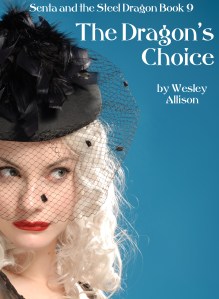
The Dragon’s Choice – available for Pre-Order

The Dragon’s Choice will drop on December 29th, 2017.  You should see pre-order availability in your favorite ebook stores soon.

The dragons seemingly have returned to the world and are once again in vying for power. Bessemer the steel dragon is worshipped by the reptilian lizzies, while the evil Voindrazius tries to put together a pantheon that he will control. Zoantheria, the coral dragon, feels pulled in all directions. Wanted both by Bessemer and Voindrazius, she is called to a world she has never known, her mistress, the sorceress Senta Bly encouraging her to take up the mantle of goddess. Her heart, however, is pulling her in a different direction, toward the young viscount Augustus Dechantagne. Which will prove stronger– love or destiny? Both Senta and Augie have their own problems, hers with teaching her wayward eponymous daughter the ways of magic, and him dealing with the yoke of leadership and a headstrong mother. Meanwhile, far across the ocean, the Dechantagne girls are taking Brech City by storm. Will one of them land a prince?

Pre-order for the Kindle at Amazon.

The Young Sorceress – Chapter 10 Excerpt

Isaak Wissinger leaned over the ship’s railing and stared down into the dark blue water. He wasn’t the only one. Dozens of other passengers on the S.S. Waif des Vaterlands were lined up to watch as half a dozen giant turtles, each larger than a kitchen table swam along apparently oblivious to the steel vessel chugging past them. They were large, but not nearly as amazing as the writer had expected, having heard for years legends of the monsters to be found in Mallon.

After leaving his employment with Herr Fuhrmann, Wissinger had taken the train from Butzbach to Friedaport, where he had worked on the docks until he had enough accumulated wealth to book passage, steerage class, to Mallontah. This had taken him several months, but at last he had set sail. Now, he had been on the ship for forty-five days. His daily meals consisted of porridge in the morning, a piece dried tack for lunch, and for supper a soup made of beans and rancid pork. It was infinitely better that his diet in the ghetto had been.

“Herr Holdern?”

It took Wissinger a moment to remember that he was Herr Holdern.

“Yes?”

He turned to find a greasy looking little man standing behind him. He didn’t recall seeing him before, and after a month and a half at sea, that was remarkable in and of itself.

“Do I know you?”

“I do not think so, but I know some Holderns. Do you come from Boxstein?”

“No,” replied Wissinger.

“Do you have relatives there perhaps?”

“Not that I know of. You know how it is. People move all around and lose touch. You meet someone with the same last name and they may or may not be related. My people come from Bad Syke, but who knows?”

“What is it you did in Bad Syke?”

“Oh, I’m not from Bad Syke. I still have cousins living there, I think. I grew up in Wahlstedt.”

“And what did you do there then?”

“Teamster.”

“A teamster?” said the greasy fellow. “I took you for a scholar.”

“I doubt you get calluses like this reading books,” said Wissinger, holding up his palms. “Why, I try to stay as far away from schools and books as possible.”

“I see.”

“But it is pleasant to meet you, Mister…”

“Spinne. Adolf Spinne.”

“A pleasure to meet you, Herr Spinne. Maybe we can talk again before we make port.”

“Perhaps,” said Spinne with an oily smile.

Wissinger turned and made his way through the portal and down several sets of stairs to his berth. His was one of twenty-five bunks stacked five high in the relatively small cabin. Most of his roommates slept at night, so he tried to spend as much time as possible outside at night, instead taking in a long morning and afternoon nap. He climbed into his bed, second from the top and pulled the sleeping curtains closed around him. He could hear the sounds of a woman moaning in passion close by. She was in the same room, but in one of the other bunk stacks. This wasn’t all that unusual. People grabbed what comfort and satisfaction they could, and there were very few places to find any real privacy on a ship as crammed as this one.

“Sweet music isn’t it?” said a husky voice near his head.

Before he could respond, the curtain surrounding him was pulled aside to reveal Zurfina’s face, framed in a shock of blond hair. She climbed up into the bed on top of him. There was no room to lie side by side even had that been her intention. He was surprised though not unhappy to find that she was completely naked, and let out a deep sigh as she rubbed herself up and down his entire length.

“Missed me?”

“Yes indeed.”

She kissed him deeply, letting her tongue explore every part of his mouth.

“Have you been true to me?” she asked as she kissed his neck and reached down to unfasten his pants.

“Yes,” he said, then sighed again as she freed him from his trousers. “Um, have you been true to me?”

She stopped and looked guiltily up at him, then shrugged.

“When you get to Birmisia, if you want, I’ll be true to you then,” she said, “for a while.”

“Oh, Lord help me, at this moment I really don’t care.”

The Young Sorceress – Chapter 9 Excerpt

Senta and Hero stepped through the great gate in the emergency wall just in time to see a fireball shoot across the square and crash into the second and third floors of Finkler’s Bakery. Patrons ran screaming from the ground floor as the upper floors took to flame.

“You stupid cow!” shouted Senta. “Why would you cast a fireball in the middle of town?”

“Oh my!” said Hero, when she saw who Senta was talking to.

Another Senta was standing in the square in front of them. This one was wearing a red dress. Hero thought she looked older than the Senta standing beside her, but then realized it was simply that she was a bit heavier.

“You stay out of this,” said the red-dressed Senta. “You take care of your business and I’ll take care of mine.”

“I don’t recall burning down the town as being part of anyone’s business,” replied leather-clad Senta.

She grabbed a glamour from the air next to her. It was one she had kept ever since Mayor Korlann’s house had burnt down. She pointed her hand and the air around the burning building was flooded with carbon dioxide, smothering the fire.

“I’m just sending a little message,” said the other Senta. “Look. Now you’ve let them get away.”

“Let who get away?”

“Graham and that girl he’s running around with.”

“He what now?” Senta looked at Hero, who shrugged. “Whatever’s going on, you have no business trying to kill Graham.”

“I’m not going to kill him. Only maim him a little bit.”

“Obviously the first thing I need to do is to get rid of you,” said Senta, waving her hands. “Teiius uuthanum.”

“Uuthanum,” said the other Senta, countering the spell. “You’ve got to be kidding. No copy is going to out-magic me. Uuthanum Teigor.”

“I thought she was the copy,” said Hero.

“Prestus uuthanum. She is the copy. Go stand out of the way. Ariana uuthanum sembor!”

A sticky mass of spider webs enveloped the red-dressed Senta. She struggled for a moment, falling to the ground. By the time she managed to dispel the webs, the leather-clad Senta had cast a charm spell on her. Stepping over, she looked down at the image of herself lying almost helpless on the ground.

“If you touch me, you’ll see,” said the prone sorceress, in a sing-song voice. “I’m the real Senta. You’ll just cease to exist.”

“Let’s see then,” said Senta, reaching down and touching a perfect copy of her own nose.

The red dress seemed to deflate as the Senta who had been wearing it dissolved and flowed up and into the hand of the standing sorceress.

“Nice,” said Senta, standing up. “A new dress. I was wondering how that was going to work out.”

“I should have known you were the source of the trouble,” said Saba Colbshallow.

He looked sternly at Senta from beneath his police helmet, his blue uniform, with the exception of the sergeant stripes, a match for those of the two constables that followed on his heels.

“I didn’t…” Senta started. “But she… Oh, bloody hell.”

“Come along with me to the station,” said Saba. “We’ll get all the details down in a report. But I can tell you right now that someone is going to be held responsible for the damage.”

The top floors of the bakery had been saved from the fire, but there was plenty of scorching on the outside walls and no one would be too surprised if some of the supports had to be replaced.

“Fine,” said Senta, and then turning to Hero. “See if Mrs. Bratihn can get this dress cleaned. Tell her I’ll come around for a fitting.”

The Young Sorceress – Chapter 6 Excerpt

Isaak Wissinger walked through the cobblestone streets of Magdafeld. He tried to be as inconspicuous as possible, but that was relatively hard to do on this particular morning because very few others were on the streets. Magdafeld sat high atop a hill in the center of a long flat plain, so even though it was spring, a chilly wind whipped about. He tucked his head down and pulled up the collar of “borrowed” trench coat. When the sounds of a chugging steam carriage approached from behind, Wissinger tensed. He watched carefully as it passed, trying not to seem as if he was watching carefully. The vehicle had an enclosed cab behind the driver, though it was easy enough to see that there was a man and a woman inside. The vehicle shot past him, but came quickly to a stop half a block away. Then it slowly backed up. Wissinger looked for a side street down which to escape, but there wasn’t one.

The car finally came to a stop next to him. He tried to continue walking.

“You there!” called a voice as a man climbed out of the car.

To his horror, Wissinger saw that the man wore the uniform of a Freedonian Army colonel.

“Halt.”

With a sigh, Wissinger turned around, affixing as convincing a smile as he could possibly manage.

“Yes? Good morning.”

“Where can I find a strudel shop around here?”

“Oh, I don’t know,” replied Wissinger. “I live on the other side of town. If you’re over there, Volker’s Bakery is the best.”

“What are you doing on this side of town then?”

“I’m visiting my cousin. She’s sick and I have to help with the kinders.”

“You have papers?” asked the Colonel.

“Of course.” Wissinger pulled out his forged papers. He had paid well for them, but didn’t really know just how good they were.

“Fritsie! Come on!” said a woman, who then poked her head out the car window. She was a gorgeous blonde in a red dress that left her shoulders bare. “I’m hungry!”

The officer looked back at her and grinned.

“Be on your way,” he told Wissinger, and then climbed back into the car and the woman’s embrace.

The writer hurried the rest of the way down the street, turning right at the first intersection he came to. This particular avenue provided a magnificent view of the surrounding countryside as it wound its way down the hill to the river dock and the adjacent train station. Even Wissinger, who was much more interested in watching for potential pursuers than sightseeing was suitably impressed. It brought a smile to him and a lightness to his step.

Any burgeoning happiness was squelched however when he reached the railroad crossing. Three Freedonian soldiers, an officer and two enlisted men carrying rifles, were checking papers of those who would cross the tracks either to reach the train station or the dock beyond. There was no way around and Wissinger needed to get on the ferryboat to go down the river. He took his place in line behind a woman in a green scarf. When he got within a dozen steps of the checkpoint, his stomach suddenly jumped up into his throat. The officer checking papers wore a four-legged fylfot on his lapel, with a matching symbol on a red armband. He was no mere soldier. He was a wizard of the Reine Zauberei.

“Papers,” said the wizard with a sigh, to the woman in the green scarf.

The woman handed the wizard her papers. He didn’t open them to read or examine them, but simply ran his hand over the outside cover. The papers glowed a sickly yellow for a moment.

“Where are you going, Mrs. Kraus?” he asked her.

“I’m taking the ferry to Rivenholz.”

“Your business in Rivenholz?” The wizard could not have seemed more bored.

“I’m having tea with my sister. I have tea with my sister every month. It’s still all right to have tea with one’s sister, is it not?”

The exchange was interrupted by the sounds of men shouting from the train a hundred feet up the track. Everyone at the checkpoint turned to see a man fall from one of the train’s doors and land flat on his back on the gravel below. There were more shouts, though what was being shouted was completely unintelligible. The wizard turned to the two soldiers.

“Go see what it is.”

The two riflemen dutifully trotted toward the parked train. A loud whistle rent the air, and the train on the other side of the station slowly started moving. It was headed toward Kasselburg and Bangdorf, the opposite direction that the ferry, and the other train, would be traveling.

“Say hello to your cousin, Mrs. Kraus,” said the wizard.

“My sister,” answered the woman, taking her papers and heading on her way.

Wissinger stepped forward and handed over his papers before being asked. As he had done before, the wizard placed his hand over them, causing them to glow sickly yellow.

“Your name?”

“Von Horst, Wilhelm Von Horst.”

“Ah, ritter?”

“My great-grandfather, on my mother’s side.”

In Freedonia a ritter was a knight, a rank which entitled a man and his descendants to add “von” to his surname, though the actual knighthood didn’t pass on through the family tree. Wissinger had reasoned that no one using forged papers would be so bold as to use the honorific and hence less suspicion would be thrown upon him. Looking at the wizard though, he now began to rethink that theory.

“And your name, Wizard?”

“Wizard Von Grieg.”

Von Grieg was just shorter than Wissinger, though much more heavily built. He wore his black hair cut short with long, close-cropped sideburns.

“And where are you off to today, Von Horst?”

“I have business in Tideburg.”

“So you are taking the train?”

“No. I’m taking the ferry. I’m not in a hurry.”

“I’ve never met a business man who wasn’t in a hurry.” Von Grieg handed him his papers. “Have a pleasant day, Mr. Wissinger.”

“Who?” asked the writer, but he knew it was no use.

He threw his papers as hard as he could into the wizards face and when the man ducked, he kicked him, knocking him down. Then he turned and ran. He heard the wizard speaking in Zurian. He dived and rolled across the ground just as half a dozen magical bolts shot over his head. Back on his feet, he turned and ran toward the train, the last car of which was just moving past the station platform. Wissinger ran up the steps to the platform and dived, just catching hold of the train car’s railing. He heard rifle fire behind him, but didn’t look back. He opened the door and entered the rear of the train, sat down in the rearmost seat, and closed his eyes.

It was ironic. In order to perform magic, the wizards had to speak the ancient language of the Zaeri, the same language he spoke in shrine. And yet, because Wissinger was an ethnic Zaeri, they wanted him locked away in a ghetto, or worse. It was at that moment that Wissinger decided he hated irony.

The Young Sorceress – Chapter 4 Excerpt

Isaak Wissinger bent down and picked up a paper from the street. At least he was still able to do that. Many of the people he saw passing him on the street seemed barely able to lift their own feet. He was still in the ghetto of Zurelendsviertel. He had been unable to get out. During the past eleven months, Wissinger had been forced to use the money that his guardian angel had given him to buy scraps of food. She had been right. When push had come to shove, the other Zaeri had helped themselves and their families, and not the famous writer they knew of, but didn’t really know.

The angel had not come back since that night. If Wissinger had not had the money to spend on moldy bread and mysterious meat, he would have thought that he had dreamed the whole thing. Of course there were also the stories. Stories had come into the ghetto from the outside world—stories about a mysterious woman. A blond woman had attacked Neuschlindenmacht Castle, burning it to the ground, though nobody knew exactly how. A powerful witch had fought and killed a dozen wizards of the Reine Zauberei on the streets of Kasselburg. A blond sorceress had freed hundreds of Zaeri prisoners held in a work camp and had killed or frightened off a company of soldiers guarding them. Wissinger carefully listened to the stories without adding his own experiences. There was nothing to indicate that these stories were about the same woman, or that they were even true. But Wissinger believed them.

“You’re thinking about me right now, aren’t you?” asked a sultry voice right by his ear.

Wissinger jumped. The woman was back. He looked up and down the street and realized that there was no one else to be seen. This was unusual. It was almost mid-day. He looked back at her. Yes, it was the same woman. She was dressed at least this time. Sort of. He tried to think where her black corset and leather pants would be everyday dress, but could imagine no such place in the world. She tossed her hair back and then took a pose with her chin held high, like a statue.

“Um, you’re back,” he said.

“Oh my. Here I was told that you were the greatest writer in Freedonia, and this is your introductory line?”

“What are you doing here?”

“Well now you’re just being thick,” she said. “I came back for you. You were supposed to be gone, out of the ghetto and to the coast at least.”

“I couldn’t get out. The Kafirite, Kiesinger, the one who smuggled some Zaeri out for money. The day after you were here, I mean in my room, he was arrested. He wasn’t arrested in my room, he was arrested… wherever they arrested him, but no one else took his place. There was no one else who would help, to smuggle me out.” Wissinger stopped speaking and realized he was out of breath.

“Relax lover. We’re leaving now.”

“Now?”

“Yes.”

“Wait. We have to go back to my room.”

She smiled seductively. “What a wonderful idea. I thought you might be more welcoming this time.”

“No, it’s just… it’s the middle of the day.”

“Yes?”

“Well, um… I… Aren’t we in a hurry?”

“You’re the one who wants to go back to your room.”

“I have to get my book.”

“What book is that?”

“My book. It doesn’t have a title yet. It’s about life here. It’s hidden in the wall.”

“Then let’s go get it.”

Wissinger led the woman down the cobblestone street to his apartment building and upstairs to his room. His building had been a fine middle class apartment twenty years earlier. Now it was rapidly falling apart from neglect. Holes had appeared in the walls and the floor. In one spot just outside his apartment door, he could see completely through to the floor below. In a way this was all fortunate. The crack in the wall next to the loose board, behind which he hid the tools of his trade, didn’t look out of place. Removing the board, he pulled out the tablet and pencil.

The tablet was the type children used in school. He had started at the beginning and had used every page. Then he had turned it over and had written on the backs of each sheet, in ever smaller script as the pages had become scarce. The pencil was the last of a package of twelve. Oh, how he had wasted his pencils at first, insisting on a sharp point, whittling each one back with his knife. When he had gotten to the sixth one, he had stopped such foolishness. He let the lead become as dull and round as a turtle’s head and had only cut back the wood around it, when it, like the turtle’s head, had become hidden inside. That was all over now.

He felt the woman press against his back. She wrapped her arms around his shoulders and licked the back of his neck. He turned around and kissed her deeply. She pulled him toward the cot, and he let her. He spent the last hour that he would ever spend on that horrible, worn, bug-ridden mattress making love to a beautiful woman.

“I don’t even know your name,” he said, as they dressed.

“It’s Zurfina.”

“Like the daughter of Magnus the Great?”

“Yes, exactly like that.”

“You’re not her, are you?”

“Yes. Yes I am.”

She slipped back into her boots and headed out the door. Wissinger stuffed his pencil in the pocket where he kept his penknife and tucked his tablet under his arm. A quick look around reminded him that he had nothing else of value. Quickly catching up with Zurfina, he followed her downstairs and out into the street. Even though the sun was still high, there was nobody to be seen. It was as if they were the only two people in the world. Down the street and around the corner, then down the main thoroughfare, they finally reached the twenty-foot tall wooden gate to the outside world. It was standing open and the guards who had always been there were gone.

“What’s going on?” Wissinger asked.

“It’s just magic.”

Once outside the gate, they wound their way through the city streets of Gartow. It was much nicer here. The buildings were in repair. The shops were open. But here the world was just as devoid of life and humanity as it had been inside the ghetto.   In no time at all they were past the edge of town. They stepped off the road and crossed the first field of many that filled the space between the city and the distant edge of the forest.

“Zurfina, how is it… oh… um.”

“What is it?”

“I just remembered that according the Holy Scriptures, Zurfina… that is the daughter of King Magnus, was burned at the stake.”

“Fine, I’m not her then.”

“But your name is Zurfina, isn’t it?”

“I’m tired of all your questions,” she said, stopping and glaring at him. “It’s been nothing but questions with you since I got here. What’s going on? Who are you? Can I be on top?”

“I’m sorry.”

“One more question and I’m leaving.”

“No. I’m sorry. No more questions, I promise,” said Wissinger. “Just tell me which way I am supposed to go.”

“That’s it!” she snapped, and with a flourish of her hands, she disappeared with a pop.

“I didn’t… that wasn’t a question… I phrased it…”

A sound drew Wissinger’s gaze to the sky. A flock of small birds flew overhead, twittering as they went. Then he heard the sounds of voices, and looking toward town, he could see people. A steam carriage chugged down the now distant road. It was as if the world had suddenly come alive. Dropping to a crouch, he looked around to see if there was anyone close. He could detect no one. Staying hunched over, he made for the forest as fast as he could.

The Young Sorceress – Chapter 3 Excerpt

Senta watched as the last pallet of copper was placed inside her rented warehouse by a lizzie crew working steam jacks. The copper was made up of oval ingots about a quarter inch thick, dozens of which were packed together in crates and then the crates had been stacked together on wooden pallets. The copper barely filled one corner of the warehouse, but occupying the rest was an enormous pile of pillows. Not all of the pillows were new. In fact most weren’t. But it looked a comfy enough pile to take a run at and jump into.

A loud whomp on the pavement next to the Drache Girl signaled the arrival of Bessemer, the Steel Dragon. The lizzies in the area reacted immediately, though not all in the same way. Some scurried away, some placed their hands in front of their dewlaps in a respectful greeting, and a few dropped to their knees in genuflection.

“I hate when they do that,” said Bessemer.

“Kisses,” said Senta, and the steel dragon bent his neck toward her, air kissing first on one side of her face and then the other.

“Oh, good. My copper is here,” said the dragon.

“Your copper? What are you going to do with copper?”

“Make pots of course. You put the copper ingot in a steam press and turn it into a pot or a skillet or even a kettle.”

“What do you know about making pots?”

“I read. Some people could do a bit more of that.”

“I’ve been busy, but I’m planning on reading a bit today.”

“Do tell,” said the dragon. “Anyway, why did you call me down here?”

“You need a place to sleep. Well, here it is. I’ve brought all your pillows down and got you a few more besides.” She saw Bessemer’s dubious look. “It’s just till we find something else.”

“Did you bring Mr. Turtlekins?” Bessemer refused to sleep without his well-worn stuffed turtle.

“Yes, he’s in there somewhere.”

“Still, I don’t know. It’s awfully noisy down here so close to the docks.”

“It’s very quiet at night.”

“I don’t just sleep at night.”

“You could sleep through an explosion. I’ll tell you what though. I’ll come down and sleep here with you for a few nights, until you get settled in.”

“That’s nice. I miss crawling into bed with you when it gets cold at night.”

“Yes well, that’s why I had to get a new bed. Anyway, it’s a bit too crowded at home.”

“What do you mean crowded? You’re the only one there, aren’t you?”

“Never mind.”

“Well, I’ll try it out,” said the dragon, stepping inside the warehouse and sliding the large rolling door almost closed. He poked his head out the small remaining opening. “You’ll be back tonight?”

“Yes.”

Bessemer pulled his head in and shut the door. Senta turned around and was almost immediately confronted by Graham. He had a big grin on his face.

“I’ve got it.”

“Got what?” she wondered.

“Your token.”

“Token of what?”

“Token of my affection… you know, like you said.”

“I did? Oh, sure I did. Okay. What is it?”

Graham held out a small box. Senta took it and carefully opened it to find the interior lined with velvet. Right in the middle was a silver pendant in the shape of a dragon on a thin chain.

“It’s real silver… mostly,” boasted Graham. “It’s a real silver chain and the dragon is covered with silver, but it’s made out of… and this is the best part… a tyrannosaurus tooth! Do you get it? Dinosaur for me and dragon for you—it’s like the perfect symbol for us.”

“Yeah, that’s pretty ace all right.” Senta was quite sincere in her appreciation for her boyfriend having come up with an acceptable gift, especially considering his lack of romantic proclivity up to this point. “Help me put it on.”

Pulling the necklace from the box and promptly dropping the box on the ground, Graham draped the necklace around Senta’s neck as she turned around. He fumbled with the latch for a minute, but at last the silver form of the dragon pendant rested comfortably on her blue dress over her heart.

“Thanks,” she said, turning around.

“When do I get mine?”

“Am I supposed to buy you a necklace too?”

“No. When do I get my, you know…” his voice grew quiet. “My kiss.”

“How about right now?”

The boy turned around to see if they were unobserved, but as was so often the case anywhere the young sorceress went, quite a crowd of people were encircled about them, too afraid to get too close, but too curious not to stay and watch.

“Maybe tomorrow. You’re still cooking dinner for me at your house, aren’t you?”

“Am I? I mean of course I am. But you don’t want to wait all the way until then, do you?”

“I think it might be better.”

“Excuse me,” said a voice from behind them.

Graham and Senta turned to look into the freckled face of a young woman. She had evidently just come off one of the ships in port. She wore a long traveling coat over a white blouse and brown dress. A brown bonnet held back bright red hair, a few strands of which escaped to hang down on the side of their face. In her right hand she grasped the handle of a small carpetbag.

“Do either of you know your way around town,” asked the girl.

“Sure,” replied Graham. “What are you looking for?”

“I don’t really know. I’m new here. I don’t have a place to stay yet and I’m not sure where I should go to find one.”

“I’ll help you. I’m Graham Dokkins.”

“I’m Nellie Swenson, girl reporter.”

“Are you supposed to be famous or something?” asked Senta.

“I’m pretty well known back in Brech. The Herald Sun is the most widely read news broadsheet, and I have a weekly column.”

“Who’s writing it now then?”

“Oh, I wrote enough extra columns to fill out a whole year, though I’m kind of sorry I’m not going to get to see the reaction to my story on orphanage abuses or the one detailing the stunt of my jumping from a dirigible. I’m here to see Birmisia Colony and I’m keeping a journal of my adventure. It should provide at least a year of new columns.”

“Come on, I’ll take you to the new arrivals bureau,” offered Graham.

“That would be lovely, but aren’t you going to introduce me to your friend?”

“Oh, that’s just Senta.” Then to Senta he said, “I’m going to help Nellie get situated. I’ll see you later.”

The boy offered the new arrival his arm, which she took, and the two of them started up Seventh and One Half Avenue. Senta’s eyes bored holes in their backs, and she absentmindedly punched her left palm with her right fist.

The Young Sorceress – Chapter 2 Excerpt

Isaak Wissinger sprang suddenly from his cot, motivated by a particularly enthusiastic bedbug. He was immediately sorry, as the pain in his back was exacerbated by the sudden movement. He looked back down at the vermin filled, inch thick mattress, a few pieces of straw sticking out of a hole in the side, sitting on an ancient metal frame. It was a sleeping place not fit for a dog. Then he laughed ruefully. That was exactly how he and every other Zaeri was thought of here—as dogs.

The Kingdom of Freedonia, like the rest of the civilized world was divided in two. There were the Kafirites, who ruled the world. And there were the Zaeri, who had long ago ruled it. Two thousand years ago, Zur had been a great kingdom, one that along with Argrathia, Ballar, and Donnata ruled the classical world. Then a single dynasty of kings, culminating in Magnus the Great, had conquered the rest of the known world, and made Zur civilization the dominant culture.   Zaeri, the Zur religion, with its belief in one god, had replaced the pagan religions of the civilizations that Magnus and his forebears had conquered. Even when Magnus’s empire had splintered into many successor kingdoms, the Zaeri religion had remained dominant.

Then a generation later, a Zaeri imam named Kafira had begun teaching a strange variation of the religion in Xygia. Kafira had taught the importance of the afterlife, an adherence to a code of conduct that would lead one to this afterlife, and a general disregard for the affairs of the world. Her enemies had destroyed her, but in so doing they had made her a martyr. From martyr, she rose swiftly to savior and then to godhead of a new religion, one that had spread quickly to engulf all that had been the Zur civilization. In the following millennia, the Kafirites had converted the remaining pagans to the creed of their holy savior, thereby making it the only religion in the world of man—the only religion in the world of man save those who held onto the ancient Zaeri belief.

Now here in Freedonia it was no longer safe to be a Zaeri. First it had become illegal for Zaeri to be doctors or lawyers, and then actors or publishers. Then laws had been passed which made it illegal for Zaeri to own businesses or property. Finally entire neighborhoods became forbidden to Wissinger’s people and they had been pushed into ghettos, segregated from the other Freedonians.

Wissinger spent the day picking up garbage on the street. That was his job here in the ghetto. He had been an award-winning writer when he had lived in Kasselburg, but here in Zurelendsviertel he walked the street, a silver zed pinned to his jacket, picking up refuse. At least people didn’t treat him like a garbage man. The other Zaeri knew him and respected him. They asked his opinion about things. They called him “professor” when they spoke to him. It was not like that at all with the Freedonian soldiers who occasionally made a sweep through the ghetto. They would as soon kick an award-winning writer to the side of the road as they would a street sweeper.

Back once again in his room, he pulled his tablet and pencil from its hiding place behind a loose board and continued writing where he had left off the day before. He could not live without writing. He wrote down what had happened that day, what he had seen, what he had heard. He wrote about the death of Mrs. Finaman, brought on no doubt by lack of nutrition, and he wrote about her husband’s grief at the loss of his wife and his unborn child. He wrote about the sudden disappearance of Mr. and Mrs. Kortoon, and the speculation that they paid their way out of the ghetto. And he wrote about the disappearance of the Macabeus family, and the speculation that something sinister had happened to them.

That night on his uncomfortable cot, Wissinger had a wonderful dream. He dreamed that a beautiful woman was making love to him. She licked his neck as she rubbed her naked body against his. She whispered to him in some foreign language—he thought it was Brech. When he managed to pull himself out of the fog of sleep, and he realized that it wasn’t a dream, that the woman was really here with him, he tried to push her off of him.

“Don’t stop now lover,” she said, a noticeably Brech accent to her Freedonian. “I’m just starting to really enjoy myself.”

Wissinger pushed again, and slid his body out from under her, falling to the floor in the process. She stretched out, lying on her stomach. He stared at her open-mouthed. Her long blond hair didn’t quite cover a fourteen-inch crescent moon tattoo at the top of her back. Another tattoo, an eight-inch flaming sun sat just above her voluptuous bottom.

“Who are you? What are you doing here?”

“I would have thought that was obvious,” she replied in a sultry voice. “I’m here to warn you.”

“You… uh, what?”

“I’m here to warn you.”

She rolled over and stood up, revealing six star tattoos all over her front.

“In a short while, maybe a few weeks, the food supply to the ghetto will be reduced. It will be reduced a lot.”

“They barely give us enough to survive on as it is. They can’t cut it back anymore.”

“They can, and they will.” She stepped closer to him. “They are going to try and starve the Zaeri to extinction.”

“They won’t be able to.”

“No, it’s true, in the end they won’t. But they will try and many will die. Even worse things will follow. Do you know how to get out of the ghetto?”

“I can’t leave. People need me here.”

“No they don’t. People like you, but they don’t need you and they won’t help you when things get very bad. You have no family and when it comes to eat or starve, you won’t have any friends either—no one will. I ask you again; do you know how to get out of the ghetto?”

“They say a Kafirite named Kiesinger will get you out if you can pay, but I don’t have any money. I didn’t have any before I came here.”

“Here.”

The woman handed him a small leather pouch, though he had no idea where she could have had it hidden. He looked inside. There was a small roll of banknotes and twenty or so gold coins.

“Brech marks?”

“Gold is gold. I don’t know if the banknotes are worth much, but they’ve got to be better than Freedonian groschen.”

“No doubt,” said Wissinger. “Why? Why are you helping me? I mean, me in particular.”

“You need to survive. You need to leave Freedonia and make your way to Birmisia.”

“Birmisia? That’s on the other side of the world. How could I get there? What would I do there?”

“Live. As for the how, we’ll deal with that later. Now you’ve wasted all my time talking when we could have been doing something far more satisfying.”

“You’ve only been here a few minutes.”

“Yes, but I have much to do. Go see this man and get out of the ghetto. I’ll find you again at a later date, hopefully, in a more hospitable mood.”

“Who are you? What are you? Are you my guardian angel?”

The woman smiled. “That is exactly what I am.”

Then with a wave of her hand, she disappeared with a pop.