Amathar – No phones, letters.


I had Amathar in my head for many years before I started writing it. In many ways, it is the perfect world that I pictured when I was a teenager. It still reflects quite a few of my own personal feelings about the technological world. I have always hated talking on the telephone. I don’t know why, I just do. My cell minutes are usually in the single digits for any given month. I suppose that it’s no surprise then that there are no phones in Amathar. The Amatharians don’t like to hear voices that don’t have a face with them. They don’t have radios or any long-distance communication. This has the added storytelling benefit of leaving our hero alone without any way to contact help. On the other hand, I like to write. The Amatharians all love to write. Hardly any Amatharian reaches adulthood without having written at least one book, and they communicate extensively by letter. The letters are sent through vacuum tubes to each house, like we have at the bank. I have always been fascinated by those tubes. When I was in the hospital a few weeks ago, I saw that they used them to send records from one floor to the other.

Amathar – Amatharian Subway

One of my favorite features of Amathar is the subway.

Just as the station was atypical of what I would expect of public transportation, so too was the train car. It was furnished more like a living room, or a comfortable den, than a public transportation system. There was a piece of furniture very much like a sofa, a small table in front of it, and a several very comfortable chairs. The sofa and chairs were covered with material that was patterned after animal skins, though it appeared to be man-made. Most surprising of all, there was a large bookcase against the back wall, filled with books. I stepped over to the small library once the subway had started into motion, and pulled one of the books from its place.

The book was very much like the book of Amath’s teachings which Norar Remontar had previously shown me. It was a bound volume with a spine, and it had a cover made of leather. The pages were made of a material something like plastic. They were thin and they could bend like paper, but they had a strength far beyond any paper product. The entire book was written in Amatharian, which of course I was unable to read, but the lines and letters seemed to be laid out in a familiar fashion. As I had noticed, the characters resembling simple line drawings of stylized animals and other almost familiar images. After staring at it for a moment, I almost thought that I could see tiny predators ready to pounce upon their prey.

“Is this a private transport car?” I asked, replacing the book.

“This shuttle train belongs to the air clan,” Norar Remontar replied, “though they make it available to anyone who needs transportation.”

“I am surprised that it doesn’t become damaged, or that the books and other furnishing aren’t stolen,” I said, noticing several small art objects atop the table, and hanging on the walls.

“Why would some one take something that wasn’t his?” the Amatharian wondered. “Of course there is a great deal of wear because of the number of people who travel on the train. That is why we must all take extra care, to see that this property of others is not needlessly damaged.”
I looked, but couldn’t find any more wear and tear than one would find in the average living room.

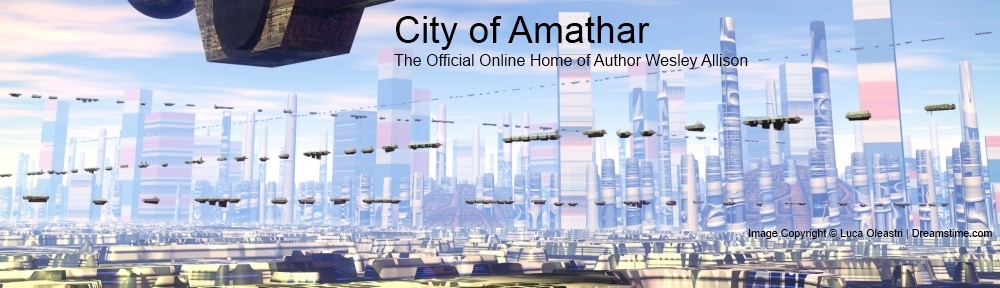
Amathar – The City of Amathar


The city of Amathar is huge– roughly the size of the continental United States or say, Australia. It is round and has a great wall around it. I have always been fascinated by city planning, especially when done long in advance of need. You can see analogs of Alexander laying out Alexandria in several of my stories.

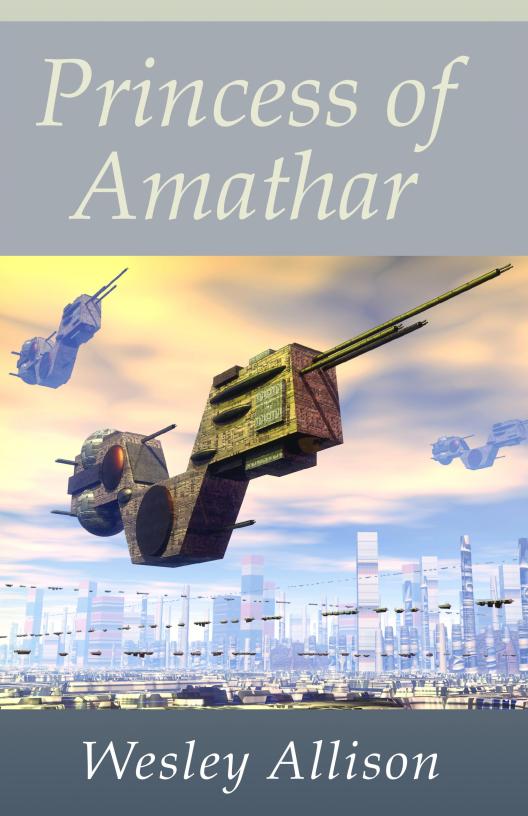
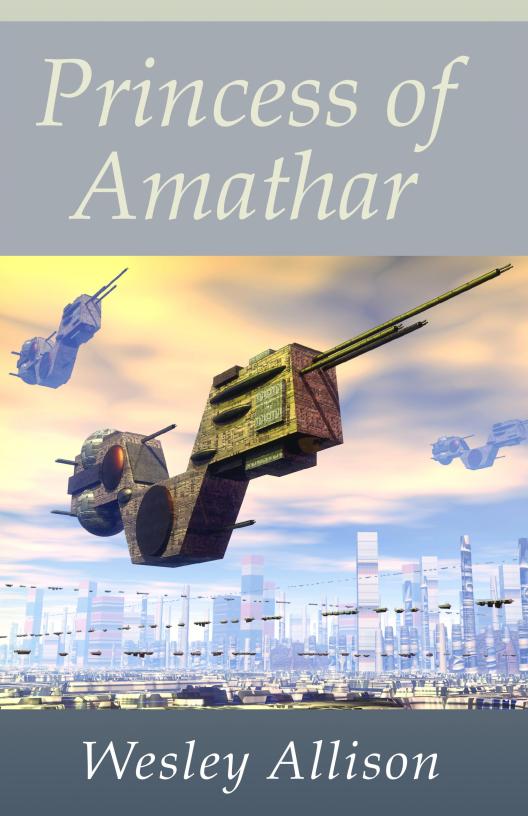
I looked through the forward view port and felt my stomach drop away. Since coming to Ecos, I had come to expect things on a grand scale– seemingly endless plains, forests so dark and thick they seemed to block the sun, vast seas and broad rivers, huge flying battleships– but nothing had prepared me for the city of Amathar. Ahead of us was a wall that stretched to the left and right as far as the eye could see. Seemingly held within this wall was a city, straining to be free of its confines. It was a city of tremendously high buildings, tall towers, and massive constructions of bizarre shape and ungodly dimension, painted with a rainbow of pastel colors from red to blue with bits of silver and gold. The city seemingly went on forever into the distance, rising up into the horizon until it became a part of the sky.

“Just how large is Amathar?” I asked.

“The city wall is a circle two thousand five hundred kentads in diameter.”

That information took several moments to compute, and at least that long to comprehend. According to my admittedly incomplete knowledge of Amatharian measurement, twenty five hundred kentads was the equivalent of two thousand miles. This seemed beyond belief, and I questioned it, but the three Amatharians confirmed my figures. Here was a single city that would, had it been located on my home planet, have almost completely covered North America.

Senta and the Steel Dragon – Hexagon Park


One of the most famous places in the capital city of Greater Brechalon is Hexagon Park.

Pushing herself regretfully away from the glass, and leaving two hand smudges, a forehead smudge, and a nose smudge, Senta ran across Prince Tybalt Boulevard, which crossed perpendicularly, making a “T” at the end of Avenue Phoenix. She ran in a zigzag motion to avoid being run over by any of the numerous steam carriages which whizzed by. Several of them honked at her with a loud ‘ah-oogah’ but none of them ran over her. And then she stood at last on the edge of Hexagon Park. Senta had no idea that Hexagon Park was so named because of its six sided shape. She didn’t even know what a hexagon was. She did not realize that Hexagon Park was the exact same size and shape as the Great Plaza, where Café Carlo was located. To her, the park had always seemed so much larger. Nor did she know that the park, the plaza, and the rest of the “Old City” had been laid out and marked, using a stick dragged through the dirt, by Magnus the Great, the King of the Zur, when he had conquered the continent almost nineteen hundred years before.


Hexagon Park was lovely in the spring. This eight hundred yard diameter wonderland was filled with delights. At the south end, to Senta’s right, the park was carefully cultivated, with large rose gardens, numerous small beds full of colorful annuals, ancient fountains spraying water from the mouths of mythical animals or pouring water from pitchers carried by statues of naked women, abundant fruit trees now in bloom behind their own little wrought iron fences, and still reflecting pools filled with tadpoles. At the north end, to Senta’s left, the park was kept more natural, with large expanses of beautifully green grass, large shade trees, now filled with more than enough leaves to do their duty, winding pathways, and small ponds full of colorful fish. Senta headed for the center of the park, following the flagstone path that led to the central courtyard. Here was a small amphitheater, a series of park benches arranged around a mosaic map of the kingdom inlaid in the pavement, and the wonderful, wonderful steam-powered calliope, which played joyful music from mid-morning to mid-afternoon.


The calliope, which had been between songs as Senta walked through the park, began toot-toot-tooting the next tune, just as she arrived in the center courtyard. Senta had heard this tune many times, though she didn’t know its name. It was lively and bouncy and made her feel even more like skipping than she usually did. The growls of hunger from her stomach overcame the urge to skip down the paths of the park though, so she sat down on one of the benches, unwrapped her red plaid bindle, opened the wax paper, and stuffed her sandwich into her mouth. Mouth watering with each bite of the course bread, the salty ham, and the tangy brown mustard, she had finished off more than half of it before she stopped to take a breath and to look around her.


There were numerous people in the park, walking down the paths, admiring the flowers, and lying on the large swaths of green grass. Several small boys, about five or six years old, tried to catch tadpoles in the reflecting pool some forty yards away. There were relatively few people in the central courtyard though. The calliope man was there, making small adjustments to the great machine. It was a large, square, red wagon upon four white wood-spoked wheels, with a shining brass steam engine, which bristling with hundreds of large and small brass pipes, each spitting steam in turn to create the wonderful music. A young man in his twenties—nicely dressed but not obviously rich—sat reading a newspaper while he ate fish and chips from a newspaper cone, which he had no doubt purchased from a vending cart just outside the park boundaries. On the bench closest to the one on which Senta sat eating, was an older man in a shabby brown overcoat. He was tossing bits of bread to several of the foot-tall flying reptiles that could be found just about everywhere in the city. Unlike birds—tending in these parts to be smaller—which hopped along when not in flight, these fuzzy, large-headed reptiles ran from bread crumb to bread crumb, in a waddling motion, with their bat-like wings outstretched.

The name and shape of Hexagon park is a nod to my background of role-playing, having drawn many maps on hexagon paper.
Senta and the Steel Dragon – The United Kingdom of Greater Brechalon

The United Kingdom of Greater Brechalon is the country from which most of the characters in Senta and the Steel Dragon come. It is a fantasy analog of Edwardian Great Britain, with a few steam punk elements thrown in. Magic exists and wizards are relatively common, though they are usually employed by the military or the police. Sorcerors are more scarce. Steam travel is common as are telegraphs and gas lighting.

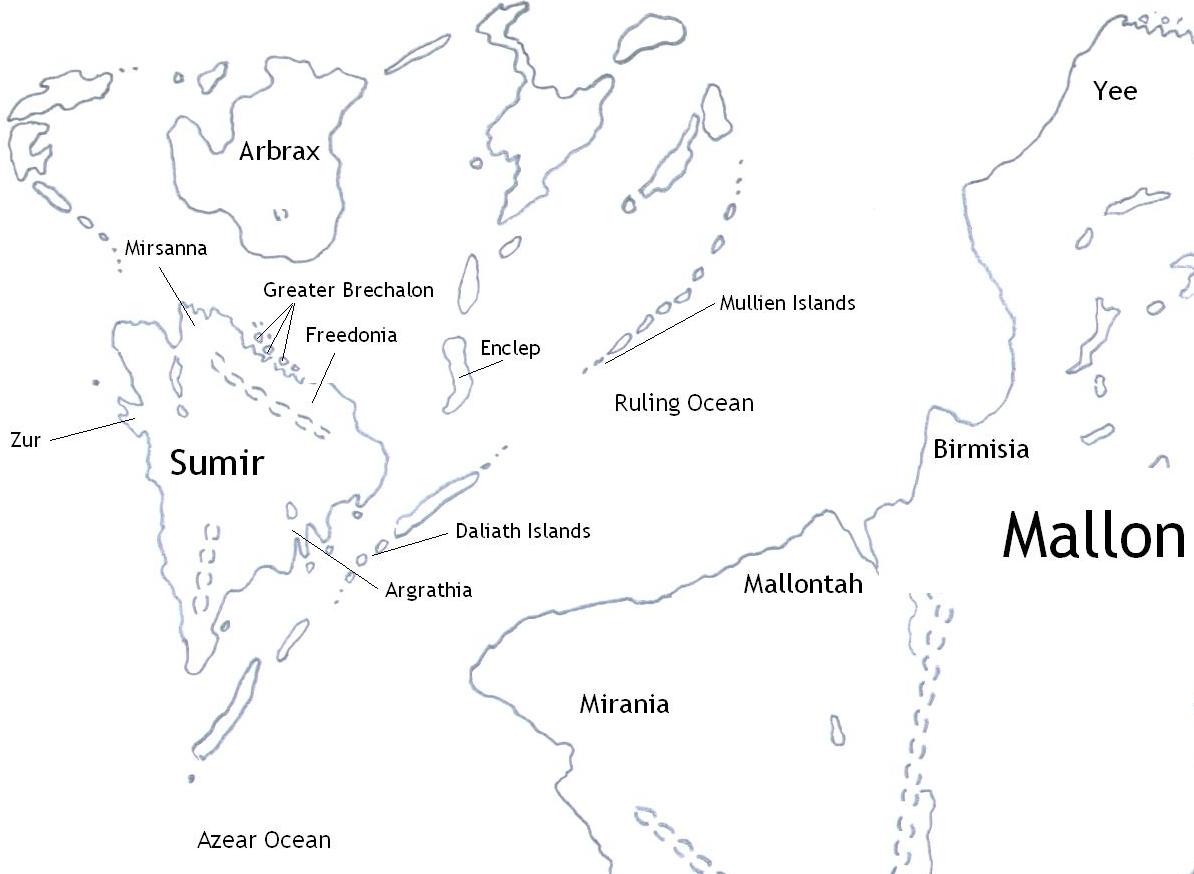
The UK is made up of three large islands and several small ones and possesses the world’s most powerful navy. Its traditional enemies are the Kingdom of Freedonia and the Kingdom of Mirsanna.

Senta and the Steel Dragon – Sumir

Sumir is a continent that though roughly the size of Africa, is never the less one of the smallest continents of the world of The Steel Dragon. It is the home of mankind. It is where the United Kingdom of Greater Brechalon, Freedonia, Mirsanna, and the other human countries can be found. From Sumir, humans have begun to reach out and colonize the rest of the world, including the continent of Mallon.

The Steel Dragon – Setting Part 3

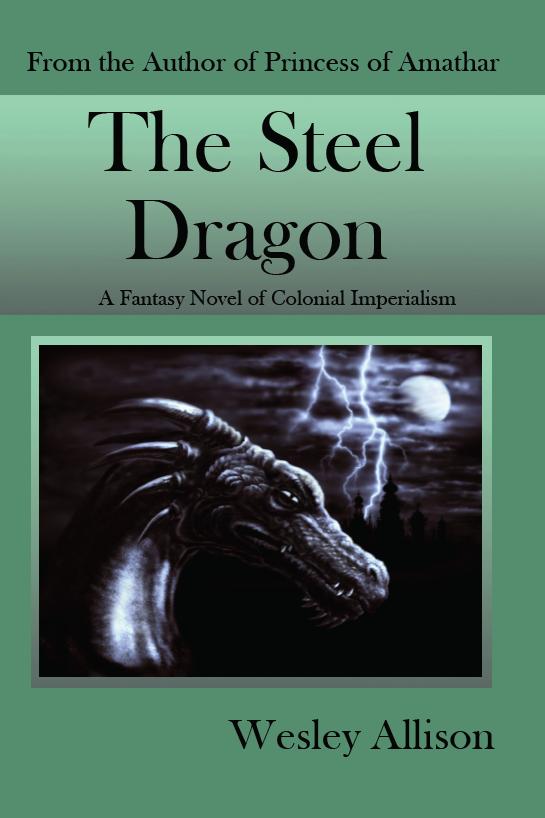
The Steel Dragon is the story of a group of settlers founding a colony in a distant mysterious continent. It is a fantasy world and I could name the continents and countries anything that I wanted. I really don’t remember where some of the names came from now. Mallon is the continent in which the story takes place. I think of it geographically as China. The colony is set up in the country of Birmisia and there is another distant colony in Mallontah. I think of them as China and India, respectively. Physically, culturally, and socially, these lands are not anything like Asia, India, or China, but putting them in that frame helped me imagine how settlers from a continent similar to Europe might see them.

His Robot Girlfriend – Setting

My next novel, His Robot Girlfriend, is a fairly straight forward science fiction story. It takes place in a fictional southern California town, although the characters make trips to LA, Vegas, and other places. I wanted to place it far enough in the future that robots might be common, but near enough that things would still feel familiar. I decided on the year 2032, which is great because it would be an election year and an Olympic year, so I can play with little things that happen this year, tweaking them to make the fit my ideas. I looked up 2032 on the internet, found a calendar for the year, and there you go. I also used the internet to research floor plans for houses that I could use.

The Steel Dragon – The Setting

The Steel Dragon is the story of a world not too different than our own Victorian/Edwardian age of Colonial Imperialism. This world however is different because in the past, mythic creatures like dragons were common. Magic is still present. In an age of steam power and rifles, wizards are sought after for service in the army and navy. In this world, the continent of Sumir is the place of origin and primary home of humanity. The people of Sumir have begun to colonize the rest of the world, which up until now, was dominated by non-human creatures.

I began creating this world, by imagining a world larger than our own, with more land as compared to ocean. I cut out a shape that I imagined as this world’s Pangia, then tore it to pieces and moved them around to simulate continental drift. When I was done, I set another piece of paper over them, and traced the outlines of the landmasses. Then I made several more drawings, attempting to make each of them more true to life. It helped that as a child, I liked to sit and look at the atlas.