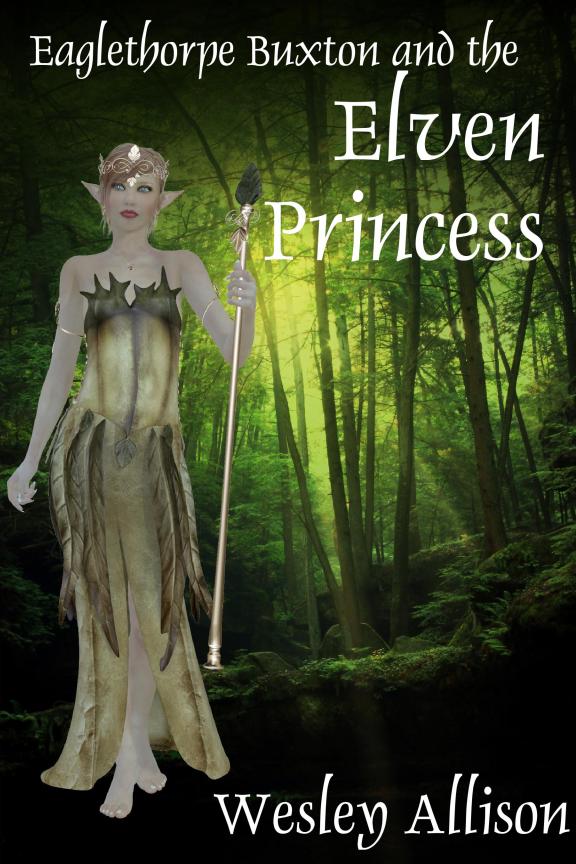
Eaglethorpe Buxton and the Elven Princess – Chapter 16

Chapter Sixteen: Wherein we travel for two days without may companion uttering a single word.

Jholeira curled up in my blanket next to the fire and went to sleep without another word. I didn’t think this strange, but when she did not deign to speak to me the following morning I began to feel a little put off. I decided that if she wasn’t going to speak to me, then I wouldn’t speak to her either. We packed up and left our campsite in complete silence. By elevenses I was getting rather tired of the quiet. Over a brief meal of raisins and cheese I tried first to coax her and then to trick her into speaking. She would have none of it however and I eventually stopped trying.

The little path that we followed wound down through a series of small valleys, eventually coming to the stream. The trees grew thick on both sides of the stream and indeed on the far side there was a vast expanse of forest that is Elven Wood. The stream itself was no more than twenty feet wide and its broadest expanse and in those places where it widened out thus, it was only a few inches deep. Though the banks were icy, the water was clear and free-flowing. Upon reaching it in late afternoon, we followed it southeast until, finding a narrow spot where the water deepened to several feet, I stopped to drink and look for fish.
The greatest skill I ever learned, with the single possible exception of story-telling which is more of an art form than a skill, is that of guddling fish. Fish which have swum up the shallow part of a stream, will often take shelter under a rock or a ledge when they come to a deeper and slower moving part of a river. When they do, they become prey for the guddler. He reaches his hand under the ledge, knowing where a fish ought to be, and carefully locates the fish’s tail. Then he begins tickling the fish with his finger, tickling its tail, then tickling its belly, and finally tickling right under the gills. Then with a quick grasp, he pulls the fish from the water and tosses it up onto the shore, ready to be cleaned, cooked, and eaten. If the temperature of the water made the fish sluggish, you couldn’t tell it by the ones I found, though it didn’t do me any good sticking my arm in. I caught two lovely river trout that day, one which I cleaned and cooked over the fire for our supper, and the other which I kept captive by running a string through its gill, and tying one end to a sapling, and tossing the other end, attached to the fish, back in the water. This second fish we ate for breakfast.
It was late the following afternoon before we reached the intersection of the stream with the East Road. By this time I had resolved myself to the fact that my little orphan boy/girl was never going to speak to me again, but as we crossed the small bridge which spanned the juxtaposition of the road and the stream, as bridges are wont to do, she at last broke her silence.
“We should spend the night on this side of the stream.”
“Why?”
“The forest is dangerous, especially at night.”
“I don’t care,” said I. “I’m not talking to you.” “Yes you are,” she replied.
“No. I am not.”
“I was not talking to you, but now I am. But you are definitively talking to me.”
“No, I’m not.”
“Yes you are.”
“I’m not talking to you. I’m just telling you that I’m not talking to you.”
“That means that you are talking to me, because in order to tell a person something you have to talk to them.”
“No you don’t.”
“Now you are just being contrary,” said she.
“No I’m not.”
“Fine,” said she. “I don’t care whether you are talking to me or not…”
“Yes you do.”
“I don’t care whether you are talking to me or not and I don’t care whether you are being contrary or not. In either case we should spend the night on this side of the stream.”
“No we shouldn’t,” said I.
“No?”
“No.”
“Why not?”
“Because,” I explained.
“Well as long as your reasoning is sound,” said she.
“No it isn’t.”
We spent the night on the west side of the bridge, just at the edge of the trees on that side of the stream. By the time we made camp, it was too late for me to find any fish to guddle, so we ate dried beef and drank coffee for our supper. Jholeira curled up in the only blanket while I snuggled up in my coat and set my head upon a large flat rock to use as a pillow.
“Are you cold?” she asked.
“No.”
“I’m sorry I stopped talking to you. You have been a very great help to me and you didn’t have to and here I am wrapped up in your only blanket while you have nothing but your coat to keep you warm.”
“I have the fire. Besides, it is only fitting that you have the blanket, being an orphan or a girl or a princess or some combination of the three.”
I stayed awake quite late watching the stars and listening to Hysteria complain about her lack of oats. She should have happy, as in that particular spot by the bridge there grew not only an abundance of grass but some early flowering szigimon, which any stable master can tell you is the very best horse feed in the world. Many times she has had to make due with busy grass, which is the least best horse feed in the world—not that it is bad for horses, but it does nothing more than give them something to chew on and doesn’t provide any real nourishment. You would think by now she would know when she had it good.
“What are you doing?” asked a small voice from the other side of the campfire.
“I’m pondering horse feed,” said I.
“Well, go to sleep.” It must have been some kind of elf magic, because no sooner had she said this than my eyes closed, seemingly of their own volition.

Amathar – Recycling & Repairing

Kate S. pointed out a feature of Amatharian society that I had actually forgotten about– recycling. Everything in Amathar is recycled from the clothing they wear to the massive aerial warships. I honestly don’t think a society of billions of people is truly sustainable in the long run if they don’t figure out how to recycle or reuse their waste products.

In addition, the Amatharians repair everything. We forget that just a few years ago, almost every town in America had an appliance repair shop that fixed everything from electric fans to toasters. In 1955 you might pay $25.oo for a new toaster, but you could get yours repaired for 50 cents. Today you can buy a similar product (not exactly, because toasters were made much better in the 50s) for $20.00 but it would cost you $125.00 to get it repaired. The Amatharians don’t have that problem. They don’t have money. Young Amatharians learn how to repair things as training for later making things and inventing new things.

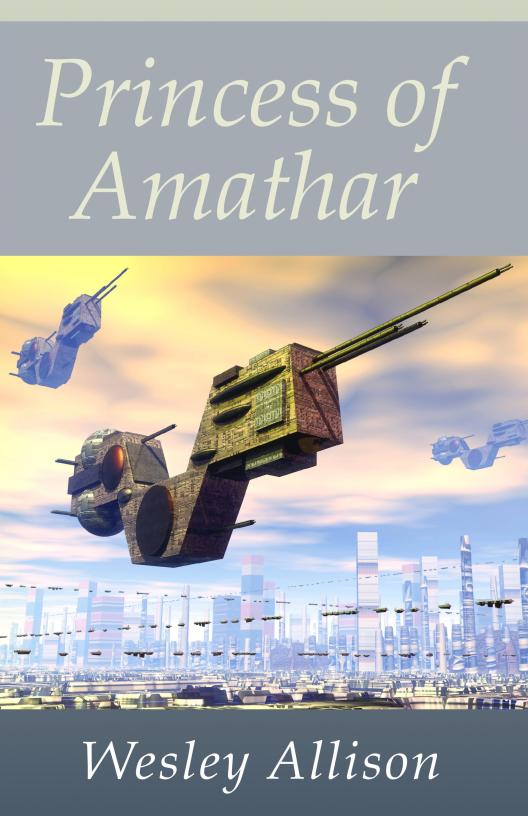
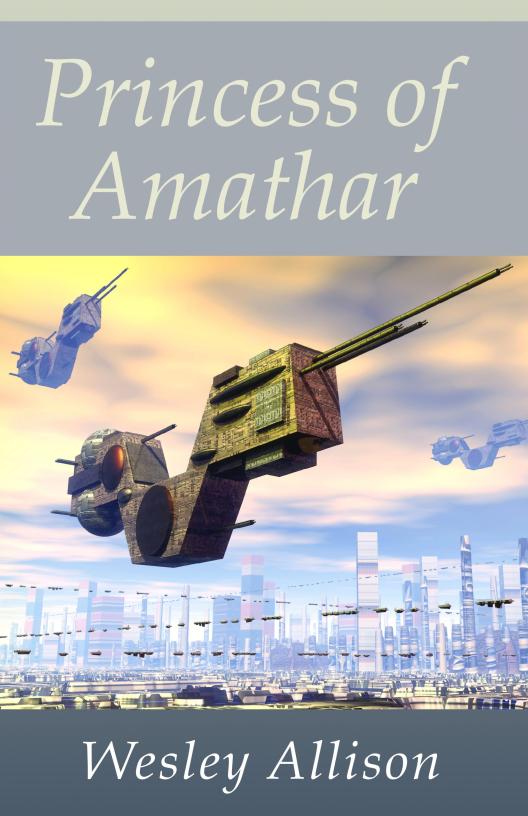
Princess of Amathar – Chapter 27 Excerpt


When Noriandara Remontar and I finally felt we were well provisioned enough for a relatively long sea voyage, we pulled the raft down to the water and placed all of our supplies on it. Then we climbed on. There was just barely enough room for us and our things, and it was impossible for both of us to lie down and sleep at the same time. It was planned that we would take turns paddling and resting. At first we both paddled to get away from the shore, and it was only after the edge of the water was only a dim line in the distance that we settled into our rotation.
The reflected sun on the water made the air a little warmer than it had been for us on the shore. At least that is my explanation for it, not being a meteorologist myself. It was by no means uncomfortable though. Indeed, if it had been a more comfortable vessel in which we found ourselves, I would have thought this the most pleasant of vacations. The water was cool but it was difficult to see down into it more than a foot or so. Perhaps this had something to do with the salt content. When the job of rowing became overtaxing, the Princess would remove her tabard and boots, and slide over the side of the raft into the water to cool off. I did this too on occasion, though more often I would simply scoop out a basket full of water to poor over my head. There was something unwholesome about an ocean with no fish. I had little problem swimming around in the Pacific Ocean near Catalina Island on Earth despite the fact that it is the summer feeding grounds for the Great White Shark– not that I didn’t think about them. At least there, they had plenty of sea lions and fish to choose from. Here in the fishless water, if some great voracious creature decided it was hungry, it didn’t have much from which to choose. The Princess and I were, not respectively, the main course and desert.
“How large do you suppose this sea to be?” I asked my companion.
“I do not believe it is much more than one hundred kentads (about two hundred miles),” she replied. “We should be across it before our food runs low.”
“How can you be sure?” “I am not sure. But I have a sense for these things.”

Senta and the Steel Dragon Illustrations

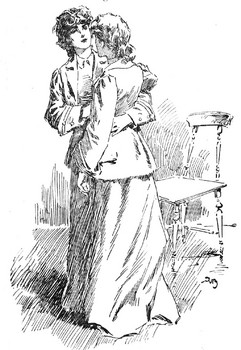
“I never expected you to be so week,” said Iolanthe.
Images Copyright 2009 by Clipart.com

Eaglethorpe Buxton and the Elven Princess – Chapter 15

Chapter Fifteen: Wherein we take the road less traveled
The following morning found both Jholeira and me awake and refreshed. So we made an early start. It was not as early as Ellwood Cyrene who had left at the crack of dawn. However when I went down to the common room that morning, not only did I find that my friend had paid for breakfast for my elf girl and myself, but he had left a package for me as well. Wrapped in a large oiled cloth were several pounds of dried beef, a wheel of yellow cheese, two or three pounds of raisins and a small cloth sack with a half dozen coins in it.
Ellwood Cyrene never seemed to be in need of money, despite the fact that he seldom took payment for his many acts of manly heroism. I have seen a bucket of gold coins gathered together by a town to pay the hero that saved them from the threat of a raging monster, only to have it politely refused by a smiling Ellwood Cyrene. I have seen him pass out coppers to every orphan in a six block radius of the inn in which he was staying. To be fair I have seen him plunder more than one baggage train, and on numerous occasions he has rifled through the pockets of a man he has just stabbed– but who hasn’t done that, when you get right down to it.
I was not able to procure any oats for my poor steed, which is to say Hysteria, but I did get a small bundle of dried hay to supplement the small amount of forage we were likely to find in that country in winter.
We set off on the East Road, but following the advice I had been given, we soon turned off to the north, following a cattle path that wandered over the hills and down into the valley. Our new path veered off from our previous course, but not enough that I thought we would lose our way. In fact at tea time, we stopped among a small copse of trees at the top of a hill. From this point we were able to look down to the south across a vast valley. True to Ellwood’s warning, a great battle was being fought. It was impossible to tell who the two sides were, as their banners at this distance were too difficult to read. All that was certain was that both sides were humans. I took some small pains to make sure that we weren’t spotted, but considering the distance and the chaos on the battlefield, I judged that there was little chance of it.
After journeying the remainder of the day, we made camp just off the path in a little hollow which had been formed by three massive boulders piled one atop of the other two. I can only imagine that some giant piled them up thus as there was no nearby mountain down which they might have slid to come to rest in such a fortuitous configuration, which is to say a pretty good shape.
“We should reach the edge of Elven Wood tomorrow,” I told my companion.
“Really? I don’t seem to recognize any landmarks.”
“Maybe when we get closer,” I offered. “How long since you’ve been home?”
“Six or seven years I would suppose.”
“That must be tough, being without your family for so long.”
“Yes.” She sighed. “And what about you? You’ve been without your family for quite a while now too.”
“What?”
“How long has it been?”
“How long has what been?”
“How long has it been since your family disappeared?”
“Oh. That. I really can’t say.”“You know, I’ve been thinking.” Jholeira stood up and began to pace back and forth beside the campfire. “The purple drops on the floor, as I’ve already said, could be from the blueberry pie you were expecting.”
“Fiends!” said I.
“As far as Gervil’s knife being stuck in his bed is concerned, that could be an indicator of foul play or of nothing at all.”
“I see.”
“The floorboards being pried up however tells us something. Whoever the culprit or culprits were, they were looking for something hidden under the floor. Money maybe? Family jewels?”
“The unpublished manuscripts of the world famous Eaglethorpe Buxton,” I offered.
“I suppose that is conceivable,” said she. “What I don’t understand is the onions in the rafters. The only thing I can think of is that they were trying to ward off vampires.”
“Monsters!” said I. “But wait. Isn’t that supposed to be garlic?”
“Maybe they couldn’t find any. Or maybe they didn’t know the difference. Garlic looks a lot like an onion.”
“Oh, my family would know the difference,” said I. “My poor old father was a fine onion farmer. In fact one variety, the Winter Margram onion was named for him. My cousin Gervil wrote an epic poem about onions, though I was never able to memorize more than the first five hundred twelve lines.”
“Is that all?” she wondered.
“Tuki was Onion Queen three years running.”
“So it is possible that your family would have had onions around? Say, hanging from the rafters?”
“Only at harvest time.”
“Was it harvest time?”“Was what harvest time?”“Was it harvest time when your family disappeared?”
“It could have been.”
“So there really are no clues at all,” postulated the half-orphan.
“What about the tracks?” I asked. “What about the tracks that ended mysteriously after only fifty feet?”
“You said it was a stormy night. The rain probably washed the tracks away.”
“You’re right,” said I. “The next time it will be morning.”
“What do you mean next time?”
“Um, nothing.”
“You mean the next time your family gets kidnapped or the next time you tell this?”
“Well…”
“Your family never was stolen at all!” She stood up with back straight and finger pointed accusingly. She looked quite intimidating. “You lied!”
“It’s wasn’t a lie,” I explained. “It was a story. Well, it was a first draft.”

Amathar – Writing

One of the ideas that I had about Amatharian culture was the imporance of writing and by extension of penmanship. I also liked the idea that their writing might have letters that looked like something other than abstract shapes. We usually forget that some of our own letters, in the distant past, came from pictographic writing.

The book was very much like the book of Amath’s teachings which Norar Remontar had previously shown me. It was a bound volume with a spine, and it had a cover made of leather. The pages were made of a material something like plastic. They were thin and they could bend like paper, but they had a strength far beyond any paper product. The entire book was written in Amatharian, which of course I was unable to read, but the lines and letters seemed to be laid out in a familiar fashion. As I had noticed, the characters resembling simple line drawings of stylized animals and other almost familiar images. After staring at it for a moment, I almost thought that I could see tiny predators ready to pounce upon their prey.

Princess of Amathar – Chapter 26 Excerpt

Climbing down the ladder in the open air, to the landing platform two hundred feet below might have created problems for anyone with a fear of heights, but it was nothing compared to the trip from the platform to the ground on a strand of plastic cable. I am not prone to acrophobia, but was still unnerved. I thought for a moment that the city had gained altitude since we had come aboard, but quickly realized that this was not so, as the cables were still trailing along the ground at about the same length.
“I’ll go down first,” I said. “Follow me.”
I wanted to make sure that if she fell, I would have a chance to catch her, and likewise if I were to fall, that I would not knock her off as well. She nodded, and I started down. The climb was much easier than I expected. I had gotten used to the effect that the lower gravity had upon me when I walked, ran, or picked something up. I had forgotten that the same principles would apply in this situation, allowing me to lift my own body with much greater ease than I would have had I been on Earth.
About half way down the cord to the ground, I stopped and looked up to check on the Princess’s progress. She was some thirty feet above me and seemed to be having no trouble with the descent. I paused for a moment to look around and noticed for the first time that as we were climbing down one rope, something was climbing up another. About fifty feet away from our position, a creature was ascending. It was horrible looking. It was frighteningly ugly. It was the stuff of nightmares. I was thankful for the eternal daylight of Ecos, for to face such a thing in the darkness was something I had no wish to contemplate. About twice the height of a man, the creature was covered with slime-dripping green hair. Its upper extremities were half hands, half flippers and its lower extremities were even more flipper-like, with suction cups lining the interiors. Its face was nothing more that a large sucker with a stinger or a long tusk protruding from it.
“Amath preserve us!” cried the Princess, seeing the thing for the first time.
“Indeed,” I replied, “Have you ever seen anything like that?”
“No, and I hope I never do again.”
The creature stared at us for several moments with its malevolent yellow eyes drilling holes into us. It then looked up and down. Then it attempted to swing the cord it was climbing, as if to, Tarzan-like, propel itself over to us. Quickly realizing that it would not be able to do so, it turned its attention away from us and resumed its task of making toward the hovering city.
“I hate to think of that thing preying on our flyers,” I said.
“Or the Kartags,” said Noriandara Remontar, and I agreed. I wouldn’t have turned that creature loose on a Zoasian.

Eaglethorpe Buxton and the Elven Princess – Chapter 14

Chapter Fourteen: Wherein we spend the evening and night in the inn.
Ellwood had just returned when the husky innkeeper appeared in the common room and made an announcement. His announcement wasn’t loud and it needn’t have been. The room wasn’t that large and there weren’t that many people in it. I counted sixteen, ourselves included. There were the three of us, the innkeeper and serving wench, six men and two women who were obviously locals—farmers no doubt, a traveling tinker; a sell-sword, which is to say a mercenary, who from the looks of things had not been doing too well; and a darkly cloaked figure in the corner. Now one might expect a darkly-cloaked figure in the corner to be the cause of potential mischief, but the truth is that I have hardly ever been in an inn or a pub or a taproom or a tavern or a bar or a saloon that didn’t have a darkly-cloaked figure in the corner. Most of the time, they do nothing more than mind their own business. It’s only those few who end up in stories causing trouble, that the name of darkly-cloaked corner lurkers everywhere becomes tarnished.
“We are privileged to have in our presence today,” said the innkeeper, “the world famous story-teller Eaglethorn Beltbuckle.”
Ellwood snorted into his recently filled cup. Was it his twelfth or thirteenth refill? I stood up.
“Eaglethorpe Buxton at your service.” I casually moved around the room to find the best spot for story-telling, eventually settling on a stool near the fireplace. “And this is the story of the Queen of Aerithraine.”
“Oh God! Not her again!” shouted Ellwood. “Don’t you have any new material?”
The sellsword at the bar began to get up, whether in defense of the Queen or of my story-telling or just to make for the outhouse I don’ t know, but a single steely look from Ellwood put him in his seat again. Apparently neither of them had any doubt who was top dog.
“I shall recount the tale of how I sold my sword to get a poor but beautiful farm girl out of prison and then slew a werewolf using only this fork!” I triumphantly pulled the fork from my fork pocket.
Suddenly the darkly-cloaked figure in the corner jumped to his feet. He swept aside his cloak to reveal black armor and a dozen long thin knifes on a bandolier across his chest. He began plucking the knives and launching them directly at Ellwood Cyrene, so quickly that seven were in flight at one time before the first met its destination. That destination was not, as had been intended, the torso of my friend, for Ellwood had jumped up at almost the same instant. With a quick flick of his wrist, he deflected the first two knives toward the wooden bar, where they stuck with loud thunks. He ducked to the side of the third and fourth knife, then grabbed the fifth, sixth, and seventh right out of the air and sent them back at the cloaked figure. By this time the assailant had thrown two more knives, but Ellwood easily dodged them. One of them hit the wall just near my head. The other went into the fireplace causing a cloud of embers to float up into the air like fireflies. And then it was all over, for the three knives that my friend had returned to the would-be assassin had all found their marks– one in the man’s right hand, one in his chest, and one in his throat.
Everything was quiet for one moment, then chaos erupted as the townsfolk and the traveling tinker rushed this way and that to get out of the way of a battle which was already over. In thirty seconds, the three of us and the darkly-cloaked dead body were the only ones left in the room. Even the sellsword had fled.
“That’s better,” said Ellwood. “Everyone likes a werewolf story.”
I recounted my story of the farm girl and the werewolf, at least so far as I had revised it up to that time, to my friend and my half-orphan companion. I’m not going to tell it now, because I want to make some final editing before it sees print. You should always get a true story just right before you print it.
Afterwards we made our way up to our rooms and I have to say that they were quite nice. I would have half a mind to write up a review for a travel company and give that particular inn three stars if only I could remember what the name of the little town was. In any case the rooms were very nice, all the more so since they were free to me. I made sure that my little elf princess was settled in and had the door locked before preparing for bed myself and was just about to lie down when there was a knock at my door.
I pulled the portal open a crack to find Ellwood Cyrene. He leaned in very close to me. I could smell the ale on his breath.
“I have something to tell you,” he said.
“Yes?” I leaned closer only to better hear him.
“I’ll be gone when you wake Eaglethorpe,” said he. “Don’t continue on the East Road. There will be a battle fifteen miles east of here tomorrow. You will have to make a detour.”
“Alright.”
“And Eaglethorpe?”
“Yes?”
“Be careful, won’t you?” He reached up his hand and brushed aside a strand of hair from my forehead. Then he turned and walked down the hallway to his room.

Amathar – No phones, letters.


I had Amathar in my head for many years before I started writing it. In many ways, it is the perfect world that I pictured when I was a teenager. It still reflects quite a few of my own personal feelings about the technological world. I have always hated talking on the telephone. I don’t know why, I just do. My cell minutes are usually in the single digits for any given month. I suppose that it’s no surprise then that there are no phones in Amathar. The Amatharians don’t like to hear voices that don’t have a face with them. They don’t have radios or any long-distance communication. This has the added storytelling benefit of leaving our hero alone without any way to contact help. On the other hand, I like to write. The Amatharians all love to write. Hardly any Amatharian reaches adulthood without having written at least one book, and they communicate extensively by letter. The letters are sent through vacuum tubes to each house, like we have at the bank. I have always been fascinated by those tubes. When I was in the hospital a few weeks ago, I saw that they used them to send records from one floor to the other.

Princess of Amathar – Chapter 25 Excerpt

Once we had eaten, the head avian stood up, and again motioned for us to follow him. He led us to the edge of the building and hopped off. Looking after him, I saw him fly up and enter the side of the building through an open window.
“I hope he doesn’t expect us to do the same,” I said, but a moment later he reappeared from the opening and flew back up to our position, this time carrying a rope stretching out from the window. When he reached our elevation, he took the end of the rope which he carried, and tied it around the base of one of the potted trees. He then pointed over the edge with his wing.
“Shall we climb down?” asked Noriandara Remontar.
“I don’t know how much more my arm can take,” I said, attempting to reminder her both that I had a broken arm, and that it had been broken in service to her.
“You are treating it like a mother’s mother’s elder sister,” she replied, which was an Amatharian expression something along the line of “babying it”– literally, treating it as you would treat a frail old great aunt.
I sighed, resigned to the knowledge that I would get no sympathy on the subject. It seemed that the Princess was, in general, an unsympathetic person. She quite reminded me of her aunt in that respect. Grasping the rope firmly, I stepped over the edge of the building top, and repelled down the side, twenty feet or so, until I reached the open window and entered. Noriandara Remontar was close behind me.
I don’t know what I expected– perhaps a feather-lined nest, but I was pleasantly surprised by what turned out to be our accommodations during our stay with the flyers. The room was about fourteen feet wide, and about twenty-five feet long. It was clean, and it was empty with the exception of two large sleeping mats made of heaps of soft grasses covered with smooth white cloth. Before I had a chance to examine anything else, our friendly avian arrived, pointed to the beds with his wing, and then left. I didn’t need to be told twice. I dropped down in the first of the beds and as usual had no trouble in dropping right off to sleep.
I suspect that I slept a long while, though as usual, I had no way to tell– it was still noon when I woke. It was a very restful sleep though, and I felt much better. The Princess sat on her bed and cleaned her weapons.
“You sleep too much,” she said.
“I have been told that,” I replied. “I don’t recall being a particularly heavy sleeper on my home world, but since I have been here in Ecos, I seem to require more sleep than anyone else around me.”
“Mm,” she replied.
“Do you suppose that my arm has healed yet?” I wondered. It was impossible to recall if it had been splinted for a week or six weeks.
“Probably.” Noriandara Remontar rose and crossed the room. She removed the remaining bits of cloth holding the splint to my ulna, and tossed the makeshift splints aside.
“Can you move it?”
“I haven’t stopped moving it since it was broken.”
“It must not be that bad then,” she replied unsympathetically.
I shrugged and started to clean my own weapons. The cleaning of one’s swords, or if one is not a warrior, one’s equipment in general, was a common Amatharian pass-time. It was a minor disgrace to have damaged or soiled equipment. It seemed that few Amatharians ever reached that state of disgrace, for Amatharian weapons needed little maintenance. Still the cleaning and maintaining of one’s equipment was just what one did during periods of relaxation.
While we were still sitting upon our beds, a flapping noise alerted us to the arrival of the old flyer, who stepped into our room. He now had a sack, tied with string, slung over his neck. After peering at each of us intently, which I took as an avian form of greeting, he removed his burden and opened it up. Inside, he had a collection of fruit much like that which had been given to us on our arrival. We each selected one of the offerings for our breakfast, and the flyer watched us as we ate. When we had finished, he indicated that he should climb up the rope to the top of the building.
Once atop the skyscraper, Noriandara Remontar and I found ourselves in the company of a large group of flyers. It seemed the entire community had turned out to welcome, or at least to examine us. The flyers were divided up into two groups– those who were brightly plumed and those who had relatively plain feathers. I still assumed that the brightly feathered ones were the males of the species. Several of these brightly colored individuals stepped forward and peered at us with what seemed to be a typical avian stare. One of these had a nasty cut across his chest. It had been stitched together with white thread.
“These must be the fellows who were fighting with the Kartags when we came along,” I suggested.
“I was just thinking the same thing,” replied my Amatharian companion.
The elder came forward again. He pointed at the two of us with his two extremities, and then made a sweeping motion toward his fellows.
“He is either welcoming us, or inviting us to join the tribe,” I said.
“I don’t suppose that there is much distinction,” replied Noriandara Remontar, “I doubt that they have many casual visitors up here on this floating little world of theirs.”