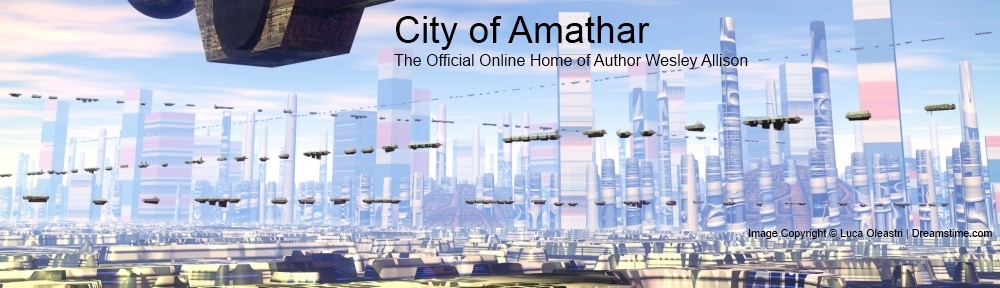

Princess of Amathar: Chapter 3 Excerpt


As we circumnavigated the hill, Malagor explained the rifle to me. For all its unearthly beauty, it was quite terrestrial in method of operation. The stock and the barrel were designed much like those of an AK-47, with a trigger and trigger guard in the usual location, but instead of a clip of ammunition projecting just in front of them, there was a slot where the power source plugged in. The sights were placed along the barrel, if such a term applies, just as with any rifle of earth. Malagor handed one of the weapons to me, and together we practiced plugging in the power source replacements. Then we slung the rifles over our shoulders and continued on our way.

When we had reached the other side of the hill, I had to stop and laugh. As far as berry picking was concerned, we had certainly chosen the poorer side of the hill. From where I now stood, the hills beyond were completely covered with the berry bushes. We were both in the mood for breakfast after having slept a long time, so we began wading through the thicket, picking the ripe berries and transferring them to our mouths. The little fruits were juicy and tart, and I am sure would not have been all that good if tasted at home with dinner, but here in the wilderness, picking them straight off the vine, they were delicious.

Malagor and I had moved apart as we picked. He was about thirty feet or so away, but there was nothing to be concerned about. We were two grown men, or in any case, two grown beings, in sight of one another. I must admit that I was not being all that watchful, and I suppose that Malagor wasn’t either. Suddenly I heard a noise from him that I had never heard before. It was a lot like the startled yelp that a big dog makes when his tail is accidentally stepped on. Then a tremendous roar reverberated through the hills. I turned to a scene that made my pulse quicken.

There, standing above the berry bushes, a full fifteen feet tall, was the most frightening apparition that I have ever beheld. It was a huge beast. It might have seemed like a bear or a large ape at first, because it stood on its hind legs and had a shaggy but almost humanoid form, but it was neither bear nor ape nor any combination of the two. It was covered with long black fur, and it had a large head. Its eyes were large, round, multifaceted, insectoid orbs. It was obviously an omnivorous beast, having like humans a variety of tooth types, but at the moment I was concerned with only one type– the great long fangs with which it was attempting to impale Malagor. The creature held him in a tight grip and was attempting to reach his throat with those great ivory tusks. For his part, Malagor was struggling to hold back the giant head and at the same time find a spot in which to employ his own considerable canines.

If I had thought about it, I am sure that I would not have bothered trying to use the light rifle; because I was fairly sure that there was no way that the power source could still be viable. But the fact is that I did not think, I just did. I put the weapon to my shoulder, took quick aim, and fired. The gun spit a thin stream of energy from its barrel. It was not like a laser or a beam. It was like molten sunshine that bubbled and churned as it flew through the air. It went past Malagor’s shoulder and into the eye of the giant beast. Then with a big explosion, it blew a large hole out of the back of the thing’s skull. The beast’s head collapsed in a most disgusting way, and then it fell to the ground.

I ran over to where the monster had fallen. Malagor jumped up to his feet, as if to prove to me and to himself that he was all right. He looked at me with a blank expression.

“Finally, an animal I know.” He said. “This is a stummada. It is not good to eat.”

“I don’t think he had the same opinion of you,” I replied.

“No it did not. But it is not a he. It is a female. The mate of this one may come along at any moment. Let us return to our side of the hill.”

We started on our way home. I would like to if I might, interject a small commentary at this point. As I tell this story it must seem that I was well versed in the language of the Amatharians. I must confess that at the time I was not, although I count myself now, to be quite fluent in that beautiful language. For example, in the previous conversation between myself and Malagor, we had a great deal of trouble at first with the Amatharian terminology for the animal’s mate, but after examining the context of the word, and a little impromptu tutelage by Malagor, I was able to piece together the meaning. So it was with a great deal of the language that I learned during my time with my alien friend. If I do not fully detail every element of my conversational education, please believe me when I say that it is not an intentional effort to make myself seem more intelligent. Rather it is just that in looking back I remember the content of our conversations rather than the exact wording.

Malagor and I made our way back around the mountain to our cliff camp. There we slept and then went out once again to fill our water skins from a small mountain brook, and to hunt for our dinner. This time Malagor let me stalk and hunt the game. He guided me, carefully giving me helpful instruction. I eventually managed to bring down a small rodent-like grazer which proved to be quite tasty.

During what seemed to me to be a few weeks, Malagor and I went hunting frequently and he seemed to take great pleasure in teaching me how to track and kill animals of all types. After a while I became relatively adept. I began to notice that when we hunted, we did not follow a random pattern. Each time, Malagor would choose a direction just to the left of the direction which we had taken upon the last hunt. While we hunted, he was surveying the land around us in a very systematic way, dividing it up like a giant pie, with us in the very center of the search pattern. On one occasion I asked him what we were searching for, but he seemed to clam up, and become positively morose for the rest of the trip, so I didn’t ask him again. He had been very good to me, and indeed we had become close friends, so if there was something that bothered him too much to talk about, I wasn’t going to pester him about it. After all, I had nothing else to do in the world of Ecos. So if Malagor wanted to conduct a search while we hunted for our game, what difference did it make to me?

One time when we out were hunting, we began tracking a particularly large bird-like animal about the size of a cow. Neither Malagor nor I had any idea whether it was edible, but we were beginning to tire of our usual catches, so we decided to experiment upon the unfortunate creature. We were still outside bow range of the beast, crouched in the tall grass, when the hair on the nape of my neck began to stand on end. I glanced at my arm and found that the small hairs there were acting in a similar fashion. Then I looked at my friend and almost laughed. He looked like he had just been blow-dried, every hair sticking straight out.

Malagor was looking at neither me nor our prey however. Then I noticed a distant hum and followed Malagor’s gaze to discover its origin. Sailing along above the countryside at an altitude of about a thousand feet was the most remarkable vehicle that I have ever seen. It was many times the size of the largest modern aircraft carrier or battleship of earth, fully a mile long and nearly half that wide. It was only a few hundred feet tall over most of its span, but there was a tower rising a hundred or more stories from the top middle of the thing. The entire vehicle was painted black, and was bristling with weapons or instruments of some kind, and the closer it got, the more obvious it was that this was the source of the strange magnetism in the air. This was some kind of great cruiser riding through the air on a field of electrical energy.

“What is that thing?” I asked.

“It is a Zoasian Battleship,” replied Malagor.

“You never mentioned the Zoasians.” I pointed out.

His voice became low.

“The Zoasians destroyed my people,” he said.

Writing Again


I’m feeling good. I’m writing again. It’s been months since I’ve been able to sit down and work on my latest novel. I don’t know why. I’ve just been in a funk. But I am writing now. I’ve almost finished chapter 9 (of 10). I’m really hoping to finish the book over the next week. Woo-Hoo!

What does the dragon have to do with anything? Nothing. But I bought non-exclusive rights to the image on Dreamstime.com so I might as well use it. Right?

Image © 2008 Oleh Zaporozhets | Dreamstime.com

The Steel Dragon – Chapter 2 Excerpt

Iolanthe Dechantagne held onto the bedpost with both hands, while her dressing maid Yuah pulled with all her might on the lacings of Iolanthe’s new Prudence Plus Fairy bust form corset. When the two sets of lacing holes reached as close a proximity as they were likely to, Yuah jerked the lacings down, pulling them into the crimping holes, so that they would stay tight until she managed to tie them into one of her patented infallible knots. Only when this knot, immotile as any which anchored a battleship to a dock, was tied, did Iolanthe let out her breath. Though still able to fasten her own bustle around her waist, the beautiful young woman was now helpless to bend over and pull on her own stockings, so Yuah carefully rolled each of the expensive silk garments up a leg, fastening it at the top to the several suspenders hanging down from the corset. Then Iolanthe stepped into her shoes, which were alligator skin high-tops with four inch heels. The maid kneeled down once again, this time to fasten each shoe’s twenty four buttons, using a button hook.

“The white, pin-striped dress today?” asked Yuah.

“No. I wore that just last week.”

“The chantilly dress?”

“Yes, I think.”

Yuah brought over the dress. Yards of sheer black lace overlaid a pink silk base that was as smooth as lotion. The dressing maid helped Iolanthe put her arms through the sleeveless shoulders and then fastened the dress up behind her. Then she helped her on with the matching jacket. Though the dress was sleeveless and had a fairly low neckline, the jacket had long sleeves with puffs of black lace at the end, and fastened all the way up and around Iolanthe’s long, thin neck. The hat that went with this ensemble was a black straw boater, and like so much of Iolanthe’s hat collection, imitated a man’s style. But in addition to the black lace veil hanging down to below her neck all the way around, the top of this boater was decorated with a dozen pink and black flowers and a small, stuffed bird. She wore no rings on her fingers or ears, but draped a cameo necklace carefully across her bosom.

Iolanthe turned and looked at herself in the floor-length cheval glass. The cameo necklace, the hat, jacket, dress, shoes and stockings, and the Prudence Plus fairy bust form corset were only the finishing touches of a process which had taken the first two hours of the morning. A hot bath and shampoo had come first, followed by shaving her body (with straight razor), and then applying four different types of body lotion and body powder. Next was a careful facial, culminating in the retouching of her very thin, carefully arched brows. Styling her long auburn hair into a bun, and constructing small ringlets with a curling iron to frame her face, had next occupied her. Then she had donned her panties, her bloomers, her underbrassier, her brassier, and her camisole. Yuah had careful manicured her fingernails and pedicured her toes. Finally came rouge, eye shadow, mascara, and lipstick—just enough to look as though she didn’t need any and thus had worn none—painted on with the care and attention to detail of the finest portrait artist .

“You look beautiful, Miss.”

“Yes, I know.”

“Will there be anything else, Miss?”

“No.”

Yuah left and Iolanthe continued to stare at herself for several moments in the mirror. Once she had decided that everything was perfect, she hyperventilated for a minute, before leaving. Doing so allowed her to make it all the way down to the steam carriage without having to gasp for breath, despite the small inhalations allowed by the Prudence Plus fairy bust form corset, though doing so exacerbated the possibility of her fainting. Women frequently fainted in Brech. It was just part of the cost of fashion.

The house that the Dechantagne family owned in the Old City was a large, square, four story building occupying most of a city block. It was so large in fact, that two thirds of the rooms were unused, the furniture covered by white linen drop cloths, and the doors kept locked. Iolanthe had been tempted to sell the house, as she had much of the family’s other city properties, but then, finding a new place to live would have occupied far too much of her time, and she doubted that any place she found would have been appropriate for entertaining the class of people that she had needed to entertain during the past year. Since she had been essentially forced to keep it, she had spent considerable money modernizing the portions that she used. Houses built three hundred years before did not have the benefits of indoor plumbing, and there was no way that she would go without her bath tub, or for that matter, a modern flushing toilet. Stairs were fine as well, for making a grand entrance, but for the everyday up and down of three flights, an elevator was a must. Then there were the dumbwaiters, the gas lights, and the upgraded kitchen. The only thing that hadn’t needed to be improved were the servants’ quarters, which were more than adequate.

Iolanthe walked from her spacious boudoir, stepping through the bed chamber, which was to her mind three or four times too large to be kept at a comfortable temperature, and then out into the hallway. The hallway was lined with large and small framed mirrors, so that she could have admired herself many times on her way out, had she chosen to do so. She did not. At the end of the hallway, she entered the elevator which awaited her. She did not need to look at or address the young man of the household staff who controlled the elevator car. He knew what to do. Exiting the elevator on the ground floor, she walked through the spacious foyer, past the great sweeping staircase. She swept right on out the front door, not even needing to slow, as the head butler Zeah was there to open the door and hand her a parasol to match her outfit.

At the bottom of the steps, another young man of the household staff waited with the steam carriage running. He had already filled the tank with water and the fire box with coal, at least she assumed he had, and if he hadn’t there would be hell to pay. Placing her high-heeled foot upon the running board, she stepped up into the seat, taking half a moment to make sure that she didn’t squash her bustle as she sat down. Then releasing the brake with her right hand and stepping on the forward accelerator with her right foot, she zoomed away from the curb, sending a dozen pedestrians diving one way or the other.

Her first stop of the day was the telegraph office in the great plaza, just across from Café Carlo, where she frequently had a light luncheon or tea. It was a short drive, almost no time at all before she pushed the decelerator, pulled the brake, and came to a stop in front of the building that must have once been glassblower’s shop or a bakery or some such, since telegraphs had not been invented when the structures around the plaza had been built. Now that she thought about it, the wooden poles leading away from the telegraph office were somewhat unsightly among the ornate stone and marble buildings. The government had even made an attempt to make the gas streetlamps attractive. The telegraph poles were just oily looking wooden sticks. Still, she supposed they were necessary. Stepping down from the steam carriage, she walked around to the rear of the vehicle and turned the steam cock, so that nothing as unfortunate as a boiler explosion would bother her while she took care of business. Then she made her entrance into the telegraph office.

The office was dark, despite having a very large window in its front wall. All of the walls were paneled with a very dark wood and were completely unornamented except for six brass gas lantern sconces. Two large wooden desks sat at odds with one another. In front of each, sat two uncomfortable looking chairs, and behind each sat a man with a stiff white collar and a green visor. Iolanthe stood holding her unused parasol in her hands and her chin high in the air, until both men in green visors jumped from their seats, ran around the desks to pull out a chair for her.

“Miss Dechantagne!”

“Miss Dechantagne!”

She chose the chair held by the older of the two men. He was about fifty, slightly fat around the middle, and was wearing a cheap wedding ring. Both men returned to their positions behind their desks, the older, slightly fat man with a look of triumph upon his face, the younger man with a look of dejection.

“My telegrams?” she said.

“Of course, Miss Dechantagne.” He produced them from a rack at the back of the room as if he had been waiting for her entrance all day, which he probably had. There were five. She read each of them carefully.

Telegram One:
My Dear Miss Dechantagne.
Will visit city three days hence. Would very much like to meet you for tea. Anxiously await your reply.
Prof. Merced Calliere, University Ponte-a-Verne.

Telegram Two:
My Dearest Miss Dechantagne.
Found you as ever, delightful, at the Opera. I still say you have the loveliest eyes ever. Can’t stop thinking about them. Would love to have you for tea.
Jolon Bendrin

Telegram Three:
Sister.
Have found two wizards that may be of some use. Need six thousand marks to settle personal accounts. Also have a girl for you to meet. Get something for Yuah’s birthday.
Augie.

Telegram Four:
Miss.
Finished closing up the house. Local business attended to. Personal baggage to arrive in three days. Staff and details will follow in five days. Your directions followed.
Macy.

Telegram Five:
Iolanthe.
Mustering out before the twelfth. Hope plans are going well. Have a full company. Leaving the rest in your hands.
Terrence.

“Take down my replies, please,” said Iolanthe.

“To Professor Merced Calliere, University Ponte-a-Verne, Regencia. My Dear Professor. I anxiously await your visit. I am understandably excited to see the results of your work. I insist that you stay with us at the house. I will meet you at station myself. Of course, we will have tea together. Very sincerely, I. Dechantagne.

“To Mister Jolon Bendrin, Bentin, Cordwell. Mister Bendrin. Never contact me again. I do not accept invitations from men who think themselves entitled to take liberties. If your face is seen within my circle of acquaintances, and my brother does not shoot you, I will do so myself. Very sincerely, I Dechantagne.

“To Lieutenant Augustus Dechantagne, Bentin Cordwell. Augie. I am sending you five thousand marks to settle accounts, as I am sure you have exaggerated your needs by at least twenty percent. Leave the girl. I am well aware of your peccadilloes. Make sure not to leave any loose ends. Bring the wizards. If you see Jolon Bendrin while you are there, you may shoot him. Your Sister. I. Dechantagne.

“To Macy Godwin, Shopton, Mont Dechantagne. Good. I. Dechantagne.

“To Captain Terrence Dechantagne, Dorridgeville, Booth. I have secured munitions and equipment. Send your company directly to the ship. Expedite your return if possible. Your expertise is needed. Iolanthe.

“Do you have all of that?”

“Yes, Maam,” replied the telegraph operator. “You know, we can abbreviate these messages and save five pfennigs per word.”

Iolanthe gave him a withering look, until he dropped his eyes to the desktop.

“Grammar is so very important,” she said. “My man will be by to settle accounts.”
She stood up and started for the door. The younger man, who had been waiting across the room for just this moment, jumped up and rushed to the door so quickly, that he knocked over his own chair along the way. With a look of utmost triumph, he opened the door for her. She rewarded him with a nod of her head, and stepped outside. Turning the steam cock to its original position once again, she climbed back aboard the carriage and started once again on her way.

His Robot Girlfriend: Chapter 1 Part 1

Chapter One
Mike’s life was crap. And every day he got up out of bed and thought about how it was crap. Today he climbed out of bed and made his way through the discarded clothing on the floor of the bedroom to the bathroom. His worn image looked out of the mirror at him. He picked up his cordless razor and turned it on before remembering that it was Saturday. He stuck out his tongue at his reflection. Slipping off his underwear, he tossed it at the hamper just outside the bathroom door. It landed on the floor. Turning on the shower, he stepped inside the glass-doored stall, and stood beneath the spray. He took a deep breath and then began soaping up and rinsing off. Pouring a handful of shampoo, he scrubbed his scalp, rinsed, and then turned off the water. He waited about two minutes– partly to drip dry and partly because he didn’t want to face the day– before he climbed out of the shower stall.
Once he was dry, he walked back into the bedroom, crossed to the dresser, and pulled out a clean pair of underwear. The underwear was so old that it looked more grey than the white that it had been, and the material had worn through enough that the elastic showed in the waistband. He slipped his left foot in the leg hole and then the right, getting his big toe caught for just a second. Pleased with himself that he had not lost his balance, he went back to the bathroom and combed his thinning and graying hair. It had been graying for a long time. It had only been thinning, at least noticeably for a few of years– just since Tiffany had died. He brushed his teeth, and grinned at the man in the mirror. It wasn’t a friendly grin. Back in the bedroom, he slipped on cut-off jeans and a green t-shirt. Then he walked through the bedroom door, down the stairs, through the living room, and into the family room.
He touched the screen of the vueTee hanging just above the fireplace to turn it on, then passed through the archway and into the kitchen. Pouring a bowl of cereal, he sniffed the milk before adding it. It was still good. Grabbing a spoon, he headed for the worn recliner which faced the vueTee. The screen was on, but it wasn’t alive with movement and sound. It still had the browser up and it was still on the Daffodil site. Mike had followed the link the night before from the very slick commercial he had seen during the Tonight Show. On the left side of the screen was a large yellow daffodil and on the right were four large yellow buttons, arranged vertically. The first said Barone, the second Amonte, the third Nonne, and the fourth PWX.
Daffodil wasn’t the largest manufacturer of robots, but it certainly had the most cultural cache. Their commercials were by far the best. Everyone seemed to be talking about them. Mike could hum their jingle right now. The four buttons corresponded to the four basic robot units that Daffodil produced. Though there was some crossover between the four types based on the many options that were chosen, the Barone was usually an aid to adults—a robot maid, gardener, or grandparent. The Nonne was a babysitter type: a tutor, a nanny, or again, depending upon the options, a maid. The PWX was an industry grade robot designed for use by corporations and government organizations as a receptionist or a clerk. Finally the Amonte was a personal companion. It could be configured as an escort, a friend, or a lover. As the commercial said, it was “anything and everything you want it to be”.
Mike leaned back in the chair and pointed the remote at the vueTee. He moved the curser over the Amonte button and pressed. The body frame options screen came up, but there was a small window along the left side that said “narrow your selections”. You could narrow them by price. You could narrow them by race-ethnicity. Or you could narrow them by gender. Mike ignored that side of the screen and looked at the body build. If you were going to dream, you might as well dream unencumbered. Dials allowed one to set height, chest, waist, and hips. He had already filled in these features the previous night. After that, one flipped through a series of screens where prospective customers could change almost every aspect of their robot. The head controls gave one control over the shape and placement of eyes, nose, lips, and ears, but also let one choose the forehead shape and jaw line, the hair color and style, the type of chin, and the placement of freckles. Other controls set every detail from fingernails to nipples. Mike flipped through them. The last screen showed the price for his particular build: $2699.00. That would just about wipe out his PayNETime account.
Mike let his curser drop down to the search bar. He moved through the postings about Daffodil. There were many from people questioning certain aspects of the design, but few from people who had actually purchased one. Daffodil didn’t disclose their sales figures to the public, but experts estimated that they had thus far sold only about 300,000 units. There were a few messages from owners of the Gizmo robot, who went on about how superior it was, because you set its personality before purchase. There was only one posting that Mike hadn’t seen. He clicked on it and an aging woman with orange hair appeared on the screen.
“I love my Daffodil. He does everything for me—takes care of the bills, fixes my meals. He drives me to visit my friends, and he rubs my feet every night. His name is Andre. I just don’t know what I’d do without him.”
“Probably move to Florida,” said Mike.
He flipped over to Today Saturday. As he watched Tania Marquez read through the top stories of the day, he thought about purchasing a Daffodil. Twenty seven hundred dollars was a ginormous amount of money to spend. If he had still been married to Tiffany there would be no question. He wouldn’t have bought one. He would still have wanted one, but he wouldn’t have bought one. Oh, Tiffany might have gone for a five hundred dollar model designed just to clean the house, but she certainly never would have let him get the one that he had designed online. Of course if she had still been here… Oh sure, he might have fantasized about a Gizmo Sexbot, but it would have remained just a fantasy. Besides, he didn’t want a Daffodil for sex—well, not just for sex. If he was going to get one, it would be for companionship. It would do all the things that it was capable of doing.
The rest of the morning, Mike watched the vueTee. After Today Saturday was over, he turned to the Cooking Channel and watched Café Italiano, Breakfast at Bloomberg’s, and America’s Test Kitchen. When Noon Buffet came on, he turned off the vueTee and picked up his texTee. The New York Times had already downloaded, so he flipped through the pages. Most of it was politics. Mike didn’t hate politics, like everyone else he knew seemed to. It was just that there didn’t seem much point to it at the moment. All three major parties had chosen their candidates even though none of them had yet had their convention, and it was more than six months till the general election.
The paper bored him after a few minutes, so he clicked through the book menu. He had the first chapter of The Janissary Tree, so he read it. When he was done, he still wasn’t sure if he wanted to spend $17.99 for it. He flipped over to Moby Dick. He had the whole book. Before this year, he hadn’t read it since college and wanted to read it through again, annotating it along the way—just because. It was slow going. Here it was April, and he was only on Chapter 24: A Bosom Friend. He tossed the texTee onto the floor beside the chair.
Though he wasn’t really hungry, Mike decided that it was lunch time, mostly out of boredom. He went to the foyer, where his tennis shoes sat on the ceramic tile. Slipping them on, he grabbed his keys and wallet from the small shelf on the wall and headed out the front door. Climbing into the car, he drove down the block and around the corner. He thought about stopping at Hot Dog Paradise, but there was a long line of cars in the drive-thru, so he went to McDonalds. The girl at the window could have been mistaken for a real person at first, but just like in every other fast food drive-thru window, she was a robot. She was probably a Gizmo Servbot, though McDonalds had their own custom build that wasn’t quite like anywhere else.
“I’ll have a McMeatloaf sandwich,” he said.
“Would you like that ala carte or with an Arch Value Meal?” She had that slightly tinny voice.
“Value meal.”
“Would you care for fries, side salad, fruit slices, or yogurt sticks?”
“Fries.”
“And what would you like to drink?”
“Diet Pepsi.”
“Your total comes to $17.96.”
Mike swiped his cash card through the slot just below the window.
“Thank you for choosing McDonalds. Please pull forward.”
At the next window a girl, a real girl this time, handed Mike his drink and then the bag with his McMeatloaf sandwich and fries. He drove back home and returned to his recliner to eat.
The vueTee had automatically turned off in his absence, so he turned it back on. He watched Face the Nation as ate. Catherine Garvey was interviewing all three presidential candidates—one at a time. The Republicans had nominated another old man. The Democrats had nominated another old lady. It was the same old thing. Barlow said lower taxes. Wakovia said balance the budget. Only the Greens seemed to have picked anyone who wasn’t a cookie-cutter image. Mendoza was young, attractive, and idealistic, and probably didn’t have a chance in hell of getting elected because she had inherited all the problems of President Busby. As long as there were troops in Antarctica, nobody was going to vote Green.
When he was done eating, Mike looked around. He really needed to clean up the house he decided. He would get up and clean for a half hour. He could manage a half hour. By the time he had emptied and then refilled the dishwasher and emptied the trash compacter though, he didn’t feel like continuing, even though only fourteen minutes had passed. He sat back down watched more vueTee, dozing off after a while and waking up just in time for Deal of the Century. Then came Rat Race and then Pajama Party. He opened a can of soup for dinner and went to bed after Saturday Night Live.
Mike woke up just after five with a splitting headache. The bed was cold, not surprising considering he had left both the oscillating fan and the auxiliary air conditioner on. He got up and turned one off then walked downstairs to the family room to turn off the other. Stopping for a moment, he reached up and touched the vueTee screen, turning it on. An infomercial for the all-in-one electronic device charger blared to life, but he sat down and grabbed the remote, thumbing back to the browser and examining the Daffodil page once more. With a sudden sense of purpose he zipped through the custom design pages, changing most of the settings that had been there since he had first looked it over. He didn’t know why he made most of the changes that he did. It was as if something unseen and unknown inside him compelled him to do it. With a slightly hesitant hand, he pressed the “Buy Now” button. $2749.00. Then he went back to bed.
It was more than five weeks later, May 31st, when the package arrived. In the interim, life had gone on much as it had for the past several years. Each weekday, Mike tried to teach World Geography to the dullards that passed for eighth grade students in Midland Middle School, after which he came home and vegetated the evening away. On the weekends, he skipped the first part, and simply vegetated. One night, the Saturday before last, he had dinner with Harriet and Jack. Every day he looked forward to the change that was coming. Even if the Daffodil never lived up to the hype, even if it was just an overpriced Gizmo Maidbot, it would be an improvement. It would pick up the laundry that had covered the floor for a month now, vacuum the carpet that hadn’t been vacuumed in two months, clean the bathrooms that hadn’t been cleaned since Tiffany’s funeral, and maybe dust the things that hadn’t been dusted… well, ever.
Mike was annoyed that the box was just sitting on the step when he got home. Something that expensive, he should have had to sign for. Somebody could have just carried it off. But they hadn’t. It was here. The box looked impossibly small—only about thirty inches on each side. It was silver with a large yellow daffodil only partially obscured by the shipping label. Unlocking and then opening the front door, he picked up the box and brought it inside. It was heavy but not too heavy to lift. He set it down first in the foyer, but once he had shut and locked the front door, he carried it into the center of the living room floor. He went to the kitchen and returned with a chef knife. Carefully sliding the blade through the packing tape, he cut along each edge and then across the top seam.
Folding back the two flaps of the box lid, Mike looked down to find it filled with packing peanuts. Brushing some of them out of the way, he almost immediately found a patch of smooth white skin. It was remarkably real looking—pearlescent on the surface and kind of peachy pink beneath, but not a single blemish or mole or hair upon it. Mike brushed more packing peanuts out onto the floor and uncovered more skin, and then plastic with black hair inside. Finally, setting the knife on the coffee table, he tipped the box over, dumping the contents into the center of the floor. White packing went everywhere. The Daffodil rolled out and came to rest on its side, facing away from him. It was curled up tightly into a ball.
At first, Mike thought he must have ordered the wrong robot. Curled up as it was, it looked like a child. He just stared at it for a moment; at its naked back and buttocks and its black hair wrapped up in plastic. Finally he kicked around through the packing peanuts. There didn’t seem to be a manual—just a single sheet of paper marked “Quick Setup”. He picked it up and looked at it. There were two pictures and no words. The first picture showed line drawing of the back of a human-looking neck, except that the neck had three round holes in it and below them a button. The second picture showed the button being pushed by a line-drawn finger. Next to the button and the finger were the numerals 1, 2, 3. Bending down, Mike lifted up the plastic wrapped hair and examined the Daffodil’s neck. There were the three holes and there was the button. He pressed it and counted aloud “one, two, three”. Then he let go.

The Steel Dragon: Chapter 1 Excerpt


Chapter One Excerpt

Past the Great Church of the Holy Savior, bounded on the south by Avenue Hart, the north by the railroad yards, the west by Contico Boulevard and on the east by what Senta didn’t know, was one of the city’s seemingly never-ending masses of tenement buildings. Here were countless brown-stones, put up quickly and cheaply, with none of the artistic style, careful engineering, or safety considerations taken into account when the buildings of the Old City had been built centuries before. The shortest among them were seven or eight stories high, but most were at least fifteen. The highest among them, reached up into the sky more than twenty stories. Senta, still skipping despite the hour and a half long journey from the park, reached the entrance of her own building and skipped up the eight steps to the front door. From that point on, skipping was out of the question. Even a child with as much energy at her disposal as had Senta, was worn out by the time she reached the twelfth story. And the twelfth story was where Senta lived with her Granny.
She turned the doorknob as she leaned against the door, and burst into Granny’s apartment. Senta had always thought of it as Granny’s apartment, rather than her own. She was only one of the children who lived there. There were six. Bertice, who was a pretty and very quiet seventeen year old, worked fourteen hours a day sewing in the shirtwaist factory. Geert, a surprisingly husky boy of twelve, traveled each day to the King’s warehouse, where the government gave away bushels of apples. Then he took the apples to the train station to sell them for a pfennig a piece. Senta herself, at nine, fell next in line. Then was Maro, Geert’s eight year old brother, who worked in a printers’ shop. He had lost the two endmost fingers on his right hand playing too near the printing press. Didrika was a cute and precocious four year old. She and her baby sister, Ernst, were Granny’s only real grandchildren, Bertice being the granddaughter of Granny’s younger sister and Senta being the granddaughter of Granny’s older sister. Senta wasn’t too sure what the exact relationship was for Maro and Geert, but everyone in the house was somehow related and everyone in the house was treated as though they were a cherished grandchild by the hunch-backed, grey-haired old woman who looked up from her washing when Senta entered.
The front door opened into the combination living room/kitchen. An old table and two chairs sat next to the coal-fire stove and just to the left of that was a large, two-basin sink with running water. This was used for washing clothing, washing dishes, and washing children. On the other side of the room, a ragged sofa sat next to a mismatched chair. At night, the room was used as a bedroom by Geert, who slept on a sheepskin, which was pulled out from under the sofa and rolled out onto the floor; and by Maro, who pushed the two chairs away from the table, and placing them side by side, spent the night lying across them.
In addition to this room, there was one other in the apartment—a bedroom. The double bed that had come with the apartment was shared by Granny and Bertice and Didrika, who was small enough to curl up between them. Ernst had her own baby crib, which had arrived when she and Didrika had, two years before. Senta didn’t know what had happened to the two girls’ parents, any more than she knew what had happened to her own, but they were dead now. Senta had her own special bed which had been made by setting side by side three wooden crates, two which had originally held Geert’s apples, and one a carrot crate, given by an old man who with his little donkey, delivered carrots to the many eating establishments in and around the great plaza. Then the three crates were covered with a hand-stuffed mattress.
Granny had a bucket in the bottom of the right hand sink. The bucket was filled with soapy water and dirty clothes. The old woman picked up from beside the sink, the washer, a device which looked like a large brass plunger attached to a broomstick, and placing it in the bucket on top of the clothes, began to plunge it up and down while turning it. This was a lot of work, but nowhere near as much as cleaning clothes with a washboard, and it was much easier on the clothes too.
“Payday,” said Senta, giving Granny a hug, and then handing over the fourteen copper pfennigs she had earned for the week.
“Thank you, dear,” said Granny, pausing from the washing to accept the money. She then handed two pfennigs back and said. “Keep one for yourself and put one in the meter. The gas went out this morning, and we’re going to need some light tonight. Maro will want to read to us, and I have to catch up on my knitting.”
High on the wall, above the coal fire stove was the gas meter. It was a square device about two feet across which controlled the flow of gas from the pipes in the wall to the two gas lamps on the ceiling. It had a coin slot and a knob on it. When a pfennig was placed in the slot and the knob was turned, the appropriate amount of gas would be allowed to flow out to be used by the family for evening light. It usually lasted about two and a half evenings, so the family, most weeks budgeting two pfennigs for artificial light, had five evenings lit by gas. The other two evenings were either lit by a single candle, or kept dark. Senta pressed the less shiny of the two pfennigs in her hand into the slot and turned the knob. She could hear the little copper coin fall down a pipe, making a little echo as it went down into the wall. A second later, she could hear hissing of the gas making its way from the meter toward the lamps. It hissed only a moment then stopped. They wouldn’t light the lamps until after dark. Waste not, want not.
“Would you like me to go get the coal for the stove, Granny?” asked Senta.
The coal supply was located in the basement—the lowest level of two basements. This meant walking down fourteen flights of stairs, and walking back fourteen flights of stairs with a bucket full of coal.
“Getting the coal is not a job for a little girl,” said Granny.
“I can do it.” “Oh, I know you can. But Geert is already getting it.”
“How come he’s home so early?”
“Oh, he had a very good day today. He sold all of his apples so quickly this morning that he was able to go get a second bushel just for us. I’m going to make a pie this evening.”
At that moment, Geert entered with a bucket full of coal. He grunted at Senta and walking over to the cast iron stove, opened the small door at its very bottom and shoveled in about a third of the bucket. He then took a sheet of newspaper from the stack nearby and wadded it up. He struck a wooden match and lit the paper, tossing it in after the coal.
An hour later, the room was warm with the heat of the oven, Ernst woke up from her afternoon nap, Didrika returned from playing with her friend on the eleventh floor, and Senta helped Granny make an apple pie. By the time the apple pie was cooked, Maro had returned from his job at the print shop and had plopped down on the sofa, while Granny and Senta peeled potatoes. Dinner was ready when Bertice arrived home, completely exhausted, curling up in the mismatched chair, able to stay awake just long enough to eat her potato soup and apple pie.
The rest of the evening was spent together in the living room/kitchen. Bertice was quietly snoring, Granny was knitting, and the rest of the children were listening to Maro read, by the light of the gas lamps, from the broadsheet he had brought home with him from work. Senta didn’t know it, but the broadsheet was just one of the many propaganda-based papers which were distributed around the city each day—some pro-government and some supporting various opposition groups. The main story in this one was about how the government was gathering all of the wizards in the kingdom and making them spend their time creating enchantments and weapons for use in a possible war with the kingdom’s hereditary enemies Freedonia and Mirsanna. This, according to the broadsheet, left no wizards to cast the spells needed by average citizens: to protect homes, to increase the crop yields of farms, and to create enchanted vehicles. Not to mention, thought Senta, to tell fortunes and create beauty or love or happiness potions. There were also local news stories—a fire had burned down a candle shop, someone had stolen a brand new steam carriage in broad daylight, and another young woman was murdered near the waterfront. Afterwards, someone nudged Bertice awake long enough for her to change into her nightgown. Everyone else changed into their own nightclothes, and they all went to bed.
Senta didn’t know what woke her up in the middle of the night, but she was awakened. Moonlight streamed in the tiny window of the bedroom. She lay on her bed, made of three crates and a hand-stuffed mattress for a long time, listening to Bertice quietly snore, and Ernst breathe. She couldn’t hear Didrika for a while, but then she heard the six year old quietly whimper as she sometimes did when she was cold. Senta thought that the blanket must have come off of her. Quietly getting up, she tip-toed over to the bed, and found that sure enough, Didrika’s knitted baby blanket had slipped down to her knees. Leaning over Granny’s form, she pulled the blanket back up to the girl’s shoulders and tucked her in. As she leaned back, Senta looked at Granny’s face. Granny’s eyes were open.
“Granny?” said Senta.
Granny didn’t answer. Senta put her hand near the old woman’s nose and mouth. No breath came from either. She then put her hand on Granny’s cheek. It was smooth and soft, but it was cold. She made the sign of the cross for the second time that day. Senta was young, but she was not naïve. No child living in the masses of brownstone tenement apartments in the great city of Brech could afford to be naïve. Life was hard. Life was unsympathetic. Life was a trial. But Granny no longer needed to worry about the trial of life. Granny was dead.

The Steel Dragon: Chapter 1 Excerpt

Chapter One Excerpt

It was a beautiful day—though Senta didn’t know it, it was the first day of spring. Senta made her way along, dodging between the many other pedestrians. It was warm enough that she felt quite comfortable in her brown linen dress, worn over her full length bloomers, and her brown wool sweater. The weather was very predictable here in the Brech. The early spring was always like this. Late in the afternoon, the sky would become overcast, and light showers would sprinkle here and there around the city. Most days, they were so light that a person would scarcely realize that he had been made wet before he was dried off by the kindly rays of the sun. Still, the ladies would raise their parasols to protect their carefully crafted coiffures from the rain, just as they now used them to protect their ivory complexions from the sun.

Summers here were warm and dry, but not so hot that people wouldn’t still want to eat in the outdoor portion of Café Carlo. Not so in the fall or winter, however. The fall was the rainy season. It would become overcast, and stay that way for months, and it would rain buckets every day. The streets would stay slick and shiny. Then winter would come and dump several feet of snow across the city. The River Thiss would freeze over and they would hold the winter carnival on the ice. And the smoke from all of the coal-fired and gas-fired stoves, and the smoke from all of the wood-filled fireplaces would hang low to the ground, and it would seem like some smoky, frozen hell. The steam carriages would be scarcer, as the price of coal became dearer, but the horse-drawn trolley would still make its way through the grey snow and make its stops every three minutes.
Senta skipped and walked and skipped again east from the plaza down the Avenue Phoenix, which was just as busy as the plaza itself. Travelers hurried up and down the street, making their way on foot, or reaching to grab hold of the trolley and hoist themselves into the standing-room-only cab. Quite a number of couples could be seen strolling along together, arm in arm; the man usually walking on the side closest to the street, in case a steam carriage should splash up some sooty water. Senta didn’t know it, but the custom a generation before had been for the men to walk furthest from the street, in case a careless apartment dweller should splash down an emptying chamber pot, modern conveniences having prevailed over custom. Others on the street were shopping, because both sides of the Avenue Phoenix were lined with stores. There were quite a few stores which sold women’s clothing and a few that sold men’s, a millinery shop, a haberdasher, a bookseller, a store which sold fine glassware, a clockmaker, a tobacconist, a jeweler, a store which sold lamps, a florist, and at the very end of the avenue, where it reached the Prince Tybalt Boulevard, just across the street from the edge of the park, on the right hand side, a toy store.
Stopping to press her face against the glass, right below the printed sign that said “Humboldt’s Fine Toys”, Senta stared at the wonders in the store. She had never been inside, but had stopped to look in the window many times. The centerpiece of the store display was a mechanical bird. It worked with gears and sprockets and springs and was made of metal, but it was covered in real bird feathers in a rainbow of hues, and would sit and peck and chirp and sing as though it were alive, until it finally wound down, and the toy maker would walk to the window and say the word to reactivate the bird’s magic spell. Senta knew that the bird would remain in the window for a long, long time, until some young prince or princess needed a new birthday gift, because that bird would have cost as much as the entire Café Carlo. Arranged around it were various mechanical toy vehicles—ships, trains, and steam carriages. Some were magical and some worked with a wind-up key, but they all imitated the real life conveyances from which they were patterned.
None of these wonderful toys held as much fascination for Senta though, as the doll which sat in the corner of the window. It wasn’t magical. It wasn’t even animated by a wind-up mechanism. It was a simple doll with a rag body and porcelain hands, feet, and face. It was wearing a simple black dress. Its brown hair had been cut in a short little bob, and looked like real human hair. It had a painted face with bright blue eyes and pink lips. It may well have been one of the lesser priced toys in the shop. It was definitely the least expensive item in the window, but Senta would never be able to purchase it. Had she been able to save every pfennig she earned, it still would have taken her more than thirty weeks before she had enough to purchase the doll. And she could not save every pfennig she earned. Most weeks, she could not even save one.
Pushing herself regretfully away from the glass, and leaving two hand smudges, a forehead smudge, and a nose smudge, Senta ran across Prince Tybalt Boulevard, which crossed perpendicularly, making a “T” at the end of Avenue Phoenix. She ran in a zigzag motion to avoid being run over by any of the numerous steam carriages which whizzed by. Several of them honked at her with a loud ‘ah-oogah’ but none of them ran over her. And then she stood at last on the edge of Hexagon Park. Senta had no idea that Hexagon Park was so named because of its six sided shape. She didn’t even know what a hexagon was. She did not realize that Hexagon Park was the exact same size and shape as the Great Plaza, where Café Carlo was located. To her, the park had always seemed so much larger. Nor did she know that the park, the plaza, and the rest of the “Old City” had been laid out and marked, using a stick dragged through the dirt, by Magnus the Great, the King of the Zur, when he had conquered the continent almost nineteen hundred years before.
Hexagon Park was lovely in the spring. This eight hundred yard diameter wonderland was filled with delights. At the south end, to Senta’s right, the park was carefully cultivated, with large rose gardens, numerous small beds full of colorful annuals, ancient fountains spraying water from the mouths of mythical animals or pouring water from pitchers carried by statues of naked women, abundant fruit trees now in bloom behind their own little wrought iron fences, and still reflecting pools filled with tadpoles. At the north end, to Senta’s left, the park was kept more natural, with large expanses of beautifully green grass, large shade trees, now filled with more than enough leaves to do their duty, winding pathways, and small ponds full of colorful fish. Senta headed for the center of the park, following the flagstone path that led to the central courtyard. Here was a small amphitheater, a series of park benches arranged around a mosaic map of the kingdom inlaid in the pavement, and the wonderful, wonderful steam-powered calliope, which played joyful music from mid-morning to mid-afternoon.
The calliope, which had been between songs as Senta walked through the park, began toot-toot-tooting the next tune, just as she arrived in the center courtyard. Senta had heard this tune many times, though she didn’t know its name. It was lively and bouncy and made her feel even more like skipping than she usually did. The growls of hunger from her stomach overcame the urge to skip down the paths of the park though, so she sat down on one of the benches, unwrapped her red plaid bindle, opened the wax paper, and stuffed her sandwich into her mouth. Mouth watering with each bite of the course bread, the salty ham, and the tangy brown mustard, she had finished off more than half of it before she stopped to take a breath and to look around her.
There were numerous people in the park, walking down the paths, admiring the flowers, and lying on the large swaths of green grass. Several small boys, about five or six years old, tried to catch tadpoles in the reflecting pool some forty yards away. There were relatively few people in the central courtyard though. The calliope man was there, making small adjustments to the great machine. It was a large, square, red wagon upon four white wood-spoked wheels, with a shining brass steam engine, which bristling with hundreds of large and small brass pipes, each spitting steam in turn to create the wonderful music. A young man in his twenties—nicely dressed but not obviously rich—sat reading a newspaper while he ate fish and chips from a newspaper cone, which he had no doubt purchased from a vending cart just outside the park boundaries. On the bench closest to the one on which Senta sat eating, was an older man in a shabby brown overcoat. He was tossing bits of bread to several of the foot-tall flying reptiles that could be found just about everywhere in the city. Unlike birds—tending in these parts to be smaller—which hopped along when not in flight, these fuzzy, large-headed reptiles ran from bread crumb to bread crumb, in a waddling motion, with their bat-like wings outstretched.
“Anurognathus,” said the man in the shabby brown overcoat, when he noticed that Senta was looking in his direction.
“No, thank you,” said Senta, in the loud voice she used for people who were deaf or addlepated. When she did so, a piece of her sandwich flew out of her mouth. One of the flying reptiles quickly ran over and gobbled it down.
The older man in the shabby brown overcoat paid her no more attention, and the winged reptile soon realized that no more partially-masticated ham was likely to come its way and so scampered back to the sure thing of the man throwing pieces of bread. Senta finished her sandwich and then opened the wax paper that contained her dill pickle. Dill pickles were one of her favorites, not that she had a wide experience with produce. She chomped her way through what had once been a prince among cucumbers, and then wiped the remainder of the vinegar from her hands and face upon the red plaid cloth. Gathering everything together, she walked over to the dust bin and deposited all her waste. She didn’t see a policeman around, but they were always around somewhere, in their stiff blue uniforms, with their tall blue helmets, carrying their stout black cop clubs—just waiting to use them to thump someone littering or spitting on the street or (at other times of the year) someone picking the fruit from the trees which grew behind their own little wrought iron fences.
The steam powered calliope was playing a different, though equally happy tune now. This time, Senta did not stifle her impulse to skip, and skipped her way north out of the park. The journey back home was quite a long one. One had to follow Prince Tybalt Boulevard through the Arch of Conquest, and out of the Old City. Then one turned east once again and followed the Avenue Hart until one reached Contico Boulevard. At the corner was the Great Church of the Holy Savior.

The Steel Dragon: Chapter 1 Excerpt

Chapter One Excerpt:

Senta didn’t need to stop work to notice all the people going here and there. She had spent so much time in the plaza, that it just came naturally for her to notice the people. It was one of the best things about working there. The horse drawn trolleys passed every three minutes, and they were all full of commuters. A few people still passed in old-fashioned carriages— in one of them, a woman in a brilliant blue dress looked like she might have been a princess. And the street was thick with steam powered carriages, spewing smoke, hissing steam, and constantly honking. Pedestrians either dodged the dizzying array of motorized and non-motorized vehicles on the street, or fought their way down the crowded sidewalks. Three women, two of them quite old, and the other very young, but wearing matching yellow dresses and matching floppy hats passed by Senta, carrying on an animated conversation about the “short men”.
Senta had seen the woman in the white pin-striped dress many times before. Sometimes she saw her visiting the telegraph office across the avenue. Sometimes she saw her visiting the alchemist next door to the telegraph office. Senta supposed that the woman must be purchasing beauty potions or happiness potions, though why she would need either, the girl couldn’t understand. Often, the woman would visit Café Carlo, where Senta worked each afternoon, sweeping the sidewalks, cleaning the wrought iron railing, and polishing the brass dragon by the door. The woman didn’t always wear the white, pin-striped dress. Senta had only seen it once before. But the woman always had the finest clothing, and that clothing was always a perfect match for her form, her posture, and her grace. Today it seemed as if the woman in the white, pin-striped dress was going to have lunch at the café, because at this moment she was walking directly toward Senta, who pushed an enormous broom across the sidewalk. The woman stepped lightly across the damp cobblestone street, heedless of the horse drawn trolley, or the honking steam carriages, or the old-fashioned carriage with the brilliantly blue clad princess, or even of the old man pulling the little donkey laden with crates of carrots.
Senta looked up at that perfect face, almost a foot above her own, as the woman in the white, pin-striped dress passed, never looking down at the child engaged in manual labor, nor indeed looking at anyone else on the street. She didn’t even look at Carlo, when he rushed out of the entrance of the café, his starched white shirt, stained with sweat under the armpits and with a dribble of morning coffee just below the collar, and stretched to the limit by his corpulent middle. He ran to greet her with a bow. She didn’t look at him, but she acknowledged him with an ever-so-slight nod of her head.
“Would you like your usual table, Miss?” said Carlo.
His fawning, almost whining tone, as he spoke to her, was nothing like the booming voice he used when calling for one of his waitresses to get back to work, or when he ordered Senta to clean the brass dragon. It was nothing like the grunting noise he made when he paid Senta the fourteen copper pfennigs she received from him each week. It was the tone of a small child who wanted to be noticed by an adult, but who was seldom if ever noticed, and it would have surprised Senta to hear it come from Carlo’s great form, if she had not heard it from him when the woman had previously visited the café.
“No. We have a party of three today.”
The woman’s voice was a clear and melodic soprano. Senta thought that she must be a singer in the opera, though having never been to the opera, she really didn’t know what the voice of a singer might be like. The woman’s voice was authoritative without being harsh. It commanded respect. But it was lovely.
Carlo led the woman to a table near the wrought iron railing, which marked the boundary between the café and the sidewalk. He carefully pulled out a chair and dusted it with his dishtowel. Senta thought the woman would be angry. This wasn’t the seat that she would have chosen if she were the woman; if she could have demanded anything and expected to get it. This seat was too near the street. A passing steam carriage could conceivably blow smoke right on her. The woman didn’t complain, however, but spread her white, pin-striped dress with her hands, and delicately, so as not to damage her bustle, sat on the chair. Her chin remained high in the air, and her back remained ever so straight, a good eight inches from the chair back.
Continuing to sweep the walkway, Senta only occasionally looked over to see what the woman in the white, pin-striped dress was doing. Carlo brought the woman tea. He brought her fancy cucumber sandwiches on white bread with the crusts carefully removed. His waitresses saw to the needs of the other patrons of the café—there must have been nearly two dozen, mostly people stopping while on their way to the train station, wearing wool traveling cloaks or business attire, but Carlo himself returned again and again to the woman. He even came back once to do nothing more than make sure that the white linen tablecloth was hanging down the same length on all sides of the table. By then, Senta had finished sweeping the sidewalk along the entire breadth of the café, so she took the enormous broom around the building to the janitorial closet in the back of the building—the one which could only be reached from the outside, exchanged it for a bucket of warm soapy water and a bristle brush, and then walked back around to the front of the café.
Having swept the dust and dirt and mud from the sidewalk, it was now time to clean the wrought iron railing. It was covered in soot. It was always covered in soot. Of course, everything in the entire city was covered in soot. The soot came from the smoke stacks of the factories that lined the waterfront. It came from the trains that rolled through the city to the great station four blocks north of the plaza. It came from almost all of the steam powered carriages that drove about the wide streets of the city. Fortunately, there were plenty of children looking for work, so that at least the beautiful places, and the important places, and the places where beautiful and important people were likely to congregate could be cleaned of the soot on a daily basis. Senta started scrubbing the wrought iron railing on the right hand side of the café. She might have been better able to watch the woman in the white, pin-striped dress drink her tea and eat her fancy cucumber sandwiches, if she had started cleaning on the left side of the café, but she had started cleaning on the left side the day before. She always alternated. One day, she cleaned from the left to the right. The next day, she cleaned from the right to the left. It wouldn’t be right to clean from the left to the right, when she had cleaned from the left to the right the day before. So by the time that she had finished cleaning all the wrought iron railing to the right of the entrance, had crossed over and begun cleaning the wrought iron on the left of the entrance, and could now see the woman drink her tea and eat her cucumber sandwiches, the woman had been joined by two men—two soldiers.

Book Excepts

Well, this blog is supposed to be mostly about my writing, with a bit thrown in about teaching. Lately I’ve gotten off on all kinds of topic tangents. I need to get back to basics a bit. Part of this is, as I’ve written already, that I’m having a hard time focusing on doing any writing. There are two main causes for this: work is taking up all my brain power, and I’m not getting any feedback to encourage me. This coming week, I’m going to start posting some excerpts of my stories. Please read them and shoot me a comment. Feel free to just say you liked it, but I’d really prefer some criticism. And thanks in advance. I’m also going to try posting more about what I’m doing in the classroom. I think that there are quite a few people out there who would like to know what’s going on in schools these days. Stick around and I’ll try to give you a glimpse.

Writer’s Block? Writer’s Fatigue and Writer’s Fugue

Writer’s block? Not really. What I have is writer’s fatigue and writer’s fugue. I’m just so tired by the time I get home after a day in the classroom, I don’t feel like doing anything as mentally strenuous as writing. Plus, I’m just not very motivated right now. When people are reading your writing and giving you feedback, it’s easy to stay motivated. I was writing up a storm this time last year. Now, waiting for replies from agents and publishers, I just can’t seem to get into it. I have only about a chapter and a half left of the first draft of His Robot Girlfriend, so I should be able to whip it out. Maybe next week.

Princess of Amathar – Culture

One of the great things about writing a science-fiction story, is creating new and interesting cultures and societies. In Princess of Amathar, I created the Amatharians. They are an advanced human culture. I wanted them to seem human enough to identify with, but to be alien enough to make them interesting. First I took all the things that I thought, when I was a kid, we would have on Earth by the time I was an adult, and gave them to the Amatharians. Moving sidewalks. Flying battleships. Laser guns. Monorails. I also gave them swords, because I knew I was writing a sword-swinging homage to Edgar Rice Burroughs. Finally I gave them all the quirks that I myself have. I hate talking on the phone, so the Amatharians have no phones. I like to write, so every Amatharian writes letters every day, and most have written books. I’m not a cat or dog person, so the Amatharians don’t have pets. I have no money, so the Amatharians don’t use money. In the end, creating the culture of this alien people was one of the most enjoyable parts about writing the book.