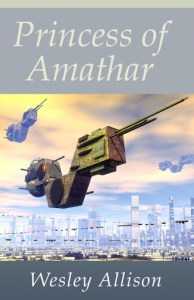
Princess of Amathar – Chapter 4 Excerpt

Malagor and I crouched in the high grass watching the mile long Zoasian battleship hum along in the sky.  The great dreadnought cruised to a point about four miles away from us, and came slowly to a halt.  I asked my friend if the Zoasians might have spotted us, as there seemed to be no other reason for the ship to have stopped, but he did not seem to think it likely. I asked him if the ship was equipped with radar or sonar, but he had no knowledge of those devices.  I tried to explain them to him, but since I am neither a scientist nor engineer, I didn’t do a very good job.  Malagor seemed to get the gist of it, though he said that such technology was unknown in Ecos, or at least the part of it known to him.  He assured me that the only detection apparatus aboard the great vessel were powerful telescopes manned by Zoasian observers.

We continued to watch the ship from our location for a very long time.  It might have been an hour, or it might have been a week— there was just no way for me to judge.  As we waited, I strained my eyes to make out every detail possible on the fantastic vessel.  The weapons were massive and futuristic in design, though possessing none of the simple beauty of the light rifles we carried.  There were numerous structures and housings along the top and sides of the ship, but it was impossible to determine what the purpose of any individual compartment might be.  In the foreword of the vessel was what I assumed to be an airstrip, lined with bizarre looking aircraft.  This was somewhat of an assumption on my part, since they did not look at all like earthly planes, but I was later to be proven to be correct.  I could see tiny figures moving around on deck but the distance was too great for me to make out what they were like.

I was drawn away from my careful observation when Malagor tapped me on the shoulder.  He directed my attention by pointing off into the distance.  At first I could see nothing except the green band where the Ecosian landscape reached up to become the Ecosian sky.  After a moment though, I saw a dot in the distance, which steadily grew in size.  It didn’t take long for me to determine what the object was.  It was a ship similar in size and method of locomotion to the great Zoasian battleship, and it was zooming toward the black ship at over one hundred miles per hour.  Of course the eternal sun of Ecos makes the measure of miles per hour almost meaningless in terms of long distances covered, but it seems the best way for me to describe the velocities involved.

I glanced at the first ship and saw that it was turning its weaponry toward the interloper.  The airstrip on the upper deck began spitting aircraft into the sky.  It turned slowly like some great black beast crouching for a spring.  It presented all its teeth to the enemy.

The second ship was close enough to observe clearly now.  It was roughly the same shape as the Zoasian vessel, and seemed to have a similar array of armament.  Instead of being the hollow black of the battleship though, it was painted navy blue with bright silver trim and highlights.  From all over the craft were hung colorful banners and bright waving flags.  Along the bow was a great golden insignia— two crossed swords above a flaming sun. This ship too began disgorging squadrons of aircraft.

“Amatharians,” said Malagor.  “The banners on the ship are the colors of her knights.  The insignia means that there is someone important on board.”

“Why would they fly into battle if they were carrying someone important?”  I asked.

“If an Amatharian sees a Zoasian, he will attack.  If a Zoasian sees an Amatharian, he will attack.  These two things are as sure as the sun in the sky.”

The two ships began to fire their weaponry almost simultaneously, as the squadrons of fighter aircraft began to engage in a huge and deadly dogfight. The Zoasian armament consisted of a broad range of weapon types, from missiles to powerful cannon to a particularly ugly black ray.  The Amatharian weaponry appeared to be all of one type, based on the same principles as the light rifles, with their churning bubbling liquid sunlight, although the shipboard guns fired light streams anywhere from one inch to one foot in diameter.

The battle went on and on.  It seemed incredible that ships of even that size could withstand the punishment that those two did.  Each took hit after hit from the enemy ship and its aircraft.  Fighters were shot out of the sky right and left, and they dropped to the ground bursting into fireballs.  Several of them crashed into the enemy ship, or into their own.  Explosions rocked the battle cruisers, and we could see tiny figures on the deck fighting fires and in many cases, losing those fights.  After a while it seemed that most of the fighters were gone, victims of the ongoing conflict, but the two great dreadnoughts refused to give up. They kept pouring volley after volley into each other.  As they did so, the battle began to slowly drift our way.

“I think that we had better find another vantage point.”  I said, as I started to gather our things together.

“Wait, look,” said Malagor, pointing at the conflict.

It seemed that both ships had been damaged to the point where they were no longer under complete control.  The Zoasian ship began to slowly twist away out of control. It was the Amatharian vessel though, it was now obvious, which had taken the greater damage.  First it listed slowly to one side, then tilted over more and more, until it appeared as though it was a toy hung from a string attached to its bow.  Then, slowly at first, but with rapidly increasing speed, the ship dropped from the sky.  As it plowed into the ground below, it erupted into flame as great explosions rocked the countryside.  It reminded me of the old film clips of the Hindenburg disaster, though on a much greater scale, and I could feel the heat of the explosion upon my face.
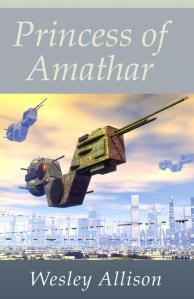

Princess of Amathar – Available at Smashwords

Mysteriously transported to the artificial hollow world of Ecos, Earth man Alexander Ashton finds himself in the middle of a millennium-long war between the reptilian Zoasians and the humanoid Amatharians. Adopted by the Amatharians, Ashton must conform to a society based on honor and altruism, ruled by Knights whose power comes from the curious energy forms known as “souls” which inhabit their supernaturally powerful swords, and rife with its own peculiarities and prejudices. When the Princess of Amathar, whom Ashton has longed for since first seeing her, is captured by the Zoasians, he must cross an alien world, battle monstrous creatures, and face unknown dangers to save her. Princess of Amathar is a sword-swinging novel of high adventure in the tradition of Edgar Rice Burroughs. It is the story a strange world filled with alien races, aerial battleships, swords and energy weapons, amazing adventures and horrible dangers, and the man who must face them all for the love of a woman he has never met.

Princess of Amathar is available in all ebook formats from Smashwords.com.  Follow this link.

Princess of Amathar – Chapter 3 Excerpt

I crawled out of the tunnel into the bright light of the eternal Ecosian day. Malagor followed me.  Between the two of us we carried the artifacts found in the inner chamber, with the exception of the rusty cans. I had a feeling they contained foodstuffs that were far from fresh.  Besides, we didn’t have a can opener.  We set everything down, and Malagor skinned his small game animal, spitted it, and put it over our campfire.  I tossed a few more twigs on the fire and then sat down to examine the fascinating swords that I had found.

I hefted the long sword in my hand, and was surprised to find that though it had obviously been crafted as a two-handed sword, it was too light for that method of swordsmanship.  I then recalled that here on Ecos my strength was increased, roughly doubling what it had been on Earth.  If I had not had this additional strength, the sword would have been quite heavy and well balanced as a two-handed weapon.  The blade was bright silver in color but strangely, neither the blade, nor the many small runes and designs carved along its length, reflected the sun. The hilt was carved of a material that looked like wood, but was much harder and did not show the great age that it must have been.  It too, was carved with fantastic designs, and, set all along it, were fourteen beautiful gems.  I guessed that they were quite valuable, though I suppose that the value of gems, like so many other things, really depends upon one’s culture.  I was never much for mineralogy, so I don’t know if they were emeralds or sapphires or what, but they certainly were lovely. The short sword was almost identical to the long sword, with the exception of its length, and the fact that it had been designed to be used single-handedly.

I looked up from my examination of the sword to see my dog-faced friend.  He had finished getting dinner cooking, and now was devoting himself to an examination of the rifles.  He drew one to his shoulder and looked down the barrel. I was somewhat surprised, because I had assumed that Malagor was from a low technology society.  It had never occurred to me that he might be acquainted with firearms, or in this case an even more advanced weapon.

“Do you know this particular weapon?”  I asked.

“It is an Amatharian gun.  They call it a light rifle,” he said.  “I have used weapons similar to this, but never one this fine or this powerful.”

“Tell me something of these Amatharians,” I said.

“The Amatharians are a most interesting race.  They look much like you, and yet they are different.  They are a race of honor.  If you insult an Amatharian you must be ready to kill him or to die. They travel over a wide area, but live only in their great city of Amathar.  It is said to be the greatest city anywhere.  They are trained in war, but do not love war the way some other races do.”  He stopped for a moment as if trying to remember.

“An Amatharian warrior’s soul is in his sword.  If the sword sees the warrior turn from an enemy, the soul will be disgusted and will never be with the warrior again.  If the warrior dies bravely, the soul leaves the sword to live in the sun, shining brightly forever.  If a warrior gives his sword away, he gives away his soul.”

He stopped and looked at me.

“These Amatharians are funny people,” he said.

“Have you actually known any Amatharians?”

“When I was a little pup, a group of Amatharians came to our village. There were only six of them.  The leader of the group was an old trader. He wanted the pottery and leather crafts that our bitches made.  He traded us tools and interesting foods.  The others were his assistants, all that is except the Remiant.”

“Remiant?”

Malagor went to some length to explain to me what I suppose would be sort of a combined military rank and social status of the Amatharians.  Most young Amatharians, he explained, were militarily trained.  Even those that pursued other occupations within their society were also soldiers. After leaving military duty, the former soldiers became explorers, scientists, or merchants.  A beginning soldier was a warrior or remiantad. After glorifying himself in battle he became a swordsman or remiantar.  When a swordsman became somehow complete, a true living weapon, he became a Remiant, something like a knight.  To be a Remiant, was the ultimate goal of all Amatharians.  Though there were ranks beyond Remiant, a Remiantad or captain and a Horemiant or general, these were only ranks for use in large-scale warfare. In the context of social status, all remiants were equal.  Yes, a Remiant was a knight.  Malagor went on.

“The knight was tall, even for an Amatharian.  He stood, back straight and head held high.  On his tabard was the crest of his house.  His swords were strapped to his sides.  They were not as magnificent as the ones you have found, but it seemed to me that the long one shined with the light of the soul within.

“The merchant and his apprentices went into the house of our alpha male to discuss the terms of trade.  The knight took his position outside the doorway.  There were several of us, all small pups.  We stood there watching him.  He smiled at us.  That is all that I remember.”

“Was that a long time ago?” I asked.

“A very, very long time ago.”  He looked at me with his head cocked to one side.  “It is a boring story.”

“No, it is not boring,” I countered, “but I wonder why the Amatharian left these swords here, and what happened to his soul?”

“It is possible that these swords have not seen use.  They certainly appear to be in fine condition,” said Malagor.

“You know a great deal about Amatharians and their swords considering you met one only when you were a small child.  You must have studied them.”

He just shrugged.

Princess of Amathar – $2.99 for nook!

Mysteriously transported to the artificial hollow world of Ecos, Earth man Alexander Ashton finds himself in the middle of a millennium-long war between the reptilian Zoasians and the humanoid Amatharians. Adopted by the Amatharians, Ashton must conform to a society based on honor and altruism, ruled by Knights whose power comes from the curious energy forms known as “souls” which inhabit their supernaturally powerful swords, and rife with its own peculiarities and prejudices. When the Princess of Amathar, whom Ashton has longed for since first seeing her, is captured by the Zoasians, he must cross an alien world, battle monstrous creatures, and face unknown dangers to save her. Princess of Amathar is a sword-swinging novel of high adventure in the tradition of Edgar Rice Burroughs. It is the story a strange world filled with alien races, aerial battleships, swords and energy weapons, amazing adventures and horrible dangers, and the man who must face them all for the love of a woman he has never met.

Princess of Amathar is available at Barnes & Noble.com for the nook reading device and nook apps.  It’s $2.99.  Just follow this link.

Princess of Amathar – Chapter 2 Excerpt

After getting a good long sleep, Malagor and I began to pack our meager belongings for an extended journey.  Our belongings truly were meager.  My dog-like friend had only a few furs and some weapons and tools to his name, and I had almost nothing to mine.  I was interested to observe Malagor’s weapons.  With the exception of his knife, which was obviously well manufactured, they all seemed to be hand-made, and consisted of a spear, a bow, and a quiver of arrows.  As soon as we had grouped the possessions into two bundles, we each took one and started on our way.  There seemed to be no north, south, east, or west in Ecos, so we went in the direction that Malagor said he had previously been traveling.  After we had walked across the plain quite a long ways, I looked back at the cabin.  It was inching its way up toward the sky.  It seemed a lonely place now.  As we got farther and farther away, it would move up the endless horizon, though of course it would disappear from view before it got very high.  I wondered though if, when we reached wherever it was we were going, it would be looking down at us from some point high up in the heavens.

While we walked along, I asked Malagor many questions about the world of Ecos, the fauna and flora, and the intelligent inhabitants.

“How big is Ecos?”  I asked. I had thought that had Ecos been just a hollow planet, I would have been able to see far more of the horizon as it stretched up into the sky and that much more clearly than I could.  It seemed to me that it was far larger.

“Two hundred twenty six thousand hokents,” he replied.

This of course, led to my lesson in the measurement of distances in Ecos, which was common to the Malagor and the Amatharians, and a few other intelligent races. The kentan was the basic unit of measurement, and had apparently been derived from the size of an insect lair, as strange as this may have seemed at the time.  Then again, I recalled that honey bees made cells in their hive that were completely uniform in size, no matter where you happened to find the hive, or what the bees were using as a source of pollen.  I marveled that the kentan had come from a zoological observation such as this.  As nearly as I could calculate, the kentan was about five and one-quarter inches.  A kentar was ten kentans, or about fifty-two and a half inches.  A kent was ten kentars, one hundred kentans, or about forty-three feet nine inches.  A kentad was one hundred kents, or some eight tenths of a mile.  And a hokent was one thousand kentads, one hundred thousand kents, or eight hundred twenty eight miles.

So when Malagor said that Ecos was two hundred twenty-six thousand hokents in diameter, he was telling me that it was about one hundred eighty-seven million miles in diameter.  With a little mental calculation on my part, I realized that with a sun just under one million miles in diameter, this would put the surface of Ecos about ninety-three million miles from the surface of the sun— about the same distance that Earth is from the surface of its sun.  If my calculations held correct, Ecos would have a surface area of over three billion planet Earths.  It was quite an astounding concept.

For a while I thought about the fact that the great plain we walked across, might well be larger than the surface area of my home planet, and yet be only a tiny fraction of Ecos.  But after a while these types of musings can only give one a headache, so I turned my head to other thoughts.  Looking around across the plain, I observed a marvelous collection of plains animals. I could identify the ecological niches of most of the beasts, by observing their similarities to Earth animals, and yet some of these denizens of the great prairie were completely unearthly. There was a herd of beautiful antelope-like creatures, with long spiral horns and stripes across their backs and six legs.  There were beautiful flying things that looked like butterflies two yards wide. Whether they were birds or insects or something entirely different than either, I could not say.  There was a large caterpillar creature thirty feet long, with a huge maw in front, that ate everything it came across, plant or animal, and there was a beast that preyed upon it that stood twenty feet tall and looked like a cross between an ostrich and a praying mantis.  Some of these animals we hunted for food, some of them we gave a wide berth, and some of them we stopped and stared at in amazement, because not even Malagor had seen the likes of them.

We walked, and we hunted as we walked, and at last I was sure we must have been traveling for a week.  It is very eerie to do anything for a long period of time, and then to look up and see the sun in the exact position that it was in when you started whatever it was that you were doing.  That’s how it was for me.  At last however, Malagor decided it was time to stop and sleep, so we cleared the grass from an area and made a fire.  Malagor and I then took turns watching for beasts and sleeping.  We each slept once, ate, then slept again, and then we started on our way once more.  We followed this procedure many, many times over.  We continued to hunt for food animals along our way, and at every small stream, we stopped to fill our water skins.  I must confess that I never did know how long a journey our trip was, but it seems to me that it must have been close to a year.  At one time I asked my friend how long he though that we had been walking.  His only reply was, “What does it matter.”

At long last we reached the edge of the great plain.  Before us stood a line of small hills that looked to be easily passable.  On the lower slope of the hills grew many small bushes, profusely covered with tiny blue berries.  Malagor picked one, smelled it, tasted it, and pronounced it good.

“We will stay a while here,” he announced.  “Berries do not grow enough places to warrant passing them by.”

I examined the bushes closest to us.

“Some of these berries are new growth, and some of them are rotting on the plant,” I said.  “How long will the season last?”

“I do not know season,” he said.  “What is season?”

I then realized that in Ecos, beneath the perpetual noonday sun, with no variation in sunlight or length of day, there would be no seasons, at least not in the sense of the word I knew.  I was walking around in an endless springtime. I wondered of the mechanics of such a weather system.  It had to be completely different than that of a regular planet.  I knew that there was weather, for I had experienced it myself, at least in its mildest forms.  There had been some partially cloudy skies as we walked along, and even an occasional shower to help keep us cool.  But I had not experienced a great storm, fog, or snow.   I asked Malagor about this and he explained.

Princess of Amathar – $7.99 in Paperback

Transported to the mysterious artificial world of Ecos, Earth man Alexander Ashton struggles understand the society of his new friends, the humanoid Amatharians. As he does so, he finds himself falling in love with their princess and being thrust into a millennium-long war with their mortal foes, the reptilian Zoasians. Princess of Amathar is a sword-swinging novel of high adventure in a world filled with fantastic alien civilizations, strange creatures, and bold heroes.

Princess of Amathar is available from Amazon for just $7.99 in paperback, with free prime shipping.

Princess of Amathar – $2.99 for Kindle

Transported to the mysterious artificial world of Ecos, Earth man Alexander Ashton struggles understand the society of his new friends, the humanoid Amatharians. As he does so, he finds himself falling in love with their princess and being thrust into a millennium-long war with their mortal foes, the reptilian Zoasians. Princess of Amathar is a sword-swinging novel of high adventure in a world filled with fantastic alien civilizations, strange creatures, and bold heroes.

Princess of Amathar is available for Amazon Kindle for just $2.99.  Follow this link and purchase your copy today.

Princess of Amathar – Chapter 1 Excerpt

I don’t expect you to believe this story, but it is the truth.  My name is Alexander Ashton.  I was born in the heart of the American west.  I have often been known to say that I was born either a hundred years too late, or perhaps a hundred years too early.  It always seemed to me that I had the misfortune to live in the single most unexciting period of time the panorama of history had to offer.  I don’t say that I longed to be transported to another time or to another world, for never in my wildest dreams did I believe this to be possible.  I was destined to be surprised.

I was born in a small city.  I played as a child in a park that was once a dusty street where outlaws of the old west fought famous gunfights.  When I was seven, my parents were killed in a motor vehicle accident.  I really remember little of them.  I was put in a state run children’s home where I lived until I was eighteen, passed by time after time by prospective adoptive parents, primarily because I was too old.  I hold no ill feelings about it now.  If there is one thing I learned while I was a ward of the state, it is that no matter how bad off one may be, there is always someone worse off than you are.

After graduating high school and being set on my own by the state, I entered college at the local university.  I became a voracious reader and excelled in athletics, but did poorly in my required studies.  After two semesters of academic probation I was asked to leave.  I walked down the street to the Army Recruiter’s office and enlisted.  There wasn’t much to the army, since there was no war on at the time.  While I was there, I did learn to shoot, and fight with a saber, and to keep in good physical condition, but otherwise I left the service just as I had gone in.

After finding a new apartment in my old hometown, I happened to run into a fellow whom I knew from college.  He was running a small grocery store, and doing quite well, since no large grocery chain was interested in such a small market area.  He offered me a job, I took it, and we became pretty close friends.

My friend, the grocery store owner, was engaged to a nice girl, and they decided in time to get married.  I was chosen to be the best man.  The wedding was nice, and the reception was even better.  I have never been much of a drinking man, but that night I made a name for myself in that capacity.  I don’t know why I drank so much.  Maybe I was feeling sorry for myself and my lot in life, I don’t know.  I do know that in short order, I had worked myself into a staggering, slobbering, half-conscious stupor.  How, when, and where I became unconscious, I cannot say, but at some point I did.  And this is where my story truly begins.

I awoke with a chill in my bones.  I was lying down in a small streambed with icy water running over my feet.  I tried to rise, but couldn’t.  My body was stiff and weak and its only response was to shiver uncontrollably.  Around me was a thick forest, and I could see dark shapes moving around in the trees. I sensed then, on some deeper level that I was in a place I had never been before.  Then I heard a deep growling as I passed once again into unconsciousness.

When next I awoke I looked around to find myself in a small shack.  I was lying on a cot made of animal furs, and I was bathed in a cold sweat.  The walls of the small shelter were made from cut logs and a roughly fashioned wooden chair was the room’s only furnishing.  When the door of the shack opened, I truly believed for the first time in my life that there were life forms other than those I was familiar with on Earth.

The creature that stepped inside the door, and closed it after him, was most ugly.  That he was intelligent was demonstrated not only by the fact that he had opened and then closed the door, but also by the fact that he wore clothing— ugly clothing yes, but clothing nonetheless.  He was about five feet tall and stood in a kind of perpetual crouch.  His body was covered with coarse brown hair, two to three inches long, from his head to his feet, which reminded me of the feet of a dog or a wolf, although larger.  He was somewhat wolf-like in every aspect, such as his protruding snout, but he also seemed somewhat baboon-like in his expressive eyes.  I am comparing him to earthly animals, but this is really inadequate, as the similarities were actually quite superficial, and he was totally unearthly in appearance.  I remember most looking at his hands.  He had four fingers not too different from my own, but his abbreviated thumb possessed a great, long, curving claw.

The creature, stepping slowly over to me, reached out a hand and gave me a piece of dried fruit.  I was quite hungry and the fruit was quite good.  As I began to eat, the creature began to bark and growl at me.  At first I thought he was angry, but then I realized that he was trying to communicate in his language.   I was too tired to respond and fruit still in hand, passed back into sleep.

The next time I woke the creature was sitting in the chair looking at me with his head cocked to one side.  I pushed myself up on one elbow and he spoke to me again, this time in a more human sort of language.  It seemed almost like French, but having learned a few phrases of that language in the army, I knew it was not.  This language was so much less nasal.  He pointed to his chest and said “Malagor” then he pointed to me.  I said “Alexander”.  He smiled wide exposing a magnificent row of long, sharp teeth.  My language lessons had begun.

It took a long time for me to recover from my illness.  It seemed to me that I was nursed by the creature for at least a month.  I slept many times, but each time I awoke I found light streaming in the window.  Not once did I wake to find darkness, or even the pale light of the moon, outside the window.  During this long period of time, my host provided me with food and water, took care of my sanitary needs, and of course, taught me to speak his language. One of the first things that I learned was that “Malagor” was not the name of my companion, but was instead his race or species.  He told me his real name, which seemed to be a growl with a cough thrown in for good measure.  I decided that I would call him “Malagor”, and he didn’t seem to mind.

Reading Women of Power

I haven’t had a lot of time for reading lately, between work and trying to write.  I read a few minutes before bed and I read the excerpts that I post here online.  I haven’t read Women of Power in a while.  I wrote it just for fun, back when I first started writing lengthier stuff– really just to see if I could do it.  It maybe my least-selling book, but I have to admit, I like it.

The idea was to take a typical comic book character, in this case Skygirl, and pair her up with a more worldly, realistic superhero– All American Girl.  All American Girl is interested in sponsorships and making money from her powers and is well-aware that secret identities are all but impossible in the modern world.  All that was fun, but it was a treat to create a world just like our but with Olympian gods being quite real.  This was before I read Gods Behaving Badly, a book I highly recommend.

If you are a fan of superheroes, try Women of Power, available fore just 99 cents, wherever fine ebooks are sold.

A Plague of Wizards – Chapter 18 Excerpt

The lizzie servant finished painting Terra’s face, half red and half black.  Terra added a yellow circle on each of her cheekbones.  Then the servant slicked back the girl’s hair, which had grown long enough to cover her scars, using fragrant plant oil. This allowed her to arrange the feathered headdress on the Terra’s head.

The young human girl arrived at the dining room and took her seat.  Though it was almost filled with lizzie nobles, the king had not yet arrived, and no one would get any food until one of his wives had fed him.  The human girl had only sat for a minute or so when her stomach let out a loud growl.  The female lizzies on either side of her tried to look without turning their heads towards her.

Terra turned to look over her left shoulder at the sound of people arriving.  In marched the queens: first Szakhandu, followed by Tokkenoht, Sirris, and finally Ssu.  The first three took their seats, while Ssu went to the food table to begin assembling the king’s meal.  Hsrandtuss at last stomped in.  He looked unusually sober.  As he walked to his seat, he looked toward Terra, and spotting her, threw a gesture toward her that the girl had never seen.  Suddenly uneasy, remembering Bessemer’s comments that the great lizzie might be looking for a new wife, she gave him a simple wave.  He took his seat just as Ssu brought him his dinner.

Now that the king had been fed, females from around the room got up to prepare meals for their males, or in a few cases just for themselves.  Terra fit into the latter category and picked up a bronze tray, filling it from the food table.

“Tsaua, Kaetarrnaya.”

Terra looked to see Hsrandtuss’s High Priestess/Queen standing next to her.

“You should try some of these fruit.  I hear humans enjoy them.”

“Yes.  We call them grapes.”  She grabbed a bunch and tossed it onto her tray next to three roasted birds that she had already acquired.

“I have something for you,” said Tokkenoht.  “I got it from the human traders.”

She handed Terra a little wooden box, about an inch wide and two inches long, with a sliding lid.

“What is it?”

“It is daksuu.  It is for your food.”

The human girl slid the box open to find it filled with what looked like fine gravel or very course sand. She held it to her face and stuck her tongue in.

“Salt!  Kafira bless you a thousand times.”

Tokkenoht nodded.

“Can I ask you something? When he came in, the Great King made a gesture toward me that I’ve never seen.  It was like this.”  She recreated the gesture.

“That is a warrior sign. It means victory.”

“Oh, good.  Then he doesn’t want to marry me.”

Tokkenoht burst into a hissing fit that was the lizzie equivalent of an uncontrollable belly laugh.

“That would never work,” she said, still struggling to get control of herself.  “It simply would not physiologically work.”  Suddenly she stopped and looked toward the king. “Then again, such an alliance would be unprecedented and very valuable, even if it was not a real marriage.”

Terra leaned on the table, as her head swam.

“Don’t worry.  Hsrandtuss knows humans better than anyone else. You’re hut… your family would never allow such a thing, would they?”

“I’m quite sure they would not.”

“It would mean war?”

“Maybe.  In any case, it would bring Hsrandtuss nothing but hatred. And I would certainly be disowned.”

“Hsrandtuss knows this. You have nothing to fear. Besides, the other wives would have to approve of you, and I would not have a human zrant as the wife of my husband.”

Terra realized that she had been insulted just as she set her plate in front of her seat.  She climbed into her chair and looked at her meal—a huge feast of roasted birds, grilled fish, grapes, and what she was fairly sure was some kind of white asparagus.

Just then, the door opened at the far end of the room and two lizzies were marched in, both wrapped in chains and escorted by a dozen warriors.  They walked morosely to stand before the king.

“What is the meaning of this?” growled Hsrandtuss, looking at one of the guards.

“We were told to bring them before you, Great King.”

Hsrandtuss deftly hopped over the table.

“Get these chains off them!”

The warriors hurried to follow his command, but it took a minute.  As they worked, the lizzie king continued speaking.

“King Oreolock of Xecheon, please excuse the rudeness of this meeting.  These fools understood the meaning of my order, but not the manner. My intention was to invite you to dine with me.  That reminds me.”  He looked over his shoulder.  “Sirris, Tokkenoht, get food for our guests.”  He looked back to see Oreolock, clearly at a loss as to what to do or say. As the last chain fell away, Hsrandtuss put his arm around the smaller king’s shoulders and led him around the table to a spot left of his own.

Terra realized at the last second that the seat for which the defeated king was destined was directly opposite hers.  As he sat down, Oreolock looked up and saw her—starting.

“That is Kaetarrnaya.  She is my tiny human.  You will know you are a great king when you have your own tiny human.”