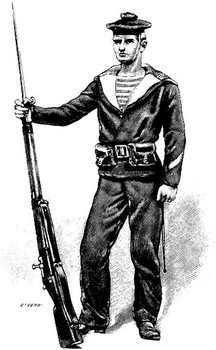
“What do you want?” asked the sailor, the emphasis on the word “you.”
Images Copyright 2009 by Clipart.com
Images Copyright 2009 by Clipart.com
Chapter Nine: Wherein I demonstrate the value of a classical education.
“Do you think they are the same goblins that we saw earlier?” asked the orphan, at my shoulder, peering into the window.
I could only shrug, for in truth one goblin looks much the same as another to me. Though I had relatively close contact with three of the creatures earlier that evening, which is to say having kicked two and poked one in the head with my knife, I can’t say that I had become familiar enough with any of the three to distinguish them from any other of their race. That being said, I was relatively sure that the one I had poked in the head with my knife was not among those now in the little cabin. These goblins were singing or drinking or dancing or doing some combination of the afore-mentioned, all of which are extremely difficult if not impossible to do when one is dead.
“What are you going to do?” wondered the orphan.
“Why do you suppose I should do anything?” I wondered.
“Shouldn’t you avenge the poor man lying on the floor? After all, he is a human being killed by foul goblins, and you are a… I mean we are human beings too.”
“Aye, it is true that we are human beings.”
“And he was killed by goblins.”
“I do hate goblins.”
Hysteria knickered. She hated goblins too, probably because they stand so low to the ground and as I have pointed out before, she dislikes anything too near her feet.
“And I am frozen,” the orphan continued. “I would love to spend the night inside of doors and near a warm fire.”
“Now you make a compelling argument,” said I.
“So what are you going to do?”
“Have you ever heard of Brementown?”
“Uh…no. Why?”
“There is a story told there of a group of musician animals.”
The orphan rolled his eyes. I explained my plan, devised on a variation of the Brementown story. Turning Hysteria so that her rear end was pointed toward the wall of the cabin, I left her with the orphan while I went back to the front and took a position by the door. Pulling out my knife, I placed my fingers in my mouth and whistled, which was the prearranged signal for both my noble steed and the orphan.
At the signal, Hysteria began kicking the wall of the cabin with both hind feet and the orphan commenced to making all manner of strange noises. I was so surprised by the cacophony of sounds, which is to say noises that came out of the youngster’s mouth that I almost forgot my own part of the plan. I am aware that boys are well-versed in the creation of creative noises as well as all kinds of mimicry, having been a boy myself once. But this orphan was a true artist. He belted out the yowls of a wildcat, the braying of a donkey, the barking of a dog, the screech of harpy, and the gurgling growl of a frog-bear. Not to be outdone, Hysteria let loose with the squeal of an angry equine, which is to say a horse.
It was scant seconds before the door burst open and the goblins began pouring out into the snow, their shrieks clearly indicating that they were frightened out of their tiny little minds. The first two who came out were quickly dispatched with my knife. After that I decided that it was too strenuous to keep bending down to kill them, as they are so low to the ground and I had been riding all night long, which under the best of conditions can give one a sore back. Thereafter, I reverted to my now well-practiced maneuver of using their heads as makeshift kick balls, which is to say I kicked them on their kick ball-shaped heads.
In the space of twenty seconds, I managed to get rid of all the goblins, which turned out to be seven. I can’t swear that all of the goblins were dead, as five had been sent in long arcs through the air into the darkness of the woods. They were gone though. Scant moments later, the orphan, Hysteria, and I were inside the cabin. I put Hysteria in the corner furthest from the fireplace and directed the boy to stoke the fire, while I pulled the body of the unfortunate former owner out into the snow next to two of his apparent murderers. Thereafter, I went back inside and bolted the door.
“That was a wonderful plan,” said the orphan.
“Indeed it was.”
“I’m surprised you thought of it.”
“Just one of the benefits of a classical education,” said I. “If I did not know the story of the Musicians of Brementown, I would not have known what to do. And as I recall, you looked noticeably unimpressed when I mentioned my knowledge of this particular bit of culture.”
“I do admit I thought it a waist of time, um… at the time,” admitted he. “I offer you my apologies.”
“I suppose I will have to accept them,” said I. “What with you being a poor, ignorant orphan.”
“Your magnanimity is wonderful to behold,” said he. “In any case, I think I would like to hear the story of the Musicians of Brementown.”
“Oh no!” cried I. “You still owe me a shiny penny for the story of Queen Elleena of Aerithraine.”
“But you didn’t finish it.”
“Of course I did.”
“No. You didn’t. When you stopped, she wasn’t even Queen yet. She was stuck in the temple in Fall City.”
“When she turned fourteen, she returned to the capital in Illustria and was crowned Queen by the Pope, after which she took control and banishing him back to Fall City.”
“How did she do that?”
“No one knows.”
“Gah!” he cried. “You are the worst story-teller ever!”
“What would a poor, ignorant orphan know about it?”
“I know you’re not getting my penny!”
“Go to sleep,” I ordered him. “You sleep on the rug by the fire. I will take the bed, after I give Hysteria a good rub-down.”
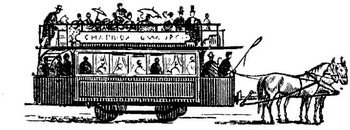
The horse drawn trolleys passed every three minutes, and they were all full of commuters.
Images copyright 2009 by Clipart.com
The Kartags are rat-like creatures that live in the dark places of the world of Ecos. They are sentient and live in tribal groups. I have to admit to a certain prejudice when I created Ecos. The creatures that resemble rats, spiders, snakes, etc. are inevitably evil, while those that resemble cute birds and cuddly teddy bears are good.
“This is a band of Kartags,” said Norar Remontar, turning on his small flashlight and pointing it at several prone figures. “They burst out of a hidden door while I was in the chamber alone, and knocked me out with a well placed blow to the head. I was lucky to regain consciousness before they were able to do whatever it was that they were planning to do to me.”
I looked at the beings lying dead in the circle of artificial illumination on the floor. They would have been about five feet tall when standing and they reminded me of a large rat, at least as far as their faces were concerned. They had legs designed for upright locomotion, and two sets of arms on their upper torso. Their dirty, wrinkled skin was a dull grey color, and hairless, reminding me quite a bit of the way rodents look just after they are born. Though they wore no type of clothing, they did wear simple leather harnesses upon which they carried crude hand-made stone tools.
“The Kartags are well-known to my people,” said my Amatharian friend. “They live by scavenging from more civilized beings.”
“I kind of got that impression from looking at them,” I replied. “It is lucky that you were able to rescue yourself. If it hadn’t been for the soul in your sword, Malagor and I would never have found you.”
“It may have been lucky for us that they attacked me. This subterranean passage may be a considerable short cut home to Amathar.”
The name Kartags is another made up word.
“Look over there,” said Tular Maximinos, suddenly at my shoulder. It was his company who had come to our aid.
I turned to see one of the black Zoasian battleships explode into a huge fireball and fall into the city below, setting off even more explosions. The battle seemed to be going well, and I could see three other enemy ships burning in the sky, as they spun out of control. All of the ships in our squadron were still in the air, though many had taken quite a bit of damage. I imagined that the squadron making the direct assault against the city was incurring even greater losses, but we had our reserves, and we knew what we were after.
Suddenly all the soldiers on deck were knocked from their feet, myself included. I jumped up to see another Zoasian ship grinding along our bow. The two ships had collided in mid-air, and the enemy was sliding down our side. As the black battleship moved closer to where we stood, it began to move away.
“Come on,” I shouted to my men, and taking a running leap into the air, I crossed the distance to the reptiles’ airship. This wasn’t really part of a plan. It just seemed like a good idea at the time to take the battle to the enemy.
Landing on the deck with a thud, I turned around to see how many of my company had made it across with me. About thirty others, including Tular Maximinos, had made it. One young warrior had not been able to make the jump, and was still falling the several thousand feet to the ground below. The remainder of our small battalion had remained behind, being unable to cross the distance before the two ships had moved too far away from each other.
“Where now?” I called to Tular Maximinos, as there seemed to be no Zoasians on deck.
“To the engine room!” he called back, and the two of us rushed toward the back of the ship, followed by thirty or so men and women.
A wide path ran along the side of the vessel between the superstructure and the edge, giving us a metal avenue down the length of the ship. It was good that it was a broad space too, because there was no rail along the side, as there was on Amatharian ships. We had gone down about half the length of the mile long vessel when I heard weapons fire behind me. I turned to see over a hundred Zoasians at the bow of the vessel, where we had just been. They were firing at us, and had already shot two of our team.
I sheathed my sword, and whipped out my light pistol. The Amatharians with me did the same, and we soon had the hulking reptiles diving for cover.
“Swordsman,” I called to a female Amatharian, “take five warriors and hold this position.”
“Yes, knight.”
I could see in her face that this young woman knew that she had just been ordered to give her life, but I could also see the fierce determination to complete her orders, and a strong desire to sell her life as dearly as she could.
Tular Maximinos and I led the other soldiers onward. At last we reached the rear of the superstructure, but there seemed to be no opening.
“We need to find a way inside.” said the Amatharian knight.
“Well then,” I said, putting away my pistol, and whipping out my long sword. “Let’s go inside.”
The blade of my sword began to glow even before my arm started its movement. I swung down to the deck, slicing with my sword, through the metal, like a butcher knife cutting through a soap bubble. With four clean strokes, I cut a large square hole in the deck. Tular Maximinos kicked the newly made door with the heal of his boot, and sent the square of metal flying downward. I whipped out my pistol and jumped into the new hole, landing some ten feet below and rolling to one side. A moment later, Tular Maximinos and the warriors of Amathar were beside me.
We were in a long hallway which seemingly stretched the length of the ship. It was brightly lit with artificial light. There were no Zoasians in sight. With a wave of his hand, Tular Maximinos signaled us to follow him, and we moved silently down the hallway toward the stern of the vessel. At each intersection of the hallway we glanced down the perpendicular shafts, expecting at any moment to be confronted by a large group of heavily armed lizard men. We ran across only one unfortunate Zoasian, whom Tular Maximinos sliced into three separate pieces.
After running literally more than a quarter mile down the hallway, we found ourselves at its end. The hallway opened up to a balcony overlooking a huge room full of machinery a hundred feet below. On the floor far below us, was the apparatus responsible for keeping the ship aloft. It looked something like a great turbine, though its hum was below the sound level of our own voices.
Almost immediately, we were spied by one of the enemy crew members on the floor, and seconds later we were engaged in a firefight with a dozen Zoasians below. Seconds later, two of my companions fell, wounds in their backs, and I turned to see a whole army of reptiles running toward us from the hallway we had just exited. I knew that the brave soldiers we had left behind had been overcome. I called out a warning to the others and fired several shots down the hall. But we were caught in a crossfire. A narrow catwalk led to the right or left of the balcony, but with weapons fire from below, and an enemy approaching from behind, it was suicide to attempt it.
“Good luck to you, my friend,” said Tular Maximinos, smiling. He then jumped to the top of the balcony railing, and holding his sword straight out, jumped down toward the machinery below.
As Tular Maximinos fell, he carved his blade into the great machine. The mechanism began to sputter and spark and shriek loudly. The Amatharian’s body continued to fall though, and hit the floor with a horrid crunching sound. I looked down to see him lying on the deck below, his legs a twisted mess of blood and bone. Before I could raise my own weapon in his defense, a nearby Zoasian pointed his ray pistol at the knight’s head and shot him.
Like a streak of lightning, a blazing light bust forth from Tular Maximinos’s sword. It danced around the room for a moment, and then blasted through the bodies of every Zoasian in the engine room. Finally it disappeared. Before my eyes had readjusted to the normal light levels, a huge fireball engulfed the room, as the massive machinery that the Amatharian had damaged, exploded.
“Come on!” I called to the brave men and women with me.
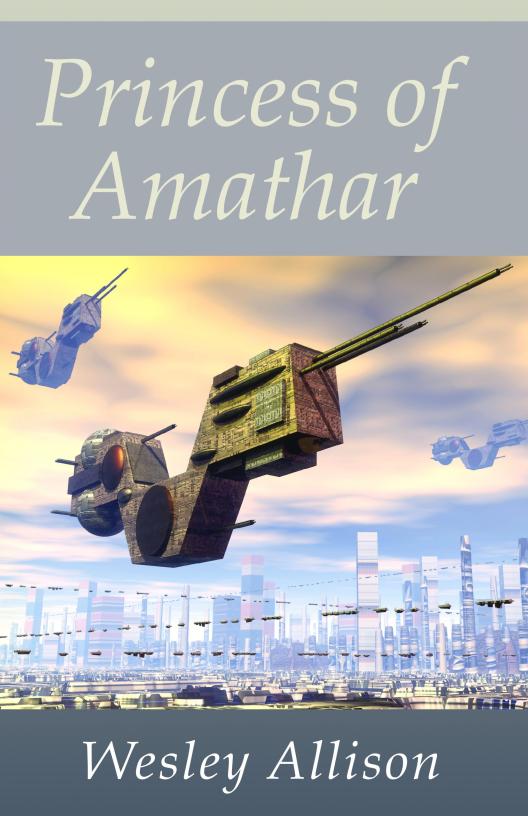
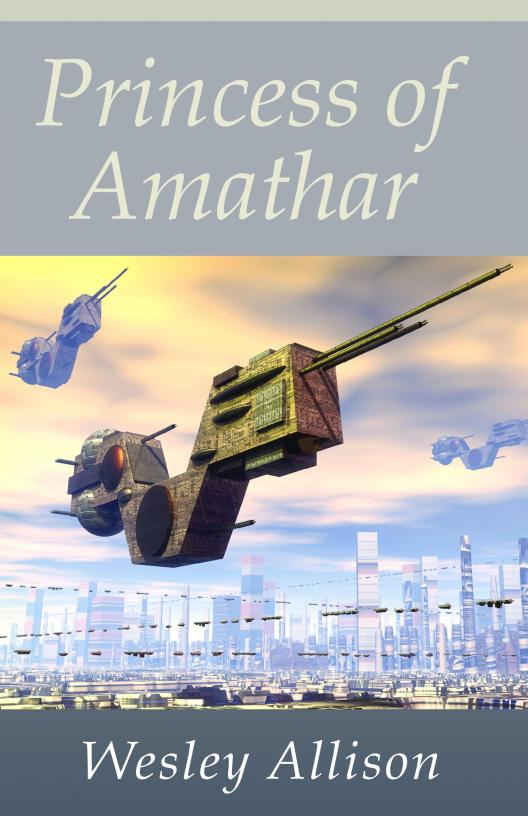
Just a reminder that Princess of Amathar is available now as an ebook for only $1.59.
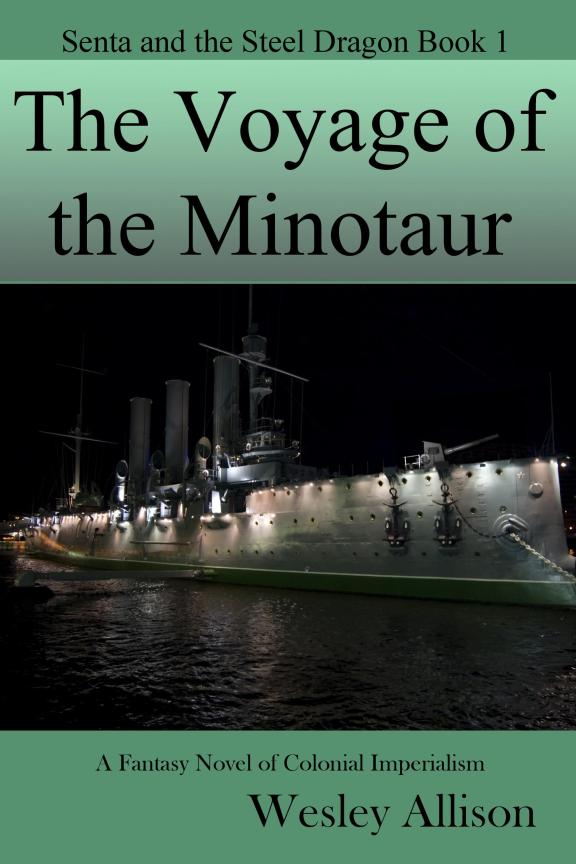
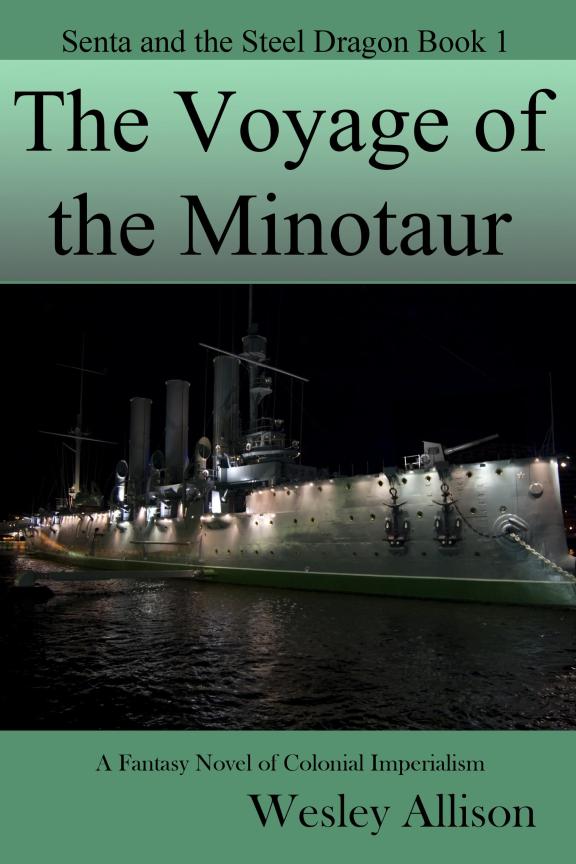
One of the most famous places in the capital city of Greater Brechalon is Hexagon Park.
Pushing herself regretfully away from the glass, and leaving two hand smudges, a forehead smudge, and a nose smudge, Senta ran across Prince Tybalt Boulevard, which crossed perpendicularly, making a “T” at the end of Avenue Phoenix. She ran in a zigzag motion to avoid being run over by any of the numerous steam carriages which whizzed by. Several of them honked at her with a loud ‘ah-oogah’ but none of them ran over her. And then she stood at last on the edge of Hexagon Park. Senta had no idea that Hexagon Park was so named because of its six sided shape. She didn’t even know what a hexagon was. She did not realize that Hexagon Park was the exact same size and shape as the Great Plaza, where Café Carlo was located. To her, the park had always seemed so much larger. Nor did she know that the park, the plaza, and the rest of the “Old City” had been laid out and marked, using a stick dragged through the dirt, by Magnus the Great, the King of the Zur, when he had conquered the continent almost nineteen hundred years before.
Hexagon Park was lovely in the spring. This eight hundred yard diameter wonderland was filled with delights. At the south end, to Senta’s right, the park was carefully cultivated, with large rose gardens, numerous small beds full of colorful annuals, ancient fountains spraying water from the mouths of mythical animals or pouring water from pitchers carried by statues of naked women, abundant fruit trees now in bloom behind their own little wrought iron fences, and still reflecting pools filled with tadpoles. At the north end, to Senta’s left, the park was kept more natural, with large expanses of beautifully green grass, large shade trees, now filled with more than enough leaves to do their duty, winding pathways, and small ponds full of colorful fish. Senta headed for the center of the park, following the flagstone path that led to the central courtyard. Here was a small amphitheater, a series of park benches arranged around a mosaic map of the kingdom inlaid in the pavement, and the wonderful, wonderful steam-powered calliope, which played joyful music from mid-morning to mid-afternoon.
The calliope, which had been between songs as Senta walked through the park, began toot-toot-tooting the next tune, just as she arrived in the center courtyard. Senta had heard this tune many times, though she didn’t know its name. It was lively and bouncy and made her feel even more like skipping than she usually did. The growls of hunger from her stomach overcame the urge to skip down the paths of the park though, so she sat down on one of the benches, unwrapped her red plaid bindle, opened the wax paper, and stuffed her sandwich into her mouth. Mouth watering with each bite of the course bread, the salty ham, and the tangy brown mustard, she had finished off more than half of it before she stopped to take a breath and to look around her.
There were numerous people in the park, walking down the paths, admiring the flowers, and lying on the large swaths of green grass. Several small boys, about five or six years old, tried to catch tadpoles in the reflecting pool some forty yards away. There were relatively few people in the central courtyard though. The calliope man was there, making small adjustments to the great machine. It was a large, square, red wagon upon four white wood-spoked wheels, with a shining brass steam engine, which bristling with hundreds of large and small brass pipes, each spitting steam in turn to create the wonderful music. A young man in his twenties—nicely dressed but not obviously rich—sat reading a newspaper while he ate fish and chips from a newspaper cone, which he had no doubt purchased from a vending cart just outside the park boundaries. On the bench closest to the one on which Senta sat eating, was an older man in a shabby brown overcoat. He was tossing bits of bread to several of the foot-tall flying reptiles that could be found just about everywhere in the city. Unlike birds—tending in these parts to be smaller—which hopped along when not in flight, these fuzzy, large-headed reptiles ran from bread crumb to bread crumb, in a waddling motion, with their bat-like wings outstretched.
The name and shape of Hexagon park is a nod to my background of role-playing, having drawn many maps on hexagon paper.
A small shop in the middle of the Avenue Phoenix is Humbolt’s Fine Toys. It is a location of interest for 8 year old Senta, who would love a doll more than just about anything.
Stopping to press her face against the glass, right below the printed sign that said “Humboldt’s Fine Toys”, Senta stared at the wonders in the store. She had never been inside, but had stopped to look in the window many times. The centerpiece of the store display was a mechanical bird. It worked with gears and sprockets and springs and was made of metal, but it was covered in real bird feathers in a rainbow of hues, and would sit and peck and chirp and sing as though it were alive, until it finally wound down, and the toy maker would walk to the window and say the word to reactivate the bird’s magic spell. Senta knew that the bird would remain in the window for a long, long time, until some young prince or princess needed a new birthday gift, because that bird would have cost as much as the entire Café Carlo. Arranged around it were various mechanical toy vehicles—ships, trains, and steam carriages. Some were magical and some worked with a wind-up key, but they all imitated the real life conveyances from which they were patterned.
None of these wonderful toys held as much fascination for Senta though, as the doll which sat in the corner of the window. It wasn’t magical. It wasn’t even animated by a wind-up mechanism. It was a simple doll with a rag body and porcelain hands, feet, and face. It was wearing a simple black dress. Its blond hair had been cut in a short little bob, and looked like real human hair. It had a painted face with bright blue eyes and pink lips. It may well have been one of the lesser priced toys in the shop. It was definitely the least expensive item in the window, but Senta would never be able to purchase it. Had she been able to save every pfennig she earned, it still would have taken her more than thirty weeks before she had enough to purchase the doll. And she could not save every pfennig she earned. Most weeks, she could not even save one.
Pushing herself regretfully away from the glass, and leaving two hand smudges, a forehead smudge, and a nose smudge, Senta ran across Prince Tybalt Boulevard, which crossed perpendicularly, making a “T” at the end of Avenue Phoenix.
I don’t remember where Humbolt came from. It’s just one of those names that popped into my head.

In many ways, life aboard the great Amatharian battle cruiser was much easier for me than it had been in the city. The ship operated on a fixed schedule based on its own version of the city-cycle, which was recalibrated each time the ship docked in Amathar. Each person on board was assigned a duty and worked three cycles, followed by six cycles off duty. I knew absolutely nothing about the ship or its procedures, so initially I was assigned to the security detail. Since I was a knight, I was given what was essentially an officer’s rank– command of ten swordsmen, each of whom commanded eight to ten warriors.
Amatharian ships didn’t have names, though they did sport numbers. The battle cruisers were essentially all of the same class, though they had minor differences, and some were newer than others. Their importance was based entirely upon who commanded them, and what mission they were on. This ship was Sun Battle cruiser 11, and it was the flagship of Norar Remontar’s twelve ship squadron, one of four squadrons making the assault on Zonamis. Like the other ships, this one was painted navy blue with silver trim. Like the other three flagships of the fleet, this one had a great crest across the bow– in this case, a flaming sun with outstretched wings. And like all Amatharian ships, this one was arrayed with the banners of her knights. When I first saw my own banner, with a flaming sun embossed by the letter “A”, flying among the many others, I was filled with pride. There were more than ten thousand soldiers aboard this one ship, and about one in a hundred were knights.
The accommodations on the vessel were far more spacious than I had expected. Every soldier aboard had his own cabin, and though they were very small in comparison to their homes in Amathar, they were far larger than I had seen on any ocean going vessels of Earth. Each was large enough to have a bunk, which was mounted to the wall rather than sunk into the floor as was the Amatharian fashion, a small table and two chairs and a closet. My own cabin had a large window looking out toward the landscape that rolled continuously past.
Now that we were finally on our way, I spent more and more time thinking of the woman I knew I was in love with, though I had seen her only one time– the Princess of Amathar. Sometimes these thoughts would lead to remembrances of her cousin, Vena Remontar, and the friendship she had shown me. Other times I just fretted over what might have happened to Noriandara Remontar since her abduction by the Zoasians. Even cruising at full speed, it would be a long time before we reached Zonamis, and I worried about all the things which she still might face. I figured our maximum speed to be between two and three hundred miles per hour, and so even accepting the more generous of the two figures, it would be the equivalent of four and a half months before the fleet arrived. It was a long time.
I tried to make good use of all the time I had available. I learned to pilot the Amatharian aircraft, both fighters and shuttles. It wasn’t as difficult as one might expect. I imagine that any child capable of playing those fast action video games could easily manage it. The controls consisted of a joystick in the left hand to control the steering and a lever for the right hand which controlled lift. There was an automated training simulator on board which I used at first, but after it became apparent to me and to the pilots that I would probably not crash the vehicle, I was allowed to participate in some of the flight drills which were constantly leaving the battle cruiser and returning.
I improved upon my growing skill with the sword, which was in fact my primary duty aboard ship. As the leader of a security team, I did little but see to the watches around the vessel, and drill my troops with the sword and the light rifle. I must say that I had never seen men and women so devoted to duty as those one hundred or so Amatharians under my command. In that entire time, never once was a soldier absent from his duty because of sickness or anything else.
Even with all of the military activity in which I was involved, there was plenty of time for recreation and social activity. The swordsmen and warriors of my company enjoyed playing a kind of catch, in which they used an irregular shaped cloth bag filled with plastic-like beads. Another game involved the skewering of various thrown objects upon a stick as the individual ran through a maze of obstacles. I gathered that this traditional activity once involved the use of swords, but now it was considered a great dishonor to endanger one’s sword for a mere game. In addition, I spent a large amount of time in the ship’s prodigious library where I read biographies of interesting Amatharians, novels of several different types, and a book of rather dark and morbid poems penned by Mindana Remontar herself.
I was lucky to have my friends present on the same ship. Norar Remontar was of course in command, and though he was busy with his duties far more than I was with mine, we still had time to discuss life, love, and duty over dinner. Malagor occupied the cabin right next door to me. He had been given command of eight warriors, and had been placed in charge of one of the ship’s great light guns. Vena Remontar was aboard this ship as well, in command of all the squadrons of fighter aircraft. She seemed more and more beautiful each time I saw her. Tular Maximinos was there too.
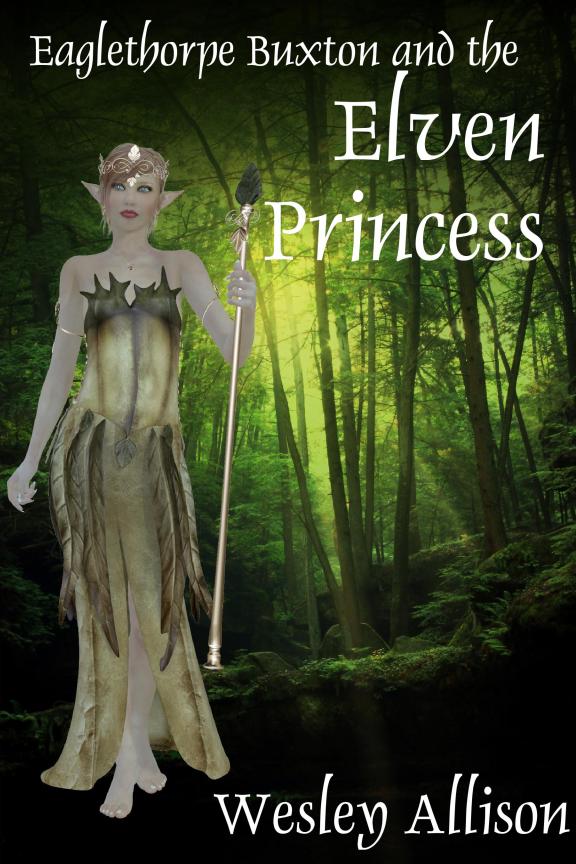
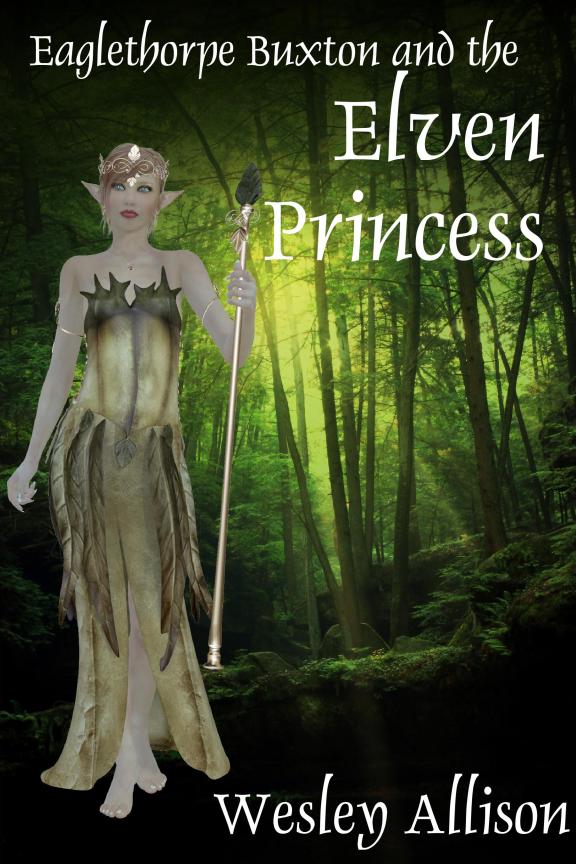
It has been one month since Eaglethorpe Buxton and the Elven Princess was released as a free ebook. So far it has been downloaded 741 times at Feedbooks and Smashwords. Get your free download now. It is not yet available in bookstores, but you can purchase a copy of the paper book by clicking on the appropriate link at the right.


 City of Amathar