The New York Review of Science Fiction

I just received my copy of The New York Review of Science Fiction for May 2012 and found a lovely article on me– “Wesley Allison– A New Kind of SF Writer” by Patrick L. McGuire.  I actually knew this article was coming, as Patrick had let me know he was working on it and had run a fact check copy by me.

I am very honored to be featured in the NYRSF, and am even more honored by Patrick’s article.  I find it very humbling when someone cares enough about my work to shine a light on it, and this is quite the spotlight.  This is especially true when that someone is such a connoisseur of science fiction.  Thank you Patrick.

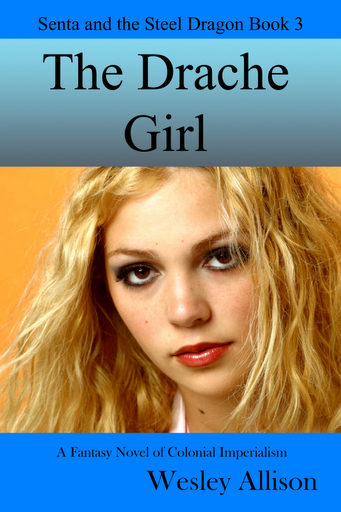
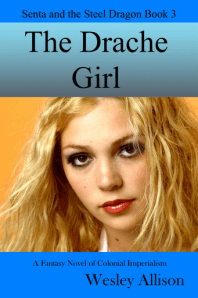
The Drache Girl: Saba Colbshallow

Saba is an important character in Senta and the Steel Dragon and in The Drache Girl, he has perhaps his bigget part.

Suddenly he heard gunfire erupting from directly in front of him.  One, two shots.  Then a pause.  Then one, two, three, four, five, six, pause.  He looked up above the trees and saw a flash of steel shoot across the sky.

“Oh, bloody hell!” he shouted and ran at top speed in the direction of the gunfire.  That he carried no other weapon than a heavy truncheon, worried him not a bit.  Two men with military issue service rifles, but wearing expensive hunting clothes stood in the middle of the gravel road.

“Guns down!” yelled Saba, as he skidded to a stop in front of them.  “Drop your guns now!”

“See here chap,” said the first man, his accent labeling him as plainly as if he had worn a placard that he was from Old Town Brech.  He must have been very new to the colony, because Saba made it a custom to get to know everyone, and neither of these men he recognized.

“We’re doing nothing illegal,” said the second man.  “Just shooting some pests.”

“What exactly were you shooting?”

“We heard from some of the neighbors that these velocipedes….”

“Velociraptors,” Saba corrected.

“Yes, them.  They’ve been a menace lately, to the point of endangering the local children.”

“Quite,” said the first man.  “We went out to put a few down and found a small group digging right into those garbage bins.  We shot a few and killed two, I think, but one took off and flew into the trees.”

“If you listen to me very, and I do mean very, carefully,” said Saba.  “I just might be able to save your lives.  Lay your rifles down on the ground.”

“But I don’t under…..”

“Do it!”

The men leaned over and carefully placed their weapons on the white gravel road.

“Nobody told you velociraptors don’t fly?”

A loud whomp made all three men jump, and they found themselves standing next to a pony-sized reptile with twenty foot wings, and more importantly a mouth open large enough to swallow a human head.  Steel scales reflected the light from the winter morning sky like shields and swords on a forgotten battlefield.  The steel dragon let out a huge roar, rending the air with a noise that must have been heard all over Port Dechantagne.  Little puffs of smoke flew out of his mouth at the two men as well as bits of saliva which burst into little sparks in the air.

“They bloody shot me!”  The dragon’s four word sentence disintegrated into another roar of rage.

One of the hunters started to bend over for his rifle.  Saba stepped on the gun and put his hand on the man’s shoulder.

“Let me see your injury, Bessemer,” he said.  The dragon folded its left wing, and held out the right wing showing an ugly lead mark on a shiny steel scale about midway between the first joint and the shoulder.

“It doesn’t look that bad,” said Saba.  “And you know this was an accident.  They were trying to knock off some velociraptors.”

“So was I,” said Bessemer.  “I didn’t expect it would get me shot!”

“It was an accident, honest and truly,” said the first hunter, shaking a little.  “Maybe we can make it up to you.”

“There was a time,” said Bessemer.  “When the only acceptable payment for this type of transgression was a virgin given at midnight on the full moon.”  Then he burst out laughing.  “Of course I didn’t mean you, Saba.”

The two hunters laughed, a bit nervously, along with the dragon, happy that the anger he had arrived with seemed to be going away.

“Well, no harm then,” said one.

“You daft fools,” said Saba, looking down the road.  “He’s the least one of your problems.”
Author’s Note Concerning Languages

Author’s Note Concerning Language and Words

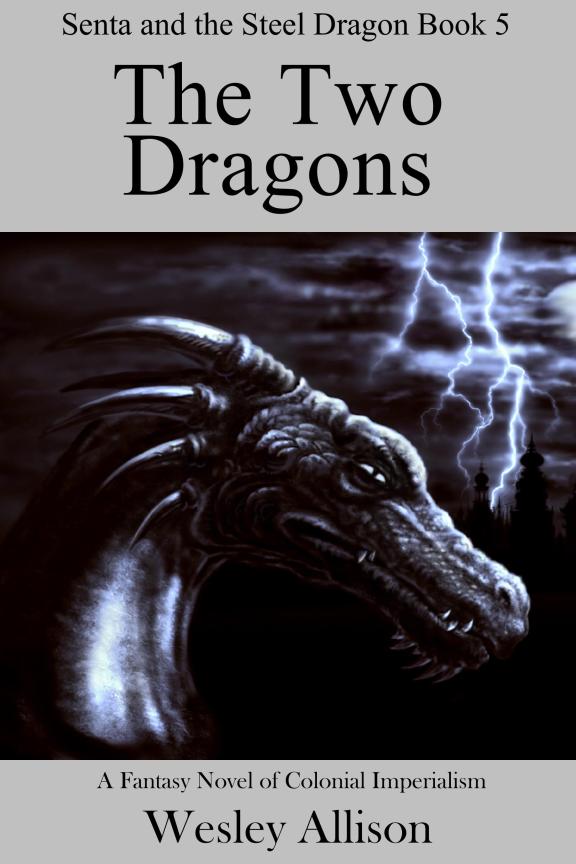
The reader will no doubt note that The Two Dragons is a work written in English.  As such, English words are used to describe the people, places, and events in the story.  Therefore it appears that the people in the story speak some form of English, a notion possibly supported by slang which may appear British.  This is not the case.  The language for most characters in the story is Brech.  Brech is not English and English in not Brech.  However, of the many languages at use in our world, English is probably closest to Brech, and the material culture of England and America, particularly of Victorian/Edwardian England, is probably closest to that of the United Kingdom of Greater Brechalon.  Likewise Freedonian is not German and Mirsannan is not French.  I have used those languages, because of the languages available to me; they probably reflect the flavor of Freedonian and Mirsannan languages and cultures best.

The vocabularies of our languages are filled with indicators of people and places in our collective cultures.  Many times this is forgotten.  For instance, few remember that Port, the fortified wine, derives its name from Portugal.  Somewhat more obvious is the fact that prehistoric utahraptors were first uncovered in Utah.  The world of The Steel Dragon is filled with creatures that, for us, are extinct and only seen in fossilized form.  Senta can see creatures walking, flying, or swimming around her world that we must travel to a museum to see.  Rather than supply the Brech names for these creatures, which would be meaningless, or give long descriptions of their specifications, I have simply used their common English names.  So, while the people of Birmisia would have no idea where Utah is, they have a very clear idea of what a utahraptor is.

The Drache Girl – Amadea Jindra and the Marchonds

Though Amadea Jindra makes a small appearance in Book 0: Brechalon, her only real part of the story is here in The Drache Girl.  If however, I ever get around to writing a sequel series, she will play a part in it.

The Marchonds are just a couple that happen to fall into the story at the right point.  Both make an impression in Radley Staff’s life.

The waiter brought steaming bowls of chicken soup and a large plate with thickly sliced dark bread and thinly sliced gingerbread.  As soon as they were finished with their soup, the bowls were taken away and large bowls of salad in light vinaigrette and topped with orange slices were distributed.  The three had almost finished with the salads when a fourth diner arrived.  It was the raven haired woman who had been playing the piano in the lounge.  Both Marchond and Staff stood as she was seated.

“Miss Jindra,” said Marchond.  “I was afraid we weren’t going to see you this evening.  Allow me to introduce Mr. Staff.”

“Call me Amadea,” said Miss Jindra.

“Miss Jindra is a sorceress of some renown,” said Mrs. Marchond, smiling at the reaction she received, as the young man’s face went unaccountably blank.

Rare prime rib was served for supper with baked potato and Staff gave over talking to tuck in.  He hadn’t had a meal this fine in years.  He certainly never managed prime rib in the officer’s mess.  Dessert was trifle, and also ranked highly among all the food that Staff had eaten in some time.  It reminded him though of his days spent ferrying a group of colonists across the ocean on the battleship H.M.S. Minotaur, and of the nights he spent dining with a strangely commanding woman with almost hypnotic aquamarine eyes.  His mind wandered from there to the evenings spent strolling along a distant shore and a few stolen moments of frantic lovemaking.

With dinner over, he excused himself and walked outside.  He leaned over the railing and watched as a pod of ichthyosaurs raced along beside the ship.  They were so much like the porpoises of home waters, except for the vertical tails.  After a few moments, he felt a warm body next to him and turned to see Miss Jindra in her deep purple dress.

“Mr. Staff,” she said.

“Miss Jindra.”

“I gathered earlier that you had a rather poor opinion of practitioners of the art.”

He shrugged.

“Have you known many?”

“I’ve known a few—a few sorceresses and quite a few wizards.  You run across a lot of wizards in the service.”

“And you don’t like them?”

He shrugged again.

“Why?”

“I don’t know.  I guess I find them to be self-important.”

“Is it self-important magic wielders who bother you?  Or self-important women?”

He shrugged again.

“Birmisia is not the place to go if you don’t like powerful women.”

“Don’t I know it?”

“Is it magic you are afraid of, Mr. Staff?  You know there is a sorceress in Birmisia who may be the most powerful in the world.  She is said to have destroyed an entire city with a single spell.”

“That’s probably exaggerated,” said Staff.  “She didn’t do anything particularly amazing when I knew her.”

“You know her?”

“Knew her.”

“So you really are not afraid of magic.”

“I’m not afraid of magic.  I’m also not afraid of a steam train.  That doesn’t mean I would stand in front of one.”  He tried to change the subject.  “You have an interesting accent, Miss Jindra.”

“My father was a Brech, but my mother was from Argrathia.”