Cover Reveal: Tesla’s Stepdaughters

Here is the new cover for Tesla’s Stepdaughters.  It should be gracing the ebooks within a few weeks and the paperbacks shortly thereafter.

I actually purchased the art for this cover some time ago, originally for use on the cover of a sequel.  I have a couple of chapters of it written and may well get back to it in the future, but decided, as part of my generally sprucing up of my books, that I would go ahead and use it.  I can always find new art if and when I get the second book finished.

If you haven’t read Tesla’s Stepdaughers, it is a rock and roll, steampunk, detective story.

In an alternate 1975, where men are almost extinct due to germ warfare, someone is trying to kill history’s greatest rock & roll band.  It falls to Science Police Agent John Andrews, only recently arrived from the distant male enclaves, to protect them.   As the band continues their come-back tour across North America, Andrews must negotiate a complicated relationship with Ep!phanee, the band’s lead singer; drummer Ruth De Molay, bassist Steffie Sin, and the redheaded clone lead guitarist Penny Dreadful, as he protects them and tries to discover who wants to kill the Ladybugs.               

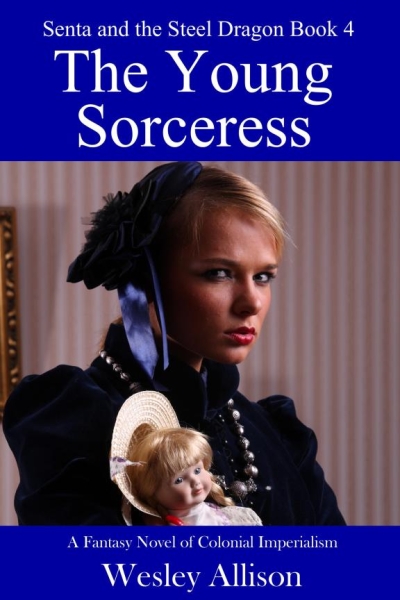
The Young Sorceress Characters: Isaak Wissinger

Isaak Wissinger was one of the main reasons I wanted to write The Young Sorceress.  I had already written The Two Dragons, in which Wissinger is a minor character.  When I was thinking up characters, I created a background for him that I really liked.  It just seemed like a shame not to write that backstory into a book.

Wissinger also gave me a chance to set part of the story in Freedonia.  Freedonia was my stand in for Germany (something of a cross between WWI under the Kaiser and WWII under the Nazis).  I got the name from the Marx Brothers’ Duck Soup, though my country bears little resemblance to the one in the movie.

Wissinger is a writer and so he has some of my own traits.  He is a member of the Zaeri minority in Freedonia and therefore ends up in the ghetto.  He escapes with the help of Zurfina (herself a Zaeri) who has a fetish for creative types.

Isaak Wissinger sprang suddenly from his cot, motivated by a particularly enthusiastic bedbug.  He was immediately sorry, as the pain in his back was exacerbated by the sudden movement.  He looked back down at the vermin filled, inch thick mattress, a few pieces of straw sticking out of a hole in the side, sitting on an ancient metal frame.  It was a sleeping place not fit for a dog.  Then he laughed ruefully.  That was exactly how he and every other Zaeri was thought of here—as dogs.

The Kingdom of Freedonia, like the rest of the civilized world was divided in two.  There were the Kafirites, who ruled the world.  And there were the Zaeri, who had long ago ruled it.  Two thousand years ago, Zur had been a great kingdom, one which along with Argrathia, Ballar, and Donnata ruled the classical world.  Then a single dynasty of kings, culminating in Magnus the Great, had conquered the rest of the known world, and made Zur civilization the dominant culture.   Zaeri, the Zur religion, with its belief in one god, had replaced the pagan religions of the civilizations that Magnus and his forebears had conquered.  Even when Magnus’s empire had splintered into many successor kingdoms, the Zaeri religion had remained dominant.

Then a generation later, a Zaeri imam named Kafira had begun teaching a strange variation of the religion in Xygia.  Kafira had taught the importance of the afterlife, an adherence to a code of conduct that would lead one to this afterlife, and a general disregard for the affairs of the world.  Her enemies had destroyed her, but in so doing they had made her a martyr.  From martyr, she rose swiftly to savior and then to godhead of a new religion, one that had spread quickly to engulf all that had been the Zur civilization.  In the following millennia, the Kafirites had converted the remaining pagans to the creed of their holy savior, thereby making it the only religion in the world of man—the only religion in the world of man save those who held onto the ancient Zaeri belief.

Now here in Freedonia it was no longer safe to be a Zaeri.  First it had become illegal for Zaeri to be doctors or lawyers, then actors or publishers.  Then laws had been passed which made it illegal for Zaeri to own businesses or property.  Finally entire neighborhoods became forbidden to Wissinger’s people and they had been pushed into ghettos, segregated from the other Freedonians.

Wissinger spent the day picking up garbage on the street.  That was his job here in the ghetto.  He had been an award winning writer when he had lived in Kasselburg, but here in Zurelendsviertel he walked the street, a silver zed pinned to his jacket, picking up refuse.  At least people didn’t treat him like a garbage man.  The other Zaeri knew him and respected him.  They asked his opinion about things.  They called him “professor” when they spoke to him.  It was not like that at all with the Freedonian soldiers who occasionally made a sweep through the ghetto.  They would as soon kick an award winning writer to the side of the road as they would a street sweeper.

Back once again in his room, he pulled his tablet and pencil from its hiding place behind a loose board and continued writing where he had left off the day before.  He could not live without writing.  He wrote down what had happened that day, what he had seen, what he had heard.  He wrote about the death of Mrs. Finaman, brought on no doubt by lack of nutrition, and he wrote about her husband’s grief at the loss of his wife and his unborn child.  He wrote about the sudden disappearance of Mr. and Mrs. Kortoon, and the speculation that they paid their way out of the ghetto.  And he wrote about the disappearance of the Macabeus family, and the speculation that something sinister had happened to them.

That night on his uncomfortable cot, Wissinger had a wonderful dream.  He dreamed that a beautiful woman was making love to him.  She licked his neck as she rubbed her naked body against his.  She whispered to him in some foreign language—he thought it was Brech.  When he managed to pull himself out of the fog of sleep, and he realized that it wasn’t a dream, that the woman was really here with him, he tried to push her off of him.

“Don’t stop now lover,” she said, a noticeably Brech accent to her Freedonian.  “I’m just starting to really enjoy myself.”

Wissinger pushed again, and slid his body out from under her, falling to the floor in the process.  She stretched out, lying on her stomach.  He stared at her open-mouthed.  Her long blond hair didn’t quite cover a fourteen inch crescent moon tattoo at the top of her back.  Another tattoo, an eight inch flaming sun sat just above her voluptuous bottom. 

“Who are you?  What are you doing here?”

“I would have thought that was obvious,” she replied in a sultry voice.  “I’m here to warn you.”

“You… uh, what?”

“I’m here to warn you.”

She rolled over and stood up, revealing six star tattoos all over her front.

Women of Power now in Paperback

Women of Power is now available for the first time in digest paperback format.  You can pick up your copy here for just $5.00.

I don’t sell a lot of paper books.  I’ve sold hundreds of ebooks for every paper book.  I understand.  I read ebooks too.  They’re easy to get.  They’re inexpensive.  I love ebooks.  What’s more, I actually make about as much selling a 99 cent ebook, as I do selling a $5 paper book, sometimes even more.  I deliberately price them as close to cost as possible, because I’m more interested at this point in my career in readers than sales.

Why do I have print editions?  Two reasons really.  I like to have some on hand to show off at home, and there is still a chance that someone might discover me as an author by stumbling upon one of my books.

So, my loyal readers.  Keep buying my ebooks.  But, if you know somebody that might like one of my books, please think about purchasing one for them as a gift.  If they like it, you will be giving them the gift and you will be giving me the gift of a new reader.  Thanks.

New Revision of His Robot Girlfriend

A new revision of His Robot Girlfriend is now available.  As I write this, it is up at Smashwords and Feedbooks, and by the time you read this, it should be available at Kobo, Diesel, iBooks, Barnes and Noble, and Sony.

I was sorely tempted to rewrite the whole thing, but I didn’t.  I just smoothed it out, fixed one or two errors, and did some content editing.

One thing I did change was the controversially low price of the Daffodil Robots.  I increased it roughly by tenfold.  It’s probably still rediculously cheap.

Please feel free to download the new version, it is still free of course, and replace your old version.  If you haven’t read it yet, download it and give it a try.  You have my thanks.

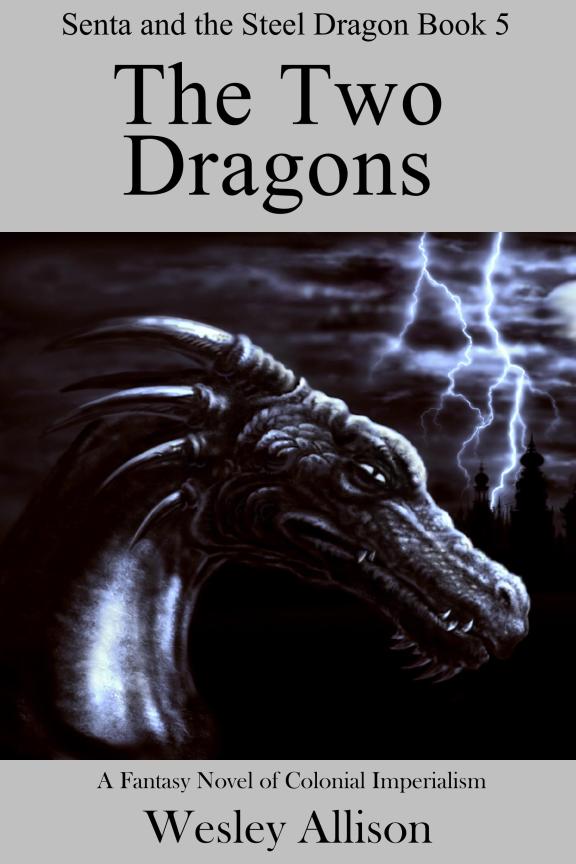
The Two Dragons: Chapter 5 Excerpt

At breakfast, there were five diners—Iolanthe, Mrs. Colbshallow, and all three of the household children.  Starr served kippers, fried eggs, deviled kidneys, and peaches.  Deviled kidneys were a favorite of young Augustus, but Iolana and Terra wanted nothing more than porridge—porridge with milk from real, live, Birmisian cows.

“Did this come from Egeria?” questioned Iolanthe.

“Yes,” replied Mrs. Colbshallow.  “She sent Chunny over with a gallon.”

“Then we must find a way to pay her back.  Let’s invite the Korlanns for dinner next week.”

Mrs. Colbshallow raised her eyebrows.

“What?” demanded Iolanthe.  “Yes, Zeah’s a former servant.  So are you.  My former dressing maid is now my sister-in-law for all that.  I regularly eat with a lizzie at the table, come to that.”

“It’s not that,” replied Mrs. Colbshallow.  “I thought you had some antipathy for the wife.”

“Of course not.  I do recall her having dined with us in the past, and I know Zeah has.”

“Yes,” replied Mrs. Colbshallow.  “But it was months ago in the case of the latter and years ago in the case of the former.”

Iolanthe smiled crookedly.  “It’s as you say.  She is the children’s grandmother.”

“Do you want to play jacks with us after breakfast, Auntie Iolanthe?” asked Terra in her peculiar little voice.

“You have your tutor, don’t you?”

“No Mother.  Master Brown is gone with Father to Tsahloose,” said Iolana.  “We have independent study until he returns.”

“Oh yes, I had forgotten.  In answer to your query Terra, I have to be at my office.  Perhaps Cissy will play with you—or your mother.  Where is your mother?”

“She’s not feeling well again today,” said Augie.

Iolanthe wiped her mouth with her napkin, and then placed it on her plate.  Before she could push the chair back on her own, Garrah was pulling it out for her.  She stomped to the doorway with the foyer and turned back around to look at her daughter.

“Independent study still means study.”

“Don’t worry Mother.  I plan to study.”

“I have no doubt of that.  Make sure that your cousins do too.”

“Blinking heck!” said Augie.

“You watch your mouth young man,” said Mrs. Colbshallow.  “I will have Garrah wash it out with soap.”

Iolanthe was already halfway up the stairs.  When she reached the top, she turned once again toward Yuah’s door.  When she knocked, she received the same reply that she had the previous day.  She balled up her fist and pounded.  There was still no answer.  Retracing her steps back a few feet, she opened the tiny drawer in the occasional table against the wall between the door to Yuah’s room and the door to the nursery.  The drawer was empty but for a large brass key.  Taking the key, she went back and stuck it in the keyhole just above the doorknob, turned it, and then pushed the door open.

Yuah’s bedroom was probably the most luxurious in the house.  Terrence had denied her nothing while he was alive, though even Iolanthe admitted in her own thoughts that he could have shown the girl more affection.  The wallpaper, with its intricate pattern of pink roses between golden bars, was difficult to see.  The color of the carpet was indistinguishable.  The pink lace curtains on both the windows had been covered over with heavy blankets and very little light entered the room.  Yuah was lying on the bed, eyes half closed.  For a moment, Iolanthe thought she was dead, but then saw her breathing.

“Yuah?”

Her sister-in-law didn’t move.  Iolanthe crossed to the window and pulled one of the heavy blankets away, allowing a bright beam of morning light to enter.  It fell directly across Yuah’s face, but she didn’t react.

“Yuah!”

On the intricately wrought stand in the corner was the antique wash basin.  Though it had not been used, the pitcher was still filled with cool clear water from the night before.  Iolanthe grabbed the pitcher by the handle and dumped it over Yuah’s head.

“Ack!  Bloody hell!” sputtered Yuah, and then jumped to her feet.  “You stupid cow!  What do you think you’re doing?”

“Are you bladdered, Yuah?”

“No.  I just don’t feel well.  Now get out.”

“You are bladdered.  You have yesterday’s dress on, your eyes are bloodshot, and you smell like you’ve peed yourself.  You’re ass over tit and it’s not even nine o’clock!”

With the suddenness of a viper strike, Yuah’s arm lashed out, her hand slapping Iolanthe solidly across the face, with a smack that could be heard all over the upper floor of the house.  A tiny fraction of a second had passed before Iolanthe’s left hand returned the favor, leaving its bright red impression across Yuah’s pale cheek.  Yuah balled up her fist and hit, stepping into the punch like a prize fighter.  She struck her sister-in-law in the right eye.  Iolanthe fell back down onto her bustle and rolled backwards, smacking both her head and the pitcher in her right hand onto the floor.  The antique porcelain exploded into a mass of white and cornflower blue pieces.

The Young Sorceress Characters: Saba Colbshallow

Saba Colbshallow wasn’t going to be a major character when I originally outlined Senta and the Steel Dragon.  Most of his part was going to be another character.  Originally, he was a minor character, who was there to step and fetch, son of the cook.

When I got to writing The Drache Girl, I just decided to use him rather than the character I had originally intended.  That he became a police constable in that book was largely due to the fact that I was watching the British TV show Hamish MacBeth at the time.

Saba’s big parts are in book 3 and book 5, so for book 4: The Young Sorceress, he appears in his role as a moon orbiting around Senta’s planet.  He almost comes to be an antagonist for her, and I struggled a bit to make sure that didn’t happen.  If they had come at odds with each other too much, it would have adversely affected my plot for book 5.

The Young Sorceress Characters: Senta

Time to get back to looking at characters, this time from The Young Sorceress.  I won’t be giving any spoilers… that is, if you have read the previous three books (and probably book 0).  If you haven’t read any of them, then spoiler alert.

Senta, the main character in the series, is the first to appear in this book.  I wanted to let the reader know right away that Senta wasn’t the same as she was two years earlier in The Drache Girl.  She’s much more powerful and has a much more complicated relationship with those around her.  We see right from the start that things are not going well with her boyfriend Graham or her mentor/guardian Zurfina.  In addition, her somewhat more than friends relationship with Saba Colbshallow is troubling because since the last book, he has gotten married.

Senta faces challenges in this book that she hasn’t faced before and is different than the tension that happens in the next book as well.  When I get to talking about her in The Two Dragons, I’ll explain that a bit more.


The Two Dragons: Chapter 4 Excerpt

The S.S. Arrow left port only hours after the captain learned of the wrecked ship.  The Ebon Forest unloaded its passengers and the shipwreck survivors that it had rescued, then refilled its coal hoppers and set out again the following morning to aid in the search.  On board was an emergency team consisting of a doctor, several clerics, and two dozen volunteers.  Mr. Radley Staff, who had planned and organized the team for just such an emergency, was in overall command of the rescue efforts.  As the massive black ship slid across the calm waters of the bay, he could be seen standing on the deck.  Next to him, dwarfing him, was the steel dragon, with gleaming scales reflecting the early summer morning sun.

Senta unhappily watched the ship going.  Bessemer had only arrived home the day before and now he was already leaving.  Though they had stayed up the entire night talking, the dragon had not had time enough to relay all of his adventures.  The girl had certainly not had time enough to tell him about hers.  It had been an unhappy few months, as it always was when she was separated from her steel-colored friend.  She would have been on the ship with him if not for the fact that Zurfina, who seldom seemed to care what she did, had expressly forbidden her from doing so.  Senta wondered about this as she idly rubbed her lower back where the dragon tattoo had appeared.  Bessemer had agreed that it looked like him, though not as he was now.  It was an image of him when he was not much bigger than a cat.

Senta heard her name called and turned to see Hero and her twin brother Hertzal running toward her.

“What are you guys doing here?”

“We’re with Honor, helping out at the Governor’s Warehouse,” said Hero.  “We saw you over here and Hertzal wanted to say hello.”

Hertzal, who had never spoken a word as long as Senta had known him, raised his hand in a friendly wave.

“Hey Hertzal.  You’re not working today?”

Hertzal shrugged, which Senta translated in her head to, “I was going to, but the ship I was to work on went back out to sea.”

“So what’s going on in the Governor’s Warehouse then?”

“That’s where they have the people from the shipwreck.  They’re getting everyone identified and finding places for them.  That’s not easy when they arrived at the same time as four thousand people from Freedonia.”

“I suspect they’re getting special treatment because they’re Kafirites, don’t you?” Senta said, voicing an opinion that would never have come out of the mouths of the twins, regardless of whether it had residence in their heads.

“They’ve been through an awful hardship,” said Hero.  “Honor brought tea and cakes for them.”

“Your sister is pretty special,” said Senta.  “You would think that Aalwijn Finkler would have brought some tea and cakes.  He owns three cafes.”

The twins turned to look behind them and watched as Aalwijn Finkler in a fine, new, grey suit walked into the warehouse.  He carried nothing with him.  The three young people looked at each other and then walked down the short block to enter the building after the restaurateur.  The large warehouse was filled with cots, though none were at present occupied by people.  Rather people wandered around the room in groups and pairs, those obviously from the ship making connection with those obviously from the colony.  Aalwijn was speaking to a handsome man of middle height with a slight paunch in his stomach not quite covered up by a nice black pinstriped suit, now that it was wrinkled from long exposure to seawater.  He had thinning blond hair and a happy though tired face.

“Here come some of your future diners now,” said Aalwijn.  “This is my new chef come all the way from Greater Brechalon.”

“How do you do?”  The man held out his left hand to Hertzal, and both girls could see that this was because he had no right arm below the elbow.

“Kafira’s tit!” shouted Senta, causing dozens of people around her to stare, open-mouthed.  “I know you!  You used to work at Café Carlo.”

“Yes.  I did.”

“You’re Gyula.  You were a line cook.”

“That’s right, Gyula Kearn.  Do I know you?”

“I’m Senta.”

Gyula looked no more enlightened than he had been a moment before.

“I used to sweep the sidewalk and polish the brass dragon.”

“Oh yes, Carlo always had the local children doing odd jobs.  It was his way of helping out, Kafira bless him.  We had quite a few kids in and out of the café over the course of the years.  I’m afraid I don’t remember any of them very well.  They just sort of blend together in my memory.”

“You used to make me a sandwich, when Carlo said it was okay.”  Senta’s voice sounded abnormally high in her own ears.

“That I did.  Carlo had a soft spot for children, though he didn’t let it show.  He would always have me load them up with food.  I suppose that’s why he had me working there too.  Who else would have hired a one-handed line cook?”

“Well, I hired a one-handed chef, and I expect great things from him,” said Aalwijn.  “And I dare say if you don’t remember Senta now, you will soon not be able to forget her.”

Senta was feeling something she hadn’t felt in a long time.  What was it exactly?  Chagrin?  Few people whom Senta saw didn’t already know who she was, and those that did, like Oswald Delks had heard of her.  That someone she had met would not remember her—that just didn’t happen.  It was inconceivable.  Whatever the feeling was that Senta felt, it was about to be turned on its end.

“Senta?”

The young sorceress turned around to face a young man and a boy standing side by side and staring at her with large eyes.  In a split second, she subconsciously registered a few bits of information—the similarity that the man and boy had to each other and the similarity they had to the image she saw each day in the mirror.  Before her brain had made much of this information though, both had grabbed hold of her and pulled her into a three way hug.

“I can’t believe it’s you Senta.”

“Who would have thought we’d find you in Birmisia?”

“Geert?  Maro?”

“Of course it’s us.”  They pulled away and Senta could clearly make out the features of the twelve year old and eight year old boys that had been her cousins, in the faces of the twenty year old man and the sixteen year old teenager.

“How long have you been here?” asked Geert.

“Eight years.”

“You’re kidding?  You look great.”

“And rich,” added Maro.  “Did you marry a rich man?”

“Is that your husband?” asked Geert, indicating Aalwijn.

“No, he’s not… I’m not married.  What’s going on?  What are you two doing here?”
The Politics of Global Warming

I’ve been re-editing His Robot Girlfriend, making quite a few changes.  The changes are all relatively minor.  Though I’m tempted to rewrite the whole thing, I’m not doing it.

Over the years I’ve seen several reviews that renounce my politics because of what I’ve written in His Robot Girlfriend.  I was never sure what politics they were talking about, but I sort of thought it might be about gay marriage– because there is a sort of analog of gay marriage in the human/robot marriage of Mike and Patience.

Only recently did I realizet that what most were talking about was the issue of Global Warming.  When I wrote the book, I didn’t realize that it was even a political issue.  Global warming just seemed to be a fact that scientists generally agreed upon.  I knew that some people believe scientists are involved in some sort of global conspiracy, but then I knew some people don’t believe we landed on the moon and some think the world is flat.  But since I was writing a science fiction book, I took global warmin far beyond what I thought at the time ever might come to pass, just to make a better story.

In the years since I wrote the book, I’ve come to believe that I may have underestimated the effects of climate change.  If I were to write it today, I might have them living beneath tinted domes.


Motivations: Astrid Maxxim and her Amazing Hoverbike

One day I was standing in my living room looking at the row of yellow spines on my collection of Tom Swift Jr. books.

In the summer of 1969, I discovered Tom Swift Jr. among the possessions of my Uncle George, who had died the year before in Viet Nam.  I started reading them and was hooked.  I was hooked on Tom Swift, on science fiction, and on reading.

So that day, looking at Tom Swift, I thought, “that’s the type of book I should write next.”  I wanted to capture the same feeling of excitement and innocence that I found when I read Tom Swift Jr., but I wanted to update the stories and make them my own.  I sat down and created the setting and the characters, and made a list of inventions that stories could be built around.

Two things that I always had trouble with as a reader of Tom Swift.  First, time never passed.  Tom was always 18.  The second, his inventions never seemed to change the world, no matter how innovative and revolutionary they were.  I decided that Astrid’s would.  I still plan to write one Astrid book a year for the next few years.  After that, well, we’ll see.