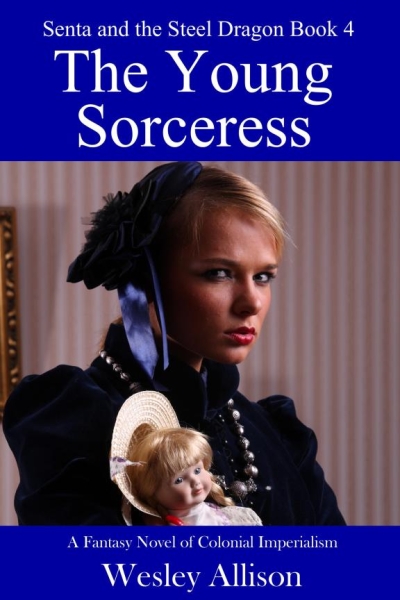
The Young Sorceress Characters: Hertzal Hertling

Hertzal Hertling is one of the characters in Senta and the Steel Dragon.  He and his two sisters arrived in Birmisia from Freedonia in book 1, victims of the anti-Zaeri racism in their homeland.

Hertzal and his twin sister Hero are two of Senta’s best friends, despite the fact that Hertzal has not spoken since he arrived in the new land.  I don’t know why I chose mutism for Hertzal (except that all the characters in the story are broken in some way), but it just grew to be a real part of the story.

In The Young Sorceress, Hertzal gets a bit of alone time with Senta, leading me to discover just how hard it is to write a conversation between two people when one can’t speak.  That being said, Hero and Hertzal, and their older sister Honor, are some of my personal favorites.

The Young Sorceress Characters: Cissy

One of my favorite characters in Senta and the Steel Dragon is the reptilian maid Cissy.  In my original trilogy, which became books 1, 3, & 5, she has an important role to play, but we don’t really get to know her.  Her part in those books didn’t change really when I expanded the series.  I just wrote more about her, particularly in The Dark and Forbidding Land, where we get to see a good portion of the story from her eyes.  We see her make a brief appearance in book 0 as well.  In book 4, she shares her part of the story with Yuah.  I couldn’t decide which of them would be the primary story-teller here.  I wanted to write more from Cissy’s eyes, but there were parts of the story that only Yuah could tell.  Hence, splitting the part up for the both of them.

Incidently, we have a large and beautiful iguana that we adopted about 4 years ago who was named for the character Cissy.  Sometimes I even call her Ssissiatok.  She, like the Cissy in the book, is a friendly reptile.

The Young Sorceress Characters: The Kids

In the latter half of the series of Senta and the Steel Dragon, there are three children in the Dechantagne household.  Augie and Terra Dechantagne and Iolana Staff.

Iolana and Augie make their appearance in book 3 as toddler and baby, and they are a bit older here.  This books marks the first appearance for Terra.

All three have larger parts in book 5, though they are still small.  All three play a large part in what happens after the series ends, so if I get around to writing the next series (which I’m already plotting out) you will see them again.

The Young Sorceress Characters: Yuah

When you write a story, you have to have a story arc for your characters.  They have to have obstacles to overcome (or not) or you don’t really have a story.  To paraphrase Joss Whedon, starting out heroic, getting more heroic, end ending up even more heroic, is not a story arc.

One of the problems with writing is, you create characters you love and then you have to do things to them.  Yuah Korlann-Dechantagne is one of my favorite characters in Senta and the Steel Dragon, but she is one who has the toughest road to follow, and in this volume, she is at her most trying point.

The whole Terrence-Yuah story is about addiction, whether it is to drugs or some other behavior, and how it can destroy (multiple) lives.  Yuah’s obsession with Terrence and his multiple problems almost destroy her, and that’s really her part in this story.  Originally as plotted, there was more to her part of the story, but I found myself simply unable to write it, and ended up cutting quite a bit out, including the death of another character.

“Why are you here?” Pantagria repeated.

“I’m here because I’m ‘seeing’.”

“Then that brings us to an entirely different question.  Why are you seeing?”

“I don’t know.”

“You didn’t want Pantagruel.”

Yuah shivered at the memory.

“Who would want that monster?”

“He is what many women want.  He is who they come to see when they use the ‘see spice’.”

“How could anyone want that monster?”

“He is what your mind makes him.  In fact, he is a perfect reflection of what your mind makes him.  You see a monster.  Another woman sees a prince—a perfect prince.  But you didn’t come seeking perfection, did you?  You don’t even want perfection.  If you wanted perfection, you would have never wanted our Terrence, would you?”

“Don’t speak of him!”  Yuah’s hand became a claw with which she threatened to lash out.  “Don’t you dare say his name!”

 “I loved Terrence,” Pantagria hissed, her eyes taking an evil gleam.  “Forty thousand dressing maids with all their quantity of love could not equal my sum!”

“I am not a dressing maid.  I am Mrs. Terrence Lucius Virgil Dechantagne!  And you… You’re nothing!  Nothing!  You’re not even real!”  Yuah burst into a fit of tears.

Pantagria laughed in her face.

“You little fool.  He didn’t love you any more than he loved me.”

“You’re evil!” wailed Yuah.  “Why did you have to have him?  Why did you have to ruin him?  Why did you have to steal him away from me?”

“I didn’t go looking for him.  I couldn’t even if I wanted to.  He came to me.  He came to me just the way you have.”  Pantagria slowly circled the other woman.  “He came to me because he wanted something perfect.  It’s why all men come to me.  And it’s why women come to Pantagruel.  But not you.”  She stopped in front of Yuah.  “You don’t want either of us.  You don’t want something perfect.”

Yuah dropped her hands to her sides and sobbed uncontrollably.

“So, what do you want?”

“I don’t want… anything.”

“Then you have picked a particularly horrible way to commit suicide.”

The Young Sorceress Characters: Townsfolk

When I started writing Senta and the Steel Dragon, one thing I started doing right away was reusing minor characters.  That is to say, that when I needed a character to stand in the background or interact with a major character, instead of making one up, I reused existing characters.  There were two purposes in this.  First, since the story takes place in a limited-sized colony, this would give an air of virisimilitude.  Second, it let me create characters that I enjoyed and build them into more than a cardboard cut-out.  Here are some of those characters who appear in The Young Sorceress.

Lawrence Bratihn has filled a number of little roles in the series.  Most importantly, he was the other soldier who was captured by the lizzies along with Terrence in book 1.  Here in book 4, he works in the port authority.

His wife, Mrs. Bratihn has seen much more use in the series, as she runs the dress shop that all the major female characters frequent.  Her assistant Mrs. Luebking likewise.  Incidently Mrs. Luebking’s husband is occassionally mentioned, but seldom seen.

Mrs. Wardlaw (who was Mrs. Lanier when she arrived along with Radley Staff in book 2) is the governor’s secretary.

Mrs. Colbshallow is very special to me, and she is the mother of a major character, but she plays a relatively minor role in this book as in the others in the series.  My favorite little trick is when someone wants to explain how wonderful some food tastes, they simply compare it to something that Mrs. Colbshallow made.  (In my original draft, she was just referred to as Cook.)

Gaylene Finkler is seldom seen.  She has just a tiny scene in book 2, one in book 5, and a bit more here in book 4.  In book 1, she’s only mentioned once.  Even so, she’s a real person to me, the sister of a major character, and she’s named after my aunt.

Edin Buttermore has a very tiny part in book 2, but much larger ones in Books 4 & 5.  I had to be careful what I did to him in this book, knowing that he had a fairly large part to play in the next one.

Benny Markham and Shemar Morris are two boys that are mentioned a few times and are arround in the background in other books of the series, but here in book 4, I was able to give them a small but meaty part, as they escort Senta through the dinosaur-infested highlands.  I had fun finally giving them (especially Benny) a bit of their own personality.  Of course we find out who they marry at the end of book 5 (for one of them it’s a major character).

Marzell Lance is Yuah Dechantagne’s driver in books 2&4, both of which were written after I’d plotted out his part in book 5.  But it all manages to fit together.


The Young Sorceress Characters: Graham Dokkins

Graham Dokkins is the boyfriend of Senta Bly, the main character in Senta and the Steel Dragon.  He plays quite a big part in Senta’s development throughout the series.

Spoiler Alert Starts Here!

The main thing I had to deal with in The Young Sorcerss, as far as Graham was concerned was what to do with him.  Senta is going through some stressful situations in this book and it’s taking her beyond her previous experiences, and Graham is a calming moderating force upon her.  I needed that calm and moderating force to be gone.  I did that by getting him involved with intrepid girl reporter Nellie Swenson, which was one more stresser for Senta to deal with too.

Senta and Nellie Swenson both get their name (and the latter, the inspiration for her origin) from real life intrepid reporter Nellie Bly, and this is a little clue about their relationship in the book as well.

Incidently, Graham isn’t named after anybody.  His is just one of those names that got pulled out of the air.  It just sounds like a pleasant kind of fellow that you’d like to know.  That works, as most people who’ve written me about the series tell me that Graham is one of their favorite characters.  How could he not be, really.  Here’s a kid who is brave and adventurous, fiercely loyal to his friends and family, knows more of the native language and culture than most adults, and gets to hang out with real live dinosaurs.

The Young Sorceress Characters: Kafira Kristos

As mentioned before, Kafira Kristos is the stand in for Jesus in Senta’s world.  Religion is a problem for most fantasy books.  Writers usually shoe-horn a polytheistic religion into settings like the Middle Ages.  It just doesn’t work.  Of course if you use Christianity, you risk the fury of people who think you might be impugning their religion.

The idea for Kafira was in part out of this necessity as a writer.  I needed a religion and a founder of that religion, but since the story takes place in a world not too unlike our own early 1900s, it wouldn’t have worked with a Greco-Roman type mythology.

I was also thinking once, that assuming Christianity were true, and life exhisted on other planets, would Jesus have appeared on each of those other worlds, or would they have their own unique messiahs.  I decided on the latter for the story and to make it a bit more interesting, made that messiah a woman.  It adds a whole new meaning to “Mother Church.”

Kafira was a Zaeri teacher before she was known as the daughter of God, and so caused the same kind of split between Kafirite and Zaeri that we have between Christain and Jew in our world.  This of course was part of the basic fabric of the story I wanted to tell.

The Young Sorceress Characters: Isaak Wissinger

Isaak Wissinger was one of the main reasons I wanted to write The Young Sorceress.  I had already written The Two Dragons, in which Wissinger is a minor character.  When I was thinking up characters, I created a background for him that I really liked.  It just seemed like a shame not to write that backstory into a book.

Wissinger also gave me a chance to set part of the story in Freedonia.  Freedonia was my stand in for Germany (something of a cross between WWI under the Kaiser and WWII under the Nazis).  I got the name from the Marx Brothers’ Duck Soup, though my country bears little resemblance to the one in the movie.

Wissinger is a writer and so he has some of my own traits.  He is a member of the Zaeri minority in Freedonia and therefore ends up in the ghetto.  He escapes with the help of Zurfina (herself a Zaeri) who has a fetish for creative types.

Isaak Wissinger sprang suddenly from his cot, motivated by a particularly enthusiastic bedbug.  He was immediately sorry, as the pain in his back was exacerbated by the sudden movement.  He looked back down at the vermin filled, inch thick mattress, a few pieces of straw sticking out of a hole in the side, sitting on an ancient metal frame.  It was a sleeping place not fit for a dog.  Then he laughed ruefully.  That was exactly how he and every other Zaeri was thought of here—as dogs.

The Kingdom of Freedonia, like the rest of the civilized world was divided in two.  There were the Kafirites, who ruled the world.  And there were the Zaeri, who had long ago ruled it.  Two thousand years ago, Zur had been a great kingdom, one which along with Argrathia, Ballar, and Donnata ruled the classical world.  Then a single dynasty of kings, culminating in Magnus the Great, had conquered the rest of the known world, and made Zur civilization the dominant culture.   Zaeri, the Zur religion, with its belief in one god, had replaced the pagan religions of the civilizations that Magnus and his forebears had conquered.  Even when Magnus’s empire had splintered into many successor kingdoms, the Zaeri religion had remained dominant.

Then a generation later, a Zaeri imam named Kafira had begun teaching a strange variation of the religion in Xygia.  Kafira had taught the importance of the afterlife, an adherence to a code of conduct that would lead one to this afterlife, and a general disregard for the affairs of the world.  Her enemies had destroyed her, but in so doing they had made her a martyr.  From martyr, she rose swiftly to savior and then to godhead of a new religion, one that had spread quickly to engulf all that had been the Zur civilization.  In the following millennia, the Kafirites had converted the remaining pagans to the creed of their holy savior, thereby making it the only religion in the world of man—the only religion in the world of man save those who held onto the ancient Zaeri belief.

Now here in Freedonia it was no longer safe to be a Zaeri.  First it had become illegal for Zaeri to be doctors or lawyers, then actors or publishers.  Then laws had been passed which made it illegal for Zaeri to own businesses or property.  Finally entire neighborhoods became forbidden to Wissinger’s people and they had been pushed into ghettos, segregated from the other Freedonians.

Wissinger spent the day picking up garbage on the street.  That was his job here in the ghetto.  He had been an award winning writer when he had lived in Kasselburg, but here in Zurelendsviertel he walked the street, a silver zed pinned to his jacket, picking up refuse.  At least people didn’t treat him like a garbage man.  The other Zaeri knew him and respected him.  They asked his opinion about things.  They called him “professor” when they spoke to him.  It was not like that at all with the Freedonian soldiers who occasionally made a sweep through the ghetto.  They would as soon kick an award winning writer to the side of the road as they would a street sweeper.

Back once again in his room, he pulled his tablet and pencil from its hiding place behind a loose board and continued writing where he had left off the day before.  He could not live without writing.  He wrote down what had happened that day, what he had seen, what he had heard.  He wrote about the death of Mrs. Finaman, brought on no doubt by lack of nutrition, and he wrote about her husband’s grief at the loss of his wife and his unborn child.  He wrote about the sudden disappearance of Mr. and Mrs. Kortoon, and the speculation that they paid their way out of the ghetto.  And he wrote about the disappearance of the Macabeus family, and the speculation that something sinister had happened to them.

That night on his uncomfortable cot, Wissinger had a wonderful dream.  He dreamed that a beautiful woman was making love to him.  She licked his neck as she rubbed her naked body against his.  She whispered to him in some foreign language—he thought it was Brech.  When he managed to pull himself out of the fog of sleep, and he realized that it wasn’t a dream, that the woman was really here with him, he tried to push her off of him.

“Don’t stop now lover,” she said, a noticeably Brech accent to her Freedonian.  “I’m just starting to really enjoy myself.”

Wissinger pushed again, and slid his body out from under her, falling to the floor in the process.  She stretched out, lying on her stomach.  He stared at her open-mouthed.  Her long blond hair didn’t quite cover a fourteen inch crescent moon tattoo at the top of her back.  Another tattoo, an eight inch flaming sun sat just above her voluptuous bottom. 

“Who are you?  What are you doing here?”

“I would have thought that was obvious,” she replied in a sultry voice.  “I’m here to warn you.”

“You… uh, what?”

“I’m here to warn you.”

She rolled over and stood up, revealing six star tattoos all over her front.
The Young Sorceress Characters: Saba Colbshallow

Saba Colbshallow wasn’t going to be a major character when I originally outlined Senta and the Steel Dragon.  Most of his part was going to be another character.  Originally, he was a minor character, who was there to step and fetch, son of the cook.

When I got to writing The Drache Girl, I just decided to use him rather than the character I had originally intended.  That he became a police constable in that book was largely due to the fact that I was watching the British TV show Hamish MacBeth at the time.

Saba’s big parts are in book 3 and book 5, so for book 4: The Young Sorceress, he appears in his role as a moon orbiting around Senta’s planet.  He almost comes to be an antagonist for her, and I struggled a bit to make sure that didn’t happen.  If they had come at odds with each other too much, it would have adversely affected my plot for book 5.

Motivations: His Robot Wife

His Robot Wife was written for entirely different reasons than any other book I’ve written.  All the other books (with maybe the exception of His Robot Girlfriend) were written because I thought I had a great story to tell and I wanted to tell it.  You could say that I wrote His Robot Wife for money, though that’s not entirely accurate.  I priced it an 99 cents even though I could have made more by pricing it higher.  I wrote it because I knew it would sell.

I publish His Robot Girlfriend in 2008, and it has been downloaded hundreds of thousands of times.  Many people wrote and asked for a sequel.  This was a big deal for me.  But I didn’t have a story.  As far as I was concerned, the story of Mike and Patience was over.  Still, people kept asking.  It took me three years to come up with a story for them, and I think it’s probably my weakest plot (but HRG wasn’t popular for its plot, but rather its characters anyway).  So in 2011 I wrote His Robot Wife.  It is short, at 28,000 words, but it went easily enough, and as it turned out, it has sold more copies than all my other books put together.

People still wanted another book in the series, but I really struggled to come up with an idea.  Then one night, it just popped into my head.  If I took the point of view away from Mike and gave it to Patience, a whole series of story ideas presented themselves.  I sat down and plotted out five books.

I spent some time writing the new book last night.  It’s not as easy to write as some other books in my workshop, but I’m having a bit of fun.  Now for those of you who bothered to read to the end… here is a little hint about something in the next book.

Patience acts as a mentor to another Daffodil, teaching her how to seem more human.  Talk about the blind leading the blind.