The Drache Girl: Loana Hewison

A group of twenty two minor characters arrive with Radley Staff and Terrence Dechantagne from Birmisia in The Drache Girl.  Of those, undboubtedly the most important to the rest of the series is Loana Hewison.  I always found it funny that as I was working on the book, my wife always disliked Loana.  I’ll admit I wouldn’t want to be married to her, but she does fill her role in the story.

Mrs. Fandice pulled Staff away from the Rutans to introduce him to her niece.  Loana Hewison looked so completely unlike Mrs. Fandice that anyone would have questioned whether they were related and sure enough, it seemed that their connection was only through marriage. 

“Aunt Rosalyn is my mother’s sister-in-law, that is to say her brother’s wife,” said Miss Hewison, who was without a doubt the most beautiful woman in the room.  Statuesque and striking, she wore a brilliant peach colored dinner gown.  Her long hair was arranged in a very complex style, with each strand seemingly a different shade from very light blond to coppery red.  As Staff spoke to her, he realized that not only was her hair multihued, but so were her eyes.  One eye was deep brown and the other eye was hazel.

“When my Uncle Henri passed on, my parents sent me to live with Aunt Rosalyn,” the young woman continued.  “And when she had the chance to go to Birmisia, well, I just had to join her.  It’s so exciting.  Imagine—a whole new world.”

“I hope you like it as much when we get there,” said Staff.  “You will easily be one of the most beautiful women on the continent.”  At which point, Mrs. Fandice steered her niece away to another part of the room.

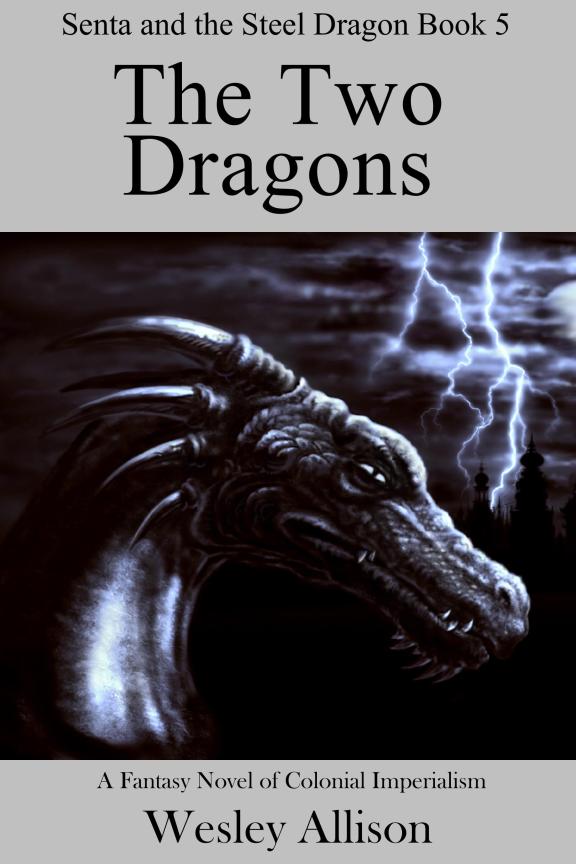
The Two Dragons: Chapter One Except

“Wasn’t that a lovely ceremony?” asked Hero.

“It seemed very nice from down here.”

“Don’t be cross.  Benny and Shemar both invited us to ride in their steam carriages to the reception.  Who do you want to go with?”

Senta rolled her eyes.  “Quite frankly I’d rather take the trolley.”

“Are you sure?  Benny’s car is brand new and candy apple red.”

Senta looked over Hero’s shoulder at Benny Markham, who was puffing himself up with pride.  She liked Benny, Shemar too for that matter, but she wasn’t too fond of steam carriages.

“Do as you wish.  I’m taking the trolley.”

When Senta stepped out of the pew, all four of the young men who were waiting jumped to get out of her way.  And though most of the congregation had by that time already exited the church, those that remained quickly cleared the aisle for her.  She heard Hero behind her.

“Sorry boys.  You can give me a ride later.”  A moment later, her friend was at her right elbow.

“Isn’t this dress beautiful?” asked Hero, as they stepped out of the church into the bright sunshine.  “I couldn’t believe it when Egeria had me try it on and then she said I could keep it.”

“What else would she do with it?”

“Well, she could keep it.  I bet we’re about the same size.”

“Egeria Lusk is probably one of three women on the continent who have more dresses than I do.  She doesn’t need another one.”

“Egeria Korlann,” Hero corrected.

“Egeria Korlann,” Senta agreed.

“What do you suppose they’re going to do with all those shoes?”

“Throw them away, of course.  People only throw old shoes at weddings—ones they were going to throw away anyhow.  Why?”

“It just seems kind of wasteful.”

By this time they had traversed the twenty four great stone steps down from the front door of the Church of the Apostles to the street level.  Crowds of people were milling around on the sidewalk and on the front lawn, despite the signs warning to stay off the grass.  Both sides of Terrence Dechantagne Boulevard were lined with steam carriages—more than Senta remembered ever having seen at one time.  The bright summer sun reflected off of their bonnets and the cobblestone that lined all four lanes of the street.

“I wish that I had brought my parasol,” said Hero, looking up at the sky.  “If we’re out her very long, we might get a tan.”

Senta held out her hand.  “Sieor uuthanum sembia,” she said.  Two parasols appeared in her palm, one teal and one purple.  She handed the teal one to Hero.

“Hey, that’s nice.  Where did you get these?”

“Created them.”

“They’re really pretty.”

“Minor creation.  It’s not that powerful a spell really.”

“But these have lace,” marveled Hero, as she spread her parasol open.  “It has a complex opening mechanism and the spokes are made from bamboo.”

“That’s why it will only last a few hours.”

“Oh.”

“It’s just as well.  We don’t want to destroy the economy for makers of parasols.  Look, let’s get down to the trolley stop.”

The trolley was coming.  Terrence Dechantagne Boulevard had been built in an area set aside early on for expansion of the transportation system.  It served as the spine of Port Dechantagne, consisting of two northbound lanes and two southbound lanes, separated by a twenty foot wide grassy median through which the trolley tracks ran.  Marching along this grassy sward, pulling a green and yellow trolley car was a monstrous three-horned beast.  The triceratops was easily as large as the trolley car that it pulled, even though it was only about ten years old.  It showed little interest in either the steam carriages or the pedestrians, but moved purposefully toward the marked ground at the trolley stop, where it had learned it would be rewarded with tasty shrubs and tree seedlings.

Senta and Hero walked down the cement sidewalk to the edge of the road, across the red brick lanes of the street, to the small awning over four bench seats that served as the stop.  The trolley had already halted and the conductor was feeding the triceratops by the time they arrived.  Senta stepped around behind the conductor and stroked the dinosaur just behind the nose horn.

“Careful,” said the conductor, as he turned around.  “She doesn’t often bite but… oh… sorry.”

“How are you today, Harriet?” Senta spoke to the triceratops.  It seemed to take no notice.

She and Hero climbed up the steps and into the trolley car.  Senta dropped two pfennigs into the glass box.  Then she sat down next to her friend just behind the driver’s position.  More and more people stepped up into the car, filling in the seats from the back forward.  By the time the conductor had finished feeding Harriet and had climbed back inside, all of the seats with the exception of the two next to Senta had been filled, and eight people stood holding on to the handrail.

“Did everyone pay their pfennig?” asked the driver.  A few people nodded, but most ignored the question.  Only about half the passengers had in fact dropped a coin into the container.  Picking up a small crop, he whacked the triceratops on the rear end, and it jerked the trolley into motion.  Then he rang the bell.
Oops! The Drache Girl: The Buttermores

Oops!  For some reason only the end of the post for the 8th appeared the day before yesterday.  Here is the whole thing as intended.

Edin Buttermore is a minor character that pops up from time to time to play a role in the story of Senta and the Steel Dragon.  His wife and son show up sometimes as well.  I liked the name Buttermore and just went with it.

Mrs. Melody Lanier was Mrs. Harper’s daughter and looked just as she must have looked in her younger days, with dark hair and a voluptuous figure that would turn any man’s head.  Likewise, her teen-aged daughter Wenda was a young, thin, and happy version of her, before adulthood had put the lines around her eyes or had put the grey in her mother’s hair.  Mrs. Lanier had lost her husband and Miss Lanier her father, when he was killed in a boiler explosion, while working on the Greater Brechalon and Northern Railroad.  Mrs. Harper had encouraged her daughter to come along with her and try to start a new life in Birmisia.

“You’ve heard me speak of them, and here they are,” said Buttermore.

Mrs. Julietta Buttermore was a very pretty, if frail looking woman at least ten years younger than her husband.  She had very fine honey blond hair and clean, sharp features, but dark circles under her large, amber eyes.  On her hip, she carried a chubby toddler, whose thick shock of golden hair perfectly matched his father’s.

The Drache Girl: Mother Linton

Everyone loves to hate Mother Linton.  I don’t find her evil.  She just has a different set of objectives than our heroes.

All four men stood up as the severe looking woman approached in a black dress.  Her graying hair was pulled tightly back into a long pony tail and her lips were so thin, it seemed as though the pony tail was pulling most of the skin of her face with it.  Her black dress was not a robe, not quite, and as was almost all feminine attire, it was endowed with a prominent bustle, but had no brocade or lace, just a priestly collar at her neck, and a thin strip of white running from each shoulder to the floor.  She had a large and ornate golden cross on a chain around her neck.

“Mother Linton,” said Dechantagne.  “May I introduce Misters Staff, Merchant, and Shannon.”

Mother Linton nodded to each.  “May I speak to you, Mr. Dechantagne?”

He shrugged and stepped away with the priest.

“So what do you say about this weather, Staff?” marveled Shannon.  “Whenever I think of Mallon, I think of the jungle.  I never expected snow.”

“I suppose there is a great deal of Mallon that’s tropical,” replied Staff, “but Birmisia is cool, dry, lots of pine trees.  Even the summers are not too bad.  That’s good from a business perspective, too.  Nobody wants to muck around in swamps.  That’s probably why Enclep isn’t better developed.”

“Good man,” said Merchant.  “Always keeping business in mind.”

Dechantagne returned to the table and sat down.

“What was that all about?” asked Staff.

“It seems Mother Linton has been pegged by the Bishop of Brech as the High Priest of Birmisia.”

“And?”

“And priests are no different than anyone else.  They all want something.”  He waved to the waiter for another drink.

“And what does she want?”

“Oh, it’s all Mother Church this and Mother Church that.”  Dechantagne picked up the cigar that he had left smoldering in the ashtray when he had stepped outside with Mother Linton, and he stubbed it out.  Then he got up and walked out the door, intercepting the waiter for his drink along the way.

The Drache Girl: The Buttermores


Mrs. Melody Lanier was Mrs. Harper’s daughter and looked just as she must have looked in her younger days, with dark hair and a voluptuous figure that would turn any man’s head.  Likewise, her teen-aged daughter Wenda was a young, thin, and happy version of her, before adulthood had put the lines around her eyes or had put the grey in her mother’s hair.  Mrs. Lanier had lost her husband and Miss Lanier her father, when he was killed in a boiler explosion, while working on the Greater Brechalon and Northern Railroad.  Mrs. Harper had encouraged her daughter to come along with her and try to start a new life in Birmisia.

“You’ve heard me speak of them, and here they are,” said Buttermore.


Kimbra

New Zealand singer/songwriter Kimbra (who is featured in Gotye’s Somebody That I Used to Know) is my new favorite.  I’ve been listening to her “Vows” album over and over again as I write.

The Drache Girl: Eamon Shrubb

Of all the major supporting characters of Senta and the Steel Dragon, I really think I like Eamon Shrubb the best.  He’s just a big lovable guy, with a strong moral compass and a stiff upper lip.  I just came up with him, because I needed another constable to work with Saba and his personality just appeared.

At that moment, Eamon opened the office door.  He paused about halfway inside, looking at his wife the way a munitions expert looks at a bomb that didn’t go off as intended.  She looked at the floor.  After a moment, the constable stepped inside.

“You nesh berk,” said Saba.  Eamon looked at him in surprise.  “You take your wife home and see to her.  I may not have two and a half months experience being married, but even I know you don’t fight with a woman who’s expecting.”

“She wanted to name the baby Yadira.”

“What’s wrong with that?” demanded Saba.

“Come on!  That’s the worst name in the world.”

“My mother’s name,” said Dot.

“That happens to be my mother’s name, too,” said Saba.

“Oh, yeah.  I forgot about that,” said Eamon.

“It’s not like Eamon’s a brilliant name.”

“I don’t want to name it Eamon either.  If it’s a boy I want to name it Darsham, and if it’s a girl I want to name it Daria.”

“Darsham Shrubb?  Why don’t you just name it ‘kick my ass on the way to school’ and have done with it.”

Eamon ballooned his cheeks out and rolled his eyes back to think for a moment.  “It doesn’t sound that good when you put it all together, does it?”

“Here’s my advice, Mr. I’ve-been-married-two-and-a-half-months.  Take the rest of the day off and take your wife home.  Make her a cup of tea and rub her feet.  Then let her decide what to name the baby.  You can go get a kitten from Mrs. Gyffington, and name it Darsham, or Daria, or whatever the bloody hell you want to name it.”

“That’s right,” said Dot, taking Eamon by the arm.  Then she said, “Rub my feet,” leading Saba to believe that she had missed most of what he had said.

“You don’t mind if I take the afternoon?” asked Eamon.  He turned his head slightly, so that his lips were not visible to his wife.  “If I rub her feet, she’ll be all rumpy-pumpy.”

“Go!”

The two left the office, arm in arm.  As soon as they were gone, Saba stepped back through the supply room and into cell number one.  Setting his helmet beside the cot, he lay down and took a nap.

The Drache Girl: Cady Gertz

Cady Gertz is one of those characters who just show up in the background all the time.  In a way, those are my favorites, because I have their back stories that only I know completely.  If you read all the books though, you might find yourself starting to know them too.

The temporary City Hall was right next door, and with the exception of the lack of hen mesh over the windows, it looked exactly like the police station.  Saba stepped up two very short steps and into the front office, which was only half the size of his own.  Miss Cadence Gertz sat at the receptionist desk.  Her black hair was pulled back into a severe bun, she had on horn-rimmed glasses, and she wore a plain brown gingham dress.  Saba still thought she was very pretty.

“Good morning, Constable,” she said, smiling shyly.

“Good morning, Miss Gertz.”

“What can I do for you?”

“I’m here to see the mayor, if he’s not too busy.”

“Police business?” she asked.

“Of course.”

“I’ll see if he can see you now.”  She got up and walked to the door separating the twenty by twenty five foot reception office from the mayor’s office, knocked on the door, and then went in, leaving Saba for a moment, to stand and contemplate brown gingham in a way that he never had before.  She was gone no more than two minutes.  When she came back out again, she ushered him into the presence of the mayor, closing the door behind him.

“Good morning, Mr. Mayor.”

Zeah Korlann rolled his eyes, and then stood up to shake hands with the young constable.

“If I had known being the mayor meant I was doing essentially all of the Colonial Council’s work, I wouldn’t have accepted the position.”  He waved for Saba to take a chair.

“Somebody has to be the big man in charge,” said Saba, sitting down, crossing his legs, and setting his helmet on his knee.

“How is your mother?  I missed her yesterday, when I was visiting my grandson.”

“She’s fine.  And how is Miss Lusk?”

“The same.  I mean, fine.  Miss Gertz said that you were here on police business?”

“Yes, I need to requisition an item.”

“A revolver or a shotgun?”

“A typewriter.”

“Do you know how to type?”

“I’ll learn.”

“I’ll bet we could get Mr. Collit to find one for us.  Are there any funds in the police budget?”

“No.”

“Alright,” Mayor Korlann sighed.  “We’ll find the money somewhere.”

“Thank you, sir,” said Saba getting up.  “Would you happen to know if Miss Gertz has gone to lunch yet?”

Saba escorted Miss Gertz to lunch at Mrs. Finkler’s Bakery as he had done on six previous occasions.  But just like those other six times, this could not be considered a date, because Miss Gertz insisted upon paying for her own meal.  Mrs. Gertz was of the opinion that her daughter, at nineteen, was too young to be courted, and ought not to be receiving gentlemen who were Kafirites in any case.  Still, the two young people had a lovely lunch and did not mention Miss Gertz’s mother, or religion, or police work.  In fact, later, Saba could not remember what the topic of conversation had been at all.  All he could remember was thick barley soup with onions and large brown eyes.

The Drache Girl: Tabby Malloy

Tabby Malloy is the local prostitute in Port Dechantagne and appears as a minor character in The Drache Girl.  An older, married Tabby also makes an appearance in The Two Dragons.

Walking north on the gravel road, which was officially Bainbridge Clark Street, Saba passed a road crew of five lizardmen and their human foreman.  They were moving very slowly in the cool morning air.  Within a month, most would stop showing up for work at all, and the repair of roads, building of sewers, and installation of gas lines would be suspended for the winter as the few Lizzies who did show up would be put to work on the docks.  Saba thought it fitting that the reptiles were repairing Bainbridge Clark Street, as Bainbridge Clark the man had been instrumental in stopping the lizardman army of King Ssithtsutsu, when it had attacked the colony.  He had later been Saba’s sergeant in the militia, and a friend.  Sadly, Saba’s first call as a constable had been to find Clark’s dead body, in bed, at the home of Miss Tabby Malloy; better than taking a lizardman spear or being eaten by dinosaurs.

Bainbridge Clark Street didn’t actually end at the Emergency Wall, because there was a road on the other side of the wall, and it too was called Bainbridge Clark Street, but the two were separated by the thirty foot tall structure.  Thirty feet to the left though was a small unobtrusive door that had been cut into the wall about two years before, after a particularly nasty problem with tyrannosaurs.  The door had been placed there specifically to allow emergency workers to move from one side of the wall to the other, without having to go all the way to the town square and through the big gate.  Relatively few had keys to the locked door, but Saba was one of those who did.  He unlocked the door, passed through, and then locked it once again with the key.

On this side of the wall, the road sloped down a hill toward the dock area.  A few small buildings, offices mostly separated it from the shoreline, while on the right were numerous warehouses and supply buildings.  At the top of the hill, Saba stopped to take in the view.  The Mirsannan freighter S.S. Meninia Impertinenta was docked and two large cranes were lifting freight from its cargo hold and setting it down onto the ground.  Half a dozen lizardman work crews were ferrying the freight from there to two different warehouses.

Walking down the hill a little way, the young constable turned from the bay and walked between a large warehouse on the left and a long row of small apartments on the right.  This area was the lowest rent district in Port Dechantagne.  The little two-story, four apartment buildings were constructed all of wood with dimensions of twelve by thirty six feet.  Each of the apartments had one room, either with a wood-burning stove, or a fireplace, and the entire block of apartments—one hundred buildings, four hundred apartments—were serviced by a block of twenty water closets.  When the apartments had originally been built, they had been built with outhouses.  Two years ago, these had been replaced by small block houses, each of which had six WCs and all of which had the latest running water facilities.  Saba stepped inside one of the WCs to relieve himself.  He luxuriously washed his hands and face, and then stepped outside to find a woman waiting.  She was slightly older than he was, about twenty, with bright red hair and a brightly painted face.  Under her pink dress, he could see she clearly wore no bustle.

“Miss Tabby Malloy,” said Saba.  “I was just thinking of you this morning.”

“Oh?  What were you thinking about me?”  She put her hand on her hip and struck a pose.  She really was attractive, considering—clean, nice, and as far as Saba knew, not a thief.

“I was just thinking about… well, about how pretty you are.”

“You know I would do a pretty young lad like you, a virgin and all, for free.”

“And you know I’m saving myself for marriage.  But it’s good to see you’re doing well.  Have a lovely day.”

“You have a lovely day yourself, lad,” she said.  “I expect to be seeing you soon, whether it’s before marriage or after.”

The New York Review of Science Fiction

I just received my copy of The New York Review of Science Fiction for May 2012 and found a lovely article on me– “Wesley Allison– A New Kind of SF Writer” by Patrick L. McGuire.  I actually knew this article was coming, as Patrick had let me know he was working on it and had run a fact check copy by me.

I am very honored to be featured in the NYRSF, and am even more honored by Patrick’s article.  I find it very humbling when someone cares enough about my work to shine a light on it, and this is quite the spotlight.  This is especially true when that someone is such a connoisseur of science fiction.  Thank you Patrick.