Eaglethorpe Buxton and the Elven Princess – Chapter 4 Excerpt

When we were not two hundred yards down the road, I let Hysteria drop to a trot, for in truth I did not expect anyone to follow us into the night, daring wild animals, bandits, or hobgoblins regardless of how fine a piesmith Mistress Gaston was reported to be. A few hundred yards beyond that, my horse dropped of her own accord to a walk and I expect she was beginning to feel a bit mopey because of the slap the orphan had dealt her. At that moment I was less interested in her mental condition than my own physical one though, because I was holding a cast pie pan in each hand and they were both heavy and still quite warm.

“Here.” I turned in the saddle and handed one pie to the orphan. “We can eat while we ride. If we wait until we find a campsite, the pies will be cold.”

“Do you have a fork?” the boy asked.

I mused that this seemed an unlikely request from any boy, most of whom I have found uninterested in tableware on the best occasion, and especially from an orphan whom one might have supposed to have been forced by necessity to dig into all manner of food scraps with his hands. However it was not a question to which I needed reply in the negative, for I always carry my fork in the inner left breast pocket of my coat, which I call my fork pocket. I gave the orphan my fork and pulled my knife from my boot to use on the remaining pie.

“This is a very nice fork,” said the orphan.

“Of course it is,” said I. “That fork came from the table of the Queen of Aerithraine herself.”

“You stole this fork from a Queen?”

“Impudent whelp!” cried I. “That fine fork was a gift from the queen, with whom I once had the pleasure of spending a fortnight.”

“What kind of queen gives a man a fork?”

“A kind and gracious one.”

That apparently satisfied the boy’s curiosity for the moment and for the next few minutes we concentrated upon the pies. I am not one to mourn a lost pie and that is well, for the pie that was lost to me on that night, as I have previously mentioned, was a pie for the ages. A fine pie. A beautiful pie. A wonderful pie. This new pie was almost as good though. It was a crabapple pie, which was a common pie to come upon in winter in those parts, which is to say Brest, as cooks used the crabapples they had put up the previous fall. This pie was an uncommonly good pie, with nutmeg and cinnamon and cloves and butter. I had more than a few bites by the time the boy spoke again.

“What kind of pie is that?”

“Crabapple,” I replied. “What pie do you have?”

“It is a meat pie.”

“A meat pie,” I mused, as I thought back upon how long it had been since I had eaten any other meat than venison. I had eaten a sausage a week before, but it had been a fortnight and half again since I had eaten mutton stew with potatoes and black bread in Hammlintown. That had been a fine stew and the serving wench who brought it to me had been nice and plump with the top two buttons of her blouse undone and she had smiled quite fetchingly when she had set down the tray. Stew is a wonderful food and even when it is not served by a nice, plump serving wench with the top two buttons of her blouse undone. It always seems to give me the same feeling when I eat it that a nice, plump serving wench with the top two buttons of her blouse undone gives me when I see her.

“What are you doing now?” asked the orphan.

“Pondering stew,” said I.

“Well stop it. Rather ponder this instead. You eat half of your crabapple pie and I will eat half of my meat pie. Then we can trade and eat the other halves of each others pies.”

“All right,” I agreed. “But this will mean that I have to eat my dessert first and my supper after.”

“Just pretend that the meat pie is your dessert and the crabapple pie is your supper.”

“A crabapple pie could be a fine supper. In fact I have been to countries where the most common part of a supper is crabapple pie.”

“Fine then.”

“But a meat pie is in no country a dessert.”

“Then trade me now.”

“How much have you eaten?” I asked.

“About a fourth. How much have you eaten?”

“About a fifth.”

“Then eat another twentieth,” said he. “Then we will trade pies and each eat two thirds of what remains and then trade them back. At that point, we will each eat what remains of the pie we originally started with. That way you can think of the first portion of the crabapple pie as an appetizer, the portion you eat of the meat pie as your supper, and the final portion of the crabapple pie as your dessert.”

“You are a fine mathematician for an orphan,” said I. “But it suits me. Will it not bother you that your appetizer and your dessert are of meat pie and your supper is of crabapple pie?”

“I have decided that I will make this sacrifice,” said he. “Since it was you that provided the meal.”
The Dragon’s Choice – available for Pre-Order

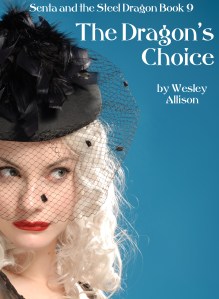
The Dragon’s Choice will drop on December 29th, 2017.  You should see pre-order availability in your favorite ebook stores soon.

The dragons seemingly have returned to the world and are once again in vying for power. Bessemer the steel dragon is worshipped by the reptilian lizzies, while the evil Voindrazius tries to put together a pantheon that he will control. Zoantheria, the coral dragon, feels pulled in all directions. Wanted both by Bessemer and Voindrazius, she is called to a world she has never known, her mistress, the sorceress Senta Bly encouraging her to take up the mantle of goddess. Her heart, however, is pulling her in a different direction, toward the young viscount Augustus Dechantagne. Which will prove stronger– love or destiny? Both Senta and Augie have their own problems, hers with teaching her wayward eponymous daughter the ways of magic, and him dealing with the yoke of leadership and a headstrong mother. Meanwhile, far across the ocean, the Dechantagne girls are taking Brech City by storm. Will one of them land a prince?

Pre-order for the Kindle at Amazon.

The Young Sorceress – Chapter 10 Excerpt

Isaak Wissinger leaned over the ship’s railing and stared down into the dark blue water. He wasn’t the only one. Dozens of other passengers on the S.S. Waif des Vaterlands were lined up to watch as half a dozen giant turtles, each larger than a kitchen table swam along apparently oblivious to the steel vessel chugging past them. They were large, but not nearly as amazing as the writer had expected, having heard for years legends of the monsters to be found in Mallon.

After leaving his employment with Herr Fuhrmann, Wissinger had taken the train from Butzbach to Friedaport, where he had worked on the docks until he had enough accumulated wealth to book passage, steerage class, to Mallontah. This had taken him several months, but at last he had set sail. Now, he had been on the ship for forty-five days. His daily meals consisted of porridge in the morning, a piece dried tack for lunch, and for supper a soup made of beans and rancid pork. It was infinitely better that his diet in the ghetto had been.

“Herr Holdern?”

It took Wissinger a moment to remember that he was Herr Holdern.

“Yes?”

He turned to find a greasy looking little man standing behind him. He didn’t recall seeing him before, and after a month and a half at sea, that was remarkable in and of itself.

“Do I know you?”

“I do not think so, but I know some Holderns. Do you come from Boxstein?”

“No,” replied Wissinger.

“Do you have relatives there perhaps?”

“Not that I know of. You know how it is. People move all around and lose touch. You meet someone with the same last name and they may or may not be related. My people come from Bad Syke, but who knows?”

“What is it you did in Bad Syke?”

“Oh, I’m not from Bad Syke. I still have cousins living there, I think. I grew up in Wahlstedt.”

“And what did you do there then?”

“Teamster.”

“A teamster?” said the greasy fellow. “I took you for a scholar.”

“I doubt you get calluses like this reading books,” said Wissinger, holding up his palms. “Why, I try to stay as far away from schools and books as possible.”

“I see.”

“But it is pleasant to meet you, Mister…”

“Spinne. Adolf Spinne.”

“A pleasure to meet you, Herr Spinne. Maybe we can talk again before we make port.”

“Perhaps,” said Spinne with an oily smile.

Wissinger turned and made his way through the portal and down several sets of stairs to his berth. His was one of twenty-five bunks stacked five high in the relatively small cabin. Most of his roommates slept at night, so he tried to spend as much time as possible outside at night, instead taking in a long morning and afternoon nap. He climbed into his bed, second from the top and pulled the sleeping curtains closed around him. He could hear the sounds of a woman moaning in passion close by. She was in the same room, but in one of the other bunk stacks. This wasn’t all that unusual. People grabbed what comfort and satisfaction they could, and there were very few places to find any real privacy on a ship as crammed as this one.

“Sweet music isn’t it?” said a husky voice near his head.

Before he could respond, the curtain surrounding him was pulled aside to reveal Zurfina’s face, framed in a shock of blond hair. She climbed up into the bed on top of him. There was no room to lie side by side even had that been her intention. He was surprised though not unhappy to find that she was completely naked, and let out a deep sigh as she rubbed herself up and down his entire length.

“Missed me?”

“Yes indeed.”

She kissed him deeply, letting her tongue explore every part of his mouth.

“Have you been true to me?” she asked as she kissed his neck and reached down to unfasten his pants.

“Yes,” he said, then sighed again as she freed him from his trousers. “Um, have you been true to me?”

She stopped and looked guiltily up at him, then shrugged.

“When you get to Birmisia, if you want, I’ll be true to you then,” she said, “for a while.”

“Oh, Lord help me, at this moment I really don’t care.”

The Dragon’s Choice

Senta and the Steel Dragon Book 9 is The Dragon’s Choice.  I am doing the final edit on it, and a pre-order date will be announced within a few days.  Watch this space for more information.

Eaglethorpe Buxton and the Elven Princess – Chapter 3

I pulled the boy out through the hole that I had created and into the deep snow that had formed in a drift beside the shack. He almost disappeared, as he couldn’t have been more than four foot ten.

“Grab the back of my belt,” said I. “I will guide you. The first thing we must do is find my noble steed.”

“The stable is on the other side of the Inn, just beyond the cart path.”

“Very good. Come along. I am sure that the noise of our escape was heard and any moment I may have to fight off a dozen or so angry villagers with pitchforks and such.”

“Do you have a weapon?” asked the boy.

“I have a knife in my boot, but I would be loath to stick it into a person over such a thing as this.”

“They deserve it,” said the boy, now trailing along behind me as I negotiated my way around the buildings in the gloomy night. “If my father was here, he’d lay waste to this town.”

“Quite the fierce cobbler was he?”

“Um… yes. Before he died…leaving me an orphan.”

I trudged through the snow around the large building that I now knew was the inn and crossed the cart path, distinguishable from the rest of the landscape by two parallel ruts in which the snow was not quite as deep as everywhere else. I perceived no danger from any direction and indeed could still hear the voices of men and women singing in the inn. The stable, which I would have recognized even without the orphan’s help, was dark and silent. The pleasant aroma of horse dung enveloped me as the slight breeze turned in my direction. I crept up to the large double door and pulled one side open slightly.

“Hysteria,” I called in a whisper and was answered by a gentle knicker, which is to say the sound that horses make when they are neither angry nor excited nor otherwise engaged.

Inside the stable was pitch black, and I cast around for a lantern, but the lad needed no such artifice.

“I see your horse in the last stall,” said he.

“You have very good night vision, orphan,” said I.

The little ragamuffin guided me by the hand to the far stall and by the time we arrived there I could make out the more prominent shapes including that of Hysteria, which is to say my horse, who tossed her head in greeting.

“Poor girl,” said I, running my hands over her. “They didn’t even bother to unsaddle you or remove your bit and bridle.”

“All the better for us and our escape,” said the boy.

I led Hysteria out of the stall, through the dark of the stable, and into the lesser dark of the night. It was in fact, quite a good night for traveling, at least as far as light was concerned. The moon was reflected off the white snow, and though the ghostly illumination created monsters of the many gaunt and gnarled trees, they were easily negotiated through. This put me in mind of a number of similar nights, when the moon was shining upon the snow. It seems somehow unfair that I more than most find myself sneaking in or out of town on cold, dark nights. I am not one to complain about my lot in life though. Then at that moment, as if to remind me that the lot of others was worse than my own, the boy tugged at my sleeve.

“What are you doing?” said he.

“I am pondering life,” I replied.

“Can you ponder life once we’ve made our escape from this wretched town?”

“Quite so,” said I, placing my foot in the stirrup. Once I was in the saddle, I reached down for my charge. “Come along orphan.”

“In some circles it might be considered rude to keep calling me an orphan,” he opined.

“Your parents are dead and so you are an orphan,” said I, lifting him up to sit behind me. “If I call you something else, your parents will still be dead.”

“Even so,” he agreed. “Let us get out of here.”

“Not until we make this town pay for its injustice and our indignities,” said I.

I spurred Hysteria forward, though truth be told I did not spur her precisely because I do not wear spurs. Spurs seem unnecessarily mean and pointed and Hysteria is possessed of something of a fragile ego. If one speaks harshly too her, she is likely to go into a mope for weeks on end and jabbing her haunches or belly with pointy metal objects could send her into a serious downward spiral of depression. It would be a sad thing to see. So I encouraged her forward. I urged her forward. I coaxed her forward. I asked her to go forward and she went forward, which now that I think about it, is the direction that she is usually most likely to go.

I guided her through the snow, across the cart path, and around the corner of the inn to the spot where upon I had first been laid hold of. I fully expected that the pie I had originally seen would by now be gone. As cold as the weather was, the pie would have gone from hot to warm to cool to quite cold in the time that I had spent escaping from the shack and rescuing my valiant steed, which is to say Hysteria. I was not wrong. The pie was gone. But Ho! There were now two new pies sitting on the very same window ledge.

Sitting astride Hysteria as I was, the pies were now at a level between my shoulder and my waist, and I could easily look inside the window. A fat woman with red cheeks and red hair and wearing a white apron was rolling out dough with a rolling pin. She was too busy to notice me. That was not the case with the stout fellow who at that moment entered from the common room beyond. He caught sight of me and let out a yell that could have, and in fact did, summon everyone in the place. The sounds of singing stopped as others rushed to see the source of his consternation.

“Let this be a lesson to you not to waylay innocent travelers!” I shouted, scooping up the pies, one in each hand. I urged Hysteria onward, but no doubt feeling the warm air exiting the window, she was loath to move. The orphan fixed that by slapping her on the backside, her fragile ego notwithstanding. She jumped and shot around to the front of the inn just as the gang of toughs from inside came out the front door. They were just in time to watch us race off into the darkness with two warm and steamy pies.

The Young Sorceress – Chapter 9 Excerpt

Senta and Hero stepped through the great gate in the emergency wall just in time to see a fireball shoot across the square and crash into the second and third floors of Finkler’s Bakery. Patrons ran screaming from the ground floor as the upper floors took to flame.

“You stupid cow!” shouted Senta. “Why would you cast a fireball in the middle of town?”

“Oh my!” said Hero, when she saw who Senta was talking to.

Another Senta was standing in the square in front of them. This one was wearing a red dress. Hero thought she looked older than the Senta standing beside her, but then realized it was simply that she was a bit heavier.

“You stay out of this,” said the red-dressed Senta. “You take care of your business and I’ll take care of mine.”

“I don’t recall burning down the town as being part of anyone’s business,” replied leather-clad Senta.

She grabbed a glamour from the air next to her. It was one she had kept ever since Mayor Korlann’s house had burnt down. She pointed her hand and the air around the burning building was flooded with carbon dioxide, smothering the fire.

“I’m just sending a little message,” said the other Senta. “Look. Now you’ve let them get away.”

“Let who get away?”

“Graham and that girl he’s running around with.”

“He what now?” Senta looked at Hero, who shrugged. “Whatever’s going on, you have no business trying to kill Graham.”

“I’m not going to kill him. Only maim him a little bit.”

“Obviously the first thing I need to do is to get rid of you,” said Senta, waving her hands. “Teiius uuthanum.”

“Uuthanum,” said the other Senta, countering the spell. “You’ve got to be kidding. No copy is going to out-magic me. Uuthanum Teigor.”

“I thought she was the copy,” said Hero.

“Prestus uuthanum. She is the copy. Go stand out of the way. Ariana uuthanum sembor!”

A sticky mass of spider webs enveloped the red-dressed Senta. She struggled for a moment, falling to the ground. By the time she managed to dispel the webs, the leather-clad Senta had cast a charm spell on her. Stepping over, she looked down at the image of herself lying almost helpless on the ground.

“If you touch me, you’ll see,” said the prone sorceress, in a sing-song voice. “I’m the real Senta. You’ll just cease to exist.”

“Let’s see then,” said Senta, reaching down and touching a perfect copy of her own nose.

The red dress seemed to deflate as the Senta who had been wearing it dissolved and flowed up and into the hand of the standing sorceress.

“Nice,” said Senta, standing up. “A new dress. I was wondering how that was going to work out.”

“I should have known you were the source of the trouble,” said Saba Colbshallow.

He looked sternly at Senta from beneath his police helmet, his blue uniform, with the exception of the sergeant stripes, a match for those of the two constables that followed on his heels.

“I didn’t…” Senta started. “But she… Oh, bloody hell.”

“Come along with me to the station,” said Saba. “We’ll get all the details down in a report. But I can tell you right now that someone is going to be held responsible for the damage.”

The top floors of the bakery had been saved from the fire, but there was plenty of scorching on the outside walls and no one would be too surprised if some of the supports had to be replaced.

“Fine,” said Senta, and then turning to Hero. “See if Mrs. Bratihn can get this dress cleaned. Tell her I’ll come around for a fitting.”

Back on Track – This time it’s for real!

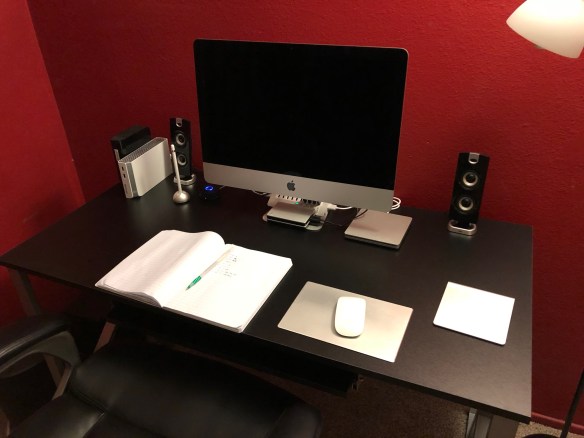
I mentioned the other day that my computer desk was lost (destroyed) during our re-carpeting adventure.  This wasn’t unexpected, as it had been a second hand desk and had been taken apart and put back together more than it was structurally capable of being.  Well, I got my new desk last night and quickly set it up.  Now I’m ready to get back to really doing some writing.  Here is a quick look at my new work space.  You will note the two external hard drives on the left.  I am obsessive about backing up.  These two drives alternate backing up my system every hour.  In addition, I back up my writing to an online location.

Eaglethorpe Buxton and the Elven Princess – Chapter 2

“I am not a pie thief,” said I, waiting for my eyes to adjust to the limited light of the little room. “If anything, I am a procurer of pies to be paid for at a later time, which is to say an eater of pies on account.”

“I don’t judge you,” said the little voice from the dark corner. “After all, am I not incarcerated for the same crime? It may well have been the same pie that I attempted to steal earlier in the evening that you tried to…”

“Check for doneness,” I interrupted.

“Steal.”

“Taste test.”

“Steal.”

“Borrow.”

“Steal.”

“For someone who doesn’t judge, you seem quite judgmental to me,” I opined. “And if self control did escape me for a moment, could I be blamed? Here am I, a cold and weary traveler from a far land, cold to the bone and hungry. And there sits a pie, and not just any pie, but a pie for the ages, sitting as if waiting especially for me, on the window ledge.”

“Mistress Gaston is an excellent piesmith.”

“I shall have to take your word for that,” said I, starting to make out the form of a child. “And what is it they call you, lad?”

“I am called Galfrid.”

“Come out of the corner and let me have a look at you.”

“Promise me that you won’t hurt me,” said he.

“All the country knows the name of Eaglethorpe Buxton and it knows that he is not one to harm children or ladies, nor old people or the infirm. Rather he is a friend to those who are in need of a friend and a protector to those who are in need of a protector and a guardian to those who are in need of a guardian.”

“So long as it is not a pie that needs guarding,” said he.

“Pies are something altogether unique. Pies are special, which is to say they are wonderful, but not rare. No, indeed they are common, but that does not make them worthless. Quite the contrary. Life is quite like a pie, at least in-so-much-as a life lived well is like a pie—warm and delicious on the inside with a protective crust on the outside. There are places in the world where pies are worshiped.”

“No.”

“No what?”

“There is no place in the world where pies are worshipped.”

“That is not worshipped, but revered as one might revere the saints.”

“No.”

“Far to the east of here, in the city of Bertold, in the land of Holland, they revere pies.”

“No. There is no city of Bertold in Holland and nowhere east of here do they revere pies.”

“You are a saucy child,” said I. “And if they do not revere pies east of here, then I should not like to travel in that direction.”

“So are you implying that you are this Englethorpe Boxcar and that I therefore have nothing to fear from you?”

“Eaglethorpe, with an A instead of an N, and Buxton, with an X and a ton, and yes, I am he and you have nothing to fear. Though to be sure there are plenty who would claim the name of Eaglethorpe Buxton, with and E not an N and an X and a ton, because greatness will ever have its imitators.”

“So you might well be an imposter,” said he.

“You may rest assured that I am not,” said I.

“But if you were an imposter, would you not insist that you were not an imposter?”

“You may be sure that I would.”

“Then how can I trust that you are the real Englethorpe Boxcar?”

“Just look at me!” I exclaimed, throwing my arms out and giving him a good look.

“Swear that you will not harm me,” said he. “And furthermore, swear that you will be my protector and guardian until I can return to my home?”

“How far away do you live?”

“Not far.”

“I swear to be your protector and guardian until you reach your home, though it be on the far side of creation,” said I. “Now come closer and let me get the measure of you.”

The lad crept forward until he stepped into a beam of moonlight shining through a space between the boards of the shack wall. He was a slight little ragamuffin, with a build that suggested he had not eaten in some time. He had a dirty face and wool cap pulled down to his eyes. His clothes were dirty and torn, but I immediately noticed that his shoes while dirty, seemed too fine for a ragamuffin such as this. I asked upon them.

“You see, Sir Boxcar, my parents were, um… cobblers… but they died, leaving me a destitute and lonely orphan child. These shoes were the only things they left me.”

“May they rest in peace,” said I, whipping off my cap, which is only proper courtesy to offer, even if one is only offering it to an orphan. “But on to the situation at hand. I see that you are a sturdy boy, despite your condition. Why did you not bust out of this shack? It looks as though it would take no more than a couple of kicks.”

The lad stared at me with his mouth open, obviously chagrined that he had not thought of this means of escape himself. “Yes,” he said at last. “I am a sturdy… boy…. but I think you will find the shack is sturdier than it looks. It is hammered together with iron nails.”

I turned and leveled a kick at the side wall through which crack I had but a moment before been peering. One of the boards flew off, landing in the snow six or seven feet away and leaving an opening almost big enough for the boy to pass through. I kicked a second board off the side of the structure and I was outside in a jiffy. Turning around, I reached through to aid my companion’s escape.

“Come along orphan,” said I.

The Young Sorceress – Chapter 6 Excerpt

Isaak Wissinger walked through the cobblestone streets of Magdafeld. He tried to be as inconspicuous as possible, but that was relatively hard to do on this particular morning because very few others were on the streets. Magdafeld sat high atop a hill in the center of a long flat plain, so even though it was spring, a chilly wind whipped about. He tucked his head down and pulled up the collar of “borrowed” trench coat. When the sounds of a chugging steam carriage approached from behind, Wissinger tensed. He watched carefully as it passed, trying not to seem as if he was watching carefully. The vehicle had an enclosed cab behind the driver, though it was easy enough to see that there was a man and a woman inside. The vehicle shot past him, but came quickly to a stop half a block away. Then it slowly backed up. Wissinger looked for a side street down which to escape, but there wasn’t one.

The car finally came to a stop next to him. He tried to continue walking.

“You there!” called a voice as a man climbed out of the car.

To his horror, Wissinger saw that the man wore the uniform of a Freedonian Army colonel.

“Halt.”

With a sigh, Wissinger turned around, affixing as convincing a smile as he could possibly manage.

“Yes? Good morning.”

“Where can I find a strudel shop around here?”

“Oh, I don’t know,” replied Wissinger. “I live on the other side of town. If you’re over there, Volker’s Bakery is the best.”

“What are you doing on this side of town then?”

“I’m visiting my cousin. She’s sick and I have to help with the kinders.”

“You have papers?” asked the Colonel.

“Of course.” Wissinger pulled out his forged papers. He had paid well for them, but didn’t really know just how good they were.

“Fritsie! Come on!” said a woman, who then poked her head out the car window. She was a gorgeous blonde in a red dress that left her shoulders bare. “I’m hungry!”

The officer looked back at her and grinned.

“Be on your way,” he told Wissinger, and then climbed back into the car and the woman’s embrace.

The writer hurried the rest of the way down the street, turning right at the first intersection he came to. This particular avenue provided a magnificent view of the surrounding countryside as it wound its way down the hill to the river dock and the adjacent train station. Even Wissinger, who was much more interested in watching for potential pursuers than sightseeing was suitably impressed. It brought a smile to him and a lightness to his step.

Any burgeoning happiness was squelched however when he reached the railroad crossing. Three Freedonian soldiers, an officer and two enlisted men carrying rifles, were checking papers of those who would cross the tracks either to reach the train station or the dock beyond. There was no way around and Wissinger needed to get on the ferryboat to go down the river. He took his place in line behind a woman in a green scarf. When he got within a dozen steps of the checkpoint, his stomach suddenly jumped up into his throat. The officer checking papers wore a four-legged fylfot on his lapel, with a matching symbol on a red armband. He was no mere soldier. He was a wizard of the Reine Zauberei.

“Papers,” said the wizard with a sigh, to the woman in the green scarf.

The woman handed the wizard her papers. He didn’t open them to read or examine them, but simply ran his hand over the outside cover. The papers glowed a sickly yellow for a moment.

“Where are you going, Mrs. Kraus?” he asked her.

“I’m taking the ferry to Rivenholz.”

“Your business in Rivenholz?” The wizard could not have seemed more bored.

“I’m having tea with my sister. I have tea with my sister every month. It’s still all right to have tea with one’s sister, is it not?”

The exchange was interrupted by the sounds of men shouting from the train a hundred feet up the track. Everyone at the checkpoint turned to see a man fall from one of the train’s doors and land flat on his back on the gravel below. There were more shouts, though what was being shouted was completely unintelligible. The wizard turned to the two soldiers.

“Go see what it is.”

The two riflemen dutifully trotted toward the parked train. A loud whistle rent the air, and the train on the other side of the station slowly started moving. It was headed toward Kasselburg and Bangdorf, the opposite direction that the ferry, and the other train, would be traveling.

“Say hello to your cousin, Mrs. Kraus,” said the wizard.

“My sister,” answered the woman, taking her papers and heading on her way.

Wissinger stepped forward and handed over his papers before being asked. As he had done before, the wizard placed his hand over them, causing them to glow sickly yellow.

“Your name?”

“Von Horst, Wilhelm Von Horst.”

“Ah, ritter?”

“My great-grandfather, on my mother’s side.”

In Freedonia a ritter was a knight, a rank which entitled a man and his descendants to add “von” to his surname, though the actual knighthood didn’t pass on through the family tree. Wissinger had reasoned that no one using forged papers would be so bold as to use the honorific and hence less suspicion would be thrown upon him. Looking at the wizard though, he now began to rethink that theory.

“And your name, Wizard?”

“Wizard Von Grieg.”

Von Grieg was just shorter than Wissinger, though much more heavily built. He wore his black hair cut short with long, close-cropped sideburns.

“And where are you off to today, Von Horst?”

“I have business in Tideburg.”

“So you are taking the train?”

“No. I’m taking the ferry. I’m not in a hurry.”

“I’ve never met a business man who wasn’t in a hurry.” Von Grieg handed him his papers. “Have a pleasant day, Mr. Wissinger.”

“Who?” asked the writer, but he knew it was no use.

He threw his papers as hard as he could into the wizards face and when the man ducked, he kicked him, knocking him down. Then he turned and ran. He heard the wizard speaking in Zurian. He dived and rolled across the ground just as half a dozen magical bolts shot over his head. Back on his feet, he turned and ran toward the train, the last car of which was just moving past the station platform. Wissinger ran up the steps to the platform and dived, just catching hold of the train car’s railing. He heard rifle fire behind him, but didn’t look back. He opened the door and entered the rear of the train, sat down in the rearmost seat, and closed his eyes.

It was ironic. In order to perform magic, the wizards had to speak the ancient language of the Zaeri, the same language he spoke in shrine. And yet, because Wissinger was an ethnic Zaeri, they wanted him locked away in a ghetto, or worse. It was at that moment that Wissinger decided he hated irony.

Eaglethorpe Buxton and the Elven Princess – Chapter 1

There was a pie. There was a pie cooling on the window ledge. Steam was rising up into the frosty air, illuminated by the flickering candlelight coming from within the building. Is there a more welcoming sight? Is there a more welcoming sight for a traveler from a far land, trudging through the cold, dark forest on a cold, dark night, waist deep in snow, frozen to the bone, than the sight of a pie cooling on the window ledge with steam rising up into the frosty air? You don’t have to wonder. I can tell you. There is no more welcoming sight than such a pie. On this night there were sights and sounds and smells, all nearly as welcoming, and they were arrayed around this particular pie like the elements of a fine meal might be arrayed around a very nicely roasted chicken breast. Candlelight flickering through the shutters casting shadows on the snow, smoke rising from the chimneys in a quaint small town, the smell of burning wood and the smell horses just overpowering the smell of pine, the sounds of men and women singing; all welcoming but not as welcoming as pie. I was as happy to see that pie as I was to see the little town in which it cooled on the window ledge.

I should stop and introduce myself. I am Eaglethorpe Buxton, famed world traveler and storyteller. Of course you have heard of me, for my tales of the great heroes and their adventures have been repeated far and wide across the land. Yes, I am sad to say that many of my stories have been told without the benefit of my name being attached to them. This is unfortunate as my appellation, which is to say the name of Buxton and of Eaglethorpe would add a certain something to the verisimilitude of a story, which is to say the truthfulness or the believability of the story. But such is the jealousy of other storytellers that they cannot bear to have my name overshadow theirs. In truth I am probably better known in any case, as an adventurer in my own right than as a teller of the adventures of others. But in any case, there was a pie.

I had been traveling for days through the snowy forests of Brest, which of course one might associate with a nicely roasted breast of chicken, but that is not necessarily the case. To be sure I have had one or two nicely roasted chickens during my travels in this dark, cold country, as I traveled from one little hamlet to the next. I would say though that I’ve eaten far more mutton and beef stew than roasted chicken breast. I suppose this has to do with the fact that eggs are dear, though I’ve seldom found an inn that didn’t offer a scrambled egg on porridge of morning. In fact, in distant Aerithraine, where I was once privileged to spend a fortnight with the Queen, I have had some of the finest breast of chicken dinners than any man has ever enjoyed. But notwithstanding this, there was a pie.

I had trudged through the snow for days, forced to lead my poor horse Hysteria who had taken lame with a stone, through drifts as high as my belt. So I was cold and I was tired. More than this though, I was hungry. And above the smell of pine and frost and people and horses and smoke, there was the smell of that pie. It smelled so very good. It smelled of warmth and happiness and home and my dear old mother. It was a pie for the ages.

I would not steal a pie. I did not steal this pie. Though I have been most unfairly accused of being a thief on one or two or sixteen occasions, I have never been convicted of such a heinous crime, except in Theen where the courts are most unfairly in control of the guilds, and in Breeria which is ruled by a tyrant, and one time in Aerithraine when the witnesses were all liars. So as you can see, I am not one to steal a pie. But being concerned that the pie might be getting too cold, I reached up to check the temperature. It was at this moment that I was laid upon by at least two pairs of rough hands.

“This is a fine welcome for a stranger to your town,” said I.

They called me varlet and scoundrel and dastard and pie thief and tossed me bodily into the confines of a small shack just out behind the structure in which the pie had rested on the window ledge. I looked around in the darkness. It was not true darkness to be sure, because the shack was poorly put together, with wide gaps through which the cold and frosty air entered with impunity. It struck me immediately that it would not be too hard work to bust out of this prison, but I waited and put my eye to one of the cracks to see if my attackers had left and to see if I could spot what they intended for Hysteria my valiant steed, which is to say my horse.

The two ruffians who had attacked me were making their way back to the front of the nearest building and just beyond them I could see one short fellow attempting to lead Hysteria away, though she tossed her head unhappily and pulled at the reigns. I sighed, and could see the steam from my breath forming a little cloud just beyond the confines of the little shack.

“So,” said a small voice, and I turned to peer into the darkened corner of the shack. “They have caught another pie thief.”