Thank you, Patrons!

The nineteenth of last month was Thank you, Patrons day at Patreon.  I am very fortunate to have several patrons supporting my writing efforts.  In exchange, I give them a few very modest perks.

If you would like to investigate supporting my work, follow this link: www.patreon.com/wesleyallison.

Patience Under Fire Update

I’m just finishing the draft, so if everything continues at the present pace, we’re looking at a publication date of about Jan. 29th 2020.

I’ll update you here periodically if the dates change.

The Voyage of the Minotaur – Chapter 19 Excerpt

The long, snaking line of soldiers marched through the forest.  Incredibly tall redwood trees, large spruces, maples and bay trees, gave shade, but offered little in the way of obstacles. Though azalea and huckleberry bushes pulled at the men’s legs, their heavy canvas pants and leather boots protected them.  At the head of the group was Terrence Dechantagne, who was followed by a lizardman named Sarkkik.  Sarkkik wore a feathered headdress and his body was painted all black along the right side and red along the left.  Next in line was Augustus Dechantagne who was followed by another lizardman.  This second lizardman, Szuss, was far less ornately adorned, with just a few stripes of ochre around his neck and arms. Behind him was the wizard Dudley Labrith.  Behind Labrith were one hundred eighty well-trained soldiers in khaki.

“Blast!” shouted Augie, as a small dinosaur jumped up from the brush near his feet with a twitter and shot away through the woods.

Terrence turned back and gave his brother a look, though he didn’t say anything. They had journeyed by his calculation, more than one hundred sixty miles.  Along the way, Augie had frightened, or been frightened by, at least half a dozen dinosaurs.  To be fair, some of the beasts had been genuinely frightening.

When they had crossed a seemingly innocuous stream two days earlier, several creatures decided that some of the humans would make a pleasant lunch. Familiar with alligators along the southernmost rivers in Sumir, Terrence had read of similar creatures called crocodiles that lived in Mallon.  That’s what these animals were—crocodiles.  Neither Terrence nor anyone else had expected them to be so large. The three beasts in the meager little river were each more than fifty feet long and must have topped the scale at eight tons a piece.  It had taken the rifle fire of more than fifty men to discourage the crocodiles.

The lizardman next to Augie hissed something in his language.

“What did he say?”

“He said not to worry.  That dinosaur was harmless.”

The reptilian hissed again.

“He says it’s only a short walk to our destination.”

“Anything else?”

Augie spoke again in the lizard language.  Again came a reply.

“He says we should be ready to fight.”

“All right.  Tell the men.”

“Check magazines.  Full loads,” said Augie to the sergeant behind him, who transmitted the order back down the line.

Less than half a mile past the point at which the small dinosaur had jumped up from the brush, the forest ended and a huge savannah spread out before the soldiers.  Terrence had the men tighten up into a two by two formation and continue on.  Here on the open grassland, tremendous beasts roamed. In the distance the men could see a large herd of triceratops, which they had grown used to seeing at home, but even closer was a troupe of nine or ten beasts whose size defied all logic. Their huge bodies were more than thirty feet tall, and they possessed a long serpentine tail and an equally long serpentine neck that placed their heads more than one hundred fifty feet from their other ends.  The monsters walked along in a line toward another distant edge of the forest far to the east.

“My god!” exclaimed Augie.  “They’re magnificent.”

“Seismosaurus,” said Terrence, and when his brother gave him a look, he said. “I’ve been reading.”

“Look what’s following them,” said Labrith.

A discreet distance behind the giants, were the huge black bodies and horrendous red faces of four large tyrannosauruses.  All four turned to eye the humans making their way across the grassland.  They might have sensed a fearlessness among the humans, or they might not have been hungry. For whatever reason, they turned back around and continued to follow the seismosauruses.

Crossing the great grassland, Terrence could see a line of rolling hills on the far side.  It was only after they had marched through the waist-tall grass for more than an hour however, when the hills revealed one of the greatest sights that he or any of the soldiers had ever seen.  Framed between two closer hills and sitting atop the larger, rockier promontory behind, was a city.  Even from a distance of many miles, it was easy to see that this city was something spectacular.  Huge gleaming white pyramids rose from its center and giant walls surrounded it, as if keeping it from flowing down the sides of the hill.  Thousands, maybe tens of thousands of houses and other buildings were contained within its confines.

“I didn’t think they were capable of anything like this,” said Augie, obviously speaking of the lizardmen.

Without thinking, Terrence had stopped to stare at the magnificent sight. He didn’t say anything, but he hadn’t been aware that the reptilians were capable of anything along this line either.  The other soldiers moved up and formed a group, rather than a line.  All stared in rapt fascination and open astonishment at a city that might very well have rivaled Brech in size.

“Dechantagne,” said Wizard Labrith, pointing.

Terrence followed his gaze and saw spread out across the savannah, a line of lizardmen.  They were so well camouflaged that they blended right into the rising landscape behind them.  They stretched out to the left and the right so far that they created a half circle around the humans, and this at a distance of more than a mile.  Many of the lizardmen were painted red and white and black, and most wore feathers.  Most also carried the swords, made of wood and flint, that the men had seen before.

“Kafira,” said one of the soldiers.  “There must be a thousand of them.”

“More like five thousand,” said Labrith.

“Talk to them,” said Terrence to Augie, indicating the two lizardmen with them. “Find out if these are our friends or the enemies.”

The Voyage of the Minotaur – Chapter 1 Excerpt

She had to wait several minutes for Carlo to notice her.  He was busy delivering sandwiches to the two soldiers who sat with the woman in the white pinstriped dress.  Not cucumber sandwiches on white bread.  Their sandwiches were thick slices of dark bread, piled high with slab after slab of ham. This was no surprise to Senta. Soldiers were always hungry.  She had seen them eating many times: the officers here at Café Carlo, and the common soldiers purchasing food from vendors near the park, or at the beanery in her own neighborhood.  At last, Carlo noticed her and held out his hand to her, dropping her fourteen copper pfennigs for the week into her callused palm. They were small coins, with the profile of the King on the obverse side, and the front of a stately building, Senta didn’t know which building, on the reverse side.  She stuffed the coins, a few fairly bright, but most well worn, into her pocket.

“See Gyula,” said Carlo.

A surprised Senta nodded and scurried back to the kitchen.  This was an unexpected boon.  Gyula was the junior of the two line cooks, which meant that he was the lowest ranked of the four people who prepared the food in the café.  An order to see him was an indication that she was being rewarded with foodstuffs of some kind.  When she entered the kitchen, Gyula looked up from his chopping and smiled. He was a young man, in his mid twenties, with a friendly round face, blond hair, and laughing eyes.  He was chopping a very large pile of onions, and the fact that he had only his left hand to do it, seemed to hinder him not at all. When Gyula was a child, about the same age as Senta was now, he had worked in a textile mill, where his job was to stick his tiny arm into the gaps in the great machines and remove wads of lint that had gummed up the works.  In his case, as in many others, the restarting machine proved quicker than his reflexes, and snipped off his arm just below the elbow.

“Hey Senta!” said Gyula, setting down his knife and wiping his left hand on his white apron.

“Carlo sent me back.”

“Excellent,” said Gyula.

He became a one-handed whirlwind, as he carved several pieces of dark bread from a big loaf, and piled an inch of sliced ham, slathered with dark brown mustard between them. He wrapped the great sandwich, which Senta happily noted was even bigger than those the soldiers had received, in wax paper.  He likewise wrapped a monstrous dill pickle, and placed both in the center of a large clean red plaid cloth; folding in the four corners, and tying them in a bow, to make a bindle.  Gyula handed the package to Senta, smiling.  When he had the opportunity, the young line cook favored Senta with great, heaping bounties of food, but he dared not do it without Carlo’s permission. It wouldn’t be easy for a one-armed man to find a job this good, and no one in his right mind, however kind-hearted and happy-go-lucky he was, would endanger it for a child he didn’t really even know.

“Thank you, Gyula,” said Senta, and grabbing the red plaid bundle, scurried out the door and down the sidewalk.

It was a beautiful day—though Senta didn’t know it, it was the first day of spring.  She made her way along, dodging between the many other pedestrians.  It was warm enough that she felt quite comfortable in her brown linen dress, worn over her full-length bloomers, and her brown wool sweater.  The weather was very predictable here in the Brech.  The early spring was always like this.  Late in the afternoon, the sky would become overcast, and light showers would sprinkle here and there around the city. Most days, they were so light that a person would scarcely realize that he had been made wet before he was dried off by the kindly rays of the sun.  Still, the ladies would raise their parasols to protect their carefully crafted coiffures from the rain, just as they now used them to protect their ivory complexions from the sun.

Summers here were warm and dry, but not so hot that people wouldn’t still want to eat in the outdoor portion of Café Carlo.  Not so in the fall or winter, however.  The fall was the rainy season.   It would become overcast, and stay that way for months, and it would rain buckets every day.  The streets would stay slick and shiny.  Then winter would come and dump several feet of snow across the city.  The River Thiss would freeze over and they would hold the winter carnival on the ice.  And the smoke from all of the coal-fired and gas-fired stoves, and the smoke from all of the wood-filled fireplaces would hang low to the ground, and it would seem like some smoky frozen hell.  The steam carriages would be scarcer, as the price of coal became dearer, but the horse-drawn trolley would still make its way through the grey snow and make its stops every three minutes.

Senta skipped and walked and skipped again east from the plaza down the Avenue Phoenix, which was just as busy as the plaza itself.  Travelers hurried up and down the street, making their way on foot, or reaching to grab hold of the trolley and hoist themselves into the standing-room-only cab.  Quite a number of couples could be seen strolling along together, arm in arm; the men usually walking on the side closest to the street, in case a steam carriage should splash up some sooty water.  Others on the street were shopping, because both sides of the Avenue Phoenix were lined with shops.  There were quite a few stores which sold women’s clothing and a few that sold men’s, a millinery shop, a haberdasher, a bookseller, a store which sold fine glassware, a clockmaker, a tobacconist, a jeweler, a store which sold lamps, a florist, and at the very end of the avenue, where it reached Prince Tybalt Boulevard, just across the street from the edge of the park, on the right hand side, a toy store.

Stopping to press her face against the glass, right below the printed sign that said “Humboldt’s Fine Toys”, Senta stared at the wonders in the store.  She had never been inside, but had stopped to look in the window many times.  The centerpiece of the store display was a mechanical bird.  It worked with gears and sprockets and springs and was made of metal, but it was covered in real bird feathers in a rainbow of hues, and would sit and peck and chirp and sing as though it were alive, until it finally wound down, and the toy maker would walk to the window and say the word to reactivate the bird’s magic spell.  Senta knew that the bird would remain in the window for a long, long time, until some young prince or princess needed a new birthday gift, because that bird would have cost as much as the entire Café Carlo.  Arranged around it were various mechanical toy vehicles—ships, trains, and steam carriages.  Some were magical and some worked with a wind-up key, but they all imitated the real life conveyances from which they were patterned.

None of these wonderful toys held as much fascination for Senta though, as the doll that sat in the corner of the window.  It wasn’t magical.  It wasn’t even animated by a wind-up mechanism.  It was a simple doll with a rag body and porcelain hands, feet, and face.  It wore a simple black dress.  Its blond hair had been cut in a short little bob, and looked like real human hair.  It had a painted face with grey eyes and pink lips.  It may well have been one of the lesser-priced toys in the shop.  It was definitely the least expensive item in the window, but Senta would never be able to purchase it.  Had she been able to save every pfennig she earned, it still would have taken her more than thirty weeks to purchase the doll.  And she could not save every pfennig she earned. Most weeks, she could not even save one.

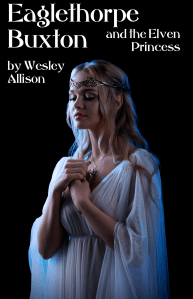
Eaglethorpe Buxton and the Elven Princess – Chapter 11

Chapter Eleven: Wherein we start to get down to the truth of things.

We rode in silence for most of the morning.  I don’t know precisely what the orphan was thinking, but I was thinking on him, or rather her.  I am well aware that one is just as likely to come upon a female orphan as a male one, but the more I thought on it, the more I realized that if my young friend had lied about being a boy, then it was just as likely that she had lied about being an orphan.

It was just about time for elevenses when I spied two snowshoe hares sitting beside the road munching on a few sprigs of green which poked out of the snow.

“Hop down,” I told the orphan.

“Why?”

“I want you to get a rock and bean one of those hares,” said I.  “If you can kill it, we can eat.”

“I don’t know that I can hit it.”

“It can’t be more than thirty feet away.  Any boy could hit it with a rock from this distance.”

“I don’t know…”

“Come on boy.”

The child slid to the ground and then picked up a likely looking stone from a small pile not too far from her feet and hefting it back, launched it in the general direction of the hares.  She didn’t have much heft, and with the lob she put on the rock, if it had hit the hare, it would have done nothing more than make it angry.  Of course there was no chance of that, since the course of the missile was off to the right by a good thirty degrees.  The hares started and took off over the snow, disappearing among the trees.

I dropped down to the ground and pointed my finger accusingly.  With my finger pointed and my back stiff, I cut an intimidating figure.  One can often get what one wants simply by being intimidating.  I know of a few warriors, warriors of great renown mind you, who in truth had never done much warrioring at all.  They simply struck an intimidating pose when the time was ripe and their reputations were made.  Now that I think about it, I quite possibly could have avoided fighting the goblins the previous night, by just striking my intimidating pose, finger out and back straight.  I mean of course, the first goblins, the ones on the road, as the second group of goblins, the ones in the cabin, were in quite a rush to get out the door and had I simply stood in an intimidating pose, they quite probably would have run me over.

“What are you doing now?” asked the orphan.

“I am thinking about intimidating poses.”

“Well, you certainly have managed an intimidating pose there.”

“Thank you.  I put a lot of work into it.”

“Well it shows.”

“Thank you.  It’s nice to have one’s work appreciated.”

“You’re welcome.”

“And don’t change the subject,” said I.

“And just what subject was that?”

“You are a girl.”

“Um, no.”

“Um yes.  And not only that, you are an elfish girl.”

“An elven girl.”

“So you admit it.”

“Um, no.”

“Um yes.  I saw you without your cap.”

“Oh.”

“Besides,” said I.  “You throw like a girl.”

“Well what do you expect?” the girl asked.  “I’ve never thrown a rock before.”

“Oh-ho!”

“Oh-ho yourself,” said she.  “All right I’m a girl.  That doesn’t change anything.  I still need your help to get home.”

“It changes quite a bit,” I said accusingly.  “For one thing, you are a liar.  You told me that you were a boy.  If you lied about that, what else have you lied about?”

“I never actually said I was a boy.”

“You most certainly did.  I said ‘I see that you are a sturdy boy, despite your condition…’ and you said ‘Yes, I am a sturdy boy…”

“Who would have guessed that you had such a perfect memory?” grumbled the child, folding her arms over her chest.

“So,” I said, again striking my intimidating pose.  “What else have you lied about?  I will wager your name is not really Orphan.”

“I never said my name was Orphan, you bloody great buffoon!  I said my name was Galfrid.  You just keep calling me orphan.”

“Is your name Galfrid?”

“No.”

“You see?  Liar!”

“It wasn’t a lie.  It was a disguise.”

“You were disguised as an orphan named Galfrid?”

“Yes.”

“Are you an orphan then?”

“Not really.”

“Liar!”

“I’m more of an orphan that you are,” she said sullenly.

“How can you be more of an orphan than I am?” I asked.

“Why couldn’t I be,” said she.  “If anyone could be, I could be.”

“I mean, what makes you more of an orphan than me.”

“My mother died.”

“I’m sorry to hear that.”  I was taken aback.  “My condolences on your loss.”

“That’s all right.  It happened a long time ago.”

“How long ago?” I wondered.

The girl looked up into the sky as she counted the years in her head.

“Sixty-five years ago.”

“Sixty-five years!  How old are you?”

“Seventy-nine.”

“An old woman and only half an orphan,” said I.

“Hold on now,” said she.  “The natural life of an elf is close enough to a thousand years as not to matter. I’m only seventy-nine.  I’m scarce out of puberty.”

“So not-Galfrid, what is your story?”

“I don’t think I want to tell you,” said she.  “You won’t believe me anyway.  You think I’m a liar, so why bother explaining.”

“I don’t think you are a liar,” I replied.  “I know you are one.  And now that I think about it, maybe I don’t care to hear your story.  Maybe you’re more trouble than you’re worth.”

“Really?  What about Eaglethump Boxcrate, friend to those who are need of a friend and a protector to those who are in need of a protector and a guardian to those who are in need of a guardian?”

She had me there.  It is well known that Eaglethump… Eaglethorpe Buxton is a friend to the friendless and all those other things.  So I had little choice but to help the old lady out.

“Well,” I took a deep breath.  “What is your name?”

“Princess Jholeira.”
A New Series Name

When the book For King and Country comes out, I plan to change the series name.  I think sales have been hindered because Senta and the Steel Dragon may come across as a children’s title.  I plan to retitle it The Sorceress and the Dragon.  Then, next year, as I do new editions of the earlier books, I’ll update them to the same series title.

Many possibilities…

Yesterday, I published a poll asking which book I should write next.  I could have made a much longer list of possibilities.  For every book that I have written, I have at least one idea for a sequel.  Some of them I’ve started in the past.  Some not.  I have partially written sequels for Princess of Amathar, Blood Trade, and Tesla’s Stepdaughters.  I have ideas for sequels for Kanana: The Jungle Girl and Women of Power, and Eaglethorpe Buxton.

For King and Country is planned to be the last Senta and the Steel Dragon book, but I have notes and an outline for a follow up series.

Patience Under Fire is planned to be the second to last book in the series, followed by Extreme Patience, but I have ideas for a follow up series.

I have notes and ideas for 35 more Astrid Maxxim books.

The first book of 82 Eridani is half-written.  It is supposed to be a seven book series.

In addition, I have five new books that I’ve partially written, and fifteen more that I have notes or an outline for.

I turn sixty years old a in a few days, so I figure I’ve got at least 22 years to get all this written.  Hopefully I can keep my brain cells working for that long.

Coming Up…

My next book will be His Robot Wife: Patience Under Fire.

Shortly after will be Senta and the Steel Dragon Book 10: For King and Country.

What would you like to see after that?

Patience Under Fire is Coming

I have finally gotten into a groove and I’m cruising right along in the new robot book.  I don’t have a date yet, but as soon as I do, it will be posted here.  The announced release date should come six to eight weeks before the release, because I know about how long the editing and proofreading takes.  Keep watching this site.

Eaglethorpe Buxton and the Elven Princess – Chapter Four

Chapter Four: Wherein we make decisions about our supper.

When we were not two hundred yards down the road, I let Hysteria drop to a trot, for in truth I did not expect anyone to follow us into the night, daring wild animals, bandits, or hobgoblins, regardless of how fine a piesmith Mistress Gaston was reported to be.  A few hundred yards beyond that, my horse dropped of her own accord to a walk and I expect she was beginning to feel a bit mopey because of the slap the orphan had dealt her.  At that moment I was less interested in her mental condition than my own physical one though, because I was holding a cast pie pan in each hand and they were both heavy and still quite warm.

“Here.”  I turned in the saddle and handed one pie to the orphan.  “We can eat while we ride.  If we wait until we find a campsite, the pies will be cold.”

“Do you have a fork?” the boy asked.

I mused that this seemed an unlikely request from any boy, most of whom I have found uninterested in tableware on the best occasion, and especially from an orphan whom one might have supposed to have been forced by necessity to dig into all manner of food scraps with his hands.  However it was not a question to which I needed reply in the negative, for I always carry my fork in the inner left breast pocket of my coat, which I call my fork pocket.  I gave the orphan my fork and pulled my knife from my boot to use on the remaining pie.

“This is a very nice fork,” said the orphan.

“Of course it is,” said I.  “That fork came from the table of the Queen of Aerithraine herself.”

“You stole this fork from a Queen?”

“Impudent whelp!” cried I.  “That fine fork was a gift from the queen, with whom I once had the pleasure of spending a fortnight.”

“What kind of queen gives a man a fork?”

“A kind and gracious one.”

That apparently satisfied the boy’s curiosity for the moment and for the next few minutes we concentrated upon the pies.  I am not one to mourn a lost pie and that is well, for the pie that was lost to me on that night, as I have previously mentioned, was a pie for the ages.  A fine pie.  A beautiful pie.  A wonderful pie.  This new pie was almost as good though.  It was a crabapple pie, which was a common pie to come upon in winter in those parts, which is to say Brest, as cooks used the crabapples they had put up the previous fall.  This pie was an uncommonly good pie, with nutmeg and cinnamon and cloves and butter.  I had more than a few bites by the time the boy spoke again.

“What kind of pie is that?”

“Crabapple,” I replied.  “What pie do you have?”

“It is a meat pie.”

“A meat pie,” I mused, as I thought back upon how long it had been since I had eaten any other meat than venison.  I had eaten a sausage a week before, but it had been a fortnight and half again since I had eaten mutton stew with potatoes and black bread in Hammlintown.  That had been a fine stew and the serving wench who brought it to me had been nice and plump with the top two buttons of her blouse undone, and she had smiled quite fetchingly when she had set down the tray.  Stew is a wonderful food and even when it is not served by a nice, plump serving wench with the top two buttons of her blouse undone.  It always seems to give me the same feeling when I eat it that a nice, plump serving wench with the top two buttons of her blouse undone gives me when I see her.

“What are you doing now?” asked the orphan.

“Pondering stew,” said I.

“Well stop it.  Rather ponder this instead.  You eat half of your crabapple pie and I will eat half of my meat pie.  Then we can trade and eat the other halves of each others pies.”

“All right,” I agreed.  “But this will mean that I have to eat my dessert first and my supper after.”

“Just pretend that the meat pie is your dessert and the crabapple pie is your supper.”

“A crabapple pie could be a fine supper.  In fact I have been to countries where the most common part of a supper is crabapple pie.”

“Fine then.”

“But a meat pie is in no country a dessert.”

“Then trade me now.”

“How much have you eaten?” I asked.

“About a fourth.  How much have you eaten?”

“About a fifth.”

“Then eat another twentieth,” said he.  “Then we will trade pies and each eat two thirds of what remains and then trade them back.  At that point, we will each eat what remains of the pie we originally started with.  That way you can think of the first portion of the crabapple pie as an appetizer, the portion you eat of the meat pie as your supper, and the final portion of the crabapple pie as your dessert.”

“You are a fine mathematician for an orphan,” said I, “but it suits me.  Will it not bother you that your appetizer and your dessert are of meat pie and your supper is of crabapple pie?”

“I have decided that I will make this sacrifice,” said he, “since it was you that provided the meal.”