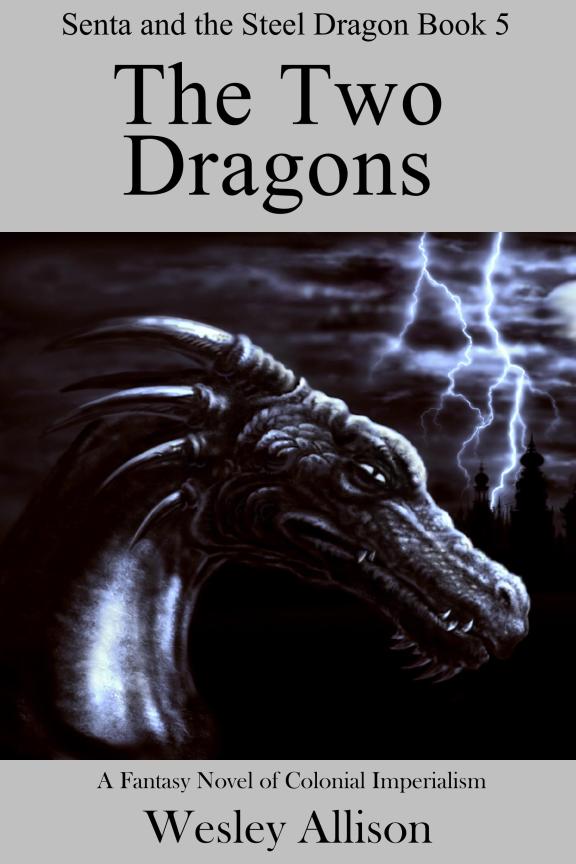
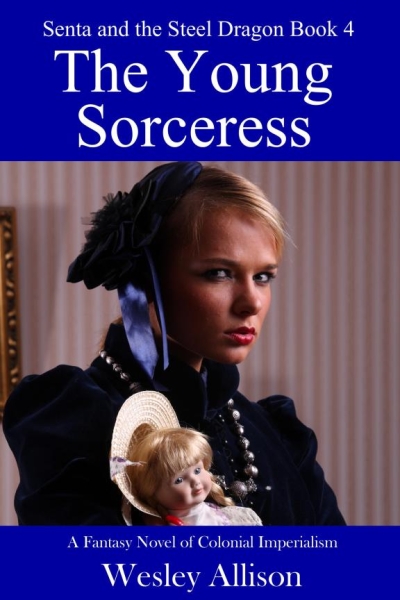
The Young Sorceress Characters: Zurfina

One of the things about the sorceress Zurfina, who is Senta’s mentor, is that she is frequently gone.  Senta ends up raising herself to a large degree.  But in book 4, because we get to see where she is going this time, we actually get to see quite a bit of Zurfina.

I love Zurfina.  She’s one of my favorite characters.  She’s completely amoral, self-absorbed, vain, slutty, and extremely powerful.  Some of my favorite moments in all the books are scenes with Zurfina, and this book is no exception.

A cloth-bodied doll with a porcelain face lay back on the pillows at the top of her bed.  It looked remarkably like her, though it was not dressed as she was, instead wearing a flowery print dress with a straw hat that matched exactly what Senta had worn the previous day.  The doll shrugged, and getting up to its feet, wobbled its way to the foot of the bed.  The young sorceress went to the window and looked out at the birds while she ate her sandwich.  The branches of a large maple reached almost right up to the side of the house and a family of microraptors had built a sloppy nest just three or four feet from the window.  Soon it would have two eggs in it, but at the moment it was empty.  Before she even realized it, Senta had finished her meal and turned back around.  The doll, seeing her hands free, stretched its arms up in the air to signal it wished to be picked up.  The girl obliged and tucked it into the crook of her arm.

“I send you on an important errand and here you are, playing with dolls.” 

The sultry voice came from Zurfina, who was standing naked at the landing.   Senta couldn’t help noticing that her mistress possessed what she thought must be the perfect female form.  Curvy and bosomy, she might have been a model for a famous statue had it not been for the constellation of five large star tattoos, two below her clavicles, one around her navel, and one above each hip bone.  And one…”

“Fina!  There’s another star on your knee!”

“So there is,” said Zurfina looking down.

“Is there even a tattooist in Port Dechantagne?”

“Don’t be stupid, and don’t change the subject.  I count on you to take care of things here in Birmisia for me.  You’re thirteen years old now and you should be able to handle that.”

“I’m almost fifteen.”

“Really?  What year is this?”

“It’s the year of our Lord nineteen hundred five.”

“Really?  What month?”

“It’s Treuary 25th—just six days till a very important date.”

“Treuary… 1905…”  Zurfina looked up at the ceiling and tapped her chin with her fingers.

“Did you hear me?  Six days?”

“I have to go away for a while, Pet,” the elder sorceress announced.  “I’ll try to be back before the end of spring.”

Senta stared open-mouthed as Zurfina turned and ascended the stairs.  She could hear her climb two flights of stairs and she could hear the door to Zurfina’s study open and shut.

“Six days!” she called up.

My Favorite Bits: The texTee and other Technologies

When I wrote His Robot Girlfriend in 2008, there was no iPad yet.  There was a Sony Reader and an Amazon Kindle, and I imagined them replacing books, so I gave Mike a texTee.  I don’t know how I came up with the name.  Then the iPad came out and made me look kind of lame.  So when I wrote His Robot Wife, I updated the texTee and made it more advanced than an iPad, with a voice activated interface.  Along comes Siri, and I’m outdated again!

One thing they don’t have in my robot stories is a computer.  One of my ideas was that computers just don’t exist anymore as standalone items.  They have computers in everything.  People use texTees (Tablets), wriTees (word processor and more), and vueTees (televisions).  The vueTees have (according to the story): interactivity, inscope (don’t know what that would be), Infinet connections, and threed (probably something like 3D).  They also use t-pods (advanced ipods maybe) and something called an andTee.

I just added the andTee so there would be something that nobody knows about today that they have in the future.  I remember reading the cross-time novels by Harry Turtledove.  In those books, the people of the future have video games and music and something called a fasarta which is never explained.  Maybe the andTee and the fasarta are the same thing.

As I write this, I’m finishing up chapter four of Patience is a Virtue.  I’ve really got a groove going now, but what I’ve written is a lot more than is in my draft.  My books usually get shorter in revision, but this might well be the longest of the three books so far (not too surprising since the others are so short).  Keep an eye out here on your computer or your texTee for more updates.  Thanks.

The Two Dragons: Chapter 7 Excerpt

“Trouble?” asked Femke Kane.  She and her husband, Croffut, and Werthimer had crossed from the far side of the courtyard.

“You could say,” replied Bratihn.  “Where’s Brown?”

“We didn’t see him come out,” replied Croffut.

“Bugger and Blast!”

“It’s not your fault,” said Senta.  “You told us all how to find our way out.”

“He was frightened out of his wits,” said Vever.  “And I don’t blame him.  I was too.”

“I had better go find him,” said Bratihn.

“I’ll go with you,” said Senta.

“So will I,” added Croffut.

“Good.  That’s enough.  I don’t want to lose anyone else down there.  The rest of you, do what you can for Mr. Vever.  He has a broken arm and I don’t know what else.”

“We’ll take care of him,” said Werthimer, just as a particularly loud cry echoed from the Unterirdisches Esser somewhere below.

The reverberating cries continued as the young sorceress and the two former soldiers went back down into the narrow chamber, following the path the party had taken before.

“There are two possibilities,” said Bratihn, when they had reached the intersecting hallway.  “Either Brown made it all the way to this point and just continued on, in which case I figure he’ll end up somewhere out in front of the fortress, or he got mixed up at the intersection up ahead.  So we’ll try the left branch there first.  If we don’t find anything, we’ll try the center branch.”

The others nodded their agreement.

From the tee junction the left branch of the corridor stretched out into the darkness well over three hundred feet before it ended with stairs dropping down.  The three descended.  Senta counted eighty seven steps before losing her place, but she later thought that this must have only been about halfway to the bottom.

“I hope we don’t have to run back up these,” said Croffut.

As if his words were a signal, the roaring monster in the distance behind them suddenly became quiet.

“I don’t know which is worse,” remarked Bratihn.  “Hearing that abomination, or knowing he’s there and not hearing.”

“The latter,” Senta decided.

At the bottom of the steps, the hallway continued its course for another fifty feet and then ended at another open doorway.  Bratihn leaned in and held up the lantern.

“Can you cast another of those really bright spells?” he asked.

“I need to cast it on something I can see.”

“If you look up there you can see something just sticking down—maybe a stalactite.”

Senta looked up and did see something just reaching down from the very high ceiling above, into the dim light of the lantern.  She aimed her spell at it.

“Regnum uuthanum riyah.”

A ball of light exploded into existence revealing a square fifty by fifty foot room.  The object to which the magic light was attached was not a stalactite, but a tube growing from the ceiling.  It looked as though it had been crafted of mud.  As they examined it, out from the end dropped a spider, its body the size of human head, quickly descending on a thin strand of silk.  Bratihn pulled his rifle to his shoulder and shot it.  A good portion of its guts sprayed out the other side and it curled into a ball.  Then the spider dropped from its webbing and fell to the bottom of the chamber, making a splash in dark water which they could now see reached to all four corners of the room.  It was impossible to tell how deep it was.  Though the dead arachnid sank, it reappeared on the surface a second later.

“I really don’t want to try to wade across,” said Croffut.

“No you don’t,” said Senta.  “There is something down there that isn’t right.  I can feel it.”

“We’re not going to wade across it,” replied Bratihn.  “If Brown did, then he’s a damn fool.  Kafira only knows how deep this is or what it is that’s causing you to feel that way.  I’ve seen enough to take you as an authority.”
The Young Sorceress Characters: Kafira Kristos

As mentioned before, Kafira Kristos is the stand in for Jesus in Senta’s world.  Religion is a problem for most fantasy books.  Writers usually shoe-horn a polytheistic religion into settings like the Middle Ages.  It just doesn’t work.  Of course if you use Christianity, you risk the fury of people who think you might be impugning their religion.

The idea for Kafira was in part out of this necessity as a writer.  I needed a religion and a founder of that religion, but since the story takes place in a world not too unlike our own early 1900s, it wouldn’t have worked with a Greco-Roman type mythology.

I was also thinking once, that assuming Christianity were true, and life exhisted on other planets, would Jesus have appeared on each of those other worlds, or would they have their own unique messiahs.  I decided on the latter for the story and to make it a bit more interesting, made that messiah a woman.  It adds a whole new meaning to “Mother Church.”

Kafira was a Zaeri teacher before she was known as the daughter of God, and so caused the same kind of split between Kafirite and Zaeri that we have between Christain and Jew in our world.  This of course was part of the basic fabric of the story I wanted to tell.

My Favorite Bits: Maxxim Industries

I enjoy reading my own books.  I guess most authors do.  I’ve been blogging, and still am, about characters in the various books, but I thought I would start writing about all my favorite “bits” that I’ve put in my books– events and people inspired by things that happened in my life, things meant to illustrate a character that someone might have missed, and inside jokes (some there for the reader and some just for myself, until now).

My first item up is Maxxim Industries– the home of Astrid Maxxim’s lab and workshops.  Maxxim Industries has two inspirations– Swift Enterprises in the Tom Swift Jr. books, and Disneyworld.

In the Tom Swift Jr. books, Tom worked on the grounds of Swift Enterprises, a four mile square (as opposed to four square miles) complex of factories and airfields and laboratories.  Since Astrid is a Tom Swift-like character and the story is essentially my take on that type of book, she needed someplace similar.

I remember being fascinated by Disneyworld when I watched Walt Disney talk about it on TV when I was little.  Disneyworld, unlike Disneyland, is not just a theme park.  It’s basically an entire county in Florida (80,000 acres) run by the Walt Disney Company, with theme parks sure, but also private residences, a Disney police force and Disney fire department, and undeveloped land.

I wanted something more like Disneyworld for Astrid– some huge county-sized place, dotted with installations, so I sat down and mapped out 180,000 acres of the southwest, in a nondescript part of an undisclosed state.

New Print Editions of Astrid Maxxim

The print editions of Astrid Maxxim and her Amazing Hoverbike have been updated.

Right now you can purchase the deluxe 81/2 by 11 inch edition of Astrid Maxxim Book 1, right here for the low price of 8.96.  On the last page of this edition only, there is a surprise (hint, it’s a sneak peak of the cover of Astrid Maxxim Book 3!)

You can also purchase the new digest edition right here for the even lower price of $5.50.  This is of course, the same text as the deluxe edition (but without the sneak cover peek).  Fear not, though readers, I will reveal the cover to Astrid Maxxim right here at wesleyallison.com in a few short weeks.

The Two Dragons: Chapter 6 Excerpt

“Say there Senta,” said Vever catching up to the other two.  “Is it magic that you’re not exhausted like I am?”

“Yes, it’s magic,” replied Staff.  “It’s the magic of youth.  She has twice the energy that either of us has and half as much idea what to do with it.”

“It’s a shame,” said Vever, though he didn’t complete the proverb.  “That youth is wasted on the young.”

“Would you like me to carry your pack for a while, Mr. Vever?” asked Senta.

“I would never allow a young lady…”

She patted Vever, who was a foot shorter than she was, twice on the top of his head and then grabbed the pack by one of the loops on the back and lifted it off his shoulders.  Pointing downward and swirling around her index finger, she said “Uuthanum Izesic.”  She tossed the backpack into the air just above where she had pointed, and it plopped onto an invisible surface, three feet above the ground.  Senta smiled and continued on, following Croffut who was none the wiser.  The backpack and whatever transparent thing supported it, followed five feet behind her.

Staff and Vever stopped walking and wondered at the hovering object.  As they stood thus amazed, Paxton Brown rushed past them.  Catching up with the invisible transport, he flung his own pack on top of Vever’s.  Now both haversacks followed along in the air behind the girl.

“Do you think I could..?” asked Buttermore, puffing up beside them.

Staff turned to see that the entire column, besides Senta, Croffut, and Brown were bunched up around him.  He shrugged.  They hurried to catch up to the sorceress and one by one began placing their backpacks on what Staff began to think of as the invisible wagon.  By trial, they eventually determined that it was a disk about three feet in diameter.  They were only able to get seven packs to stay on it, and then only by balancing them one on the other in a three story pyramid.  In the end, they were so distracted by the game that they scarcely noticed the miles that had passed, and even Brown’s complaining had ceased.

An angry screech brought their attention back to their surroundings.  Hopping down the sloping landscape from their right was a pack of frightening beasts.  Staff didn’t quite know whether most of the animals in Mallon belonged in the dinosaur family or the bird family, and these did little to unmuddy the question.  They were fifteen to twenty feet long, slightly larger than the utahraptors seen near Port Dechantagne.  From their shoulders back, they were covered with brilliant crimson feathers with a dash of black on the tufts of their tails.  Their heads were feathered in black.  They had large lizard-like mouths filled with knife-like teeth.  Eight of the creatures ran, in little fits and starts, toward the line of humans.

The stock of Staff’s rifle was at his shoulder before he realized he had slipped it over his arm.  He aimed at the first creature’s head and fired.  The thirty caliber bullet exploded out the back of its skull.  The spent cartridge clanged onto a large rock at his feet and he targeted a second charging animal.  But the first one didn’t fall down.  It kept running, going right past him and continuing down the slope for several hundred more feet, its legs no longer directed by its brain, but continuing to kick anyway.  His second target he shot twice, once in the neck and once in the chest.  He heard a couple of shots fired by the others, but by this time the entire pack was upon them.

Staff didn’t let the sounds of battle distract him.  He fired quickly at a third and fourth beast.  He heard Vever’s voice shouting over the others and he heard Brown screaming.  The crack of rifle fire was suddenly overpowered by an even louder crack as a tremendous bolt of lightning shot horizontally across the hillside.  Staff fired one more time, but the crimson-plumed monster in his sights was already dead—killed by the lightning.  Looking around he saw it was the last one.

“Surgeon!” yelled Werthimer, out of habit, as he jumped toward the prone form of Mr. Brown.

Staff picked his way through the large feathered bodies to where the man lay.  A quick examination revealed however that he was unharmed.  He had apparently fainted from sheer terror.  The only one injured was Manring, who had dived out of the way of the vicious claws, but not quite quickly enough, and had sustained a horrible gash across his forearm.  Staff quickly drew a healing draught from his pack and poured half of the contents of the small brown bottle onto the cut and had Manring drink the remaining potion.  Within seconds the bleeding had stopped and the injury had already begun to heal.

“Thank heavens for magic,” said Mr. Vever.

“Yes,” agreed Staff, then turning to look at Senta.  “I assume that was your magical lightning?”

The girl nodded.

“These are beautiful,” said Femke Kane, holding up a long black tail feather.  “Perhaps we should take some to present to the lizzies in Tsahloose.”

“Alright,” replied Staff.  “We earned them I suppose.”

Cover Reveal: Tesla’s Stepdaughters

Here is the new cover for Tesla’s Stepdaughters.  It should be gracing the ebooks within a few weeks and the paperbacks shortly thereafter.

I actually purchased the art for this cover some time ago, originally for use on the cover of a sequel.  I have a couple of chapters of it written and may well get back to it in the future, but decided, as part of my generally sprucing up of my books, that I would go ahead and use it.  I can always find new art if and when I get the second book finished.

If you haven’t read Tesla’s Stepdaughers, it is a rock and roll, steampunk, detective story.

In an alternate 1975, where men are almost extinct due to germ warfare, someone is trying to kill history’s greatest rock & roll band.  It falls to Science Police Agent John Andrews, only recently arrived from the distant male enclaves, to protect them.   As the band continues their come-back tour across North America, Andrews must negotiate a complicated relationship with Ep!phanee, the band’s lead singer; drummer Ruth De Molay, bassist Steffie Sin, and the redheaded clone lead guitarist Penny Dreadful, as he protects them and tries to discover who wants to kill the Ladybugs.               

The Young Sorceress Characters: Isaak Wissinger

Isaak Wissinger was one of the main reasons I wanted to write The Young Sorceress.  I had already written The Two Dragons, in which Wissinger is a minor character.  When I was thinking up characters, I created a background for him that I really liked.  It just seemed like a shame not to write that backstory into a book.

Wissinger also gave me a chance to set part of the story in Freedonia.  Freedonia was my stand in for Germany (something of a cross between WWI under the Kaiser and WWII under the Nazis).  I got the name from the Marx Brothers’ Duck Soup, though my country bears little resemblance to the one in the movie.

Wissinger is a writer and so he has some of my own traits.  He is a member of the Zaeri minority in Freedonia and therefore ends up in the ghetto.  He escapes with the help of Zurfina (herself a Zaeri) who has a fetish for creative types.

Isaak Wissinger sprang suddenly from his cot, motivated by a particularly enthusiastic bedbug.  He was immediately sorry, as the pain in his back was exacerbated by the sudden movement.  He looked back down at the vermin filled, inch thick mattress, a few pieces of straw sticking out of a hole in the side, sitting on an ancient metal frame.  It was a sleeping place not fit for a dog.  Then he laughed ruefully.  That was exactly how he and every other Zaeri was thought of here—as dogs.

The Kingdom of Freedonia, like the rest of the civilized world was divided in two.  There were the Kafirites, who ruled the world.  And there were the Zaeri, who had long ago ruled it.  Two thousand years ago, Zur had been a great kingdom, one which along with Argrathia, Ballar, and Donnata ruled the classical world.  Then a single dynasty of kings, culminating in Magnus the Great, had conquered the rest of the known world, and made Zur civilization the dominant culture.   Zaeri, the Zur religion, with its belief in one god, had replaced the pagan religions of the civilizations that Magnus and his forebears had conquered.  Even when Magnus’s empire had splintered into many successor kingdoms, the Zaeri religion had remained dominant.

Then a generation later, a Zaeri imam named Kafira had begun teaching a strange variation of the religion in Xygia.  Kafira had taught the importance of the afterlife, an adherence to a code of conduct that would lead one to this afterlife, and a general disregard for the affairs of the world.  Her enemies had destroyed her, but in so doing they had made her a martyr.  From martyr, she rose swiftly to savior and then to godhead of a new religion, one that had spread quickly to engulf all that had been the Zur civilization.  In the following millennia, the Kafirites had converted the remaining pagans to the creed of their holy savior, thereby making it the only religion in the world of man—the only religion in the world of man save those who held onto the ancient Zaeri belief.

Now here in Freedonia it was no longer safe to be a Zaeri.  First it had become illegal for Zaeri to be doctors or lawyers, then actors or publishers.  Then laws had been passed which made it illegal for Zaeri to own businesses or property.  Finally entire neighborhoods became forbidden to Wissinger’s people and they had been pushed into ghettos, segregated from the other Freedonians.

Wissinger spent the day picking up garbage on the street.  That was his job here in the ghetto.  He had been an award winning writer when he had lived in Kasselburg, but here in Zurelendsviertel he walked the street, a silver zed pinned to his jacket, picking up refuse.  At least people didn’t treat him like a garbage man.  The other Zaeri knew him and respected him.  They asked his opinion about things.  They called him “professor” when they spoke to him.  It was not like that at all with the Freedonian soldiers who occasionally made a sweep through the ghetto.  They would as soon kick an award winning writer to the side of the road as they would a street sweeper.

Back once again in his room, he pulled his tablet and pencil from its hiding place behind a loose board and continued writing where he had left off the day before.  He could not live without writing.  He wrote down what had happened that day, what he had seen, what he had heard.  He wrote about the death of Mrs. Finaman, brought on no doubt by lack of nutrition, and he wrote about her husband’s grief at the loss of his wife and his unborn child.  He wrote about the sudden disappearance of Mr. and Mrs. Kortoon, and the speculation that they paid their way out of the ghetto.  And he wrote about the disappearance of the Macabeus family, and the speculation that something sinister had happened to them.

That night on his uncomfortable cot, Wissinger had a wonderful dream.  He dreamed that a beautiful woman was making love to him.  She licked his neck as she rubbed her naked body against his.  She whispered to him in some foreign language—he thought it was Brech.  When he managed to pull himself out of the fog of sleep, and he realized that it wasn’t a dream, that the woman was really here with him, he tried to push her off of him.

“Don’t stop now lover,” she said, a noticeably Brech accent to her Freedonian.  “I’m just starting to really enjoy myself.”

Wissinger pushed again, and slid his body out from under her, falling to the floor in the process.  She stretched out, lying on her stomach.  He stared at her open-mouthed.  Her long blond hair didn’t quite cover a fourteen inch crescent moon tattoo at the top of her back.  Another tattoo, an eight inch flaming sun sat just above her voluptuous bottom. 

“Who are you?  What are you doing here?”

“I would have thought that was obvious,” she replied in a sultry voice.  “I’m here to warn you.”

“You… uh, what?”

“I’m here to warn you.”

She rolled over and stood up, revealing six star tattoos all over her front.

Women of Power now in Paperback

Women of Power is now available for the first time in digest paperback format.  You can pick up your copy here for just $5.00.

I don’t sell a lot of paper books.  I’ve sold hundreds of ebooks for every paper book.  I understand.  I read ebooks too.  They’re easy to get.  They’re inexpensive.  I love ebooks.  What’s more, I actually make about as much selling a 99 cent ebook, as I do selling a $5 paper book, sometimes even more.  I deliberately price them as close to cost as possible, because I’m more interested at this point in my career in readers than sales.

Why do I have print editions?  Two reasons really.  I like to have some on hand to show off at home, and there is still a chance that someone might discover me as an author by stumbling upon one of my books.

So, my loyal readers.  Keep buying my ebooks.  But, if you know somebody that might like one of my books, please think about purchasing one for them as a gift.  If they like it, you will be giving them the gift and you will be giving me the gift of a new reader.  Thanks.